























Jebel Akhdar: Tourism, Climate and Property Rules (2026)
As of 4 November 2026, Jebel Akhdar (Al Jabal Al Akhdar, the “Green Mountain”) is a wilayat of Ad Dakhiliyah Governorate whose Saiq plateau sits at about 2,000 meters in the Al Hajar range. According to the National Centre for Statistics and Information (NCSI), the wilayat recorded 222,151 visitors in 2025 and 101,608 in the first half of 2026, and on 10 September 2026 GCC tourism ministers named it GCC Tourism Capital for 2027. Jebel Akhdar is also the site of Al Jabal Al Aali, a planned tourism and residential district that the Ministry of Housing and Urban Planning puts at OMR 1.2 billion ($3.12 billion at the rial peg of 2.6008).
This guide replaces the 2024 version of the article and rebuilds it from official and primary figures. It covers the geography and administration of Jebel Akhdar, the access road and the checkpoint rule, climate data from the Saiq weather station set against Muscat, Salalah and Nizwa, the rose season and the terraced farms, visitor and hotel statistics, the hotels on the plateau, the announced projects with their status today, and the ownership and residency rules that apply to non-Omanis. Every price, rule and statistic carries its source and date, because several of them change from one quarter to the next.
Jebel Akhdar at a Glance: Key Facts as of 4 November 2026
The table collects the figures used in this guide. Each row names the source, and the sections below explain how the numbers were derived and what they do and do not cover. US dollar amounts use the Omani rial peg of 2.6008 dollars per rial.
| Item | Figure | Source and date |
|---|---|---|
| Saiq plateau elevation | About 2,000 m; the wilayat’s terrain reaches 2,980 m | Oman Observer, 12 Feb 2023 (water project report) |
| Planned Al Jabal Al Aali elevation | About 2,400 m | Oman Observer, 28 Dec 2025 |
| Governorate | Ad Dakhiliyah | NCSI via Oman Observer, 18 Jan 2026 |
| Drive from Muscat | About two hours | Oman Observer, 9 Apr 2023 |
| Visitors, full year 2025 | 222,151 (203,629 in 2024) | NCSI via Oman Observer, 18 Jan 2026 |
| Visitors, January to June 2026 | 101,608 (89,780 in the same months of 2025) | NCSI via Times of Oman, 15 Jul 2026 |
| Hotel guests and occupancy, January to July 2026 | 44,365 guests; 32.1% occupancy | Times of Oman, 20 Sep 2026 |
| Saiq mean temperature, January and July | 9.3 °C and 25.0 °C (Seeb, Muscat: 21.3 °C and 34.3 °C) | WMO normals filed with NOAA |
| Non-Omani ownership | Listed as a prohibited area, except inside a licensed integrated tourism complex | Ministerial Decision 292/2020 (CMS Oman summary) |
| Regional title | GCC Tourism Capital for 2027 | TradeArabia, 10 Sep 2026 |
Geography and Administration of Jebel Akhdar
Jebel Akhdar is the central block of the Western Hajar mountains inside Ad Dakhiliyah Governorate. The Oman Observer’s report on the 2023 water project describes the area as reaching altitudes of up to 2,980 meters, including the Saiq plateau at 2,000 meters, and a Times of Oman report on the UNESCO biosphere listing gives the protected area an elevation range of 600 to 2,980 meters. The villages and terraced farms of the plateau sit near the 2,000-meter level, while the planned Al Jabal Al Aali district is described at about 2,400 meters.
Administratively, Al Jabal Al Akhdar is a wilayat with its own wali, who in 2025 and 2026 was reported as Sheikh Sultan bin Mansoor Al Ghafeeli. A June 2022 Oman Observer report on royal orders states that the wilayat’s Shura Council representatives would be chosen by election, with the vote set for the council’s tenth term in 2023. That date matters for statistics: the 2020 census tables for Ad Dakhiliyah, published by the NCSI and reproduced by citypopulation.de, list eight districts and no separate line for Jebel Akhdar.
| District (Ad Dakhiliyah) | 2010 census | 2020 census | Change |
|---|---|---|---|
| Nizwa | 84,528 | 131,763 | +47,235 (+55.9%) |
| Bahla | 58,234 | 88,286 | +30,052 (+51.6%) |
| Samail | 55,896 | 80,402 | +24,506 (+43.8%) |
| Izki | 41,402 | 58,905 | +17,503 (+42.3%) |
| Bidbid | 24,705 | 37,434 | +12,729 (+51.5%) |
| Al Hamra | 19,509 | 28,228 | +8,719 (+44.7%) |
| Adam | 27,321 | 28,163 | +842 (+3.1%) |
| Manah | 15,056 | 25,320 | +10,264 (+68.2%) |
| Governorate total | 326,651 | 478,501 | +151,850 (+46.5%) |
The eight district rows add up to the governorate totals exactly (326,651 in 2010 and 478,501 in 2020), so the people living on the Jebel Akhdar plateau at the 2020 census were counted inside one or more of those districts rather than under a wilayat of their own. For Jebel Akhdar the useful demographic figure is therefore the visitor count, not a resident count. The planned Al Jabal Al Aali district is described by the Ministry of Housing and Urban Planning as housing about 10,000 residents when complete, which is a design figure and not a census result.
Two protection layers shape what can be built and farmed. In 2011 a Royal Decree designated the mountain a sanctuary for natural scenery; Gulf News reported at the time that the Minister of Environment and Climate Affairs could draft guidelines on access and development inside it. In September 2025 UNESCO’s Man and the Biosphere Programme added the Jabal Akhdar Nature Reserve, about 4,500 hectares, to its World Network of Biosphere Reserves at the 37th session of its International Coordinating Council in Lin’an, China, according to Times of Oman on 27 September 2025. The same report says the area hosts 60% of Oman’s vascular plant species and more than 71 bird species, and places it in a network of 759 reserves in 136 countries.
Getting to Jebel Akhdar: Road, Checkpoint and Planned Access
The road to Jebel Akhdar climbs from Birkat Al Mouz, near Nizwa, to the Saiq plateau. The Oman Observer described the drive from Muscat as about two hours in its April 2023 rose-season guide, and Gulf News used the same two-hour figure in its 2011 report on the nature reserve. The Oman Observer’s 2018 report on the opening of the Sama Hotel placed that hotel 21 km from Nizwa Souq, which gives a sense of the plateau’s distance from the interior’s main town.
The rule that has governed the ascent for years is a vehicle check at Birkat Al Mouz. On 14 February 2022 the Oman Observer wrote that a four-wheel-drive vehicle was required to pass the Al Jabal Al Akhdar checkpoint and that drivers had to carry a driving license and the car registration papers. On 13 October 2026 the same newspaper reported that electric vehicles are now permitted to make the climb without four-wheel drive, quoting Shabib al Maamari, Managing Director of Visit Oman, and that visitors without an electric car can rent one for the trip. The report attributes the earlier restriction to safety regulations for the steep, winding road and does not name the enforcing body, so this guide does the same.
| Access item | Status | Source and date |
|---|---|---|
| Checkpoint at Birkat Al Mouz | Four-wheel drive required for conventional cars; electric vehicles now permitted | Oman Observer, 14 Feb 2022 and 13 Oct 2026 |
| Documents at the checkpoint | Driving license and car registration | Oman Observer, 14 Feb 2022 |
| Entrance and dual carriageway (5 km) | Design consultancy 90% complete | Times of Oman, 20 Sep 2026 |
| Marwah road maintenance | 40% complete | Times of Oman, 20 Sep 2026 |
| Internal road project, phase 2 (3.7 km) | At contracting stage | Times of Oman, 20 Sep 2026 |
| Road linking villages and residential areas (7 km) | Completed | Times of Oman, 20 Sep 2026 |
| Alternative road from South Al Batinah | Tender floated by the Ministry of Transport, Communications and Information Technology | Oman Observer, 5 Sep 2023 |
| Cable car linking Ad Dakhiliyah and South Al Batinah | Described as planned by the wali | Oman Observer, 28 Dec 2025 |
| Regional airport | Oman Airports tender for pre-fabricated terminal buildings (deadline 21 Mar 2026); engineering design study complete | Oman Observer, 21 Feb 2026 |
The same February 2026 airport report notes that Jebel Akhdar is reachable only by four-wheel vehicles from a certain point, which matches the October 2026 change only for electric cars. The alternative road from South Al Batinah was described in 2023 by a Ministry of Transport official as a way to link tourist sites with the rest of the country, because the existing road is hard to navigate for smaller cars. The December 2025 report on the wali’s briefing adds a cable car, and the Ministry of Housing’s Al Jabal Al Aali plans include a cable car as well. None of these links is open to traffic as of this date; they are plans and tenders at different stages.
For an estimate of the climb itself, the Oman Observer’s 2023 water-project report gives the wilayat’s altitude range as up to 2,980 m with the plateau at 2,000 m. Muscat’s coast is at sea level, so a visitor driving from the capital gains about 2,000 meters of elevation over a two-hour trip, which is relevant to the altitude notes later in this guide.
Jebel Akhdar Climate: Saiq Station Versus Muscat
The Saiq weather station (WMO number 41254, 23°04′ N, 57°39′ E) is the long-running instrument record on the plateau. NOAA hosts the climate normals that Oman’s meteorological service filed with the World Meteorological Organization: temperature and precipitation for Saiq cover 1979 to 1990, relative humidity and pressure cover 1987 to 1990. The table sets the Saiq monthly mean temperature and rainfall against Seeb (WMO 41256), the station serving Muscat, whose temperature record runs from 1974 to 1990 and rainfall from 1975 to 1990. The difference column is Seeb minus Saiq, calculated here from the two files.
| Month | Saiq mean °C | Seeb mean °C | Difference °C | Saiq rain mm | Seeb rain mm |
|---|---|---|---|---|---|
| January | 9.3 | 21.3 | 12.0 | 6.2 | 12.8 |
| February | 11.4 | 21.9 | 10.5 | 60.1 | 24.5 |
| March | 14.8 | 25.2 | 10.4 | 51.9 | 15.9 |
| April | 18.4 | 29.8 | 11.4 | 32.6 | 17.1 |
| May | 22.2 | 34.2 | 12.0 | 26.2 | 7.0 |
| June | 25.1 | 35.2 | 10.1 | 13.0 | 0.9 |
| July | 25.0 | 34.3 | 9.3 | 37.2 | 0.2 |
| August | 24.1 | 32.0 | 7.9 | 51.2 | 0.8 |
| September | 21.7 | 31.4 | 9.7 | 18.6 | 0.0 |
| October | 18.1 | 29.7 | 11.6 | 1.6 | 1.0 |
| November | 13.4 | 25.7 | 12.3 | 5.8 | 6.8 |
| December | 10.5 | 22.6 | 12.1 | 11.7 | 13.3 |
| Year | 17.8 | 28.6 | 10.8 | 316.1 | 100.4 |
Three readings follow from the table. First, the gap between the plateau and the capital is real but narrower than the “10-15 °C year-round” figure in the 2024 version of this article: monthly means differ by 7.9 °C in August up to 12.3 °C in November, and by 10.8 °C over the year (28.6 °C minus 17.8 °C). The daily maximum gap is wider, because the plateau’s afternoons are cooler than the coast’s: the Saiq annual mean of daily maxima is 20.2 °C against 33.3 °C at Seeb, a difference of 13.1 °C, and in June the figures are 27.6 °C and 40.4 °C, a difference of 12.8 °C.
Second, winter nights on the plateau are cold. The mean daily minimum at Saiq in January is 3.7 °C, and the NOAA file records a minimum value of minus 3.6 °C in January. The Seeb mean minimum for the same month is 17.3 °C. The warmest month at Saiq is June, with a mean of 25.1 °C, and the maximum value logged in the file is 34.8 °C, also in June, while Seeb’s June mean is 35.2 °C, higher than the plateau’s recorded maximum.
Third, the plateau is wetter than the coast. The Saiq annual total is 316.1 mm against 100.4 mm at Seeb, a ratio of 3.1 to 1. February is the wettest month at 60.1 mm, followed by March at 51.9 mm and August at 51.2 mm, so the plateau has a second rainfall peak in late summer that Muscat does not share (0.8 mm in August at Seeb). The same NOAA files give an annual relative humidity of 43% at Saiq (27% in June, 59% in December) and 58% at Seeb, and a station pressure of 804.2 hPa at Saiq against 1,007.6 hPa at Seeb, which is about 20% lower. The stations measured pressure and humidity in different year ranges, so those two comparisons are indicative.
Jebel Akhdar, Muscat, Salalah and Nizwa Compared
Travelers looking for relief from summer heat compare several Omani destinations. The table compares them on the same measures, using the NOAA/WMO normals for Saiq, Seeb and Salalah (WMO 41316, temperature record from 1961 to 1990) and, for Nizwa, the monthly table on the Nizwa page of Wikipedia, which lists 1991 to 2020 normals compiled from WMO and weather-service data. Because the record periods differ, small gaps should not be over-read.
| Measure | Jebel Akhdar (Saiq) | Muscat (Seeb) | Salalah | Nizwa |
|---|---|---|---|---|
| January mean °C | 9.3 | 21.3 | 22.9 | 19.6 |
| July mean °C | 25.0 | 34.3 | 26.4 | 35.6 |
| August mean °C | 24.1 | 32.0 | 25.2 | 34.2 |
| Annual mean °C | 17.8 | 28.6 | 26.0 | 28.8 |
| July mean daily maximum °C | 27.3 | 38.6 | 28.4 | 42.9 |
| July rainfall mm | 37.2 | 0.2 | 24.6 | 6.6 |
| August rainfall mm | 51.2 | 0.8 | 24.5 | 8.0 |
| Annual rainfall mm | 316.1 | 100.4 | 130.9 | 73.3 |
In July the plateau’s mean temperature of 25.0 °C is 1.4 °C below Salalah’s 26.4 °C, 9.3 °C below Muscat’s 34.3 °C and 10.6 °C below Nizwa’s 35.6 °C. The mean daily maximum tells the same story in a sharper form: 27.3 °C at Saiq against 42.9 °C at Nizwa, a gap of 15.6 °C, even though Nizwa is the nearest large town and the starting point for many trips up the mountain. In January the order reverses for visitors who want warmth, since Salalah’s mean of 22.9 °C is 13.6 °C above Saiq’s.
The rainfall rows show how different the two cool-summer destinations are. Salalah’s July and August totals (24.6 mm and 24.5 mm) come from the monsoon season described in the Salalah travel guide and the note on the Khareef season. Saiq’s late-summer rain, 37.2 mm in July and 51.2 mm in August, is higher than Salalah’s in both months. Muscat’s two summer months total 1.0 mm. For the coastal capital’s own climate and neighborhoods, the Muscat areas guide sets out the districts, and the cost of living guide covers day-to-day expenses across Oman.
Seasons, Roses, Terraces and Falaj Irrigation in Jebel Akhdar
Jebel Akhdar’s visitor calendar follows two things: the rose bloom in spring and the temperature gap in summer. The Oman Observer’s April 2023 guide gave the rose season as mid-March to mid-May in some accounts and late March to early May in others, depending on weather, and said farmers pick a few hours after sunrise and usually finish by about 9 a.m. or an hour before sunset so that the blossoms do not wilt. A Times of Oman report of 15 July 2026 states that the Rose Spring Festival runs annually from the end of March to mid-April. The Oman Observer’s 11 April 2026 feature adds that rose cultivation in the region dates to the 17th century.
| Period | What the sources report | Source |
|---|---|---|
| January to February | Saiq mean 9.3 to 11.4 °C; February is the wettest month at 60.1 mm | NOAA, Saiq normals |
| Mid-March to mid-May | Range given for the rose bloom and harvest, varying with weather | Oman Observer, 9 Apr 2023 |
| End of March to mid-April | Rose Spring Festival, held annually | Times of Oman, 15 Jul 2026 |
| June to August | Saiq means of 24.1 to 25.1 °C against 32.0 to 35.2 °C at Seeb | NOAA, Saiq and Seeb normals |
| August | Second rainfall peak on the plateau, 51.2 mm | NOAA, Saiq normals |
| Year-round | Pomegranates, olives, saffron, roses, aromatic plants and cash crops named as the main farm products | Times of Oman, 20 Sep 2026 |
The farmland itself is a policy subject. The September 2026 Times of Oman briefing lists 14 agricultural investment projects covering about 166 acres, worth OMR 3.5 million ($9.10 million). Dividing the two totals gives about OMR 21,084 ($54,836) of investment per acre, a simple average across projects of different kinds. The same report names the preservation of the aflaj and the terraces among the natural, cultural and heritage assets the wilayat wants to protect while it prepares for 2027. Gulf News described the terraced orchards near the summit in its 2011 report as growing pomegranate, grape, pear, apricot, peach and walnut, with rose water produced from a pink rose.
The falaj is the traditional channel system that moves water by gravity from springs or underground sources to fields and homes. UNESCO’s description of the Aflaj Irrigation Systems of Oman, inscribed on the World Heritage List in 2006, says the five listed systems represent some 3,000 such systems still in use across Oman, that the practice may date to about AD 500, and that archaeological evidence points to irrigation in the area as early as 2500 BC. The listing is for five named systems, so this guide does not claim that any Jebel Akhdar channel is itself inscribed; it cites the listing as the official explanation of what a falaj is and how widespread the practice remains.
Jebel Akhdar Visitor and Hotel Statistics
NCSI publishes visitor counts for the wilayat of Al Jabal Al Akhdar, and the Oman News Agency and the Oman Observer carry them. The 2025 total of 222,151 visitors is 9.1% above the 203,629 recorded in 2024 (a rise of 18,522). The first half of 2026 reached 101,608, which is 13.2% above the 89,780 of the first half of 2025 (a rise of 11,828), according to Times of Oman on 15 July 2026, and a Times of Oman report of 20 September 2026 repeats the figure.
| Period | Visitors | Change |
|---|---|---|
| 2024, full year | 203,629 | Base |
| 2025, full year | 222,151 | +9.1% on 2024 |
| January to June 2025 | 89,780 | Base |
| July to December 2025 (2025 total minus first half) | 132,371 | 59.6% of the 2025 total |
| January to June 2026 | 101,608 | +13.2% on the same months of 2025 |
The second-half figure is derived here by subtracting the first-half count from the annual count. It shows that about three in five 2025 visitors arrived between July and December, so the visitor year is not concentrated in the rose weeks alone. The 2025 total averages about 609 visitors a day (222,151 divided by 365).
| Nationality group, 2025 | Visitors | Share of 222,151 |
|---|---|---|
| Foreign nationals (non-Arab) | 110,643 | 49.8% |
| Omani | 82,142 | 37.0% |
| Saudi | 14,957 | 6.7% |
| Other Arab nationalities | 9,902 | 4.5% |
| Emirati | 1,588 | 0.7% |
| Kuwaiti | 1,441 | 0.6% |
| Qatari | 779 | 0.4% |
| Bahraini | 699 | 0.3% |
The eight groups sum to the stated total of 222,151, and the shares are calculated here. The Oman Observer notes that the NCSI counts credit hotel facilities, rest houses and tourist lodges among the drivers of the numbers.
Hotel-specific statistics come from the 20 September 2026 Times of Oman report on the wilayat’s preparations for 2027. For the period to the end of July 2026 it gives hotel revenue of about OMR 7.8 million ($20.29 million), 44,365 hotel guests and an occupancy rate of 32.1%. Dividing revenue by guests gives roughly OMR 176 ($457) per guest, a rough average that depends on what the reported revenue includes. For national context, Times of Oman reported on 27 September 2026, from NCSI data, that Oman’s 3-to-5-star hotels recorded 1.32 million guests, 46.5% average occupancy and OMR 156.54 million ($407.11 million) of revenue from January to August 2026, against 52.9% occupancy in the same months of 2025. The Jebel Akhdar figure covers January to July and the national figure January to August, and the hotel categories counted may differ, so the two occupancy rates are context rather than a like-for-like ranking.
Hotels and Resorts on the Jebel Akhdar Plateau
Hotel supply on the plateau comes from a small set of named properties. The table lists those with a fetched operator or press source, with the unit count and date as the source states them. Unit counts mix rooms, suites, chalets and villas, as each operator describes them.
| Property | Units as stated | Opening or announcement | Source |
|---|---|---|---|
| Anantara Al Jabal Al Akhdar Resort (Minor Hotels) | 115 guest rooms and villas, at about 2,000 m | Opened October 2016 | Minor Hotels release, 6 Nov 2016 |
| Alila Jabal Akhdar (Alila Hotels and Resorts, developed by Omran) | 78 rooms, 6 suites and 2 royal villas (86 units) | Pre-opening announcement, 17 Jul 2012, planned for late 2013 | Asia Travel Tips reprint of the Alila release |
| dusitD2 Naseem Resort | 252 rooms and suites, at 2,000 m on the Saiq plateau | Opened July 2021 | The National, 5 Jul 2021 |
| Sama Hotel (three-star) | 60 rooms, suites and chalets | Inaugurated 24 Nov 2018 | Oman Observer, 24 Nov 2018 |
| Hotel Indigo Jabal Akhdar Resort and Spa (IHG) | 173 rooms, suites and chalets, at about 2,000 m | Welcomed guests from 1 Sep 2024 | IHG release, 2 Sep 2024 |
Adding the five unit counts gives 686 units (115 plus 86 plus 252 plus 60 plus 173). That sum is a reader’s arithmetic on the figures above, not an official inventory: the Alila number is the 2012 pre-opening plan, and the operators’ own counts change as rooms are renovated or reclassified. The Oman Observer’s report on the planned Al Jabal Al Aali district puts its hotel complex at more than 2,000 rooms, about 2.9 times the five-property sum, which gives a sense of how large the planned addition is relative to the existing stock.
A few property details are worth stating as the sources give them. The Sama Hotel report lists an outdoor swimming pool, fitness centre, restaurant and children’s playground, and the opening was attended by the then Minister of Tourism. IHG’s release for Hotel Indigo names three dining venues and a spa with three wellness zones. The National’s report on dusitD2 Naseem lists an all-day restaurant, a fitness centre and an outdoor pool at launch, with a speciality restaurant, kids’ club and spa to follow in 2021. The Hail Al Yaman commercial complex described in the December 2025 report adds a further three-star hotel to the plateau’s pipeline.
Al Jabal Al Aali and Other Planned Projects on Jebel Akhdar
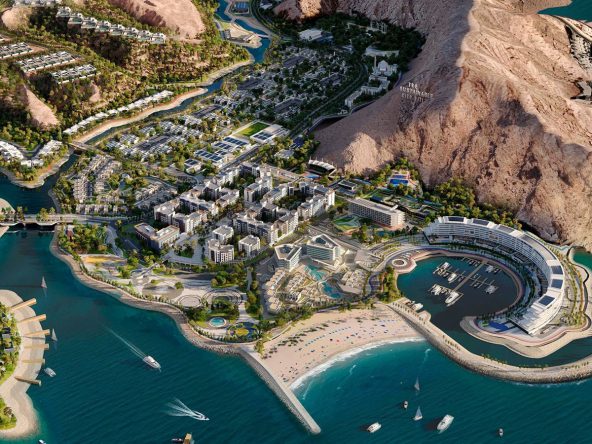
The main planned project is Al Jabal Al Aali, also called the Omani Mountain Destination, led by the Ministry of Housing and Urban Planning. Its figures have been reported at several dates, and the table keeps each figure attached to its report so the changes can be traced.
| Report and date | Figures and status stated |
|---|---|
| Oman Observer, 29 Feb 2024 | High-altitude mixed-use development; about 2,527 residences and 2,000 hospitality rooms; estimated investment of US$2.4 billion; AtkinsRéalis appointed to master-plan the project; planned road infrastructure and a cable car |
| Oman Observer, 14 Jun 2025 | Site of 11.8 km² at 2,400 m; estimated cost OMR 1.2 billion ($3.12 billion); about 10,000 residents; more than 2,500 homes and 2,000 hotel rooms; project moves to design stage; consultants invited to bid, submissions closing 10 Jul 2025; Western Wellness Village of about 500 residential and hotel units on 630,000 m² with OMR 200 million ($520.16 million) of investment |
| Oman Observer, 28 Dec 2025 | Wali describes the city as under implementation; golf course estimated at 1.5 million m²; more than 10 architectural, cultural and tourism landmarks; planned cable car |
| Oman Observer, 10 May 2026 | Musstir, the development arm of the Mohammed Al Barwani Group, unveils Musstir Heights within the Al Jabal Al Aali masterplan: about OMR 300 million ($780.24 million), more than 750 villas and other residences, over one million m² |
| Times of Oman, 20 Sep 2026 | Plan restated at OMR 1.2 billion, 2,000 hotel rooms, 2,500+ units, 11.8 km² at about 2,400 m, roughly 10,000 residents |
Simple ratios show the scale described. Ten thousand residents in 2,500 units is 4.0 residents per unit. Spread over 11.8 km², the plan implies about 847 residents, 212 residential units and 169 hotel rooms per square kilometer, and OMR 1.2 billion over 11.8 km² is about OMR 101.7 million ($264.5 million) per square kilometer. These are averages for planning figures, and the reports state them as estimates. The 2024 report gave its investment in US dollars (US$2.4 billion), while the 2025 and 2026 reports give the rial figure that the ministry cites; this guide keeps each number in the currency and on the date it was reported.
Smaller projects are advancing alongside the district plan. The Oman Observer’s report on the wali’s 28 December 2025 briefing lists a package worth about OMR 9 million ($23.41 million) carried out by Ad Dakhiliyah Governorate: dualization of the main entrance and road, paving of internal roads, the completed Al Jabal Al Akhdar Park and a completed festivals and celebrations square, plus private projects including the Hail Al Yaman commercial complex with a three-star hotel, an open-air 3D arena at Saih Qatna, Da’an Al Basiteen Park and the operating Saih Qatna Park with a restaurant and viewpoint. The 20 September 2026 report counts development and service projects worth more than OMR 5.7 million ($14.82 million) and a public park of 20,000 m² that is complete. The two totals describe different packages reported nine months apart and are not added together here.
The title of GCC Tourism Capital for 2027, announced on 10 September 2026 at the tenth meeting of GCC tourism ministers in Bahrain, comes with a programme TradeArabia describes as including major events, seasonal experiences, promotional campaigns aimed at Gulf and regional markets, new tourism products, investment attraction and support for small businesses. Sayyid Ibrahim Said Al Busaidi, Minister of Heritage and Tourism, linked the selection to efforts to make the area an integrated destination. The announcement carries no investment figure.
Property Ownership on Jebel Akhdar: What the Law Says
The 2024 version of this article stated that foreign ownership on the plateau was “available primarily through branded residence developments”. That statement does not match the law. Under Royal Decree 29/2018 and its regulations in Ministerial Decision 292/2020, as summarized by CMS Oman, non-Omanis cannot own land or property in a list of prohibited places that includes Jebel Al Akhdar and Jebel Shams, unless the property lies inside a licensed integrated tourism complex (ITC). The Oman Observer’s June 2020 report on the same decision lists the places as Musandam, Buraimi, Dhahirah, Al Wusta, Dhofar except Salalah, the wilayats of Liwa, Shinas and Masirah, Jebal Akhdar and Jebal Shams, and also covers strategic mountains, islands and sites near palaces and security facilities. The same instrument bans non-Omanis from holding agricultural land in any governorate.
| Question | What the sources say | Source and date |
|---|---|---|
| Is Jebel Akhdar on the prohibited list for non-Omanis? | Yes: named with Jebel Shams and other mountains of strategic importance | CMS Oman summary of MD 292/2020; Oman Observer, 7 Jun 2020 |
| Is there an exception? | Property inside a licensed integrated tourism complex | CMS Oman; Oman Observer, 13 Aug 2020 |
| Which ministry licenses ITCs? | The Ministry of Heritage and Tourism, under Royal Decree 12/2006 and Ministerial Decision 191/2007 | Oman Observer, 28 Sep 2025 (Jebel Sifah bylaw) |
| Can GCC citizens own? | Outside exclusion areas, excluding agricultural land, with ministry approval; and inside licensed ITCs through an electronic form | Oman Observer, 13 Aug 2020 |
| Can companies hold land in prohibited places? | Companies with at least 60% Omani ownership may take a usufruct for development projects, for a term of 1 to 10 years, with approvals | CMS Oman; Oman Observer, 13 Aug 2020 |
| Can a non-Omani owner change the property? | The ministry does not accept requests to divide it, change its use or alter plot shape or height in prohibited places | Oman Observer, 13 Aug 2020 |
| Is Al Jabal Al Aali a designated development? | Named by the ministry on 28 June 2026 among the future cities where foreign ownership is permitted; the statement does not describe the tenure form | Gulf News, 28 Jun 2026 |
The last row is the one that matters for the plateau’s new district. In a statement carried by Gulf News on 28 June 2026, the Ministry of Housing and Urban Planning said the recent amendments to the Foreigners’ Residence Law regulations concern residency only and not ownership, and that foreign ownership is limited to locations specified under existing laws. It named three kinds of designated location: integrated tourism complexes; the future cities of Sultan Haitham City, Al Thuraya City and Al Jabal Al Aali; and integrated residential neighborhoods such as Surooh. Because Al Jabal Al Aali is on the mountain and the 2020 decision lists Jebel Akhdar as a prohibited place, ownership by non-Omanis in that district rests on its designation under the ministry’s statement and the project’s own legal instruments; the statement does not say whether units will be freehold, usufruct or another form, and this guide does not assume one.
The earlier rules for people already holding property in prohibited places show how strict the regime is. The Oman Observer reported in 2020 that land and real estate in prohibited places had to be transferred to an Omani by 19 November 2020, with one extension of up to one year available; inherited, willed or gifted property had to be transferred within two years, with one extension. Rental or lease registration for non-Omani-owned property in those places requires a no-objection certificate. The wider rules for foreigners across Oman, including the freehold zones, are covered in the guide on whether foreigners can buy in Oman, the note on buying land and the list of property foreigners cannot buy; the GCC citizens guide sets out the separate GCC rules.
For general information on owners’ obligations inside an ITC, the Oman Observer’s 28 September 2025 report on a ministerial decree for Jebel Sifah resort says the developer must complete the procedures that enable non-Omani nationals to own property, prepare bylaws governing the relationship between developer and owners, and appoint an independent auditing firm to review accounts and annual service fees; owners pay the annual service fee set under the bylaws.
Residency Rules and Jebel Akhdar Property
Two property-linked residency routes exist in Oman as of this date, and neither follows automatically from owning a home. The conditions below are stated as the official sources state them.
| Route | Stated conditions | Source and date |
|---|---|---|
| Golden Residency | Minimum investment OMR 200,000 ($520,160); one listed track is buying ready-made real estate units in integrated tourism complexes; ten-year residency, renewable; family included without limits on age or number | Ministry of Commerce, Industry and Investment Promotion, 13 Sep 2025 |
| Owner Visa and property-owner residency | Royal Oman Police decision published in Official Gazette 1653 on 21 Jun 2026 and effective the next day; sponsor-free visa for foreign owners of units, and for buyers of land designated for construction or of unregistered units on a certificate from the competent authority; visa validity 6 months to 1 year, renewable; stay up to 3 months per visit; entry within 3 months of issue; no minimum value stated; permits end automatically if the property is transferred | Times of Oman, 22 Jun 2026 |
The Golden Residency track refers to units in integrated tourism complexes, which is the same category that the prohibited-places rules use as their exception. The Ministry of Commerce’s description does not name Jebel Akhdar, so whether any given unit on the plateau can count toward the OMR 200,000 depends on whether it is a unit in a licensed ITC and on the programme’s own review of the application. The Owner Visa, by contrast, is tied to ownership of a registered unit or to a certificate for land or an unregistered unit, which means it presupposes that ownership is lawful in the first place; the ministry’s June 2026 statement is explicit that the residency amendments do not open ownership. The detailed comparison is in the Golden Residency versus Owner Visa article and the residency by property guide.
Costs and taxes that follow ownership elsewhere in Oman are covered in the property registration guide and the property tax article. Rental income from a unit in a tourism complex is discussed in the rental yields article, and the national picture is in the market outlook and the Oman and Dubai comparison. The Oman country page lists the other markets. None of these pages deals with the plateau specifically, because the legal position described above sets Jebel Akhdar apart from the freehold zones those pages cover.
Altitude, Water and Practical Notes for Jebel Akhdar
Altitude is a health consideration for anyone who sleeps on the plateau, and the US Centers for Disease Control and Prevention (CDC) gives thresholds in its Yellow Book chapter on high-altitude travel, last updated 23 April 2025. It says unacclimatized travelers sleeping at 2,450 m (8,000 ft) or higher, and sometimes lower, are at risk of altitude illness; that, assuming a starting altitude below 1,200 m, the risk of acute mountain sickness on day 1 is low below 2,750 m, medium at 2,750 to 3,400 m and high above 3,400 m; and that symptoms usually start 2 to 12 hours after arrival, usually with a headache, and usually resolve within 12 to 48 hours if the traveler does not ascend further.
| Sleeping altitude | CDC risk statement | Jebel Akhdar location |
|---|---|---|
| Below 2,450 m | Below the altitude at which unacclimatized travelers are described as at risk | Saiq plateau, about 2,000 m; Al Jabal Al Aali, about 2,400 m |
| 2,450 m and above | Unacclimatized travelers, and sometimes those sleeping lower, are at risk of altitude illness | Terrain on the wilayat reaches 2,980 m |
| Below 2,750 m | Low risk of acute mountain sickness on day 1 for a traveler starting below 1,200 m | Saiq plateau and Al Jabal Al Aali |
| 2,750 to 3,400 m | Medium risk on day 1 | Upper parts of the mountain only |
On those thresholds the Saiq plateau at about 2,000 m and the planned district at about 2,400 m sit below the 2,450 m level the CDC uses, although the CDC notes that illness can occur lower in some travelers. The CDC also lists the practical measures: ascend gradually, avoid alcohol and respiratory depressants for the first 48 hours, limit exercise to mild activity during that time, and do not ascend further while symptoms are present. The CDC chapter is general guidance and not a Jebel Akhdar-specific assessment.
Water supply on the plateau changed with the project launched on 12 February 2023 by the Minister of Housing and Urban Planning and implemented by the Oman Water and Wastewater Services Company. The Oman Observer reports it at OMR 41 million ($106.63 million), with 1.760 million gallons a day for the wilayat, 36 km of transmission pipelines from the desalination plant toward Ad Dakhiliyah, six pumping stations and four main reservoirs of 1,800 to 5,000 cubic meters. The report says the networks serve the villages and communities of the area and that supply had previously come from the pumping station in Barka. For what households pay for water and electricity elsewhere in Oman, the utility bills guide sets out what owners pay.
Building on the plateau is constrained from several directions: the prohibited-places regime described above, the nature sanctuary and the biosphere reserve, and, for the new district, the Ministry of Housing’s masterplan. The Oman Observer’s reporting on the 2020 decision shows one concrete rule: for non-Omani-owned property in prohibited places, the ministry will not accept requests that change the plot’s shape or height. The entry rules at the Birkat Al Mouz checkpoint and the seasonal calendar earlier in this guide frame any stay. OMRAN Group, the government-owned tourism investment company named as developer in the Alila release, has a separate profile.
Frequently Asked Questions
Do I need a four-wheel-drive vehicle to reach Jebel Akhdar?
As of 4 November 2026, conventional cars have needed four-wheel drive to pass the Birkat Al Mouz checkpoint, with a driving license and car registration papers (Oman Observer, 14 February 2022). On 13 October 2026 the Oman Observer reported that electric vehicles are now permitted to make the climb without four-wheel drive.
How far is Jebel Akhdar from Muscat?
The Oman Observer and Gulf News both describe the drive from Muscat to Jebel Akhdar as about two hours. The Oman Observer’s report on the Sama Hotel places that hotel 21 km from Nizwa Souq. Road distances to Jebel Akhdar vary by start point and by where on the plateau the trip ends.
Can foreigners buy property on Jebel Akhdar?
Jebel Akhdar is on the list of places where Royal Decree 29/2018 and Ministerial Decision 292/2020 bar non-Omanis from owning land or property, with an exception for property inside a licensed integrated tourism complex (CMS Oman summary; Oman Observer, June 2020). The Ministry of Housing and Urban Planning separately named Al Jabal Al Aali among designated future cities on 28 June 2026 without describing the tenure form.
Is Al Jabal Al Aali open to foreign buyers?
The ministry’s 28 June 2026 statement places the future city among the locations where foreign ownership is permitted under existing laws. The reports on the project, including the Musstir Heights announcement of 10 May 2026, describe investment values, unit numbers and areas but not the tenure terms for individual units.
How much cooler is Jebel Akhdar than Muscat?
Using the WMO normals filed with NOAA, the Jebel Akhdar (Saiq) annual mean temperature is 17.8 °C against 28.6 °C at Seeb, a gap of 10.8 °C. Monthly means differ by 7.9 °C in August to 12.3 °C in November, and the July mean is 25.0 °C at Saiq against 34.3 °C at Seeb.
When is the rose season in Jebel Akhdar?
Times of Oman reported on 15 July 2026 that the Jebel Akhdar Rose Spring Festival runs from the end of March to mid-April each year. The Oman Observer’s 2023 guide gave wider windows of mid-March to mid-May or late March to early May, depending on the weather, with picking in the early morning and the hour before sunset.
How many people visit Jebel Akhdar?
NCSI figures reported by the Oman Observer show 222,151 visitors to Jebel Akhdar in 2025, up 9.1% from 203,629 in 2024. Times of Oman reported 101,608 visitors for January to June 2026, up 13.2% on the same months of 2025. In 2025, foreign non-Arab nationals made up 49.8% of visitors and Omanis 37.0%.
Which hotels are on the Jebel Akhdar plateau?
The Jebel Akhdar properties with sourced figures are Anantara Al Jabal Al Akhdar Resort (115 rooms and villas, opened October 2016), Alila Jabal Akhdar (86 units as announced in 2012), dusitD2 Naseem Resort (252 rooms and suites, opened July 2021), Sama Hotel (60 rooms, suites and chalets, inaugurated November 2018) and Hotel Indigo Jabal Akhdar Resort and Spa (173 rooms, suites and chalets, from 1 September 2024). Hotel guests numbered 44,365 and occupancy was 32.1% from January to July 2026 (Times of Oman, 20 September 2026).
Does altitude sickness affect visitors to Jebel Akhdar?
The CDC describes the risk of altitude illness as starting at sleeping altitudes of 2,450 m for unacclimatized travelers, and sometimes lower. The Jebel Akhdar plateau at Saiq is at about 2,000 m and the planned Al Jabal Al Aali district at about 2,400 m, below that level. Symptoms, when they occur, usually appear 2 to 12 hours after arrival, and the CDC advises against ascending further while they are present.
Does owning a home on Jebel Akhdar lead to a residence permit?
Residence permits follow their own conditions. The Golden Residency lists a minimum of OMR 200,000 ($520,160) and a track for ready units in integrated tourism complexes (Ministry of Commerce, Industry and Investment Promotion, 13 September 2025). The Owner Visa under the Royal Oman Police decision published on 21 June 2026 requires ownership or a competent-authority certificate and ends if the property is transferred. The ministry’s statement of 28 June 2026 says the residency amendments do not open ownership.
Last checked: 4 November 2026. Sources: NOAA WMO normals, Saiq 41254; NOAA WMO normals, Seeb 41256; NOAA WMO normals, Salalah 41316; Nizwa climate table (Wikipedia); NCSI census 2010 and 2020 via citypopulation.de; Oman Observer, 2025 visitors (NCSI); Times of Oman, H1 2026 visitors and Rose Spring Festival; Times of Oman, 2027 readiness; Times of Oman, national hotel statistics; TradeArabia, GCC Tourism Capital 2027; Oman Observer, RO9 million projects; Oman Observer, design phase; Oman Observer, Omani Mountain Destination; Oman Observer, Musstir Heights; Oman Observer, electric vehicles on the mountain road; Oman Observer, 4×4 checkpoint rule; Oman Observer, airport plans; Oman Observer, alternative road tender; Oman Observer, water project; Oman Observer, Shura representation; Oman Observer, rose season guide; Oman Observer, rose harvest feature; CMS Oman, non-Omani ownership; Oman Observer, prohibited places; Oman Observer, MD 292/2020; Gulf News, Ministry of Housing statement; Oman Observer, ITC bylaw; Ministry of Commerce, Industry and Investment Promotion, Golden Residency; Times of Oman, ROP residency decision; CDC Yellow Book, altitude illness; Times of Oman, UNESCO biosphere reserves; Gulf News, nature reserve; UNESCO, Aflaj Irrigation Systems of Oman; Minor Hotels release, Anantara; Alila release, Alila Jabal Akhdar; The National, dusitD2 Naseem; Oman Observer, Sama Hotel; IHG release, Hotel Indigo Jabal Akhdar.