




How Many Hotels Are There in Turkey? Official Counts for 2026
How many hotels are there in Turkey? The Ministry of Culture and Tourism’s September 2026 table lists 21,490 accommodation facilities that hold one of its three tourism certificates, with 928,427 rooms and 1,939,248 beds. The table is provisional and counts hotels, holiday villages, apart hotels, guesthouses and other accommodation types together. If only facilities classed as hotels with one to five stars are counted, the Ministry’s latest class breakdown, dated 31 December 2025, shows 4,180 hotels with a tourism operation certificate and another 439 with an investment certificate. The two numbers answer different questions, and the sections below explain how each one is built.
This guide sets out the Ministry’s count by certificate type for 2023 to 2026, the breakdown by star class and facility type, the provinces and resort districts where capacity is concentrated, and the demand side: visitors, overnight stays and occupancy from the Ministry’s 2025 accommodation bulletin and its border statistics. It then explains how to read the statistics, including the municipality-certified category that became the simple accommodation certificate under Law 7334, and why short-term rentals under Law 7464 are outside the facility tables. A short section on hotel capacity and the property market follows, including the rules for foreign buyers. Every figure carries its source and data period, and the sources are listed at the end.
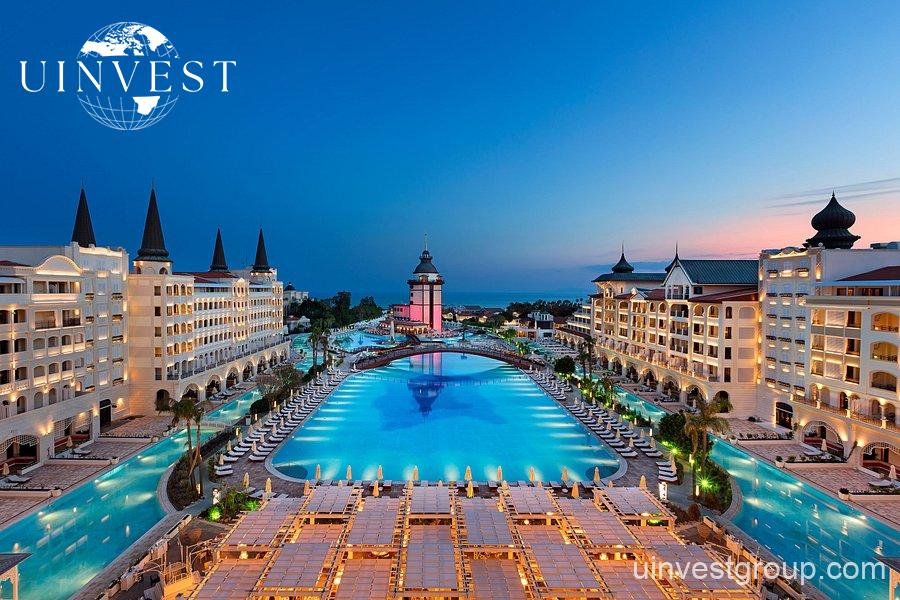
How Many Hotels Are There in Turkey by Certificate Type?
The Ministry of Culture and Tourism publishes accommodation counts under three certificates: the tourism operation certificate, the tourism investment certificate and the simple accommodation operation certificate. Each row of Table 1 is one certificate type at one data date, with facilities, rooms and beds. Where the Ministry’s annual bulletin for a year gives only the operation and investment certificates, the table shows those two rows and their subtotal.
| Data date | Certificate type | Facilities | Rooms | Beds |
|---|---|---|---|---|
| September 2026 (provisional) | Tourism operation certificate | 8,821 | 600,638 | 1,264,786 |
| September 2026 (provisional) | Tourism investment certificate | 444 | 53,834 | 120,713 |
| September 2026 (provisional) | Simple accommodation operation certificate | 12,225 | 273,955 | 553,749 |
| September 2026 (provisional) | All three certificates | 21,490 | 928,427 | 1,939,248 |
| Year-end 2025 | Tourism operation certificate | 8,159 | 583,120 | 1,225,633 |
| Year-end 2025 | Tourism investment certificate | 573 | 62,770 | 140,065 |
| Year-end 2025 | Operation and investment certificates | 8,732 | 645,890 | 1,365,698 |
| Year-end 2024 | Tourism operation certificate | 6,905 | 564,534 | 1,183,568 |
| Year-end 2024 | Tourism investment certificate | 715 | 75,737 | 168,947 |
| Year-end 2024 | Simple accommodation operation certificate | 14,596 | 321,270 | 648,018 |
| Year-end 2024 | All three certificates | 22,216 | 961,541 | 2,000,533 |
| Year-end 2023 | Tourism operation certificate | 5,228 | 530,648 | 1,111,701 |
| Year-end 2023 | Tourism investment certificate | 720 | 74,992 | 165,067 |
| Year-end 2023 | Operation and investment certificates | 5,948 | 605,640 | 1,276,768 |
Table 1 source: Ministry of Culture and Tourism, September 2026 monthly table, and the 2025 and 2024 annual bulletins. Totals are added from the Ministry’s rows. The simple-accommodation table inside the 2025 bulletin repeats the 2024 figures, so the year-end 2025 simple-certificate row is left out rather than estimated.
In the September 2026 table the operation certificate covers 8,821 facilities, which is 41.0% of all certified facilities but 65.2% of beds. The simple accommodation certificate covers 12,225 facilities, 56.9% of the facility count and 28.6% of beds. The investment certificate covers 444 facilities, 2.1% of facilities and 6.2% of beds. The average size differs sharply by certificate: 143 beds per facility for operation-certified facilities, 272 for investment-certified facilities and 45 for simple-certified facilities, against 90 across all three. This is why a headline of “21,490” and a headline of “1.94 million beds” describe different parts of the same system.
Other monthly tables show the same direction. The January 2026 table, reproduced by Alomaliye from the Ministry, listed 22,005 facilities and 1,969,234 beds (8,276 operation, 576 investment and 13,153 simple). The August 2026 totals reported by the Anadolu Agency from Ministry data were 21,608 facilities, 928,638 rooms and 1,939,125 beds. Between January and September 2026 the number of operation-certified facilities rose from 8,276 to 8,821 while the simple-certificate count fell from 13,153 to 12,225.
Change over time can be stated where both ends are published. From year-end 2024 to year-end 2025 the number of operation-certified facilities rose by 18.2% (6,905 to 8,159) and their beds by 3.6% (1,183,568 to 1,225,633), so the average operation-certified facility fell from 171 to 150 beds. Investment-certified facilities fell by 19.9% (715 to 573) and their beds by 17.1%. Together the two certificates added 1,112 facilities and 13,183 beds, a rise of 14.6% in facilities and 1.0% in beds. Between year-end 2024 and September 2026 the count across all three certificates fell by 726 facilities (3.3%) and by 61,285 beds (3.1%); simple-certified facilities fell by 2,371 while operation-certified facilities rose by 1,916. The Ministry’s tables do not show how many facilities moved from one certificate to another, how many closed and how many were new, so the series is a count of certificates in force, not a count of new building.
What the Three Certificates Mean
Tourism operation certificate
The operation certificate is the Ministry’s principal licence for a running tourism business. Law 2634 on the Promotion of Tourism, as amended by Law 7334, defines it as the certificate the Ministry issues to businesses operating in the tourism sector, with simple accommodation facilities excluded from that definition. The Ministry’s statistics metadata describes the facility types in this group: hotels are classified from one to five stars, a guesthouse (pansiyon) has between five and twenty-five rooms, a motel is a roadside facility outside a settlement with at least ten rooms, and a holiday village is a nature-based resort whose buildings stand no higher than three storeys. Other types in the bulletin include apart hotels, boutique hotels, thermal hotels, camping sites, rural tourism facilities and “special facilities”.
Tourism investment certificate
The investment certificate belongs to a project in its investment period. The Ministry reports investment-certified facilities in a separate column, with their own rooms and beds, and an investment-certified hotel appears in the counts of its star class (for example 125 five-star hotels in the year-end 2025 table) alongside the operating ones. Because the same facility type can appear under either certificate, the star-class table below keeps the two certificates side by side instead of merging them.
Simple accommodation certificate and the former municipality-certified category
Before 2021 a large part of Turkish accommodation held only a permit from its municipality and was reported in the Ministry’s separate municipality-certified series. Law 7334, accepted on 18 July 2021 and published in the Official Gazette (No. 31551) on 28 July 2021, added Provisional Article 11 to Law 2634. Under it, accommodation facilities that held a workplace opening and operating permit and had no tourism operation certificate could apply to the Ministry within one year and receive a simple accommodation tourism operation certificate; facilities that did not apply within the year could not keep operating, and the competent authority was to cancel their permits within one month of the Ministry’s notice. The Ministry’s municipality-certified statistics page now explains this law and directs readers to the simple-certificate figures. For this reason the 12,225 “simple” facilities in Table 1 are the successor of the old municipality-certified category and should not be added to a separate municipality count.
The umbrella term in the law is “tourism certificate”, which Law 7334 defines as the investment certificate, the operation certificate and the simple accommodation certificate together. Anyone asking how many hotels are there in Turkey should first decide which of the three the question includes, because the answer moves by a factor of two depending on the choice.
Where the figures come from
The Ministry’s metadata page describes the facility statistics as a full census built from administrative records, entered facility by facility by Ministry staff. The monthly table appears on about the eighth day of the following month and is provisional; the annual bulletin, published with data for 31 December, is finalised about three months after the reference date. The Ministry’s facility statistics page currently links the September 2026 monthly file, and the type-and-class tables used in this guide come from the annual bulletin for 2025.
Facilities, Rooms and Beds: Three Counts for One Question
A facility count treats a 40-bed guesthouse and a 1,000-bed resort as one unit each. The Ministry therefore publishes three counts for every table: facilities (tesis), rooms (oda) and beds (yatak). In September 2026 the national figures work out to 2.09 beds per room (1,939,248 beds in 928,427 rooms), and the ratio is between 2.0 and 2.2 in each certificate group. Rooms are the better unit for comparing hotels with similar layouts; beds are the unit the Ministry and the press use for national capacity and for market shares, and they are used for the province and region tables below.
The size gap between facility types is wide. In the year-end 2025 bulletin the 2,446 operation-certified guesthouses have 49,662 beds, about 20 beds each. The 848 operation-certified five-star hotels have 550,530 beds, about 649 beds each. A province with many guesthouses ranks high by facility count and low by beds, and a province with large resorts does the opposite. This size gap is the key to reading the provincial tables.
A fourth count appears in the demand statistics: “arrivals at facilities” (tesise geliş). It counts check-ins, so a traveller who stays in two facilities on one trip is counted twice. The 98,981,217 check-ins in certified facilities in 2025 are therefore not the number of tourists, and the section on demand keeps visitor counts from the border statistics apart from check-ins and overnight stays.
Hotels by Star Class and Facility Type
When people ask how many hotels are there in Turkey they usually mean facilities classed as hotels, with a star rating. The annual bulletin gives that count by class for 31 December 2025. Table 2 shows the five classes for both certificates.
| Star class | Operation-certified facilities | Rooms | Beds | Beds per facility | Investment-certified facilities | Rooms | Beds |
|---|---|---|---|---|---|---|---|
| 5-star | 848 | 258,989 | 550,530 | 649 | 125 | 27,881 | 62,424 |
| 4-star | 985 | 119,086 | 245,767 | 250 | 143 | 14,430 | 30,695 |
| 3-star | 1,519 | 75,115 | 151,952 | 100 | 145 | 8,377 | 16,750 |
| 2-star | 454 | 14,505 | 29,096 | 64 | 9 | 225 | 479 |
| 1-star | 374 | 7,467 | 15,100 | 40 | 17 | 606 | 1,220 |
| All star-rated hotels | 4,180 | 475,162 | 992,445 | 237 | 439 | 51,519 | 111,568 |
Table 2 source: Ministry of Culture and Tourism, annual bulletin 2025, “type and class” table, 31 December 2025. Beds per facility is calculated for operation-certified facilities. Thermal hotels carry their own star classes and are shown in Table 3, not here, and boutique hotels have no class.
Star-rated hotels with an operation certificate are 51.2% of all operation-certified facilities and 81.0% of their beds. Within the group, the five-star class is 848 facilities, or 20.3% of operation-certified hotels, but 55.5% of their beds; five-, four- and three-star hotels together hold 95.5% of the beds. Counted by facilities the picture is more even, with 1,519 three-star hotels against 848 five-star hotels. The class system is the Ministry’s classification of hotels, as its metadata describes, and is not a guest-review score.
Hotels are only one of many types in the bulletin. Table 3 lists the other types with enough facilities to matter, again with both certificates.
| Facility type | Operation-certified facilities | Beds | Investment-certified facilities | Beds |
|---|---|---|---|---|
| Hotel (one to five stars, Table 2) | 4,180 | 992,445 | 439 | 111,568 |
| Holiday village | 76 | 55,608 | 19 | 12,281 |
| Thermal hotel | 106 | 32,657 | 18 | 7,242 |
| Boutique hotel | 112 | 9,060 | 46 | 3,147 |
| Apart hotel | 454 | 29,545 | — | — |
| Guesthouse (pansiyon) | 2,446 | 49,662 | — | — |
| Special facility (özel tesis) | 623 | 38,623 | 22 | 1,484 |
| Detached apart hotel | 28 | 3,336 | — | — |
| Motel | 10 | 653 | 1 | 118 |
| Camping | 42 | 3,121 | 4 | 376 |
| Rural tourism facility | 44 | 1,131 | 21 | 1,977 |
| All other types | 38 | 9,792 | 3 | 1,872 |
| All facility types | 8,159 | 1,225,633 | 573 | 140,065 |
Table 3 source: Ministry of Culture and Tourism, annual bulletin 2025, 31 December 2025. Thermal hotels are also star-rated and are counted in their own row, not in the hotel row. “All other types” combines the thermal holiday village, thermal detached apart hotel, inn (oberj), golf facility, tourism complex, B-type holiday site, boutique holiday villas, mountain house, farm house, plateau house, thermal tourism facility, boutique thermal hotel and the bulletin’s “other” line. A dash means the bulletin lists no facilities of that type under that certificate.
Guesthouses show how much the facility count depends on small units. The 2,446 operation-certified guesthouses are 30.0% of all operation-certified facilities and 4.1% of their beds. Apart hotels, at 454 facilities, hold 29,545 beds, about 65 per facility. Holiday villages are few and large: 76 operation-certified villages hold 55,608 beds, about 732 beds each, which is larger on average than the five-star hotel class. Boutique hotels and thermal hotels are classified as their own types in the bulletin, so a boutique property is not counted in the star table.
Provincial Breakdown: Facilities, Rooms and Beds
The Ministry’s September 2026 table gives every province’s counts under the three certificates. Table 4 adds the three certificates together for the twelve provinces ranked first by bed count and shows each province’s share of the national total of 1,939,248 beds.
| Province | Facilities | Rooms | Beds | Share of national beds | Beds per facility |
|---|---|---|---|---|---|
| Antalya | 2,720 | 306,852 | 657,807 | 33.9% | 242 |
| İstanbul | 3,176 | 133,997 | 271,148 | 14.0% | 85 |
| Muğla | 2,940 | 115,358 | 243,129 | 12.5% | 83 |
| İzmir | 1,911 | 46,884 | 94,596 | 4.9% | 50 |
| Aydın | 416 | 28,019 | 58,228 | 3.0% | 140 |
| Balıkesir | 1,265 | 25,232 | 54,338 | 2.8% | 43 |
| Ankara | 353 | 20,793 | 40,812 | 2.1% | 116 |
| Mersin | 594 | 18,402 | 40,258 | 2.1% | 68 |
| Nevşehir | 756 | 15,676 | 32,459 | 1.7% | 43 |
| Çanakkale | 960 | 14,673 | 29,889 | 1.5% | 31 |
| Trabzon | 414 | 12,170 | 26,561 | 1.4% | 64 |
| Bursa | 333 | 12,111 | 25,214 | 1.3% | 76 |
Table 4 source: Ministry of Culture and Tourism, September 2026 monthly table, operation, investment and simple certificates added together; provisional data. Shares and beds per facility are calculated.
The facility ranking and the bed ranking differ. By facility count İstanbul ranks first with 3,176, followed by Muğla with 2,940 and Antalya with 2,720; by beds Antalya ranks first with 657,807, which is 33.9% of the national figure, ahead of İstanbul with 271,148 and Muğla with 243,129. The three provinces together hold 60.4% of the beds, and the first five (adding İzmir and Aydın) hold 68.3%. The Anadolu Agency’s August 2026 report from the same Ministry data gives Antalya 654,133 beds in 2,764 facilities (33.7% of national capacity) and İstanbul 3,192 facilities, which matches the September table within a month’s revision.
The reason the ranks differ is the average facility size shown in the last column. Antalya’s average is 242 beds per facility; the average for its operation-certified facilities alone is 415 beds (527,042 beds in 1,269 facilities). İstanbul’s 1,364 operation-certified facilities average 128 beds (174,531 beds), and a further 1,767 simple-certified facilities in the city have 83,832 beds, about 47 each. Muğla has 876 operation-certified facilities with 129,816 beds and 2,007 simple-certified facilities with 97,715 beds. Counting only operation-certified facilities the order is İstanbul (1,364), Antalya (1,269) and Muğla (876); counting simple-certified facilities it is Muğla (2,007), İstanbul (1,767) and Antalya (1,367). City hotels in İstanbul and many small properties on the Muğla coast produce high facility counts, while large all-inclusive resorts in Antalya produce high bed counts.
Below the first twelve, Sakarya has 452 facilities and 14,545 beds, Kocaeli 287 and 16,694, Afyonkarahisar 114 and 16,030, and Denizli 155 and 14,742 (September 2026). Prices of property by province are a separate subject; the guide to the cheapest and most expensive cities in Turkey covers cost-of-living and price-per-square-metre data from TÜİK and the central bank.
Regions and Resort Areas
Regional overview
The annual bulletin groups provinces into the twelve statistical regions of the NUTS-1 classification (TR1 to TRC). Table 5 shows the operation and investment certificates for 31 December 2025; the simple certificate is not included, because the regional tables of the bulletin do not cover it.
| Statistical region | Facilities (operation + investment) | Beds | Share of beds |
|---|---|---|---|
| TR6 Mediterranean (includes Antalya) | 1,630 | 592,389 | 43.4% |
| TR3 Aegean (includes İzmir, Aydın, Muğla) | 1,925 | 277,425 | 20.3% |
| TR1 İstanbul | 1,330 | 183,704 | 13.5% |
| TR4 East Marmara | 630 | 57,429 | 4.2% |
| TR2 West Marmara | 833 | 49,512 | 3.6% |
| TR5 West Anatolia (includes Ankara) | 309 | 46,166 | 3.4% |
| TRC Southeast Anatolia | 336 | 34,954 | 2.6% |
| TR7 Central Anatolia (includes Nevşehir) | 537 | 34,592 | 2.5% |
| TR9 East Black Sea | 478 | 34,582 | 2.5% |
| TR8 West Black Sea | 303 | 20,815 | 1.5% |
| TRA Northeast Anatolia | 220 | 17,360 | 1.3% |
| TRB Central East Anatolia | 201 | 16,770 | 1.2% |
| Turkey | 8,732 | 1,365,698 | 100% |
Table 5 source: Ministry of Culture and Tourism, annual bulletin 2025, regional tables; shares are calculated from the Ministry’s bed counts. The TR6 region also contains Adana, Mersin, Hatay and other provinces, and TR3 contains Afyonkarahisar, Denizli and others.
The Turkish Riviera: Antalya and Muğla
“Turkish Riviera” is a travel term, not a statistical unit, and the Ministry’s tables use provinces and districts only. In common use it means the coast of Antalya province, often extended westward to the Muğla coast of Bodrum, Marmaris and Fethiye. Asking how many hotels are there in Turkey’s Riviera therefore has no single official answer; the provincial figures are the nearest fixed point. In the September 2026 table the two provinces together have 5,660 facilities (2,720 in Antalya and 2,940 in Muğla) and 900,936 beds, which is 26.3% of the national facility count and 46.5% of national beds.
The Ministry also publishes district tables. Table 6 sets the year-end 2025 count of operation- and investment-certified facilities in the main resort districts beside the 2025 demand figures for facilities with an operation or simple certificate. The two sets of columns come from two bulletins with different coverage and should not be divided into each other.
| District | Facilities, 31 Dec 2025 | Beds, 31 Dec 2025 | Beds per facility | Check-ins 2025 | Overnight stays 2025 | Average stay (nights) | Occupancy 2025 |
|---|---|---|---|---|---|---|---|
| Manavgat (Antalya) | 272 | 170,699 | 628 | 8,207,300 | 33,071,399 | 4.03 | 69.3% |
| Alanya (Antalya) | 305 | 138,153 | 453 | 7,735,765 | 26,041,119 | 3.37 | 66.0% |
| Kemer (Antalya) | 165 | 83,096 | 504 | 5,167,954 | 17,543,420 | 3.39 | 66.1% |
| Serik (Antalya) | 84 | 77,288 | 920 | 4,348,427 | 17,421,831 | 4.01 | 73.4% |
| Muratpaşa (Antalya) | 164 | 22,148 | 135 | 2,169,741 | 5,918,115 | 2.73 | 59.1% |
| Aksu (Antalya) | 32 | 34,425 | 1,076 | 1,587,349 | 7,481,592 | 4.71 | 65.5% |
| Marmaris (Muğla) | 192 | 34,932 | 182 | 3,088,759 | 7,984,117 | 2.58 | 56.5% |
| Bodrum (Muğla) | 320 | 63,521 | 199 | 2,823,425 | 7,579,360 | 2.68 | 42.4% |
| Fethiye (Muğla) | 172 | 24,957 | 145 | 1,966,368 | 5,671,468 | 2.88 | 59.4% |
| Antalya province | 1,261 | 548,234 | 435 | 30,763,631 | 111,340,634 | 3.62 | 66.3% |
| Muğla province | 861 | 143,427 | 167 | 9,129,867 | 24,669,490 | 2.70 | 50.0% |
Table 6 sources: Ministry of Culture and Tourism, annual bulletin 2025 (facilities and beds) and accommodation bulletin 2025 (check-ins, overnight stays, average stay and occupancy). Beds per facility is calculated.
The district figures show two kinds of resort coast. Manavgat, Kemer, Serik and Aksu have large hotels: Serik has 84 certified facilities with 77,288 beds, about 920 each, and an occupancy of 73.4% in 2025. Bodrum has 320 certified facilities with 63,521 beds, about 199 each, and an occupancy of 42.4%, and Marmaris, Fethiye and Muratpaşa average between 135 and 182 beds. Antalya province recorded 111,340,634 overnight stays in 2025, of which 93,951,453, or 84.4%, were by foreign guests. Muğla recorded 24,669,490 overnight stays, 57.9% of them foreign.
Aegean coast
Along the northern and central Aegean the province tables list İzmir with 1,911 facilities and 94,596 beds, Aydın with 416 facilities and 58,228 beds, Balıkesir with 1,265 facilities and 54,338 beds and Çanakkale with 960 facilities and 29,889 beds (September 2026). Within Aydın the bulletin shows Kuşadası with 88 operation- and investment-certified facilities and 26,094 beds and Didim with 33 facilities and 13,435 beds at the end of 2025. Occupancy in 2025 was 51.2% in Kuşadası, 58.3% in Didim and 60.5% in Selçuk, the district that contains Ephesus, against 25.2% in Çeşme, where 279 certified facilities share 19,677 beds. Bozcaada and Gökçeada, the two Çanakkale islands, recorded 19.3% and 18.5%.
Cappadocia
Cappadocia is spread over several provinces, and the Ministry’s counts for Nevşehir, the province that contains Ürgüp, Göreme and Avanos, are 756 facilities and 32,459 beds in September 2026: 411 operation-certified (19,267 beds), 8 investment-certified and 337 simple-certified. The average facility has 43 beds. At the end of 2025 the districts of Ürgüp, Nevşehir centre and Avanos had 156, 213 and 32 operation- and investment-certified facilities. Nevşehir recorded 2,110,346 check-ins in 2025, 1,156,359 of them foreign, 4,105,898 overnight stays, an average stay of 1.95 nights and an occupancy of 42.7%. Foreign guests accounted for 56.6% of overnight stays. The museums and sites in the region are described in our guide to the best museums in Turkey.
Black Sea
The Black Sea provinces are small in the national totals. Trabzon has 414 facilities and 26,561 beds, Samsun 124 and 8,039, Rize 170 and 7,534 and Ordu 104 and 6,415 (September 2026). In the 2025 regional table the East Black Sea region (Artvin, Giresun, Gümüşhane, Ordu, Rize and Trabzon) has 478 operation- and investment-certified facilities with 34,582 beds, 2.5% of the national figure, and the West Black Sea region 303 facilities with 20,815 beds. In September 2026 Trabzon holds 295 of the 501 operation-certified facilities in the region’s six provinces, or 58.9%.
Eastern and south-eastern Anatolia
In September 2026 Şanlıurfa has 141 certified facilities with 8,536 beds, Mardin 123 and 8,231, Gaziantep 115 and 11,591, Van 113 and 9,032, Diyarbakır 101 and 9,269, Kars 102 and 6,728 and Erzurum 87 and 6,808. The Southeast Anatolia region (TRC) has 336 operation- and investment-certified facilities with 34,954 beds in the 2025 bulletin, and the Northeast and Central East Anatolia regions together have 421 facilities and 34,130 beds. The average facility in the seven provinces listed has between about 60 and 100 beds.
İstanbul by district
İstanbul’s 1,330 operation- and investment-certified facilities at year-end 2025 are concentrated in three districts, which together have 781 of them (58.7%). Fatih has 458 of them with 34,977 beds, Beyoğlu 227 with 30,338 beds and Şişli 96 with 19,713 beds; Beşiktaş has 57 facilities and 9,733 beds, and Kadıköy 47 and 4,837. The 2025 demand tables show the same pattern: Fatih recorded 5,105,768 check-ins and an occupancy of 59.3%, Beyoğlu 2,770,016 and 62.3% and Şişli 1,966,332 and 57.0%, which together are 54.4% of the 18,095,346 check-ins in the city. Foreign guests made 66.0% of check-ins in İstanbul and 71.8% of overnight stays, and the average stay was 2.22 nights, against 3.62 in Antalya. The İstanbul travel guide describes these districts for visitors, and property costs by district are on the site’s İstanbul page.
Demand: Visitors, Revenue, Overnight Stays and Occupancy
The question of how many hotels are there in Turkey only makes sense next to demand. The Ministry’s border statistics bulletin records 52,775,055 foreign visitors in 2025, 0.3% more than the 52,629,283 of 2024 and 7.2% more than 49,209,180 in 2023. Adding citizens resident abroad, total visitors were 63,941,261 in 2025. For the first eight months of 2026 the Ministry’s figures, as reproduced by Alomaliye, show 34,826,677 foreign visitors, 1.84% fewer than a year earlier; the data are provisional.
Revenue follows a TÜİK method rather than the border count. TÜİK’s 2025 figure, reported by the Anadolu Agency, is USD 65,230,749,000 of tourism revenue, 6.8% more than in 2024, from 63,917,057 departing visitors (up 2.7%), of whom 11,175,394 were citizens resident abroad. Average spending was USD 100 per visitor per night. The Ministry and TÜİK count visitors who cross the border; the accommodation figures that follow count check-ins and overnight stays in certified facilities, so the three sets of numbers should not be added or divided into each other.
The foreign visitors enter through a few provinces. In 2025 the border gates of İstanbul recorded 18,972,699 foreign entries (35.95%), those of Antalya 16,007,580 (30.33%) and those of Muğla 3,492,746 (6.62%). By nationality the border bulletin lists the Russian Federation at 6,903,981 foreign visitors in 2025, Germany at 6,745,190, the United Kingdom at 4,270,036 and Poland at 1,914,958. The accommodation bulletin counts by country of residence, not nationality, and lists the same four markets with Germany ahead of Russia, as Table 7 shows.
| Market | Border entries 2025 (nationality) | Check-ins at facilities 2025 (residence) | Overnight stays at facilities 2025 (residence) |
|---|---|---|---|
| Germany | 6,745,190 | 8,918,700 | 33,872,446 |
| Russian Federation | 6,903,981 | 7,806,246 | 27,188,939 |
| United Kingdom | 4,270,036 | 5,374,805 | 18,781,149 |
| Poland | 1,914,958 | 2,551,389 | 9,001,913 |
Table 7 source: Ministry of Culture and Tourism, border statistics bulletin 2025 and accommodation bulletin 2025. Residents of a country and nationals of that country are different groups, and a guest can be checked in at several facilities during one visit.
The accommodation bulletin covers facilities with an operation or simple certificate. It records 98,981,217 check-ins and 252,323,483 overnight stays in 2025. Foreign guests made 48,817,851 check-ins (49.3%) and 154,799,879 overnight stays (61.3%); guests resident in Türkiye made 50,163,366 check-ins and 97,523,604 overnight stays. The average stay was 2.55 nights (3.17 for foreign guests and 1.94 for domestic guests), and the occupancy rate was 49.5%. Occupancy varied from 26.8% in March to 71.2% in August across the months of 2025. Table 8 puts 2021 to 2025 side by side.
| Year | Check-ins | Overnight stays | Foreign share of overnight stays | Average stay (nights) | Occupancy |
|---|---|---|---|---|---|
| 2021 | 47,281,139 | 123,654,711 | 61.1% | 2.62 | 42.3% |
| 2022 | 70,242,410 | 185,902,110 | 66.3% | 2.65 | 54.1% |
| 2023 | 77,298,091 | 203,187,830 | 64.3% | 2.63 | 50.1% |
| 2024 | 83,243,556 | 216,017,715 | 64.6% | 2.60 | 51.9% |
| 2025 | 98,981,217 | 252,323,483 | 61.3% | 2.55 | 49.5% |
Table 8 source: Ministry of Culture and Tourism, accommodation bulletin 2025. From 2022 the data cover facilities with an operation or simple certificate. Shares are calculated.
Between 2024 and 2025 check-ins rose by 18.9% and overnight stays by 16.8%, while the foreign visitor count was almost unchanged. Foreign overnight stays rose 10.9% and domestic overnight stays 27.6%, which is why the foreign share fell from 64.6% to 61.3%. Occupancy was 49.5% in 2025 against 51.9% in 2024. The year-to-year changes should be read together with the certificate counts in Table 1, because the number of certified facilities also changed.
Occupancy differs by type and class. Table 9 shows the 2025 figures for the main hotel classes and other types.
| Facility type and class | Check-ins 2025 | Overnight stays 2025 | Average stay (nights) | Occupancy |
|---|---|---|---|---|
| 5-star hotel | 31,248,237 | 101,637,132 | 3.25 | 61.0% |
| 4-star hotel | 15,724,024 | 38,846,858 | 2.47 | 54.0% |
| 3-star hotel | 9,544,071 | 18,427,263 | 1.93 | 42.1% |
| 2-star hotel | 1,676,380 | 3,114,199 | 1.86 | 38.7% |
| 1-star hotel | 665,703 | 1,248,960 | 1.88 | 37.8% |
| Holiday village | 2,397,539 | 9,364,133 | 3.91 | 68.2% |
| Thermal hotel | 2,474,290 | 4,785,186 | 1.93 | 40.7% |
| Apart hotel (operation certificate) | 914,504 | 2,890,439 | 3.16 | 37.9% |
| Boutique hotel | 562,752 | 1,191,069 | 2.12 | 42.3% |
| Guesthouse (operation certificate) | 1,910,839 | 3,636,725 | 1.90 | 35.1% |
| Guesthouse (simple certificate) | 7,279,886 | 15,196,850 | 2.09 | 33.5% |
| Hotel (simple certificate) | 18,214,825 | 37,323,812 | 2.05 | 41.5% |
Table 9 source: Ministry of Culture and Tourism, accommodation bulletin 2025, type-and-class table; occupancy is the Ministry’s occupancy rate for the year.
Five-star hotels accounted for 101,637,132 overnight stays, 40.3% of the national total, with 3.25 nights per stay and a 61.0% occupancy, of which 47.6 percentage points came from foreign guests. Three-, two- and one-star hotels have shorter stays (1.93, 1.86 and 1.88 nights) and are used mostly by domestic guests. Holiday villages show an average stay of 3.91 nights and an occupancy of 68.2%, above the five-star class (3.25 nights and 61.0%). The bulletin separates simple-certified hotels (18,214,825 check-ins, 41.5% occupancy) from operation-certified ones, which matters for any hotel count that includes the former municipality-certified category. Museum entry rules and passes for visitors on city trips are covered in the guide to the Museum Pass.
Pipeline and Supply Under Investment Certificates
Counts of how many hotels are there in Turkey sometimes include projects under construction, but the Ministry does not publish a count of hotels under construction. It publishes the number of facilities that hold an investment certificate, and that is the closest official figure to the pipeline. In September 2026 there are 444 investment-certified facilities with 53,834 rooms and 120,713 beds, which is 2.1% of the facility count and 6.2% of beds. At the end of 2025 there were 573 (140,065 beds), at the end of 2024 715 (168,947 beds) and at the end of 2023 720 (165,067 beds).
Province data for September 2026 show where these projects are registered: Antalya has 84 investment-certified facilities with 35,610 beds, Muğla 57 with 15,598, İzmir 47 with 10,231, İstanbul 45 with 12,785, Mersin 22 with 10,078 and Aydın 9 with 4,790. The investment-certified count in the year-end 2025 bulletin includes 125 five-star hotels (62,424 beds), 143 four-star hotels (30,695 beds), 145 three-star hotels (16,750 beds) and 19 holiday villages (12,281 beds). The count has fallen since 2023 while operation-certified facilities have risen, which fits projects moving from the investment to the operation certificate, but the tables do not trace individual facilities and the fall can also reflect cancelled certificates.
The Ministry also publishes a separate table for facilities with its environmentally sensitive facility certificate. The August 2026 figure reported by the Anadolu Agency is 428 facilities with 132,241 rooms and 284,507 beds, of which Antalya has 217 facilities and 195,206 beds. That table reports a quality designation and is not a fourth accommodation category. No official figure for new openings by month or by year is included in the tables used here, so this guide gives none.
How to Read These Statistics
A reliable answer to how many hotels are there in Turkey needs three things stated with the number, and omitting any of them is the usual source of error. First, state the certificate: a number for “hotels” that includes the simple accommodation certificate is about 2.4 times as large as one for operation-certified facilities alone (21,490 against 8,821 in September 2026). Second, state the unit: facilities, rooms or beds. Third, state the date: the monthly table is provisional, the annual bulletin is dated 31 December, and the two differ by the months between them.
Accommodation that holds none of the three certificates is outside the Ministry’s tables. Figures that add such accommodation to the certified count come from estimates outside the official series, and this guide uses only the certified counts. The same applies to Airbnb-style rentals. Law 7464 on the tourism-purpose rental of dwellings was published in the Official Gazette on 2 November 2023, and its main provisions took effect on 1 January 2024. It covers rentals of up to 100 days per contract and requires a permit from the Ministry before a rental contract is concluded. An application must include a decision taken unanimously by all unit owners of the building, and in a building with more than three units a permit may be issued to the same landlord for at most 25% of the units. Administrative fines apply to rentals without a permit.
The Ministry’s application page says applications are made through e-Devlet only and sets conditions on the type of building, zoning and the condominium management plan. The permit under Law 7464 is a document for a dwelling and is not one of the three facility certificates. The Ministry’s statistics metadata defines the facility population as facilities with a tourism operation or simple tourism operation certificate, so dwellings licensed under the rental law are not part of the 21,490. The Ministry’s public register of permitted dwellings held 33,966 permit records covering 49,102 homes, 120,365 rooms and 237,844 beds when read on 17 October 2026; this is a separate series and is not added to the 21,490 facilities.
A last caution concerns old figures. Counts reported before the 2021 reform listed municipality-certified facilities in a series of their own, with their own methods. A count from 2023 or earlier for “all certified hotels” can mix definitions and should not be compared with the three-certificate totals above. The Ministry’s numbers in this guide were checked against the original files on 17 October 2026, and secondary reports are used only where they quote the Ministry.
Hotels and the Property Market
The answer to how many hotels are there in Turkey also shows where tourist accommodation is concentrated: Antalya, İstanbul and Muğla hold 60.4% of certified beds. Property transactions by foreign buyers are concentrated in some of the same places. TÜİK’s 2025 housing sales statistics, as reproduced by Alomaliye, record 21,534 homes sold to foreigners in 2025, 9.4% fewer than in 2024 and 1.3% of all sales (1,688,910 in total). İstanbul accounted for 7,989, Antalya for 7,118 and Mersin for 1,800, and TÜİK lists the Russian Federation (3,649 homes), Iran (1,878) and Ukraine (1,541) as the first three buyer nationalities. Hotel statistics describe tourism supply and do not measure the housing market, so the two should not be read as one dataset.
Foreign ownership of real estate in Turkey is governed by Article 35 of Land Registry Law No. 2644. As amended by Law 6302 (Official Gazette No. 28296, 18 May 2012), it limits the total area that foreign individuals can acquire to 10% of a district’s privately owned surface and 30 hectares per person across the country, and allows the Council of Ministers to raise the per-person limit to twice that figure. Military prohibited zones, military security zones and strategic zones are defined by maps and coordinates from the Ministry of National Defence, and special security zones through the Ministry of the Interior. Since 24 January 2022 a foreign individual who buys property must submit a foreign exchange purchase certificate (döviz alım belgesi) to the land registry office, according to the Land Registry and Cadastre General Directorate. The Directorate’s guide for foreigners sets out the procedure.
Two thresholds link property purchases to residence and citizenship. For a short-term residence permit based on property ownership, the Presidency of Migration Management’s list of required documents asks for a title deed and states that the dwelling’s value at the acquisition date must be at least USD 200,000 in Turkish lira equivalent; the dwelling must be used by the foreigner as a residence and not for rent or similar income. For citizenship by exception, the Konya Investment Support Office lists real estate worth at least USD 400,000 or its equivalent in foreign currency with a note on the title deed that the property will not be sold for three years; the Ministry of Environment, Urbanisation and Climate Change determines eligibility. The USD 400,000 limit applies from 13 June 2022, replacing USD 250,000, and the Official Gazette of 13 May 2022 carries a regulation amending the citizenship implementing regulation (decision no. 5554). The site’s overview of citizenship and immigration covers the process, the tax calculator covers purchase costs, and listings in İstanbul are on the apartments for sale in İstanbul page.
Frequently Asked Questions
How many hotels are there in Turkey?
According to the Ministry of Culture and Tourism’s September 2026 table (provisional), Turkey has 21,490 certified accommodation facilities: 8,821 with an operation certificate, 444 with an investment certificate and 12,225 with a simple accommodation certificate. Counting only hotels with a star class, the year-end 2025 bulletin lists 4,180 operation-certified hotels and 439 investment-certified hotels.
How many rooms and beds do Turkey’s hotels have?
The September 2026 table lists 928,427 rooms and 1,939,248 beds across all certified accommodation. Star-rated operation-certified hotels had 475,162 rooms and 992,445 beds on 31 December 2025, and investment-certified hotels another 51,519 rooms and 111,568 beds.
Which province ranks first by hotels, and which by beds?
By facility count İstanbul ranks first in September 2026 with 3,176 certified facilities, ahead of Muğla (2,940) and Antalya (2,720). By beds Antalya ranks first with 657,807, or 33.9% of the national total, ahead of İstanbul (271,148) and Muğla (243,129). The ranks differ because Antalya’s resorts average 242 beds per facility against 85 in İstanbul and 83 in Muğla.
How many 5-star hotels are there in Turkey?
On 31 December 2025 the Ministry listed 848 five-star hotels with an operation certificate (550,530 beds) and 125 with an investment certificate (62,424 beds). Thermal hotels and thermal holiday villages carry five-star classes of their own: 46 operation-certified thermal hotels are five-star, with 21,279 beds.
How many hotels are there on the Turkish Riviera?
The Ministry has no Riviera category. Using Antalya and Muğla provinces as the nearest fixed unit, the September 2026 table shows 5,660 certified facilities with 900,936 beds: 2,720 facilities and 657,807 beds in Antalya, 2,940 facilities and 243,129 beds in Muğla. These counts include all three certificates.
How many tourists visit Turkey in a year?
The Ministry’s border statistics record 52,775,055 foreign visitors in 2025 and 63,941,261 visitors including citizens resident abroad. TÜİK reports USD 65.23 billion of tourism revenue for 2025, up 6.8%. For January to August 2026 the Ministry’s figure is 34,826,677 foreign visitors, 1.84% fewer than a year earlier.
Are Airbnb-style rentals counted in the hotel statistics?
No. Dwellings rented for tourism under Law 7464 hold a rental permit, which is a separate document from the operation, investment and simple accommodation certificates, and the Ministry’s facility statistics cover facilities holding those three certificates. The law applies to rentals of up to 100 days per contract and has been in force since 1 January 2024. The Ministry’s register of permitted dwellings listed 33,966 permit records covering 49,102 homes on 17 October 2026.
Can foreigners buy property in Turkey?
Yes, within the limits of Article 35 of Law No. 2644: foreign individuals may acquire up to 10% of a district’s privately owned surface and 30 hectares per person nationally, subject to the Council of Ministers’ power to double the per-person limit, and not in military prohibited or security zones. A foreign exchange purchase certificate has been required for purchases by foreign individuals since 24 January 2022.
Does buying property give a residence permit?
A short-term residence permit can be based on a dwelling whose value at the acquisition date is at least USD 200,000 in Turkish lira equivalent, per the Presidency of Migration Management’s document list. Citizenship by exception requires real estate of at least USD 400,000 with a three-year no-sale note on the title deed, and the Ministry of Environment, Urbanisation and Climate Change determines eligibility.
Last checked: 17 October 2026. Sources: Ministry of Culture and Tourism (facility statistics, September 2026 table, annual bulletin 2025, annual bulletin 2024, accommodation bulletin 2025, border statistics 2025, metadata, municipality-certified page, rental permit page); Official Gazette (Law 7334, Law 6302, 13 May 2022); Law 7464; Presidency of Migration Management; Konya Investment Support Office; Land Registry (foreign exchange certificate, guide for foreigners); Anadolu Agency (tourism revenue, August 2026 capacity); Alomaliye reproductions of Ministry and TÜİK releases (January 2026, foreign visitors August 2026, housing sales 2025).


