




Taxes on Vehicle Purchases in Turkey (2026)
Buying a car in Turkey involves two taxes that apply once, at purchase: the Special Consumption Tax (ÖTV, often translated as SCT) and Value Added Tax (KDV, VAT). After the purchase the owner also pays the annual Motor Vehicle Tax (MTV), a registration or transfer charge, and a periodic roadworthiness inspection. This guide sets out the rates and amounts in force on 11 October 2026, with the legal source and date for each, and flags the points where published sources disagree.
Turkish car prices are built in a fixed order: the pre-tax price (the ÖTV base) is multiplied by the ÖTV rate, VAT is then charged on the base plus the ÖTV, and the total is the price on the dealer’s label. Because the ÖTV rate depends on the engine and on the size of the base, two cars with similar sticker prices can carry very different tax shares.
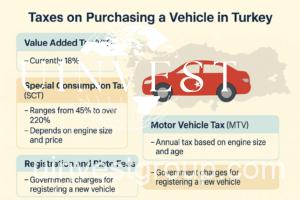
Taxes and Charges at a Glance
| Item | 2026 position | When it is paid |
|---|---|---|
| ÖTV (special consumption tax) | 25% to 220% of the base, depending on engine, power and base size | Once, included in the purchase price |
| KDV (VAT) | 20% of base plus ÖTV | Once, included in the purchase price |
| MTV (motor vehicle tax) | From 5,750 TL a year for the smallest new cars; 10,016–12,028 TL for a typical 1,301–1,600 cc car aged 1–3 years | Every year, in January and July |
| Notary levy on a sale | 2 per thousand of the price, minimum 1,000 TL | At the notary, on a registered vehicle sale |
| Transfer and plate charges | About 1,870–1,970 TL transfer fee; 850 TL for a double plate (secondary sources) | At registration or transfer |
| TÜVTÜRK inspection | 3,288 TL plus 460 TL emission test for a car | First inspection after 3 years, then every 2 years |
Value Added Tax (VAT) on Vehicles
The general VAT rate has been 20% since 10 July 2023, when Presidential Decision 7346 (Official Gazette of 7 July 2023, no. 32241) raised it from 18%. Both EY and KPMG Türkiye published alerts on the change. VAT on a car is calculated on the sum of the base price and the ÖTV, so the buyer pays tax on a price that already contains another tax.
Example: a car with a base price of 600,000 TL and ÖTV of 420,000 TL has a VAT base of 1,020,000 TL. VAT at 20% is 204,000 TL, and the price on the label is 1,224,000 TL.
Special Consumption Tax (ÖTV) on Passenger Cars
Passenger cars (customs tariff heading 87.03) are listed in List (II) of Law no. 4760 on the Special Consumption Tax. List (I), which is sometimes quoted for cars, covers fuels. The rates and base limits for cars are set by Presidential Decision under Article 12 of the Law, and the table currently in force is Presidential Decision 10115, published in the Official Gazette of 24 July 2025 (no. 32965).
The Gazette text states that the Decision entered into force on its publication date, 24 July 2025. EY and KPMG alerts describe the new rates as applying from 1 August 2025. The Gazette is the primary source, and no later amendment to the passenger-car table was found through 11 October 2026.
How the Base Is Defined
The ÖTV base is the price before ÖTV and before VAT; on an imported car it is the customs value plus duties and charges. A tax summary by a Turkish law firm adds that accessories, paint protection or extended warranty billed to the buyer at delivery form part of the base. ÖTV is calculated first and VAT second.
The Rate Applies to the Whole Base
The Decision lists, for each rate, the bases that “do not exceed” a stated amount. In practice the rate that matches the base applies to the entire base, not only to the part above the previous limit. A base of 1,100,000 TL in the 1,401–1,600 cc class carries 80% (880,000 TL of ÖTV), while a base of 1,100,001 TL carries 90% (about 990,001 TL of ÖTV).
Petrol and Diesel Cars
| Engine capacity | ÖTV base (TL) | ÖTV rate |
|---|---|---|
| Up to 1,400 cc | Up to 650,000 | 70% |
| Up to 1,400 cc | 650,001–900,000 | 75% |
| Up to 1,400 cc | 900,001–1,100,000 | 80% |
| Up to 1,400 cc | Above 1,100,000 | 90% |
| 1,401–1,600 cc | Up to 850,000 | 75% |
| 1,401–1,600 cc | 850,001–1,100,000 | 80% |
| 1,401–1,600 cc | 1,100,001–1,650,000 | 90% |
| 1,401–1,600 cc | Above 1,650,000 | 100% |
| 1,601–2,000 cc | Up to 1,650,000 | 150% |
| 1,601–2,000 cc | Above 1,650,000 | 170% |
| Above 2,000 cc | No limit | 220% |
The base limits of 650,000, 850,000, 900,000, 1,100,000 and 1,650,000 TL and the rates of 70%, 75%, 80%, 90%, 100%, 150%, 170% and 220% were checked against the Gazette text and against tables published by EY, CNBC-e and Araclo. No source disagreed on a band.
Hybrid and Electric Cars
| Vehicle type | ÖTV base (TL) | ÖTV rate |
|---|---|---|
| Hybrid, electric motor above 50 kW, engine up to 1,800 cc (1,601–2,000 cc class) | Up to 1,250,000 | 70% |
| Hybrid, electric motor above 50 kW, engine up to 1,800 cc (1,601–2,000 cc class) | Above 1,250,000 | 80% |
| Hybrid, electric motor above 100 kW, engine up to 2,500 cc (above 2,000 cc class) | Up to 1,650,000 | 150% |
| Hybrid, electric motor above 100 kW, engine up to 2,500 cc (above 2,000 cc class) | Above 1,650,000 | 170% |
| Plug-in hybrid, up to 1,600 cc | Up to 1,350,000 | 45% |
| Plug-in hybrid, up to 1,600 cc | Above 1,350,000 | 75% |
| Plug-in hybrid, 1,601–1,800 cc | Up to 1,350,000 | 85% |
| Battery electric, up to 160 kW | Up to 1,650,000 | 25% |
| Battery electric, up to 160 kW | Above 1,650,000 | 55% |
| Battery electric, above 160 kW | Up to 1,650,000 | 65% |
| Battery electric, above 160 kW | Above 1,650,000 | 75% |
The plug-in hybrid lines apply to cars that meet the Decision’s emission and range criteria: weighted CO2 emissions below 25 g/km and an electric range of at least 70 km. Non-plug-in hybrids without a large electric motor fall into the ordinary petrol and diesel bands above. The lines for hybrids with larger electric motors come from the tax publishers’ tables of the Decision. None of the sources reviewed gives a rate for a plug-in hybrid of 1,601–1,800 cc above a base of 1,350,000 TL.
Minimum ÖTV from 31 July 2026
Law no. 7590, published in the Official Gazette of 31 July 2026 (no. 33326), introduced a minimum fixed ÖTV on cars: 100,000 TL for passenger cars and 30,000 TL for L-class vehicles, with exclusions for L-class vehicles with internal combustion engines, small electric L-class vehicles and tractors. The amounts rise each year with the revaluation rate. At ordinary prices the proportional ÖTV is far above 100,000 TL (70% of a 600,000 TL base is 420,000 TL), so the minimum does not change the tax on most cars.
Worked Examples
The examples below use only the rates in the tables above. They show the pre-tax base, not the price on the label, and exclude registration, plates and insurance.
| Car | Base (TL) | ÖTV (TL) | VAT 20% (TL) | Total (TL) |
|---|---|---|---|---|
| Petrol car, up to 1,400 cc, base in the lowest band (70%) | 600,000 | 420,000 | 204,000 | 1,224,000 |
| Petrol car, 1,401–1,600 cc, base in the 80% band | 1,000,000 | 800,000 | 360,000 | 2,160,000 |
| Battery electric car, up to 160 kW, base up to 1,650,000 (25%) | 1,500,000 | 375,000 | 375,000 | 2,250,000 |
The arithmetic for the second row is: ÖTV = 1,000,000 × 0.80 = 800,000; VAT base = 1,000,000 + 800,000 = 1,800,000; VAT = 1,800,000 × 0.20 = 360,000; total = 1,800,000 + 360,000 = 2,160,000 TL. A dealer’s label price already contains both taxes: label price = base × (1 + ÖTV rate) × 1.20.
Because the base limits are fixed in lira and the rate applies to the whole base, a price change that crosses a limit changes the rate for the entire base. The 2025 reset also moved the lowest petrol band from the 45% that applied under the 2022 table to 70%. In the same reset, battery electric rates went from 10%, 40%, 50% and 60% to 25%, 55%, 65% and 75%, and plug-in hybrid rates from 30%, 60% and 70% to 45%, 75% and 85%, according to Anadolu Agency.
Motor Vehicle Tax (MTV) in 2026
MTV is an annual tax paid by the owner. The 2026 amounts were raised by 18.95% under Presidential Decision 10783 (Official Gazette of 31 December 2025, no. 33124), in force from 1 January 2026; the calculated revaluation rate would have been 25.49%. Press tables that use 25.49% are out of date. The tax depends on engine capacity, the age of the car and, for cars registered since 2018, the value band of the car.
| Engine capacity (car aged 1–3 years) | Annual MTV in 2026 (TL), by value band from lowest to highest |
|---|---|
| Up to 1,300 cc | 5,750 / 6,319 / 6,902 |
| 1,301–1,600 cc | 10,016 / 11,023 / 12,028 |
| 1,601–1,800 cc | 19,472 / 21,251 |
| 1,801–2,000 cc | 30,679 / 33,474 |
| 2,001–2,500 cc | 46,027 / 50,217 |
| Above 4,000 cc | 251,554 / 274,415 |
The figures come from the CNBC-e table of 1 January 2026 and match the 18.95% increase (for example 4,834 × 1.1895 = 5,750 TL). The value limits between bands that the table gives include 309,100 TL and 541,500 TL for the smallest class and 775,100 TL for the 1,601–1,800 cc class. The labels in the table are “vehicle value”, and the link to the post-2018 scheme is inferred. Older cars are taxed on engine capacity and age only.
Battery electric cars are taxed on motor power rather than engine capacity. Bloomberg HT attributes to the Finance Minister the statement that this comes to roughly a quarter of the tax on a comparable combustion car. Press examples for 2026 include 12,553 TL for a BYD Atto 3, about 17,505 TL for a single-motor Togg T10X and 68,603 TL for dual-motor models, but the power bands themselves were not verified. Hybrids are taxed by engine capacity like petrol cars.
MTV is paid in two equal instalments, in January and July, or in full in January. Payment is made at ivd.gib.gov.tr, at a tax office or through bank branches, websites and apps. Garanti BBVA gives late interest as 1.4% a month. Public bodies, foreign diplomatic missions and people with a disability of 90% or more are exempt.
Registration, Transfer and Plate Charges
Since 1 January 2026, notarised sales of registered vehicles carry a levy of 2 per thousand of the sale price, with a minimum of 1,000 TL (Law no. 7566, Article 7; confirmed by a Revenue Administration ruling of 30 April 2026). The same levy applies to a first registration carried out at a notary. Sales and transfers to holders of a second-hand motor vehicle trade authorisation certificate, that is dealers, are exempt.
Fixed charges are quoted by secondary sources that cite the 2026 notary tariff, and the official tariff was not read. They give a transfer fee of about 1,870–1,970 TL, a first registration fee for a new car of about 1,970 TL and 850 TL for a double plate from 2 February 2026. The buyer pays the transfer fee, and the seller must settle taxes and traffic fines before the sale. Compulsory traffic insurance and comprehensive (kasko) insurance are separate purchases, and a law-firm article of 23 March 2026 states that traffic insurance is required from the registration date.
Inspection (TÜVTÜRK)
Press reports based on the 2026 tariff give 3,288 TL for a passenger car inspection, plus 460 TL for the exhaust emission test, with a card-payment commission on top. According to TÜVTÜRK as quoted in the press in April 2024, the first inspection of a private car falls three years after first registration, and then every two years. Commercial vehicles are inspected every year. One outlet reports a late charge of 5% of the fee for each started month and a traffic fine of 2,719 TL for an uninspected vehicle; another summary mentions a different late-charge rate, so the figure should be confirmed at an inspection station.
New and Used Cars
ÖTV is paid when a car is first acquired or imported. The sources reviewed do not describe a new ÖTV charge on a later private resale. Dealers selling second-hand cars they bought without VAT from non-VAT payers use a special base, the sale price minus the purchase price (VAT Law, Article 23/f, since 1 June 2018). The rate applied to that special base after the general rate moved to 20% in 2023 was not verified.
A separate regulation limits resale of new cars. Under the Regulation on the Trade of Motor Land Vehicles (Official Gazette of 27 August 2024, no. 32645, as amended), a vehicle registered as new cannot be resold until both 6 months and 6,000 km have passed. Secondary sources report that the rule was extended in six-month steps, most recently to 1 January 2027, and that it applies to dealers and to anyone selling three or more used vehicles in a calendar year. The Ministry notice itself was not read.
Imported Cars and Temporary Imports
Cars of EU origin, or in free circulation in the EU, enter Turkey at 0% customs duty under the Customs Union. For cars from other countries, EY Türkiye and Moroğlu Arseven describe an additional financial liability under Decisions 10435 and 10436 (Official Gazette of 22 September 2025, no. 33025) for origin outside the EU and Turkey’s free-trade partners. It is the higher of a percentage or a fixed US dollar amount per car:
- 25% or USD 6,000 for conventional and non-plug-in hybrid cars;
- 30% or USD 7,000 for plug-in hybrids;
- 30% or USD 8,500 for electric cars.
The basic customs duty on third-country cars was not confirmed. A further 10% obligation is reported for cars of free-trade-partner origin that arrive via the EU, and sources differ on whether it applies to EU-sourced imports. On any import, ÖTV is calculated on the customs value plus duties and charges, and 20% VAT is added on top.
The Ministry of Trade states that Turkish citizens who have lived abroad for at least 24 months, or at least 5 of the last 10 years, may import one vehicle not older than three years free of customs duty only; ÖTV and VAT are still collected. They must apply within 6 months of the qualifying entry, and the vehicle cannot be sold, transferred, leased or pledged for one year without customs permission. For temporary import, residents abroad for more than 185 days in the past year may bring one foreign-plated vehicle for up to 730 days, foreigners are limited to their permitted stay, and the title cannot be transferred.
Exemptions for Disabled Persons
Under Article 7/2 of the ÖTV Law, a disabled person is exempt from ÖTV on a first acquisition. The 2026 price ceiling is 2,873,900 TL including all taxes (communiqué no. 16, Official Gazette of 31 December 2025), the vehicle must have at least 40% domestic content, and the exemption can be reused after 10 years. A summary dated 15 June 2026 states that VAT is still charged on the sale price. Exemptions for diplomats and tax-free exports were not verified from official text.
Buying a Car as a Foreign Resident
The ÖTV and VAT rules depend on the vehicle, not on the nationality of the buyer. For registration, a law-firm article of 23 March 2026 describes a passport and, for blue “MA” plates, a residence or work permit. Whether a tourist can register a car, and the registration deadline, are described differently by different sources and were not verified. Related pages: our Turkey property tax calculator and the current Istanbul property listings.
Frequently Asked Questions
What is the largest tax when buying a car in Turkey?
ÖTV is the largest component. Petrol and diesel cars pay 70% to 100% up to 1,600 cc, 150% or 170% from 1,601 to 2,000 cc, and 220% above 2,000 cc; qualifying plug-in hybrids pay 45% to 85% and battery electric cars 25% to 75%.
Is the VAT rate on cars 18% or 20%?
It is 20% since 10 July 2023, charged on the base price plus ÖTV.
Do foreign buyers pay different taxes?
The rates in the Presidential Decision and the VAT law depend on the car, not the buyer’s nationality. Registration documents differ by status.
Is there a minimum ÖTV?
Yes. From 31 July 2026 the ÖTV on a passenger car cannot fall below 100,000 TL under Law no. 7590, which does not affect most cars at normal prices.
Is MTV included in the purchase price?
No. MTV is a separate annual tax, paid in January and July.
How often are car taxes changed?
The ÖTV table was reset on 24 July 2025, the MTV amounts are revalued every January, and the minimum ÖTV was added on 31 July 2026.
How often must a private car be inspected?
The first inspection is due after three years and then every two years, according to TÜVTÜRK as quoted in the press.
Last verified: 11 October 2026. Sources: Official Gazette, 24 July 2025 (Decision 10115), Official Gazette, 31 July 2026 (Law 7590), EY Tax Alert on the 2025 ÖTV rates, KPMG on revised SCT rates, Anadolu Agency, EY on the VAT increase, CNBC-e on 2026 MTV, Alomaliye on the 18.95% increase, EY Türkiye on import liabilities, Ministry of Trade on vehicle imports and Alomaliye on the notary levy.


