









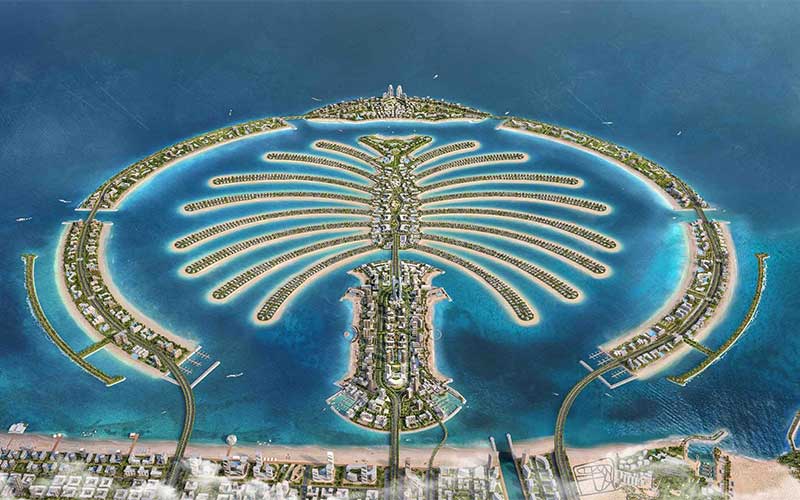
Few addresses in the world are as instantly recognizable as Palm Jumeirah. The palm-shaped, man-made island off Dubais coast has become shorthand for the emirates ambition, and for foreign investors, it remains one of the most sought-after — and most consistently resilient — freehold destinations in the entire UAE property market. This guide looks at what actually makes Palm Jumeirah apartments a strong choice for buyers today, beyond the postcard imagery, covering the practical realities of pricing, rental performance, building selection, and how the island compares to Dubais other premium freehold communities.
What Palm Jumeirah Actually Is
Palm Jumeirah is a fully reclaimed artificial archipelago built in the shape of a palm tree, comprising a trunk, sixteen fronds, and a surrounding crescent, connected to the mainland by a bridge and, more recently, the Dubai Metros Blue Line extension. The development houses a mix of low-rise apartment buildings along the fronds, villas at the tip of individual fronds, and larger hotel and mixed-use towers along the trunk and crescent. This variety matters for buyers: an apartment at the base of the trunk, close to the mainland connection, has a very different profile — in price, in access, and in rental demand — from a unit on one of the outer fronds.
Why Demand for Palm Jumeirah Apartments Has Stayed Strong
Scarcity by Design
Unlike many of Dubais newer freehold communities, Palm Jumeirah is essentially built out — there is limited scope for significant new supply on the island itself, since the reclaimed land available for development was largely allocated in the original masterplan. This scarcity has historically supported pricing resilience during periods when other, more supply-elastic communities have seen sharper corrections, since new competing inventory simply cannot be added at the same pace elsewhere.
Beachfront Access as a Structural Advantage
Every frond apartment offers direct or near-direct beach access, a genuinely differentiated feature compared to most of Dubais other freehold communities, where beach access, if available at all, is typically shared and more distant. For both owner-occupiers and the short-term holiday rental market, direct beach access is one of the most consistently valued amenities in the Dubai market.
A Global Brand Address
Palm Jumeirahs global recognition — arguably rivaling Downtown Dubais Burj Khalifa skyline as the emirates most iconic image — gives it a marketing and brand-recognition advantage that supports both resale liquidity and, notably, international short-term rental demand from travelers specifically seeking to stay at this address rather than simply anywhere in Dubai.
Types of Apartments Available on Palm Jumeirah
- Frond apartments: Low-rise buildings (typically four to eight storeys) along the sixteen fronds, offering the closest beach access and generally the most exclusive, quieter atmosphere on the island.
- Shoreline apartments: A cluster of towers at the base of the trunk, offering strong connectivity to the mainland and generally more accessible pricing than frond units while retaining beach access.
- Trunk and crescent towers: Larger, higher-density developments including branded residences and hotel-affiliated apartments, often commanding premium pricing tied to brand association and amenity packages.
- Branded residences: A growing category on Palm Jumeirah, where apartments are managed under an international hotel or lifestyle brand, typically commanding a further price premium in exchange for hotel-standard services and brand cachet.
Rental Performance: Long-Term vs. Short-Term
Palm Jumeirah apartments perform well across both long-term residential leasing and short-term holiday rental strategies, though the two markets attract different tenant profiles and require different management approaches.
Long-Term Rental
Long-term tenants on Palm Jumeirah are typically drawn from Dubais higher-income professional and executive population, willing to pay a premium for the beachfront lifestyle and address prestige. Long-term rental yields on Palm Jumeirah have historically run somewhat lower than in higher-density, lower-price-point communities like Jumeirah Village Circle, reflecting the higher entry price of Palm Jumeirah units relative to their rental income — a classic tradeoff between yield and capital appreciation potential that investors should weigh explicitly.
Short-Term Holiday Rental
Palm Jumeirah is one of Dubais strongest-performing locations for short-term holiday rentals, given the direct beach access and international brand recognition that drives strong demand from tourists specifically seeking this address. Owners pursuing this strategy need to secure the appropriate short-term rental licensing through Dubais tourism authority, distinct from standard residential leasing, and should budget for the more intensive management and turnover costs associated with short-term letting compared to a long-term tenant.
What Drives Price Differences Within Palm Jumeirah
- Frond number and position: Fronds closer to the trunk generally command different pricing than those further out, and views (open sea versus marina-facing versus Dubai skyline) significantly affect value within the same frond.
- Building age and renovation status: Some of the islands original buildings, dating to the mid-2000s, have undergone renovation cycles, and buyers should factor building age and condition into their comparison rather than assuming uniform quality across all frond properties.
- View category: Sea-facing units generally command a premium over units facing the trunk or neighboring buildings, even within the same building.
- Branded vs. non-branded: Branded residence developments typically command a meaningful premium over comparable non-branded units in exchange for the brand association and associated services.
How Palm Jumeirah Compares to Other Dubai Premium Communities
- Downtown Dubai: Offers the Burj Khalifa and Dubai Mall address prestige and dense urban amenity access, but without beachfront access — a fundamentally different lifestyle proposition than Palm Jumeirahs beach-first identity.
- Dubai Marina: A denser, more urban waterfront community with strong rental demand from young professionals, generally at a lower price point than Palm Jumeirah but without direct beach access from most units.
- Emirates Hills and Jumeirah Golf Estates: Villa-focused communities built around golf course access rather than beachfront, appealing to a different buyer profile prioritizing space and privacy over beach lifestyle.
For buyers specifically prioritizing beachfront lifestyle and the strongest possible short-term rental demand tied to a globally recognized address, Palm Jumeirah remains largely without a direct substitute within the Dubai market.
A Brief History of the Island
Palm Jumeirah was conceived in the early 2000s as part of Dubais broader strategy to dramatically expand its coastline and create globally distinctive real estate that would put the emirate on the map internationally — a strategy that, in retrospect, succeeded spectacularly in terms of brand recognition even as the islands construction and early sales cycle coincided with significant volatility, including the 2008-2009 global financial crisis that affected property markets worldwide. The islands subsequent recovery and long-term price performance through multiple market cycles since then is part of what gives current buyers confidence in its durability as an asset class, distinct from newer, less-tested communities still working through their first full market cycle.
Palm Jebel Ali: The Second Palm
Dubai has also developed Palm Jebel Ali, a second, larger palm-shaped island further along the coast, which is at an earlier stage of development than the original Palm Jumeirah. Investors sometimes ask whether Palm Jebel Ali represents a lower-entry-price alternative to Palm Jumeirah with similar long-term potential. The honest answer is that the two are different investment propositions: Palm Jumeirah offers an established, proven track record and genuine supply scarcity, while Palm Jebel Ali offers earlier-stage pricing but with the execution and timeline risk inherent to any large-scale development still working through its construction and initial occupancy phases. Buyers should not conflate the two simply because they share a similar name and shape.
Notable Building Categories and What Sets Them Apart
- Established frond developments from the islands original construction phase, now with a long track record of resale transactions and rental performance that gives buyers substantial comparable data to work from.
- Newer branded residence towers on the trunk and crescent, offering contemporary design and hotel-brand association at a premium price point, with a shorter track record than the original frond buildings.
- Hotel-apartment hybrid developments, where units are sold to individual owners but operated as part of a hotel rental pool, offering a more hands-off investment structure in exchange for management fees and typically a share of pooled rental income rather than direct control over individual unit rental decisions.
Which category suits a given buyer depends heavily on whether they are prioritizing direct control and flexibility (favoring individually managed frond or shoreline apartments) or a fully hands-off, professionally managed income stream (favoring hotel-pool or branded residence structures).
Due Diligence Specific to Palm Jumeirah Purchases
- Confirm the exact frond position and view category before committing, since these materially affect both current value and future resale liquidity.
- Review the buildings service charge history closely, since amenity-rich beachfront buildings on Palm Jumeirah can carry higher service charges than comparable buildings in other communities, directly affecting net yield.
- Check beach access specifics — while most frond apartments offer beach access, the exact nature (private, shared, resort-managed) varies by building and is worth confirming rather than assuming.
- For branded residences, understand the management agreement governing the relationship between ownership and the brand operator, including any mandatory rental pool participation or management fee structures that may apply.
Financing a Palm Jumeirah Purchase
Mortgage financing for Palm Jumeirah apartments works within the same general framework covered in broader guides to buying property in the UAE as a foreign national, though buyers should be aware that premium beachfront properties can sometimes face more conservative valuation from lenders relative to the asking price, particularly for unique or unusually configured units where fewer directly comparable recent sales exist. Working with a mortgage broker experienced specifically in Dubais premium waterfront segment, rather than a generalist, can help navigate valuation and approval more smoothly for a Palm Jumeirah purchase specifically.
Resale Liquidity: What the Data Shows
One of the practical advantages of Palm Jumeirahs established track record is the depth of comparable resale data available through the Dubai Land Departments transaction portal, which allows buyers and their agents to benchmark a specific unit against a substantial history of actual recorded sales rather than relying primarily on asking prices. This depth of data is itself a form of investment security that newer, less-established communities cannot yet offer, since a thinner transaction history makes accurate valuation and exit planning inherently more uncertain.
Seasonal Factors Affecting Palm Jumeirah Rental Demand
Short-term rental demand on Palm Jumeirah follows Dubais broader tourism seasonality, with peak demand during the cooler winter months (roughly November through March) when the emirate draws the largest volume of international leisure visitors, and comparatively softer demand during the hot summer months. Owners pursuing a short-term rental strategy should budget for this seasonality explicitly rather than assuming flat year-round occupancy, and some owners choose a hybrid strategy — short-term letting during peak season and a medium-term lease during the slower summer months — to smooth out income across the year.
Infrastructure and Connectivity
Palm Jumeirahs connectivity to the rest of Dubai has improved significantly with the Dubai Metros Blue Line extension serving the island directly, reducing a historical concern about the islands relative isolation from central Dubai during peak traffic periods. This infrastructure investment has been a meaningful factor supporting continued demand and pricing resilience, since improved connectivity directly addresses what was previously one of the main practical drawbacks of island living relative to more centrally located communities like Downtown Dubai or Business Bay.
Palm Jumeirahs Ongoing Development
While the original palm-shaped island is largely built out, the surrounding area continues to see new development, including additional hospitality and mixed-use projects on the crescent and trunk. Buyers should distinguish between the established frond communities, where supply is genuinely fixed, and newer trunk or crescent developments, where some additional inventory can still come to market — a distinction that affects the scarcity argument differently depending on which part of the island a specific property sits in.
Who Palm Jumeirah Suits Best
- Lifestyle-first buyers prioritizing beachfront living and international brand-name amenities over maximizing rental yield.
- Short-term rental investors targeting the strong holiday-let demand tied to the address global recognition.
- Long-term capital appreciation investors comfortable trading lower current yield for the pricing resilience that comes with genuine supply scarcity.
- Buyers seeking a second home in a globally recognized resort-style setting with strong resale liquidity should they choose to exit in the future.
Buyers primarily focused on maximizing gross rental yield from day one, without weighting lifestyle or brand prestige, may find better numbers in higher-density, lower-price-point communities — the choice ultimately depends on which of these priorities matters most for a given investor.
Frequently Asked Questions
Are Palm Jumeirah apartments a good investment for rental income?
Long-term rental yields tend to run somewhat lower than in higher-density, lower-price-point Dubai communities, reflecting the premium entry price, but short-term holiday rental performance is consistently among the strongest in Dubai given the beach access and global brand recognition of the address.
What is the difference between frond apartments and shoreline apartments?
Frond apartments sit along the sixteen individual fronds with direct or near-direct beach access and a quieter, low-rise atmosphere; shoreline apartments are located in towers at the base of the trunk, offering stronger mainland connectivity and generally more accessible pricing.
Do all Palm Jumeirah apartments have private beach access?
Most frond apartments offer some form of beach access, though the exact nature — private, shared with the building, or resort-managed — varies, and buyers should confirm the specifics for any building they are considering.
Is Palm Jumeirah a good choice for a primary residence rather than an investment?
Yes, for buyers prioritizing beachfront lifestyle and international brand-name amenities, though it is worth weighing against the somewhat lower rental yield profile if investment return is also a consideration alongside personal use.
How does Palm Jumeirah pricing compare to Downtown Dubai?
Pricing varies by specific building and unit, but both are considered premium, top-tier Dubai addresses; the key differentiator is lifestyle proposition — beachfront island living on Palm Jumeirah versus dense urban skyline living in Downtown Dubai.
Is Palm Jumeirah more expensive than Downtown Dubai?
Pricing at the premium end of both markets is broadly comparable, though the specific building, unit, and view category matter more than the community comparison alone — some Downtown Dubai units command higher prices than comparable Palm Jumeirah units, and vice versa.
How liquid is the resale market for Palm Jumeirah apartments?
Generally strong, supported by a long transaction history and consistent international demand, though liquidity varies by specific building and unit type, with established frond apartments typically trading more readily than newer or more unusual configurations.
Should I buy off-plan or resale on Palm Jumeirah?
Since the original island is largely built out, most Palm Jumeirah opportunities are resale rather than off-plan, with off-plan opportunities more commonly found in newer crescent or trunk developments rather than the classic frond apartments.
Comparing Palm Jumeirah to International Beachfront Markets
For investors weighing Palm Jumeirah against beachfront property in other international markets — the French Riviera, Miami Beach, or the Costa del Sol, for example — the comparison typically comes down to a few structural factors that favor Dubai specifically. There is no annual property tax and no capital gains tax on individually held Dubai real estate, a meaningful structural advantage over many established Western beachfront markets where both can be significant. Dubais freehold framework for foreign buyers is also considerably more straightforward and less restrictive than ownership rules in a number of comparable international beachfront destinations, some of which impose residency requirements, ownership caps, or complex local company structures on foreign buyers that Dubais system does not require. This combination of tax treatment and ownership simplicity is a meaningful part of why Palm Jumeirah continues to attract a genuinely international buyer base rather than being dominated by any single nationality or region.
Key Takeaways for Prospective Buyers
- Palm Jumeirahs built-out status creates genuine supply scarcity that has historically supported price resilience across multiple market cycles.
- Frond apartments offer the strongest beach-lifestyle proposition; shoreline and trunk towers trade some of that exclusivity for better mainland connectivity and generally lower entry prices.
- Short-term holiday rental performance is consistently among Dubais strongest given the addresss international recognition, though long-term rental yields tend to run lower than in higher-density communities.
- Palm Jebel Ali is a different, earlier-stage investment proposition and should not be assumed to carry the same track record or scarcity profile as the original Palm Jumeirah.
- Service charges on amenity-rich beachfront buildings can be meaningfully higher than in other communities — factor this into net yield calculations before purchase.
The Bottom Line
Palm Jumeirahs combination of genuine supply scarcity, direct beach access, and globally recognized brand identity gives it a durable position among Dubais premium freehold communities that is difficult for newer developments to replicate. For buyers prioritizing lifestyle and strong short-term rental performance tied to an internationally recognized address, it remains one of the strongest choices in the Dubai market — provided the specific building, frond position, and service charge profile are researched carefully rather than relying on the address alone to justify the purchase.


