



Read this before the prices
Northern Cyprus is the cheapest market on this site, and the reason is not simply that it is less developed. It is a different legal environment, and the discount is partly a risk premium. Anyone selling you a £62,000 apartment here without explaining title deeds is not doing their job.
The factual position: the Turkish Republic of Northern Cyprus is recognised only by Türkiye. The Republic of Cyprus — the EU member state covered on our Southern Cyprus page — is internationally recognised as the government of the whole island. That has practical consequences for title, mortgages, insurance and resale, and they are set out below rather than buried.
None of which means people do not buy here successfully. Many do, and the lifestyle-per-pound is genuinely hard to match. It means the due diligence is different, and heavier.
Northern Cyprus at a glance
| Northern Cyprus | |
|---|---|
| Projects listed | 25, across 12 towns |
| Currency | Pounds sterling — all 25 |
| Entry price | £62,000 (Olea Grand, Geçitkale) |
| Top of the range | £1,044,000 (ESVillas, Esentepe) |
| Price per m² | £1,240 – £3,622 — a narrow 2.9× spread |
| Completion | 2023–2027; 10 of 25 record no year |
| Prices withheld | 5 of 25 are “price on request” |
| EU status | Outside the EU; recognised only by Türkiye |
| Foreign buyers | Permitted, but need Permission to Purchase |
Title deeds — the thing that actually matters
Not all land in Northern Cyprus carries the same kind of title, and the difference is the single biggest determinant of risk. Broadly there are four categories, and you should know which one applies before you pay a deposit.
| Category | What it is | Risk |
|---|---|---|
| Turkish title (pre-1974) | Land owned by Turkish Cypriots before 1974 and never subject to any exchange | Lowest — no competing claim |
| Foreign title (pre-1974) | Land owned by foreign nationals before 1974 | Low |
| Exchange / Eşdeğer | Allocated to Turkish Cypriots in compensation for property they left in the south | Moderate — generally accepted, but derived from the 1974 settlement |
| TRNC title (Tahsis) | Allocated by the TRNC from land previously owned by Greek Cypriots | Highest — subject to potential claims by the original owners |
Why this is not theoretical. Displaced Greek-Cypriot owners retain legal claims to property in the north, and those claims have been pursued through the courts — including in EU jurisdictions, where judgments against buyers have been enforced against assets held elsewhere in Europe. A buyer with EU assets should treat TRNC-title land with particular caution. There is also an Immovable Property Commission in the north through which compensation claims are made, which is the mechanism the European Court of Human Rights has accepted as a domestic remedy.
Practically, this means one question outranks every other on any property here: what category is the title, and can your lawyer evidence it? If a seller or agent is vague about it, that is your answer. Instruct an independent lawyer who is not connected to the developer, and get the category confirmed in writing before any money moves.
Permission to Purchase, and registering the contract
Foreign buyers need Permission to Purchase from the Council of Ministers before title can be transferred into their name. It involves background checks, and it takes months rather than weeks — often well over a year. You can complete the purchase and take possession while it is pending, which is normal practice, but the title transfer waits on it.
That gap is why the second step matters just as much: register the sale contract at the Land Registry, which under TRNC law should be done within 21 days of signing. Registration is what stops the developer selling the same unit twice or mortgaging the land out from under you. It is the closest equivalent to the protection a buyer in the south gets from depositing the contract, and skipping it is the most common expensive mistake made here.
North versus south, side by side
We sell both halves of the island, and they are genuinely different products. This is the honest comparison.
| Northern Cyprus | Southern Cyprus | |
|---|---|---|
| EU member | No | Yes |
| Currency | Pounds sterling | Euro |
| Entry price | £62,000 | €195,000 (home) |
| Top of our range | £1,044,000 | €4,830,000 |
| Price spread | 16.8× | 28.6× |
| Geography | 12 towns, well spread | 33 of 35 in Paphos district |
| Dominant type | Apartments and studios | Villas |
| Title risk | Category-dependent — material | Deed-delay history, but single system |
| Residency route | Renewable permit tied to ownership | Permanent residency from €300,000 |
| Mortgages | Developer plans; international lending scarce | EU banking framework |
Put simply: the north is roughly a third of the price and carries legal risk the south does not. The south costs more and behaves like an ordinary EU property market. Which is right depends entirely on your risk tolerance and what the money is for — and it is a decision you should make deliberately, not by drifting toward the cheaper number.
Price per square metre
Twenty of the twenty-five listings carry a price. Dividing entry price by the smallest listed unit gives a range of £1,240 to £3,622 per m² — a spread of only 2.9×, much tighter than Istanbul’s 4.8× or Southern Cyprus’s range. That tells you something real: in Northern Cyprus the location premium is modest, and what mainly varies is how much floor area you get.
| Cheapest per m² | £/m² | Ticket |
|---|---|---|
| Olea Grand, Geçitkale | £1,240 | £62,000 — cheapest overall |
| Sea Breeze Resort & Spa, Bafra | £1,826 | £69,950 |
| Grande Palazzo, İskele | £1,849 | £220,000 |
| Elysium 2, Ötüken | £1,860 | £160,000 |
| ESVillas, Esentepe | £1,905 | £1,044,000 — dearest overall |
That last row is the point of the table. ESVillas is the most expensive property on the page by a wide margin, and simultaneously one of the best value per square metre, because you are buying 548 m². At the other end, K Archipelago in Tatlısu is £163,000 — mid-range on ticket — but £3,622/m², the dearest on the list, because its entry unit is 45 m².
The method’s limits: this is entry price divided by smallest listed size, which assumes the headline price attaches to the smallest unit. Developers do not always price that way, and larger units usually carry a different rate. Use it to rank, then ask us for the rate on the specific unit.
Where these actually are
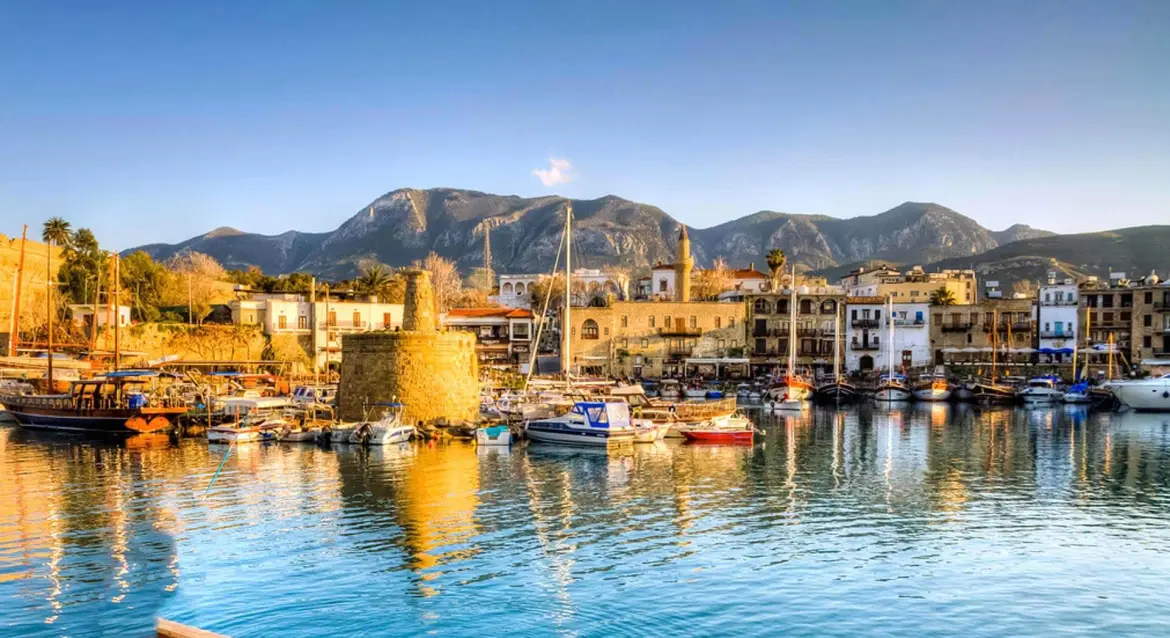
Unlike Southern Cyprus, this inventory is genuinely spread out — twelve towns, with no single place holding more than five projects.
İskele — 5 projects. The east coast, and the busiest development corridor in the north by some distance. Long sandy beaches, heavy new-build activity, and the widest choice here: from Sea Breeze at £80,000 to Grande Palazzo at £220,000.
Esentepe — 3 projects. North coast east of Kyrenia, below the mountains, golf-adjacent and quieter. Holds both Grand Crystal Resort at £114,900 and ESVillas at £1,044,000 — the widest internal range of any town on the list.
Famagusta — 3 projects. A walled medieval city with a university population, which gives it something most of this list lacks: year-round rental demand that is not tourism.
Tatlısu — 3 projects. Quiet north coast, low density, sea and mountain between them. Includes the dearest-per-m² project on the list.
Ötüken — 3 projects. Elysium, Elysium 2 and Infinity, £160,000–£180,000, all clustered at a similar level.
Nine more towns with one or two each — Yeni Boğaziçi, Alsancak, Bafra, Çatalköy, Geçitkale, Kalecik and Tuzla. Bafra is the resort strip on the Karpaz side; Çatalköy and Alsancak sit either side of Kyrenia and carry the north’s most established expatriate communities.
What it costs to buy
| Item | What to plan for |
|---|---|
| VAT (KDV) | Typically 5% of the purchase price |
| Stamp duty | Around 0.5%, payable when the contract is registered — do not let this slide |
| Title transfer fee | Commonly 6%, with a reduced once-in-a-lifetime rate for a first purchase |
| Permission to Purchase | Application fee plus the wait; budget many months |
| Legal fees | Modest in absolute terms, and the last place to economise in this market |
| Communal charges | Monthly; resort-style schemes with pools and grounds cost more to run |
| Currency | Sterling pricing — a live exchange exposure if you earn in euros or dollars |
Rates and thresholds do change, so treat these as planning figures and have them confirmed for your specific purchase. The sterling point is worth dwelling on: every one of these 25 listings is priced in pounds, so a euro-earning buyer carries currency risk here that they would not carry in the south.
Risks specific to this market
Title category. Covered above, and it is the one that can cost you the asset rather than a percentage of it.
Resale liquidity. The buyer pool is narrower than in the south, and largely British, Turkish and Russian. Exit can be slower.
Financing and insurance. International mortgages are hard to obtain; developer payment plans do much of the work. Insurance and banking options are correspondingly limited.
Off-plan delivery. Six of the priced projects complete in 2026 and one in 2027. Off-plan anywhere carries delivery risk; where the legal recourse is less tested, it carries more.
Currency. Sterling pricing, local costs in Turkish lira, and rental income likely in a third currency.
Gaps in the data on these listings
Five of the twenty-five carry no price at all — Emere Villas (Tuzla and Yeni Boğaziçi), Arslan Villas, K-Villas Archipelago and Urban Oasis are all “price on request”. That is a fifth of the inventory you cannot compare, and we will quote them on request.
Ten of the twenty-five record no completion year, so ready and off-plan cannot be told apart from the listing alone — which matters more here than elsewhere, because off-plan is exactly where the legal protections get tested.
Prices are also recorded inconsistently — some as plain numbers, others as “111 000 £” or “170000 £” — which is cosmetic, but it is why you may see them sort oddly in filters.
Frequently asked questions
What is the cheapest property in Northern Cyprus?
Olea Grand in Geçitkale at £62,000, which is also the best value per square metre on the list at about £1,240/m².
Is it safe to buy in Northern Cyprus?
It depends almost entirely on the title category and the quality of your legal work. Turkish and Foreign title carry little claim risk; TRNC title carries real risk. Use an independent lawyer, confirm the category in writing, and register the contract at the Land Registry.
Can foreigners own property there?
Yes, subject to Permission to Purchase from the Council of Ministers, which takes months. You can normally take possession while it is pending.
Why is it so much cheaper than the south?
Lower development costs and lower demand, but also a risk premium for the unrecognised status and the title question. Both things are true at once.
Can I get EU residency or a passport this way?
No. Northern Cyprus is outside the EU. Ownership supports a renewable residence permit in the north only. For an EU route see Southern Cyprus; for a passport route, Türkiye.
What currency will I pay in?
Sterling — all 25 listings are priced in pounds, unlike the euro-priced south.
Are these ready or off-plan?
A mix, and ten listings do not say. Completion years on the rest run 2023 to 2027. Ask before you commit.
The verdict on Northern Cyprus
This is the value end of our range, and honestly so: £62,000 buys an apartment on a Mediterranean island, and nothing else on this site comes close. The coastline is genuinely beautiful, the towns are spread rather than crammed into one district, and the price per square metre barely varies from place to place, so you are not paying a heavy premium for the fashionable address.
The counterweight is legal, not aesthetic. Title category determines whether you own something durable or something contestable, the Permission to Purchase process is slow, and the exit is narrower than in the south. None of that makes it a bad purchase — it makes it a purchase where the lawyer matters more than the view.
Tell us your budget and whether you are buying to use, to let, or to hold, and we will come back with the title category for each option before we talk about anything else.
Related searches
By town: İskele, Esentepe, Famagusta, Tatlısu, Bafra, Çatalköy. Compare: Southern Cyprus, Türkiye, Georgia, Oman.
