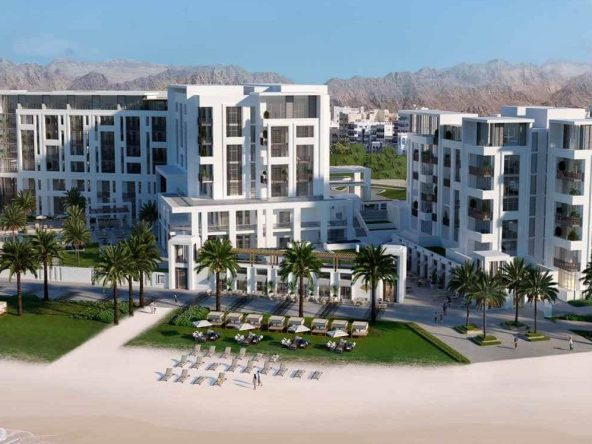





























Service charges in Oman real estate are the recurring cost most foreign buyers forget to model. Most run the same mental math when evaluating a purchase: purchase price, expected rent, divide one by the other, arrive at a yield, decide whether the number is good enough. It is a reasonable starting point, and it is also incomplete in a way that quietly erodes returns for investors who never correct for it. Every freehold unit inside an Omani Integrated Tourism Complex (ITC) carries a recurring cost that sits outside that simple equation: the service charge, paid to the owners association that maintains the community the property sits in. Get the purchase price and the rent right but ignore the service charge, and the yield you modeled on a spreadsheet will not be the yield that shows up in your bank account. This guide explains exactly what Oman service charges are, how they are set, what drives the difference between a modest apartment block and a marina-front villa community, and — most usefully — how to vet a specific development’s charges before you commit capital to it.
What Are Service Charges in Oman Real Estate?
A service charge — sometimes called a community fee or maintenance fee — is an annual payment made by every unit owner in a freehold development to fund the upkeep of everything outside the four walls of their own unit. It covers the shared infrastructure and amenities that make a master-planned community function: landscaping, security, waste collection, common-area cleaning, lift maintenance, shared utilities in communal spaces, and the marinas, pools, gyms and beach clubs that Oman’s freehold ITCs are typically built around. Owners do not pay this fee to the government and it is not a form of property tax — Oman levies no annual property tax at all. The service charge instead goes to the owners association (OA) or, in the early years of a development, to the master developer acting in that capacity, and it exists purely to keep the physical asset — both the individual building and the wider community around it — in the condition that justifies its price and its rental value.
This distinction matters because investors comparing Oman to markets with an annual property tax sometimes assume Oman’s total cost of ownership is dramatically lower across the board. It is lower — there is no government levy repeating every year — but the service charge is a real, recurring, and in some developments substantial cost that has to be underwritten by the rent or absorbed by the owner. Treating Oman as a “no ongoing cost” market is the single most common miscalculation foreign buyers make before they own a unit there.
How Service Charges Are Set: The Owners Association System
Oman’s freehold foreign-ownership structure runs through Integrated Tourism Complexes, established under Royal Decree 12/2006 and its amendments, with the underlying property registry maintained by the Ministry of Housing and Urban Planning, which allow non-Omanis to hold freehold or usufruct title inside designated zones such as Al Mouj Muscat, Hawana Salalah and Jebel Sifah. Each ITC is required to operate under a strata-style ownership regime once units are handed over, meaning shared spaces — roads, landscaping, marinas, beach frontage, clubhouses — become common property managed on behalf of all owners collectively, rather than remaining the developer’s to run indefinitely at its own discretion.
In practice, this works in two phases. In the years immediately after handover, the master developer typically continues to manage the community directly, setting and collecting service charges, contracting facilities-management companies, and running the annual budget. Over time — and this varies significantly by project, with some ITCs further along than others — an owners association is formally constituted, giving unit owners a board, voting rights on major decisions, and formal sight of the annual budget before it is approved. Buyers evaluating an older, more established ITC such as Al Mouj should expect a more mature, more transparent OA structure than buyers looking at a newly launched community still entirely under developer control. Neither structure is wrong, but they carry different levels of owner influence over how fees are spent, and that is worth understanding before you buy rather than after your first invoice arrives.
Service charges in Oman are calculated per square metre of a unit’s built-up area (sometimes gross floor area, sometimes net internal area depending on the development’s bylaws) and billed annually, though many OAs and developers now offer quarterly or semi-annual instalment options for owners who prefer to spread the cost. The rate is reviewed and typically re-approved each year as part of the annual budget cycle, based on the community’s actual and projected operating costs.
What Oman Service Charges Typically Cover
While the exact scope varies by development and is defined in each community’s bylaws, most Oman ITC service charges are budgeted to cover:
- Common area maintenance — cleaning, repairs and upkeep of lobbies, corridors, stairwells, lifts and shared building systems
- Landscaping and irrigation — a genuinely significant line item in Oman’s climate, where green common areas require constant irrigation infrastructure and gardening staff
- Security — gatehouse staffing, CCTV, access control and community patrols
- Waste management — collection and disposal across the community
- Shared amenities — pools, gyms, tennis and padel courts, community centres, and in marina communities, the marina infrastructure itself
- Shared utilities — electricity and water consumed by common areas, external lighting, irrigation systems and amenity buildings
- Facilities management fees — the professional management company contracted to run day-to-day operations
- Insurance — buildings insurance on shared structures and common-area liability cover
- Reserve fund contributions — a portion set aside for major long-term capital repairs, covered in more detail below
What’s Not Included — and Billed Separately
Service charges do not cover costs that are specific to an individual unit rather than the shared community. Owners should budget separately for:
- Individual electricity and water consumption — metered per unit and billed directly by Oman’s national utility providers, not bundled into the service charge
- Internal unit maintenance — anything inside your own walls, from air conditioning servicing to appliance repairs, is the owner’s responsibility
- Internet, cable and telecoms — contracted individually by each owner or tenant
- Municipal fees on rental income, where applicable, and any property management commission if you use a rental agent rather than self-managing
- Unit-specific insurance — contents and any owner-elected additional cover beyond the building’s structural policy
A buyer running yield projections should treat these as a separate line item from the service charge itself, since they scale with how the unit is used and furnished rather than with the wider community’s operating costs.
Typical Service Charge Ranges Across Oman’s Major ITCs
Actual service charges in Oman real estate vary widely by community and amenity level. Published, audited service-charge data is not centrally available the way it is in more mature markets, and rates genuinely differ between developments, unit types and even buildings within the same community — so treat the figures below as indicative ranges to sense-check against, not quoted prices. Always request the current, specific rate for the exact unit you are considering directly from the developer or OA before finalising a purchase.
| Community Type | Example Communities | Indicative Annual Range |
|---|---|---|
| Standalone apartment blocks, limited amenities | Smaller ITC apartment buildings | OMR 8 – 15 per sqm |
| Full-amenity waterfront apartments | Al Mouj Muscat, The Wave-style marina districts | OMR 12 – 22 per sqm |
| Marina & golf villa communities | Jebel Sifah, Muscat Bay | OMR 10 – 20 per sqm |
| Beach resort-integrated communities | Hawana Salalah | OMR 10 – 18 per sqm |
As a rough illustration: a 120 sqm apartment in a full-amenity waterfront community charging OMR 16 per sqm would carry an annual service charge in the region of OMR 1,920 — a figure that needs to be underwritten by rental income if the unit is bought as an investment, and that should be weighed against the amenity level, finish quality and rental demand the community actually delivers in return.
What Drives the Difference Between Developments
Several factors explain why one Oman community charges meaningfully more than another:
Amenity density. A marina with berths to dredge and maintain, a golf course requiring daily irrigation and greenkeeping, or a private beach club all cost real money to run — and that cost is shared across the owners who benefit from it. A simple apartment block with a small pool and gym will always be cheaper to maintain per square metre than a resort-style master community.
Building age. Newer buildings generally carry lower maintenance costs and smaller reserve-fund contributions in their first years, since major systems are all under warranty and nothing yet needs structural attention. As a building ages, reserve contributions typically rise to fund the roof replacements, façade work and mechanical system overhauls that become necessary a decade or more after handover.
Occupancy and unit density. A community with a high proportion of vacant or unsold units spreads fixed operating costs — security, landscaping, management overhead — across fewer paying owners, which can push individual charges higher until the community reaches a more mature occupancy level. This is a genuine consideration for buyers looking at very newly launched ITCs, where charges may run higher in year one or two than they will once the community fills out.
Facilities-management efficiency. The quality and cost-discipline of the contracted management company varies, and an owners association actively scrutinising its FM contract will generally deliver better value than one that has never gone to competitive tender.
The Sinking Fund: Why It Matters More Than the Headline Rate
Buried inside most Oman service-charge budgets is a reserve fund — sometimes called a sinking fund — a portion of the annual charge set aside specifically for major, infrequent capital expenditure rather than day-to-day upkeep: repainting building exteriors, replacing lift machinery, resurfacing roads, or refurbishing a pool a decade or more into a building’s life. It is, functionally, a savings account for the community’s own eventual big repair bills, funded gradually by owners over many years instead of being sprung on them as a single large special assessment when the roof finally needs replacing.
This is worth scrutinising specifically because it is the part of a service charge most likely to hide a future problem. A community charging a low headline rate because its reserve fund is thin or nonexistent is not actually cheaper to own — it is deferring a cost that will eventually land on owners as a lump-sum special levy, often at the worst possible moment, when a major system fails and there is no reserve to draw on. A well-run OA can usually produce a reserve-fund study or at minimum a stated contribution policy; a development that cannot is one worth asking harder questions about before buying, particularly if the building is already several years old.
How Service Charges Affect Your Net Rental Yield
Oman’s headline rental yields are typically quoted gross — annual rent divided by purchase price, before any costs are deducted. Service charges are one of the largest deductions between that gross figure and what an investor actually nets. Consider a simplified example: a 100 sqm apartment purchased for OMR 90,000, rented for OMR 6,300 per year, produces a clean 7% gross yield. If that community charges OMR 15 per sqm annually, the owner pays OMR 1,500 in service charges before accounting for anything else — bringing net rent to OMR 4,800 and the net yield down to roughly 5.3%, before even factoring in vacancy periods, property management commission, or maintenance reserves for the unit’s own interior.
None of this means service charges make Oman a poor investment — the gap between gross and net yield exists in essentially every mature real estate market in the world, and Oman’s overall cost base remains competitive against comparable Gulf and Mediterranean freehold markets. It does mean that any yield figure quoted without a service-charge deduction is, at best, incomplete, and serious investors should always ask for the specific unit’s service-charge rate before finalising a yield calculation — not estimate it after the fact.
How to Vet Service Charges Before You Buy
A disciplined buyer can largely de-risk this side of an Oman purchase with a short, specific set of questions to the developer or owners association before signing:
- Request the last two to three years of actual service-charge budgets and year-end accounts, not just the current year’s projected figure — this shows whether charges have been rising sharply, staying flat, or tracking the OA’s actual spending accurately.
- Ask specifically about the reserve/sinking fund — how much is currently held, what percentage of the annual charge feeds it, and whether a formal reserve-fund study has ever been conducted.
- Check for arrears among other owners. A community with a high proportion of unpaid service charges from other unit owners is a red flag — it typically means the OA is underfunded relative to its budget, regardless of what the headline rate suggests, and remaining owners may eventually be asked to cover the shortfall.
- Ask about any planned special assessments — a one-off additional charge levied outside the normal annual fee, usually to fund an unplanned major repair the reserve fund could not cover.
- Compare the rate against similar unit types in the same community, not just the community average, since ground-floor units, penthouses and villas often carry different rates reflecting different maintenance burdens.
- Understand who currently controls the budget — the master developer or a constituted, owner-elected OA board — and, if it is still developer-controlled, ask when transition to an owners association is planned.
An experienced local agent can request and interpret this documentation directly with the developer’s sales team, which is one of the more concrete, practical reasons foreign buyers work with a broker on the ground rather than negotiating a purchase purely by email from overseas.
What Happens If You Don’t Pay
Service charges are a contractual obligation tied to ownership, set out in each ITC’s bylaws and, ultimately, in Oman’s strata and property legislation. Non-payment typically results in the same consequences seen across other Gulf freehold markets: late fees accruing on the outstanding balance, restrictions placed on the unit’s ability to be resold or have its title transferred until arrears are cleared, and in persistent cases, legal action by the owners association to recover the debt. For buy-to-let investors, this is a direct argument for keeping service charges current even during vacant periods between tenants — an accumulating arrears balance becomes a real liability the moment you try to sell or refinance the unit, not just an inconvenience in the meantime.
Service Charges in Oman vs Dubai
Investors weighing Oman against Dubai often assume the two markets’ ongoing costs are broadly similar, since both run on comparable strata/OA structures inherited from the same regional freehold model. In practice, Oman’s service charges generally sit at the lower end of comparable Dubai rates for equivalent amenity levels, reflecting Oman’s lower overall cost base for labour, utilities and facilities management. Dubai’s market is also considerably more mature, with a longer track record of published, audited service-charge data (via RERA’s index) that Oman’s newer OA system has not yet built up at the same scale — meaning Oman buyers currently rely more on direct developer and OA disclosure, and less on standardised public benchmarking, when vetting a specific community’s charges.
How and When Service Charges Are Actually Paid
Most Oman ITCs invoice service charges annually in advance, calculated against the coming year’s approved budget, though the exact billing cadence is set out in each community’s bylaws and enforced by whichever entity — developer or OA — currently manages the community. Many developments now offer owners the option to split the annual invoice into quarterly or semi-annual instalments rather than a single lump sum, which is worth asking about directly if cash-flow timing matters to your investment plan, particularly for overseas buyers managing several properties across different markets and billing cycles simultaneously.
New buyers should also confirm how the first year’s charge is handled at handover. It is common for a portion of the first year’s service charge to be collected at the point of title transfer, effectively pre-funding the community’s early operating costs before enough units have changed hands to generate a full year of billing. This is a normal part of the ITC handover process rather than a hidden fee, but it is worth budgeting for as part of your total completion costs alongside the transfer fee itself, rather than treating it as a surprise on top of the purchase price.
Buyers using a property management company to handle a rental unit on their behalf should also clarify whether that company handles service-charge payment as part of its management fee or whether the owner remains directly responsible for paying the OA. Both arrangements are common in Oman’s market, and getting this wrong is one of the more avoidable ways an overseas owner ends up with an unexpected arrears notice on a unit they assumed was being fully managed.
Frequently Asked Questions
Are service charges the same as property tax in Oman?
No. Oman has no annual government property tax. Service charges are a private payment to your community’s owners association, covering shared maintenance and amenities — not a government levy.
Can service charges increase after I buy?
Yes. Rates are typically reviewed annually as part of the OA’s budget cycle and can rise if operating costs increase, amenities are added, or the reserve fund needs topping up. Reviewing several years of historical rates before buying gives a sense of how stable a given community’s charges have been.
Do all Oman properties have service charges?
Any unit inside a freehold ITC with shared amenities or common areas will carry a service charge. Ownership structures without shared community infrastructure are rare among the freehold products marketed to foreign buyers, since most sit inside master-planned ITCs by design.
Who sets the service charge before an owners association is formed?
The master developer typically manages the community and sets charges directly in the early years after handover, transitioning control to an elected owners association as the community matures — the timeline varies by development.
Should I avoid a development with high service charges?
Not automatically. A higher charge funding genuine amenities, strong security and a healthy reserve fund can support higher rents and stronger resale value. The more useful question is whether the charge is proportionate to what it delivers and whether it has been rising unpredictably.
Can I negotiate my service charge?
Individual owners cannot negotiate their own rate, since it is set uniformly per square metre across comparable units. Owners can, through the OA board, influence the annual budget and vote on major spending decisions once the association is formally constituted.
Get in Touch
Understanding service charges in Oman real estate is a core part of understanding the true, all-in cost of owning property in Oman — purchase price, transfer fees, service charges and realistic net yield — is the difference between a return that looks good on a broker’s brochure and one that actually shows up in your account. Contact UInvest for current service-charge data on specific developments across Oman’s freehold ITCs, and to compare all-in ownership costs against opportunities elsewhere in our Oman portfolio.