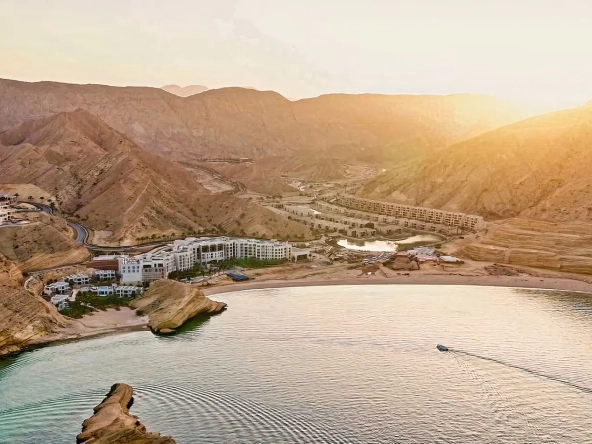





























Twenty minutes east of Salalah city, on Oman’s southern coast, a resort masterplan spanning 13.6 million square metres has grown into one of the country’s most distinctive freehold destinations for years to come. Hawana Salalah is not built for Muscat’s business crowd — it is built around Dhofar’s Khareef monsoon season, a marina, an aquapark, and 7 kilometres of sandy beach that put it in a different climate and buyer category from every other Integrated Tourism Complex (ITC) in Oman. This guide covers what Hawana Salalah actually offers, its newest phase Amazi, and how residency and returns work for foreign buyers.
What Is Hawana Salalah?
Hawana Salalah is a beachfront resort ITC on Oman’s southern coast , about 20 minutes from Salalah city centre and roughly the same distance from Salalah International Airport, in Dhofar Governorate. It was master-developed by Muriya, the same state-linked developer behind Jebel Sifah near Muscat, and combines residential neighbourhoods with a marina, hotels, and full resort infrastructure along the coastline.
| Feature | Detail |
|---|---|
| Location | Southern coast near Salalah city, Dhofar Governorate |
| Drive time | About 20 minutes from Salalah city and the airport |
| Beach frontage | 7 kilometres |
| Marina | 170 berths |
| Peak season | Khareef monsoon, late June to early September |
| Ownership | Full freehold, open to all nationalities |
What sets Hawana Salalah apart from Oman’s Muscat-area developments is climate. Every June to September, Dhofar catches the Khareef monsoon, turning the mountains and coastline green in a way the rest of the Gulf simply does not experience, and drawing large numbers of Gulf tourists to Salalah for a season the rest of the Arabian Peninsula does not get. That seasonal draw is central to why Hawana Salalah exists as a resort destination in its own right, not just a satellite of Muscat’s freehold market.
Life At Hawana Salalah: Amenities And Lifestyle
- 170-berth marina
- 65,760 square-metre Hawana Aquapark
- 4- and 5-star hotels with roughly 1,100 rooms combined
- 7 kilometres of sandy beach frontage
- Diving and water sports facilities
- Restaurants, cafes, and retail along the marina promenade
Where To Buy: Developments In Hawana Salalah
Amazi
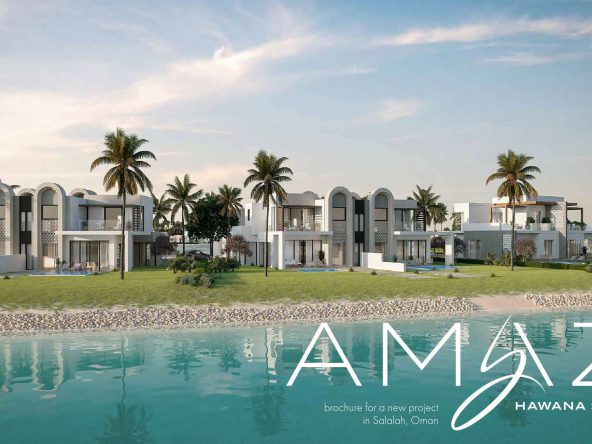
Amazi is Hawana Salalah’s newest masterplan phase: 13.6 million square metres of land, of which 3.2 million square metres are already developed, with 7 residential projects planned across the site and roughly 750 units already built. Unit types across Amazi range from one- and two-bedroom chalets to two-, three-, and four-bedroom villas, with a standard 10% down payment and instalment plans available.
Lubana Island
Lubana Island is Amazi’s flagship waterfront phase: freehold apartments and townhouses built around the community’s lagoon, with one-bedroom units from OMR 99,000, two-bedroom units from OMR 136,000, and three-bedroom units from OMR 233,000. Its completion date is disputed: the sales sheet describes units as move-in ready, while the developer brochure gives 2029, so get the contractual handover date in writing before paying a deposit. Payment starts with 10% on booking. See our current Lubana Island listing for availability.
| Development | Unit types | Entry price | Handover |
|---|---|---|---|
| Lubana Island | 1–3 bedroom apartments and townhouses | From OMR 99,000 | Disputed (brochure: 2029) |
| Amazi masterplan | 1–2 bedroom chalets, 2–4 bedroom villas | Varies by unit | Phased |
Investing In Hawana Salalah: Residency And Returns
Foreign buyers can own property at Hawana Salalah on a full freehold basis, with zero annual property tax anywhere in Oman. A qualifying purchase of OMR 200,000 or more can secure a renewable 10-year residency for you and your family through Oman’s official Invest Oman platform — the same Golden Residency programme covered in our guide to buying property in Oman.
Hawana Salalah’s Khareef season creates a rental pattern unlike anywhere else in the Gulf: peak demand runs June through September, when Gulf tourists fill Salalah’s hotels and short-term rentals to escape the summer heat elsewhere in the region. UInvest Group offers furnishing and property management for owners who want to capture that seasonal income. For a broader look at what your budget can buy across the country, see our guide to what you can buy in Oman for $200,000, $400,000, and $600,000 in 2026.
Hawana Salalah Vs Oman’s Muscat-Area Developments
Hawana Salalah competes on climate and lifestyle rather than proximity to Muscat’s business district. Buyers targeting Al Mouj or Jebel Sifah are typically looking at a primary residence, a Muscat rental, or day-to-day proximity to the capital; buyers looking at Hawana Salalah are usually drawn by Khareef-season tourism, beach lifestyle, and Salalah’s lower entry prices for freehold apartments. Many of our clients hold a Muscat-area property alongside a Salalah unit specifically to capture both markets.
Understanding The Khareef Season
The Khareef monsoon is the single most important thing to understand about investing in Hawana Salalah, since it drives the market’s entire demand pattern in a way no other Omani ITC experiences. From roughly late June through early September, seasonal winds bring persistent cloud cover and drizzle to the Dhofar mountains and coastline, transforming a normally arid landscape into lush, waterfall-fed greenery found nowhere else on the Arabian Peninsula. This is precisely when neighbouring Gulf countries experience their hottest, driest months, making Salalah a uniquely cool, green escape that draws large numbers of Saudi, Emirati, and other Gulf tourists specifically for the Khareef window. Hotel occupancy, retail footfall, and short-term rental demand across Hawana Salalah spike accordingly during these months, before returning to a quieter, more typical resort pattern for the remainder of the year. Investors should think of the Khareef season less as a bonus and more as the core demand driver the entire Hawana Salalah investment thesis is built around.
Salalah City: Context Beyond The Resort
Hawana Salalah sits within easy reach of Salalah city itself, Oman’s second-largest urban centre and the capital of Dhofar Governorate. Beyond the resort’s own marina and aquapark, residents and visitors have access to Salalah’s souqs, frankincense heritage sites, Al Husn Palace, and a growing hospitality and retail scene supported by Salalah International Airport’s direct connections to Muscat and several Gulf hubs. This broader city context matters for investors: Hawana Salalah is not an isolated resort compound but part of a functioning regional capital with its own economy, healthcare, and infrastructure independent of the tourism season, which supports a base level of demand even outside the Khareef peak.
Amazi And Lubana Island: Pricing And Unit Detail
Within Amazi’s broader 13.6-million-square-metre masterplan, Lubana Island stands out as the flagship waterfront phase, built around the community’s lagoon with a mix of freehold apartments and townhouses. Current indicative pricing runs from OMR 99,000 for one-bedroom units, OMR 136,000 for two-bedroom units, up to OMR 233,000 for three-bedroom units, with a disputed completion date (the developer brochure says 2029) and a payment plan of 10% on booking followed by 7.5% every quarter. Across the wider Amazi masterplan, unit types range from one- and two-bedroom chalets through to two-, three-, and four-bedroom villas, spread across the 7 planned residential projects within the site’s 3.2 million square metres of developed land. This range gives buyers meaningfully more choice than a single-product development, from compact rental-focused apartments through to larger family villas.
Rental Yield And Seasonal Income At Hawana Salalah
Rental economics at Hawana Salalah follow the Khareef pattern closely. Gross yields blended across the full year commonly fall in the 6–9% range, but this average masks a sharp seasonal skew: owners who actively manage short-term bookings during the June–September peak can capture nightly and weekly rates well above what an equivalent long-term lease would generate, while occupancy and achievable rates outside the season are comparatively modest. This makes Hawana Salalah a fundamentally different rental proposition from Muscat’s steadier, less seasonal communities like Al Mouj — investors here are generally better served by an active short-term management strategy during Khareef, paired with either long-term letting or accepting lower occupancy the rest of the year, rather than treating the property as a passive, evenly-distributed income source. UInvest Group’s furnishing and property management service is specifically built around this seasonal pattern, handling turnover and marketing through the peak window on behalf of overseas owners. Note that short-term letting in Oman requires a tourism licence under Royal Decree 69/2023, individually owned properties were the last group included in the licensing rollout, and ITC community rules can restrict it, so confirm both before counting on Khareef income — see our guide on whether you can Airbnb property in Oman.
| Period | Demand pattern | Best strategy |
|---|---|---|
| June–September (Khareef) | Peak Gulf tourist demand | Active short-term letting |
| October–May | Quieter, resort pace | Long-term letting or lower occupancy |
How To Buy Property In Hawana Salalah
The purchase process follows Oman’s standard ITC framework: shortlist a unit within Amazi or Lubana Island, confirm current pricing and payment plan with the developer or your broker, sign a reservation agreement followed by a Sale and Purchase Agreement setting out the 10% down payment and instalment schedule through to handover, and register title with the Ministry of Housing and Urban Planning land registry on completion. Buyers targeting the Golden Residency should confirm their chosen unit clears the OMR 200,000 threshold, since not every Amazi unit type reaches this level individually — smaller chalets and one-bedroom units may need to be combined with additional investment or upgraded to a larger unit to qualify.
Comparing Hawana Salalah To Other Seasonal Resort Markets
Investors familiar with other seasonal resort real estate markets — ski destinations in Europe, or summer-season Mediterranean coastal towns — will recognise Hawana Salalah’s basic pattern: a defined peak season driving the majority of rental income, with a quieter shoulder period the rest of the year. What differentiates Hawana Salalah is the combination of that seasonal upside with Oman’s broader tax and residency advantages — no annual property tax, no capital gains tax, and a Golden Residency pathway that applies equally whether a property is in Muscat or Salalah. Few seasonal resort markets globally pair a strong tourism season with this level of tax efficiency and a genuine long-term residency incentive for foreign buyers.
Property Management For Overseas Owners
Given how many Hawana Salalah buyers live outside Oman, property management is a central part of ownership there rather than an afterthought. Owners not living locally typically rely on a dedicated management service to handle Khareef-season turnover, guest communication, cleaning, and maintenance between bookings, since the concentrated peak season demands considerably more operational intensity than a steady year-round tenancy would. UInvest Group’s furnishing and management service is built specifically around this pattern, covering everything from initial unit setup through to marketing the property for the Khareef window and handling bookings on the owner’s behalf, so buyers who never plan to visit personally can still capture the seasonal income opportunity.
Furnishing For The Salalah Rental Market
Furnishing standards matter more in Hawana Salalah’s short-term rental market than in Muscat’s steadier long-term tenant pool, since Khareef-season guests are booking a holiday experience and compare listings accordingly. Units targeting this market generally benefit from a resort-standard furnishing package, including durable, easy-to-clean finishes given the high turnover during peak season, and amenities that photograph well for short-term rental listings. Owners should budget furnishing costs as part of their initial investment rather than an optional add-on if short-term Khareef rental income is central to the investment plan.
Hawana Salalah’s Broader Growth Trajectory
Beyond the Khareef season itself, Hawana Salalah and the wider Amazi masterplan represent a long-term bet on Dhofar’s growth as a tourism and logistics region. Population and tourism data for Dhofar published by the National Centre for Statistics and Information show Salalah’s port and free zone continuing to develop as an economic anchor independent of tourism, and Oman’s broader tourism strategy has increasingly promoted Dhofar as a distinct destination alongside Muscat, rather than treating southern Oman as an afterthought. As Amazi’s remaining 7 residential projects deliver over time and the masterplan’s infrastructure matures, early buyers are positioned similarly to early Al Mouj or Jebel Sifah buyers — accepting near-term construction and delivery timeline risk in exchange for potential appreciation as the community fills in and infrastructure comes fully online.
Who Should Consider Buying In Hawana Salalah?
Hawana Salalah suits a specific investor profile better than others. Buyers specifically seeking Khareef-season rental income, drawn by the seasonal tourism opportunity unique to Dhofar, are the clearest fit. Golden Residency seekers who want geographic diversification within Oman — holding a Salalah asset alongside or instead of a Muscat property — are a second common profile. Lifestyle buyers drawn to Salalah’s marina, beach, and cooler Khareef climate, who want a genuine change of scenery from Muscat’s more corporate freehold communities, represent a third. Investors purely optimising for the steadiest, least seasonal rental income, by contrast, will generally find Muscat-area communities like Al Mouj a better fit than Hawana Salalah’s more concentrated seasonal pattern. Our advisors can help match your specific goals to the right unit type and phase within the masterplan.
How Does Hawana Salalah’s Freehold Status Compare To Muscat’s ITCs?
Hawana Salalah carries the same Integrated Tourism Complex freehold status as Al Mouj, Jebel Sifah, and Oman’s other major ITCs, meaning foreign buyers of any nationality can hold full title with the same Golden Residency eligibility at the OMR 200,000 threshold. The distinction between Hawana Salalah and Muscat’s developments is entirely about location, climate, and rental demand pattern, not ownership structure or legal rights.
Does Hawana Salalah Have Schools And Healthcare Nearby?
Salalah city, roughly 20 minutes from Hawana Salalah, offers established schools and healthcare facilities serving the wider Dhofar Governorate, though the selection is smaller than Muscat’s. Buyers relocating full-time with families should evaluate Salalah’s specific school and healthcare options against their needs before committing, since the city’s infrastructure, while functional, is more modest in scale than the capital’s.
Comparing Amazi With Other Salalah-Area Freehold Options
While Amazi and Lubana Island represent the primary freehold offering within Hawana Salalah itself, Salalah’s broader real estate market includes other tourism and residential developments at varying stages of maturity. Amazi’s advantage over smaller, standalone Salalah projects is scale and backing — a 13.6-million-square-metre masterplan developed by Muriya, the same group behind Jebel Sifah, with the marina, aquapark, and hotel infrastructure already partially delivered rather than promised for a distant future phase. This distinction between marketing promise and delivered infrastructure is one of the most important due-diligence checks for any Salalah-area purchase. Buyers evaluating Salalah options should weigh a smaller project’s potentially lower entry price against Amazi’s stronger infrastructure backing and clearer path to Golden Residency-qualifying inventory at Lubana Island.
Can I Visit Hawana Salalah Before Buying?
Yes, and an in-person visit is generally recommended, particularly to experience the property and marina firsthand outside of marketing material. Many buyers time their visit to coincide with or just after the Khareef season to see the community at its most active, though the resort and marina infrastructure operate year-round.
Are There Direct Flights To Salalah From International Destinations?
Salalah International Airport offers domestic connections to Muscat along with a growing number of direct regional and seasonal international routes, particularly during the Khareef season when tourism demand peaks. Lending and currency conditions for foreign buyers are set by the Central Bank of Oman. Buyers should confirm current route availability from their home country, as international connectivity continues to expand alongside the broader development of Dhofar’s tourism sector.
What Are The Total Closing Costs For A Hawana Salalah Purchase?
Closing costs follow the same structure as elsewhere in Oman: a 3% government transfer fee for foreign buyers, plus agency commission and legal or admin costs, typically totalling roughly 5–6% on top of the purchase price. New-build units, including much of Amazi’s current inventory, may also carry 5% VAT on the developer’s first sale — see our full property tax in Oman guide for a complete breakdown and worked examples.
How Does Hawana Salalah’s Marina Compare To Al Mouj’s?
Al Mouj’s 400-berth marina is larger and more established, having operated for over a decade, while Hawana Salalah’s 170-berth marina is smaller but purpose-built around the same Khareef-season tourism draw that defines the whole development. We recommend requesting the latest infrastructure delivery status directly from the developer before reserving any unit still in an early construction phase. Buyers prioritising yacht and marina lifestyle at the largest possible scale generally lean toward Al Mouj, while those specifically drawn to Salalah’s climate and seasonal tourism opportunity choose Hawana Salalah regardless of marina size.
Can I Combine A Muscat And A Salalah Property For Golden Residency?
Golden Residency qualification is generally based on meeting the OMR 200,000 threshold through a single qualifying purchase, though buyers considering a combined strategy across two properties in different cities should confirm the specific qualifying-investment rules with the Invest Oman platform or their broker, since programme requirements can be precise about what counts toward the threshold.
What Is The Typical Buyer Profile For Amazi And Lubana Island?
Buyers at Amazi and Lubana Island split fairly evenly between three profiles: Gulf-based buyers seeking a Khareef-season holiday home close to their own region, international investors targeting Golden Residency with a lower entry price than comparable Muscat inventory, and yield-focused investors specifically building a short-term rental portfolio around the seasonal tourism opportunity unique to Dhofar.
Frequently Asked Questions
Where Is Hawana Salalah Located?
Hawana Salalah is a beachfront resort community on Oman’s southern coast, about 20 minutes from Salalah city centre and Salalah International Airport, in Dhofar Governorate.
Can Foreigners Buy Property In Hawana Salalah?
Yes. Properties across Hawana Salalah, including the Amazi and Lubana Island developments, are sold on a full freehold basis open to all nationalities.
Does Buying In Hawana Salalah Qualify For Oman Residency?
Yes. A qualifying purchase of OMR 200,000 or more can secure a renewable 10-year residency under Oman’s Golden Residency programme, applied for through the official Invest Oman platform.
What Is Amazi?
Amazi is Hawana Salalah’s newest masterplan phase, spanning 13.6 million square metres with 7 planned residential projects, including the waterfront Lubana Island development.
Is Hawana Salalah A Good Rental Investment?
Hawana Salalah’s Khareef monsoon season, which runs June to September, drives strong seasonal holiday-rental demand from Gulf tourists, and UInvest Group offers furnishing and property management for owners seeking rental income.
When Exactly Is The Khareef Season In Salalah?
The Khareef monsoon typically runs from late June through early September, though exact start and end dates vary slightly year to year depending on weather patterns. This window is when Hawana Salalah sees its strongest tourism and short-term rental demand.
Is Hawana Salalah Only Worth Owning For Khareef-Season Rental Income?
No. While Khareef drives the strongest rental spike, Hawana Salalah also functions as a year-round freehold asset with Golden Residency eligibility, marina and beach lifestyle amenities usable outside the monsoon season, and exposure to Salalah’s broader growth as a regional tourism and logistics hub.
What Is The Handover Timeline For Lubana Island?
Lubana Island’s completion date is disputed: the sales sheet describes units as move-in ready, while the developer brochure gives 2029. It is sold with 10% on booking and quarterly instalments of 7.5% through to completion. Buyers should confirm the current payment schedule and any updates to the timeline directly with the developer or their broker before reserving a unit.
Ready To Invest In Hawana Salalah?
Hawana Salalah pairs a resort lifestyle found nowhere else in Oman with the same freehold ownership and 10-year Golden Residency available across the country. Explore our current Lubana Island listing, or get in touch with our team for a personalised recommendation based on your budget.