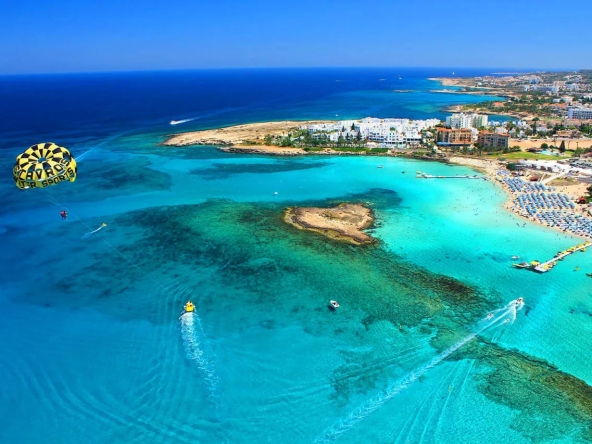

Cyprus tourism swung from a record-breaking 2025 into a sharp 2026 reversal driven almost entirely by regional geopolitics, then began stabilising through the summer. This guide covers the latest arrivals and revenue data, what caused the downturn, and what the swing means for anyone evaluating Cyprus real estate with rental income in mind.
2025: A Record Year
Cyprus tourism closed 2025 at an all-time high. Tourist arrivals reached 4,534,073 for the year, up 12.2% on 2024’s 4,040,200, while total traveller arrivals (including returning residents) hit 7,102,208, up 13%. Tourism revenue for January–December 2025 came in at approximately €3,696.1 million, a 15.2% increase on 2024’s €3,209.4 million. Average spending per visitor rose to €815.16, up 2.6% year-on-year, peaking at €966.41 in August and dipping to €595.71 in the quieter month of February.
The United Kingdom remained by far the largest source market, accounting for 31.8% of total tourist traffic in 2025, followed by Israel (13.0%), Poland (8.2%), Germany (6.1%), Greece (3.9%) and Sweden (3.4%). The overwhelming majority of visitors — 79.8% — came for holidays, with 13.1% visiting friends and relatives and 7.0% travelling for business.
2026: A Sharp Reversal Tied to Regional Conflict
The picture changed abruptly in 2026. Arrivals fell as much as 27.6% year-on-year in April, and some months saw declines approaching 30–40%, as the Iran–Israel conflict and a widely publicised drone incident near RAF Akrotiri unsettled travellers and prompted airlines to cut capacity. The United Kingdom, France, Germany, Switzerland, Greece, and Poland all pulled back, with carriers including easyJet and Lufthansa trimming daily frequencies on key routes. Rising jet fuel costs — up roughly 130% year-on-year at one point — compounded the pressure on airline capacity and fares.
For the first half of 2026 overall, tourist arrivals totalled 1,656,015, down 10.1% from 1,843,013 in the same period of 2025. By June 2026, the pace of decline had narrowed considerably to -1.7% year-on-year, with arrivals of 489,965 for the month. Despite the reversal, the Cyprus Statistical Service noted that the first half of 2026 still ranks as the second-highest first-semester total on record, behind only the record-setting first half of 2025 — underscoring that this is a correction from an exceptional peak rather than a collapse to historically weak levels.
June 2026 Source Markets
The United Kingdom remained the top source market for June 2026 arrivals at 33.0% (161,913 visitors), followed by Israel at 16.4% (80,343), Poland at 7.3% (35,871), Sweden at 5.5% (26,884) and Germany at 4.4% (21,587) — a broadly similar ranking to the full-year 2025 figures, suggesting the core demand base has not fundamentally shifted even as overall volumes softened.
Why the Decline, and Why It’s Narrowing
The 2026 downturn has been driven overwhelmingly by external, geopolitical factors rather than any weakening in Cyprus’s underlying tourism product. The Iran–Israel conflict and the RAF Akrotiri drone incident generated negative headlines and travel-advisory caution at a moment when airlines were also facing sharply higher fuel costs, prompting reduced capacity on several key European routes. As the acute phase of the regional tensions eased through the spring and summer, the year-on-year decline narrowed steadily — from drops of 30% or more in March and April to just 1.7% by June — suggesting demand has been recovering as headlines have quieted rather than reflecting any structural loss of interest in Cyprus as a destination.
Tourism’s Role in the Cyprus Economy
Tourism remains one of the three core pillars of the Cyprus economy alongside real estate and construction, and domestic consumption, as detailed in our Cyprus economic forecast guide. The sector’s resilience through 2025’s record year, and its narrowing decline through 2026, is one of the reasons both the European Commission and CypERC continue to forecast Cyprus GDP growth above the euro-area average despite the external shocks affecting the wider region.
What This Means for Real Estate and Rental Income
For property investors, particularly those buying with short-term rental income in mind, the 2025-2026 tourism swing is a useful case study in how quickly external shocks can move visitor volumes even in an otherwise structurally healthy market. Properties in the districts most dependent on UK and Israeli arrivals — Paphos and Limassol in particular — were likely more exposed to the early-2026 dip than those with a more diversified guest base. At the same time, Cyprus real estate transactions continued setting records through the first half of 2026 even as tourist arrivals fell, covered in detail in our Cyprus real estate market statistics guide — indicating that property buyers, unlike short-stay tourists, were not deterred by the same headlines. This divergence suggests investment demand and holiday-visitor demand are responding to different signals, and that a temporary tourism dip need not translate directly into a weaker property market.
Infrastructure and Product Development
Alongside the swings in visitor numbers, Cyprus has continued investing in its tourism infrastructure and event calendar, including hotel-sector expansion, road and urban-infrastructure upgrades, and a growing programme of cultural, sporting, and thematic events designed to diversify the island’s appeal beyond the traditional sun-and-sea holiday. This continued investment is part of why both the government and industry bodies remain confident in a return to growth once the current regional tensions fully subside.
How Uinvest Group Can Help
Uinvest Group tracks Cyprus tourism and real estate data together to help investors understand how visitor trends in a specific district are likely to affect short-term rental income, and can match a rental-focused investment goal to the location and property type best positioned given current demand patterns.
Frequently Asked Questions
How many tourists visited Cyprus in 2025?
A record 4,534,073 tourists, up 12.2% on 2024, generating approximately €3,696.1 million in tourism revenue, up 15.2% year-on-year.
Why did Cyprus tourism decline in 2026?
Primarily due to the Iran–Israel conflict and a widely publicised drone incident near RAF Akrotiri, which triggered travel caution and reduced airline capacity from key markets including the UK, Germany, and Switzerland, compounded by a sharp rise in jet fuel costs.
Is the decline continuing?
No, it has narrowed substantially. Arrivals were down as much as 27.6% year-on-year in April 2026 but only 1.7% by June 2026, and the first half of 2026 still ranks as the second-highest first-semester total on record.
Which countries send the most tourists to Cyprus?
The United Kingdom is by far the largest source market (31.8% of 2025 arrivals), followed by Israel, Poland, Germany, Greece, and Sweden.
Has the tourism decline affected Cyprus real estate?
Not clearly. Cyprus property transactions continued setting records through the first half of 2026 even as tourist arrivals fell, suggesting investment demand has responded differently than short-stay visitor demand to the same regional headlines.