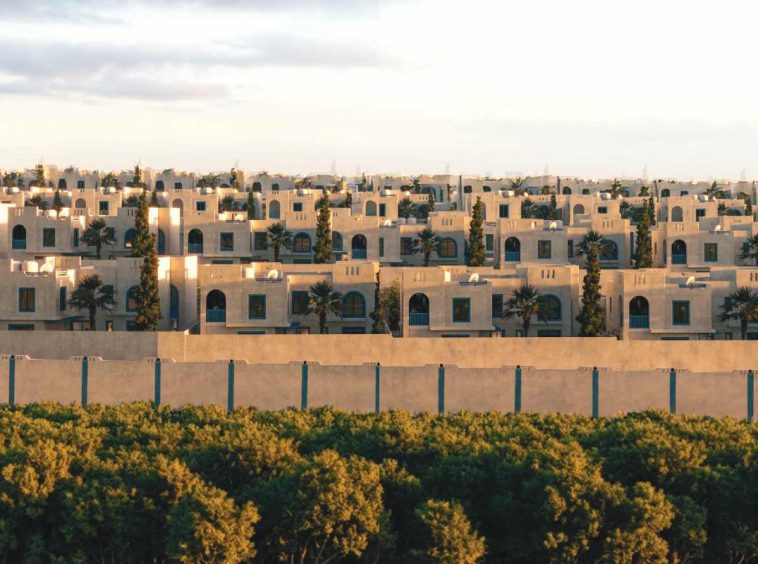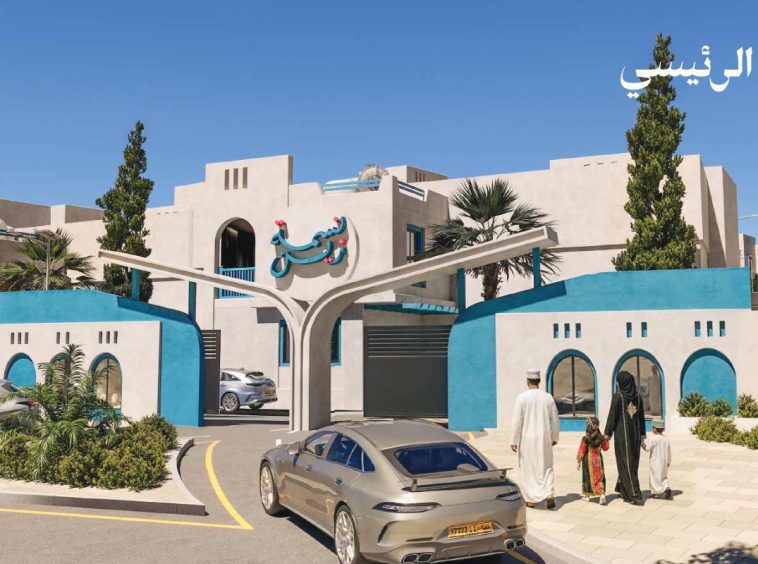
Nismat Zain is an integrated residential community of 358 homes — townhouses, standalone villas and serviced land plots — under construction in Sur, the historic port city on Oman’s south-eastern coast, in South Al Sharqiyah Governorate. It is built by Zain Property Development under the Ministry of Housing and Urban Planning’s Surooh programme for integrated neighbourhoods. Townhouses open at $104,000 and villas at $130,000, 81 units remain available, and completion is scheduled for the fourth quarter of 2033.
Two things need saying before the detail, because together they decide whether this project is relevant to you. The first is eligibility: like its sister scheme Husn Al Zain in Bidbid, Nismat Zain is a government-programme neighbourhood built principally for Omani citizens. Sur is not an Integrated Tourism Complex, the homes are two-storey houses rather than apartment buildings, and part of the offer is serviced land plots — the one category of Omani real estate most firmly closed to foreign individuals. The second is time: a Q4 2033 handover is more than seven years away, which is an unusually long horizon by any market’s standards and the single most important number on this page. We work through both below, and set out what a non-Omani buyer should look at instead.
| Project name | Nismat Zain (نسمة زين) |
| Developer | Zain Property Development (Oman, founded 2008) |
| Programme | Surooh — Ministry of Housing and Urban Planning |
| Location | Wilayat of Sur, South Al Sharqiyah Governorate |
| Coordinates | 22.5469° N, 59.5173° E (Plus Code GGW8+QW) |
| Site area | 268,339 m² (per the Ministry register) |
| Total homes | 358 per the developer; 407 per the Ministry register |
| Available now | 81 |
| Product | Townhouses, standalone villas and developed land plots |
| House types | Five models (R, S, T, U, W) — 3, 4 and 5 bedrooms |
| Built-up area | 173 – 284 m² (1,862 – 3,057 sq ft) |
| Plot sizes | 140 – 350 m² |
| Entry prices | Townhouses from $104,000; villas from $130,000 |
| Completion | Q4 2033 |
| Parking | 2–3 covered spaces per home |
| Title basis | Ordinary Omani land, outside the ITC framework — see eligibility below |
The Ministry of Housing and Urban Planning lists Nismat Zain on its Surooh project register — a 268,339 m² site in the Wilayat of Sur with 407 residential units, standalone and attached villas, plus a mosque, green space and a commercial area. Surooh is the ministry’s programme for building complete residential districts for Omani citizens entitled to residential plots, delivered in partnership with private developers who design, finance, build and market them.
Neither established route for foreign individual ownership reaches a scheme like this:
| Route | Requirement | Nismat Zain |
|---|---|---|
| ITC freehold | Property must lie inside a designated Integrated Tourism Complex | No — Sur is ordinary land in South Al Sharqiyah, with no ITC designation |
| Expatriate usufruct | Applies to units in buildings of at least four floors; buyer aged 23+, resident in Oman 2+ years; one unit per person; expat share capped at 40% of a building | No — these are two-storey houses, not multi-storey apartment buildings |
| Land plots | Freehold land ownership outside an ITC | No — bare land is the most restricted category of all for non-Omani individuals |
Some neighbourhoods in the related Hai family have been opened to non-Omanis — Hay Al Wafa in Sultan Haitham City is the usual example — so the programme is not uniformly closed, and it is decided project by project. But nothing in the Nismat Zain material states any such opening. If you are not an Omani citizen, obtain written confirmation of your eligibility from the developer before paying anything, and have an independent Omani lawyer verify it against the land registry. A brokerage listing is not confirmation.
On residency the conclusion follows directly. Oman’s Golden Residency requires OMR 200,000 and its property route is limited to ITC real estate; the entry townhouse here is about OMR 40,000 and sits outside the ITC framework, so it fails on both tests. If a residence permit is your objective, the productive places to look are Alef Qurum Residence in central Muscat, Muscat Bay, or Al Mina at Barr Al Jissah.
The brochure defines five models. Sizes and plots repeat the pattern used at Husn Al Zain, but the layouts differ — and the top two types add a formal majlis, the reception room that matters in Omani family life.
| Type | Plot | Built-up area | Bedrooms | Parking | Form |
|---|---|---|---|---|---|
| Type R | 140 m² | 173 m² (1,862 sq ft) | 4 + maid’s room | 2 cars | Townhouse, terraced |
| Type S | 280 m² | 183 m² (1,970 sq ft) | 3 + maid’s room | 3 cars | Standalone villa |
| Type T | 280 m² | 227 m² (2,443 sq ft) | 4 + maid’s room | 3 cars | Standalone villa |
| Type U | 350 m² | 260 m² (2,799 sq ft) | 5 + maid’s room | 3 cars | Villa with majlis |
| Type W | 350 m² | 284 m² (3,057 sq ft) | 5 + maid’s room | 3 cars | Villa with majlis |
Those five figures reconcile exactly with the published range of 1,862 to 3,057 sq ft, which is a good sign that the sales sheet and the architecture agree.
Type R (173 m² on 140 m²) is the townhouse and the entry point. Its ground floor holds a family hall of 4.0 × 4.2 m, a 3.8 × 3.8 m kitchen, a guest bedroom with bathroom, a maid’s room, laundry and a 5.0 × 5.0 m parking bay. Upstairs are a master bedroom at 3.8 × 6.0 m plus two further bedrooms and a 5.7 × 7.8 m roof terrace. Four bedrooms on the smallest plot in the scheme makes this the density play — and the render shows it built in continuous terraces, so expect neighbours on both sides.
Type S (183 m² on 280 m²) adds only ten square metres of building over Type R but doubles the plot, converting a terrace into a detached house with a 7.6 × 8.6 m garden and three parking spaces. It drops to three bedrooms and gains a proper entrance lobby, a separate dining hall of 2.6 × 4.9 m and a 3.5 × 7.3 m first-floor terrace. If you want a garden rather than a fourth bedroom, this is the trade.
Type T (227 m² on 280 m²) keeps Type S’s plot and adds 44 m² of building — four bedrooms, and unusually a separate living room on the first floor (4.07 × 2.9 m) alongside the bedrooms, giving the upper storey its own sitting area independent of the ground-floor family hall. For a household with teenagers or visiting relatives, that second lounge is worth more than the floor area suggests.
Type U (260 m² on 350 m²) is the first five-bedroom model and introduces the majlis at 4.0 × 3.8 m with its own guest toilet, plus a dining room, a 6.8 × 11.7 m garden and a 6.5 × 15.0 m first-floor terrace.
Type W (284 m² on 350 m²) is the largest house. It carries the majlis, five bedrooms, a first-floor living room, and a garden of 8.1 × 20.0 m — by a wide margin the most outdoor space in the community, on the same plot size as Type U but with the building arranged to leave a long private garden strip. If the outdoor space is what you are buying, Type W rather than Type U is the one to ask about.
Every model includes a maid’s room with its own bathroom, and every model is handed over finished — the interiors shown are complete, with fitted kitchens, wardrobes and bathrooms in a blue-and-white palette that echoes the exteriors.
| Product | From (size) | Price (USD) | Price (OMR) | Per sq ft |
|---|---|---|---|---|
| Townhouse | 1,862 sq ft (Type R) | $104,000 | OMR 39,988 | $56 |
| Villa | 1,970 sq ft (Type S) | $130,000 | OMR 49,985 | $66 |
All conversions use 1 OMR = 2.6008 USD. Note one discrepancy: the sales sheet also records an August 2026 starting price of OMR 44,500, which is about $115,736 — above the $104,000 townhouse figure quoted on the same sheet, equivalent to roughly OMR 40,000. The likely explanation is that the two numbers describe different products (a villa versus a townhouse) or different release phases, but they are not reconciled anywhere in the documentation. Ask for a written quotation in Omani rials against a named plot number.
Set against the rest of the Omani market, the pricing is remarkable — and the reason is the same as at Husn Al Zain:
| Development | Setting | Approx. price per sq ft |
|---|---|---|
| Nismat Zain (townhouse) | Sur, South Al Sharqiyah | $56 |
| Nismat Zain (villa) | Sur, South Al Sharqiyah | $66 |
| Husn Al Zain | Bidbid, Ad Dakhiliyah | $66 |
| Alef Qurum Residence (1-bed) | Telal Al Qurm ITC, Muscat | $166 |
| Uptown Muscat (studio) | Knowledge Oasis, Muscat | $261 |
At $56 per square foot the Nismat Zain townhouse is the cheapest built space we have recorded anywhere in Oman — roughly a fifth of the price of a small central-Muscat apartment. A four-bedroom house here costs less than a studio in the capital. That is not a market failure waiting to be exploited; it is the combined price of a provincial location, a 2033 handover, and a title most foreign buyers cannot hold.
The sales sheet records “no info” against both mortgage availability and terms of payment, and unlike Husn Al Zain — where Alizz Islamic Bank publicly announced a financing partnership — we have found no announced bank facility for Nismat Zain. The brochure refers to “competitive prices and flexible payment plans” without publishing a schedule. Given the completion date, this is the first thing to pin down: ask for the instalment schedule in writing, with calendar dates, and establish what proportion falls due before 2033 and what is payable on handover. A seven-year construction period with an unpublished payment structure is not something to enter on trust.
This deserves its own section because it is the defining risk. A completion date in the fourth quarter of 2033 is roughly seven years and four months from today. For comparison, everything else in our Oman portfolio hands over between 2027 and 2029.
Seven years is long enough for a great deal to change: construction cost inflation, developer circumstances, the Omani mortgage market, the buyer’s own life plans. Practical consequences worth weighing:
It is also possible that Q4 2033 refers to the completion of the final phase of the masterplan rather than the first homes. The documentation does not say. That single clarification is worth more than any other question you could ask.
Nismat Zain is listed under “Muscat” on brokerage platforms. It is not in Muscat. The plus code decodes to 22.5469° N, 59.5173° E — about 2.5 km from the centre of Sur and roughly 153 km from central Muscat, a drive of two to three hours along the coastal road. The site sits on the southern shore of Sur’s lagoon, beside a wadi, with the Arabian Sea a short distance north.
Sur itself is one of Oman’s most distinctive cities: a historic dhow-building port at the mouth of a turquoise lagoon, with the Al Ayjah lighthouse and corniche across the water, Sanesla and Skikra forts on the ridges, a maritime museum and a traditional shipyard still building wooden vessels. In 2024 Sur was named Arab Tourism Capital, and the surrounding region holds some of the country’s best-known natural attractions.
| Destination | Driving time |
|---|---|
| Indian School Sur | 5 minutes |
| Dhow Factory Museum | 6 minutes |
| Global Village Hypermarket | 8 minutes |
| Country Park Tire State | 8 minutes |
| Badr Al Samaa Polyclinic Sur | 9 minutes |
| Oman College of Health Sciences, South Sharqiya branch | 11 minutes |
| University of Technology and Applied Sciences | 14 minutes |
| Emaad Sur Shopping Centre | 14 minutes (but see note) |
| Al Rafsah natural attraction | 14 minutes |
| Sur Murtafa Beach | 16 minutes |
One inconsistency to note: the same data sheet gives Emaad Sur Shopping Centre as both 14 minutes and 10 minutes away, in the infrastructure list and the location description respectively. A four-minute discrepancy changes nothing material, but it is a reminder to treat all of these figures as approximate.
Further afield lie Ras Al Hadd and Ras Al Jinz, the green turtle nesting reserves about 35 km east; Wadi Shab, one of Oman’s most photographed wadis, around 43 km west; and the ruins of Qalhat, the medieval port described by Marco Polo and now a UNESCO World Heritage Site. Muscat International Airport is roughly 170 km away — a genuine road journey, not a commute.
The masterplan is laid out along the lagoon edge, with terraces and villa plots arranged around a central spine and a wadi running through the eastern side of the site. The published legend identifies a main entrance and guards’ room, a side entrance, mosque, shops, a commercial building, an activity building, a central park combining playground, kids’ area, seating, cycling track and green walkways, a sewage treatment plant, a jogging track, and a bridge across the wadi.
| Facility | Detail |
|---|---|
| Mosque | Community mosque with a distinctive slender minaret, beside the central park |
| Central park | Playground, kids’ area, seating, cycling track and green walkways |
| Recreational spaces | Extensive play equipment, climbing frames, outdoor fitness stations and shaded seating |
| Shops | Two retail parades — an arcaded courtyard of small shops and a larger street-front block with a drive-through |
| Commercial building | Separate commercial premises within the community |
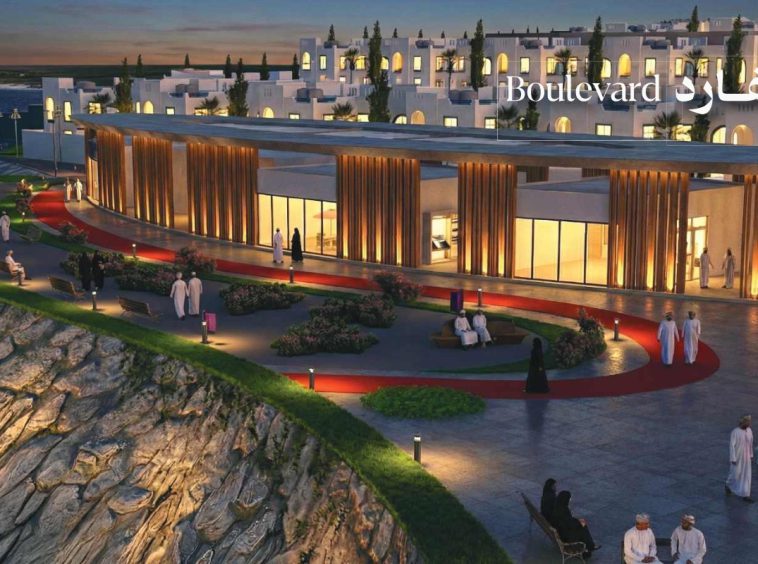
| Activity building | Community activity centre on the boulevard |
| Boulevard | Clifftop promenade above the water with a curved pavilion |
| Nursery | Community nursery |
| Jogging track | Marked route through the community |
| Security | Controlled main and side entrances, guards’ room, protection systems |
| Wastewater treatment | On-site STP |
The boulevard is the most striking element in the renders — a landscaped promenade running along the rocky shoreline with a curved, timber-finned pavilion overlooking the water. It is a genuinely ambitious piece of public space for a project at this price point, and if delivered as drawn it will be the community’s defining feature.
Two practical notes. The masterplan marks wadi areas and a wadi setback zone along the eastern boundary — sensible planning, but ask which plots sit nearest the watercourse and what the flood design assumptions are, since wadis in Oman can run hard after rain. And the on-site sewage treatment plant recycles water for the landscaping, which is what makes the green spine viable in this climate.
The brochure makes an argument that is worth taking seriously on its own terms, and it is stronger here than at the developer’s inland projects. Sur has an active trading port, proximity to major energy and industrial projects in the region, a growing student population served by two colleges, and a tourism draw built on turtles, wadis, forts and dhow heritage — reinforced by the Arab Tourism Capital 2024 designation. The brochure argues this supports demand for both short- and long-term rental, including serviced apartments and tourist villas.
That is a real thesis rather than a hollow one. Sur genuinely receives visitors, and rental demand from industrial and public-sector employees is genuine too. Three caveats, though. First, the tourism trade in Sur is concentrated around the corniche, Ras Al Jinz and the wadis rather than in residential neighbourhoods on the lagoon’s southern edge. Second, provincial rental yields in Oman run well below Muscat’s, with longer void periods and a thinner tenant pool. Third — and decisively — none of this is accessible to a foreign investor unless the eligibility question resolves favourably, and there is no indication that it does. Official population and economic series are published by the National Centre for Statistics and Information, and tourism policy by the Ministry of Heritage and Tourism.
Under Oman Vision 2040 the Ministry of Housing and Urban Planning has been developing integrated residential neighbourhoods — whole districts with mosques, schools, parks and retail rather than bare land grants — for Omani citizens entitled to residential plots. The government supplies land and utilities; private consultants, banks, developers and contractors handle design, funding, construction and sales.
That model explains the pricing. This is citizen housing with a policy purpose, not investor product, and the numbers should be read in that light. Related initiatives include the Hai neighbourhoods and the large district-building programme at Sultan Haitham City, where schemes such as Jood and Al Ahlam operate under a framework that has been opened more widely.
Zain Property Development was established in 2008 and works across residential and commercial property inside and outside Oman, under the tagline “affordable luxury is everything.” Its stated portfolio includes Dar Al Zain, Tawi Al Zain, Zain Height, Zain Park, The Zain, Al Muna Gardens, Zain Azaiba, Murooj Al Zain, Husn Al Zain and Al Zain View.
Running two Surooh neighbourhoods concurrently — Husn Al Zain in Ad Dakhiliyah and Nismat Zain in South Al Sharqiyah — is a meaningful mandate, and Husn Al Zain is roughly 95% sold, which suggests the product finds its market. The relevant caution is specific to this project rather than the company: a seven-year delivery window is a long time to hold a developer to a promise. Ask for completed Zain communities you can visit in person, confirm the escrow arrangements, and read the delay-compensation clause before anything else.
| Development | Setting | Framework | Handover | Open to non-Omanis? |
|---|---|---|---|---|
| Nismat Zain | Sur, South Al Sharqiyah | Surooh | Q4 2033 | Not established — verify |
| Husn Al Zain | Bidbid, Ad Dakhiliyah | Surooh | Q4 2027 | Not established — verify |
| Alef Qurum Residence | Telal Al Qurm, Muscat | ITC freehold | Q2 2029 | Yes |
| Bellevue, Al Mouj | Coastal, marina | ITC freehold | — | Yes |
| Muscat Bay | Coastal coves | ITC freehold | Completed | Yes |
| Al Mina, Barr Al Jissah | Coastal, marina | ITC freehold | — | Yes |
| Olive Farms, Jebel Sifah | Coastal resort | ITC freehold | — | Yes |
| The Sustainable City — Yiti | Yiti valley | ITC freehold | — | Yes |
| Uptown Muscat | Knowledge Oasis | Madayn estate | Q1 2027 | Marketed as such — unconfirmed |
| Hay Al Wafa | Sultan Haitham City | New capital district | — | Yes — reported open |
Read the last two columns together and the picture is clear. Nismat Zain offers the cheapest space in the country, on the longest timeline, with the least certain access. Each of those three facts follows from the same underlying reality: it is citizen housing in a provincial governorate, not an investment product.
And who it is not for: foreign investors seeking freehold title or residency, anyone needing rental income within the next several years, anyone who needs to be near Muscat, and anyone uncomfortable with an unpublished payment schedule on a seven-year build. For those readers, the ITC projects linked throughout this page answer the brief properly.
UInvest Group works directly with developers across Oman, and we would rather tell you a project does not fit than sell you into it. On Nismat Zain we can obtain current availability from the 81 remaining units, plot-specific pricing in Omani rials, the full specification for all five house types, the phasing schedule behind the Q4 2033 date, and — the decisive item — written confirmation of whether you personally are eligible to buy.
If that answer is negative, we will point you to the Omani projects where it is unambiguously positive: Alef Qurum Residence inside the Telal Al Qurm ITC in central Muscat, the marina and beachfront communities at Al Mouj and Barr Al Jissah, and the resort villas at Jebel Sifah — all open to foreign freehold ownership with a residency permit attached, and all delivering years before 2033. Mortgage benchmarks are published by the Central Bank of Oman, general information on the Sultanate at oman.om, and current affairs by the Times of Oman. Oman also ranks among the safest countries in the world in Numbeo’s crime indices — one of the quieter reasons it keeps drawing people in.

"*" indicates required fields