- Developers Developers in Oman
 Muriya8 projects
 Dar Global7 projects
 Al Mouj Muscat5 projects
 OMRAN Group4 projects
 Al Osool2 projects
 Al Zaid Real Estate & Development (AZD)2 projects
 Diamond Developers2 projects
 Muscat Bay2 projects

 Wujha Real Estate Development2 projects
 Zain Property Development2 projects
 Adanté Realty1 project
 Al Ahly Sabbour1 project
 Al Nama Real Estate1 project
 Barr Al Jissah1 project
 Dar Arabia1 project
 Dream Villa1 project
 Eagle Hills Muscat1 project
 Maysan Properties1 project
 Mira Developments1 project
 Rozal Development1 project
 Sohar Real Estate Development (Majd)1 project
 Zen Development and Investment1 project




























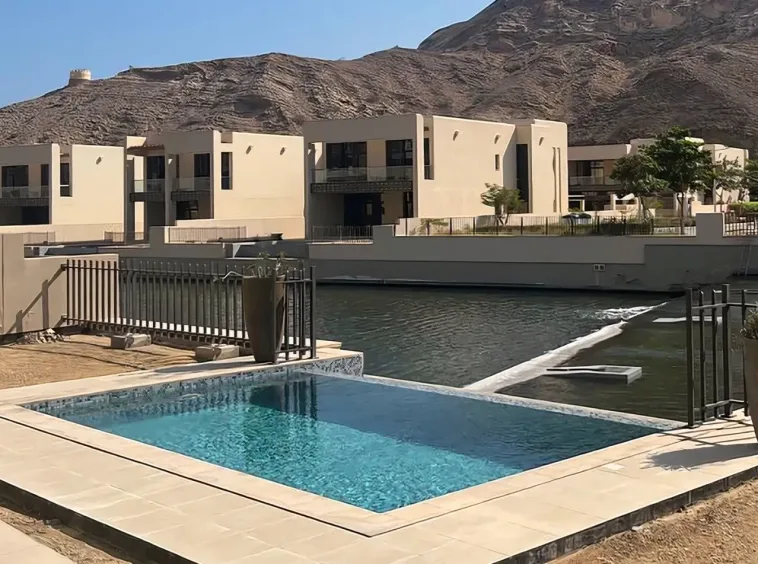
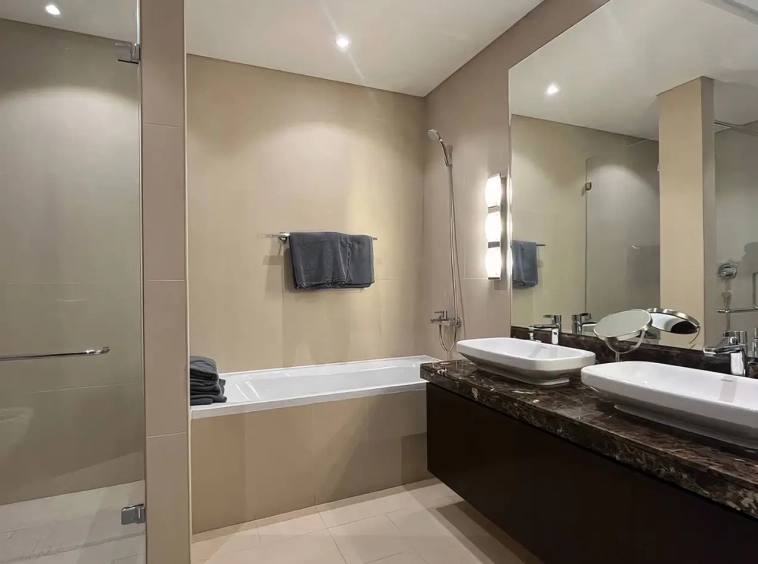


Description
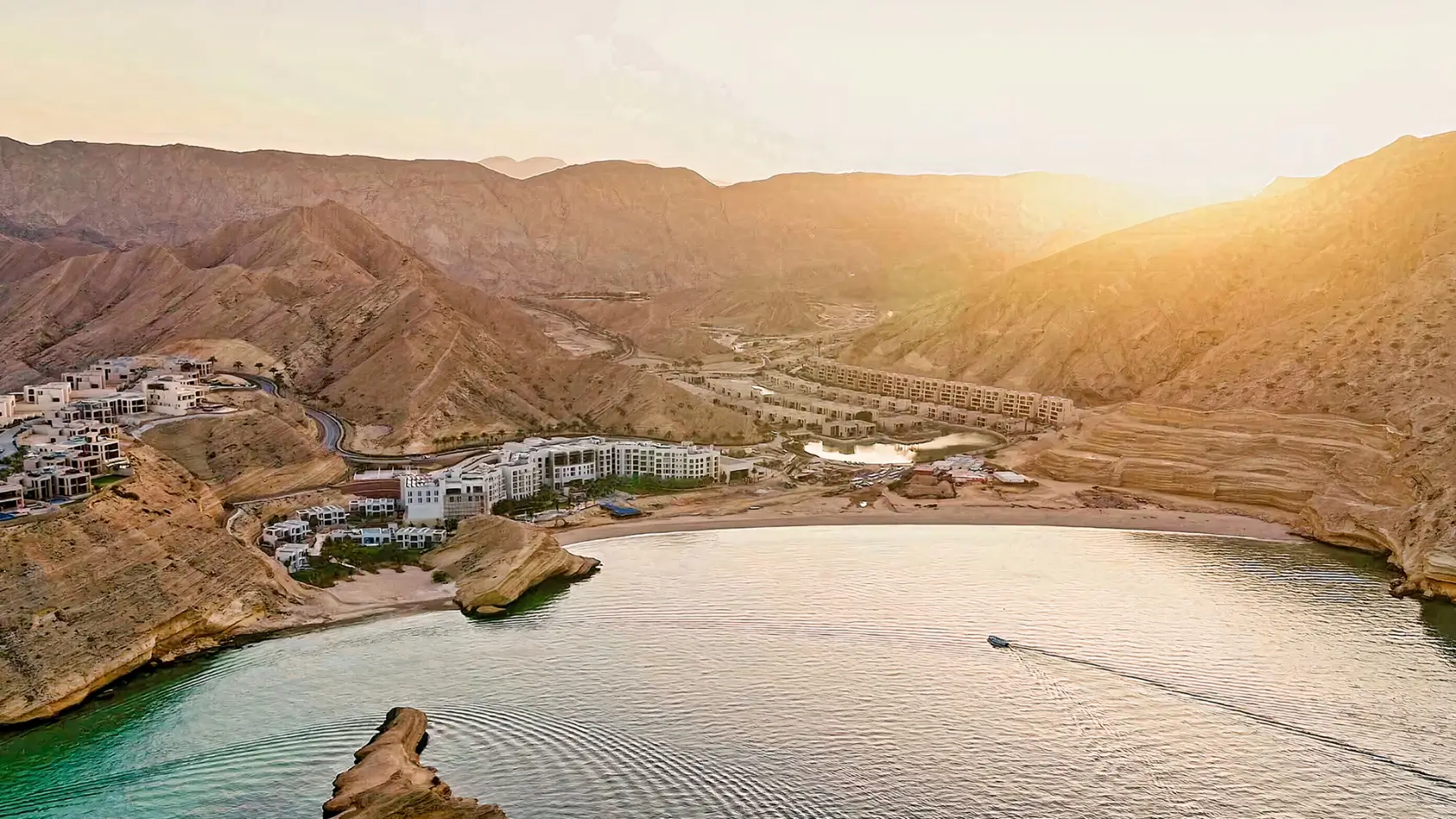
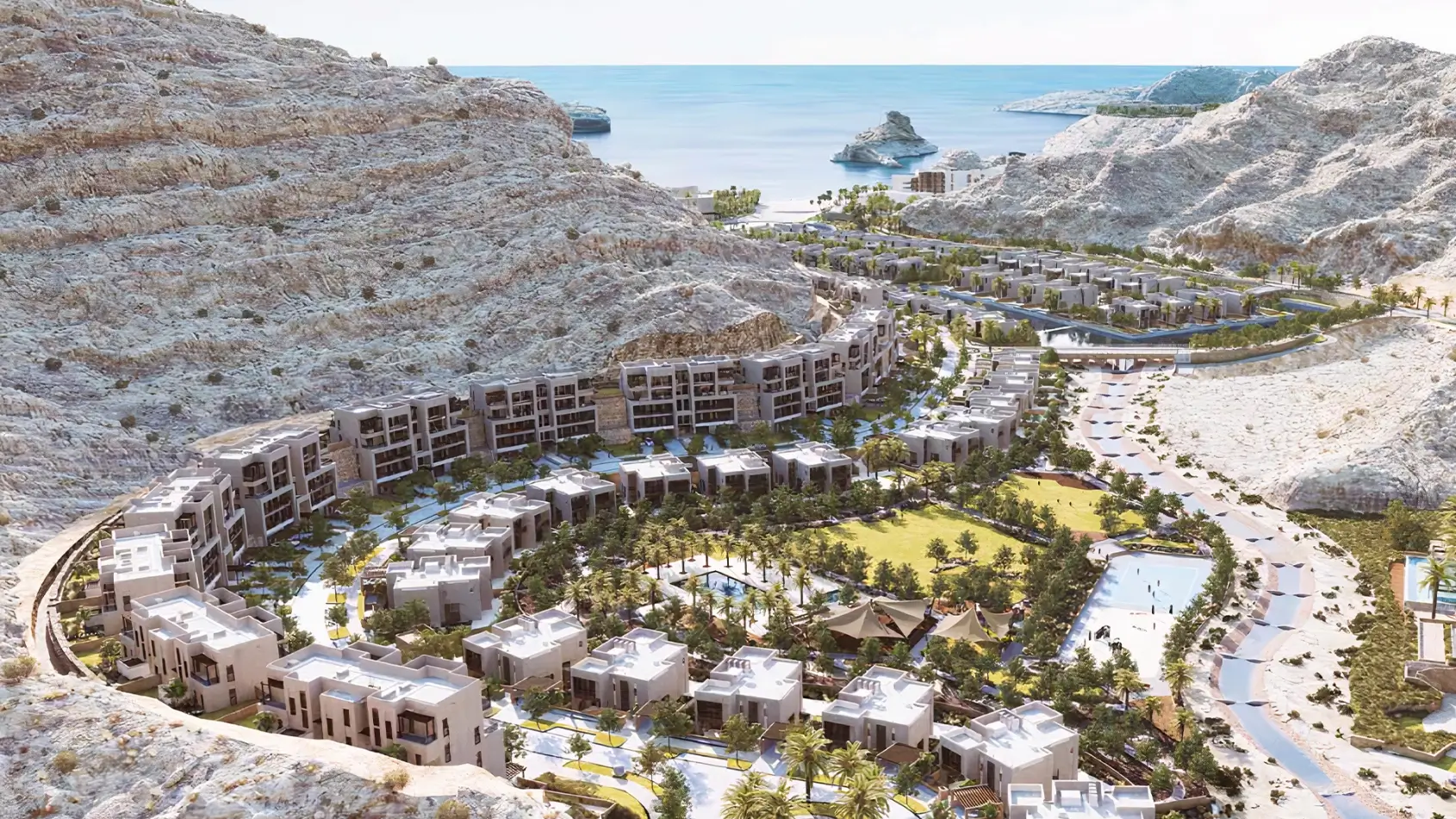
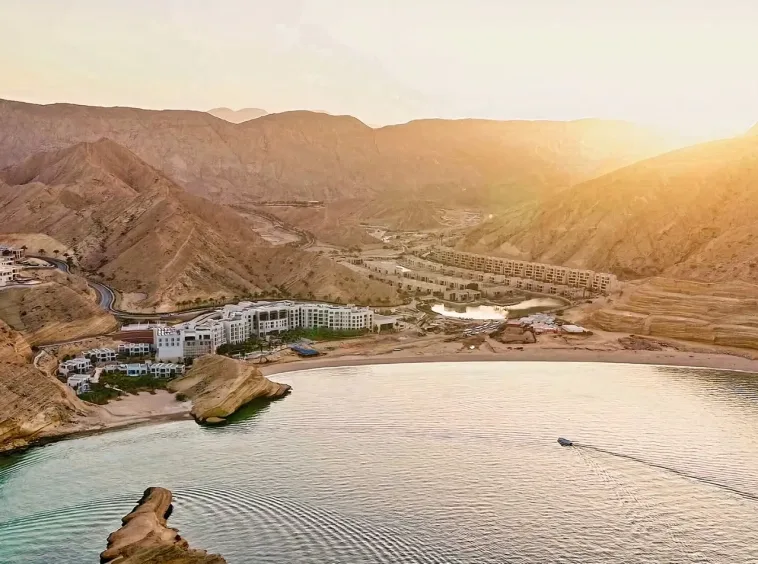
Muscat Bay is a gated resort community on the shore of the Gulf of Oman, set in a natural bay between the water and the Al Hajar Mountains, twenty-five minutes from central Muscat. It has seven distinct residential neighbourhoods, the Jumeirah Muscat Bay hotel and a village square with shops and restaurants, all behind one entrance. The developer’s sales material also lists a boutique hotel, a school, a health club and an amphitheatre.
One fact matters first. It is finished. Muscat Bay is move-in ready — you can walk the streets, swim in the pools, eat in the restaurants and inspect the actual home before you buy. The other projects we cover hand over between 2027 and 2029. There are 15 homes left, from a $234,100 one-bedroom apartment to hilltop villas above 8,000 sq ft, and the developer offers instalments over three or five years on a completed property. This guide covers the seven neighbourhoods, the prices, the service charge, the payment terms and the buying process.
Muscat Bay at a glance
| Location | Muscat Bay, Gulf of Oman coast, Muscat |
| Developer | Saraya Bandar Jissah — OMRAN Group and Saraya Oman (est. 2007) |
| Status | Complete — move-in ready |
| Market | Primary and secondary — developer stock and owner resales |
| Ownership | Freehold, open to all nationalities |
| Currently available | 15 homes |
| Neighbourhoods | Seven — Zaha Waterfront, Zaha Parkland, Zaha Duplexes, Nameer Island, Wajd Grand Hilltop |
| Home types | 1–3 bed apartments, 3-bed duplexes, 3/4/5-bed two-storey villas |
| Size range | 646 – 8,181 sq ft (60 – 760 m²) |
| Apartments from | $234,100 |
| Villas from | $897,000 |
| Payment | Cash, or instalments over 3 or 5 years, depending on the lot |
| Airport | Muscat International — 40 minutes |
A completed, move-in-ready community
Many homes sold in Oman today are off-plan: the buyer pays against a schedule until handover. That is a normal way to buy, and our guides to off-plan property in Oman set out how the escrow protections work.
Muscat Bay is different: construction is complete. In practice that means:
| Off-plan purchase | Muscat Bay |
|---|---|
| You judge from renders and a spec sheet | You walk the actual home |
| Amenities are promised | Shops, restaurants and the Jumeirah Muscat Bay hotel are operating |
| Service charge is an estimate | There is a real operating history to ask about |
| No rental income until 2027–2029 | Rental income can start immediately |
| Neighbours arrive years later | You can see who lives there and how full it is |
The last two matter financially. A completed home in a working community can be let from the month you own it, and you can see the occupancy in person before committing.
Sizes and prices
| Home type | Size from | Price from | Per sq ft |
|---|---|---|---|
| 1-bedroom apartment | 850 sq ft (79 m²) | $234,100 | $275 |
| 2-bedroom apartment | 1,238 sq ft (115 m²) | $382,000 | $309 |
| 3-bedroom apartment / Zaha Duplex | On request | On request | — |
| Villa (3, 4 or 5 bedrooms) | 3,330 sq ft (309 m²) | $897,000 | $269 |
| Home at 8,181 sq ft | 8,181 sq ft (760 m²) | On request | — |
Per square foot, the one-bedroom apartment is $275, the two-bedroom apartment $309 and the villa — a detached, two-storey home with a private courtyard and pool — $269.
Apartment prices carry a share of lift cores, lobbies and shared facilities, while villa prices are weighted towards land; Luma Residence next door follows the same structure.
Reading the price table, unit by unit
The one-bedroom apartment starts at 850 sq ft (79 m²) and $234,100, which is $275 per square foot, or about OMR 90,000. The two-bedroom apartment starts at 1,238 sq ft (115 m²) and $382,000, or $309 per square foot; compared with the first row, it adds 388 sq ft and $147,900. The villa row starts at 3,330 sq ft (309 m²) and $897,000, or $269 per square foot, and covers three-, four- and five-bedroom homes.
Service charge
The developer’s data sheet gives the service charge as 8.72 OMR for apartments and 6.01 OMR for villas, per square metre per year. Luma Residence, by the same developer inside the same community, publishes 8.27 OMR for apartments and 6.27 for villas on the same basis. Applied to the home sizes above:
| Home | Annual charge (OMR, per m² rate) | Per year | Share of price |
|---|---|---|---|
| 1-bed, 79 m² | 689 OMR | ≈ $1,791 | 0.77% |
| 2-bed, 115 m² | 1,003 OMR | ≈ $2,608 | 0.68% |
| Villa, 309 m² | 1,859 OMR | ≈ $4,836 | 0.54% |
| Home, 760 m² | 4,568 OMR | ≈ $11,880 | — |
These figures cover a community with a resort hotel, a village square and 24-hour patrolled security to maintain. The rate is confirmed in writing, with the unit and the period stated. On a completed community, the last two years of actual service charge invoices for the specific home can also be requested. Our guide to service charges in Omani real estate covers what these normally include.
How the service charge is calculated
The charge is quoted in rials per square metre per year. For the 79 m² one-bedroom apartment, 79 × 8.72 gives about 689 OMR a year, or roughly 57 OMR a month. The villa’s 1,859 OMR a year is roughly 155 OMR a month. At OMR 1 = USD 2.6008, these match the dollar figures in the table above.
The seven neighbourhoods
Muscat Bay is not one product. It is seven, arranged by position — waterfront, parkland slope, island, and hilltop — and the choice between them is really a choice about view and privacy.
| Neighbourhood | Type | Position and outlook |
|---|---|---|
| Zaha Waterfront Residences | Apartments | Direct waterfront access; sea and central lagoon views |
| Zaha Waterfront Villas | Villas | On the water, facing the sea and lagoon |
| Zaha Parkland Residences | Apartments | Set on the mountain slope over the Zaha Valley |
| Zaha Parkland Villas | Villas | Slope position, valley outlook |
| Zaha Duplexes | 3-bed penthouses | Private gardens and pools, water views |
| Nameer Island Villas | 3 & 4-bed villas | On a man-made island in the lagoon; private pools and gardens |
| Wajd Grand Hilltop Villas | 5-bed villas | Hilltop plots, sea and mountain views |
Two are defined by position. Nameer Island puts villas on their own man-made island in the middle of the lagoon. Wajd Grand Hilltop sits on the hilltop, with large plots and long views over both the water and the Al Hajar range.
According to the sales material, the masterplan also carries a boutique hotel and a resort hotel alongside the village square; the resort hotel, Jumeirah Muscat Bay, opened in 2022.
With only 15 homes left across all seven neighbourhoods, availability is the constraint, not preference. Ask for the live list by neighbourhood before you decide which one you want.
Architecture and finish
| Element | Detail |
|---|---|
| Facades | Sand-coloured, with patterned inserts and timber elements referencing classical Eastern architecture |
| Windows | Panoramic, black frames |
| Interior finish | Delivered finished, classical style, predominantly beige tones |
| Kitchen | Designer kitchen included |
| Villas | Two-storey, with a private courtyard, sunbathing terrace and pool |
| Setting | Massing and colour chosen to blend into the mountain landscape |
The designer kitchen is a specification line that is explicitly called out in the sales material.
Because the homes are built, you can inspect the actual unit, not a show apartment.
Facilities within the community
| Category | On site, per the sales material |
|---|---|
| Retail and dining | Village Square with restaurants, cafés and shops; supermarkets |
| Education | A school within the community (listed in the sales material) |
| Hospitality | Jumeirah Muscat Bay resort hotel (opened 2022); a boutique hotel is listed in the sales material |
| Fitness and wellness | Health club, residents’ gym, swimming pools |
| Culture and family | Amphitheatre, children’s area, landscaped park |
| Services | Concierge, delivery, laundry, property management |
| Security | Gated, 24-hour security with active patrolling |
The sales material lists a school inside the gates. For a family buying a primary residence, the school’s name, operator, places and fees can be discussed with the UInvest team.
Property management and a rental-management option also exist as services, which matters if you are buying to let and are not resident in Oman.
Location and drive times
| Destination | By car |
|---|---|
| SPAR Muscat Bay supermarket | 2 min |
| Muscat Bay Village Square | 2 min |
| Cold Store supermarket | 8 min |
| Qantab Cliffs | 8 min |
| Indian School | 12 min |
| Al-Mumyan Cave | 13 min |
| ISWKI School | 14 min |
| Wadi Kabir Park | 15 min |
| Ruwi Street | 18 min |
| Apollo Hospital Muscat | 20 min |
| Central Muscat | 25 min via Al Jissah Road |
| Sultan Qaboos Grand Mosque | 25 min |
| VOX Cinemas, Qurum City Centre | 26 min |
| Al Sawha School | 26 min |
| Al Amal Medical Centre | 30 min |
| Muscat International Airport | 40 min |
The top of the table is the community itself — supermarket and village square two minutes from the door. Beyond the gates: the city is 25 minutes and the airport 40.
Getting around from Muscat Bay
Daily shopping is 2 minutes away at the SPAR supermarket and Village Square. For schools, the Indian School is 12 minutes away and ISWKI 14; for healthcare, Apollo Hospital Muscat is 20 minutes away. Qantab Cliffs are 8 minutes away, central Muscat is 25 minutes and the airport 40.
Airport access across our Oman listings
| Project | District | To airport | Handover |
|---|---|---|---|
| Golf Hills | Muscat Hills | 14 min | Q4 2028 |
| Opal Residences | Muscat Hills | 14 min | Q4 2028 |
| Hay Al Wafa | Sultan Haitham City | about 30 min | 2027 |
| Zen Residences | Muscat Bay | — | Q1 2027 |
| Luma Residence | Muscat Bay | — | Q1 2029 |
| Muscat Bay | Muscat Bay | 40 min | Complete |
| TSCY | Yiti | 40 min | 2027 |
| The Great Escape | Yiti (AIDA) | 55 min | 2028 |
Muscat Bay offers a bay, a lagoon and mountains, forty minutes from the airport; Muscat Hills is fourteen minutes away. Unlike the other projects on this list, Muscat Bay is complete now rather than in 2028.
Payment: instalments on a finished home
The published terms are set out plainly here. The plan depends on the lot, and three routes exist:
| Route | What it means here |
|---|---|
| Cash | Full payment; the cash price can be requested alongside the instalment prices |
| 3-year instalments | Spread across three years after you own a finished home |
| 5-year instalments | Spread across five years |
Here is how this differs from the other payment plans on this site. Elsewhere, instalments exist to fund construction — your money builds the building. Here the building is already built, so the instalments are vendor financing on a completed asset. You take possession and pay over time.
Straight-line arithmetic, for scale only:
| Home | Price | Over 5 years | Over 3 years |
|---|---|---|---|
| 1-bedroom apartment | $234,100 | ≈ $3,902 / month | ≈ $6,503 / month |
| 2-bedroom apartment | $382,000 | ≈ $6,367 / month | ≈ $10,611 / month |
| Villa | $897,000 | ≈ $14,950 / month | ≈ $24,917 / month |
These are straight-line figures, for scale only. The cash price and the five-year price can be requested side by side, in writing; the gap between them is the cost of the financing.
A worked example of the instalment routes
The plan depends on the lot, so this example is illustrative. On the one-bedroom apartment at $234,100, an even spread over five years is $46,820 a year, or about $3,902 a month; over three years it is about $78,033 a year. For the $897,000 villa, the yearly figures are $179,400 and $299,000. The method ignores any deposit, so the cash, 3-year and 5-year prices are requested side by side in writing.
The developer: Saraya Bandar Jissah
Muscat Bay’s developer is an Omani company founded in 2007 as a partnership between the state-owned tourism group OMRAN Group and Saraya Oman, specialising in integrated residential and resort destinations. Muscat Bay is its community project, and the company took the community’s name as its own brand in 2017. The developer’s material says the project won four national and two regional awards at the International Property Awards 2015.
The community is built and running, so it can be inspected in person: walk the streets, look at how the landscaping is maintained and see how the retail units are used.
The same developer is now building Luma Residence inside this community for Q1 2029. Muscat Bay is the finished work of the same team, on the same site. Official information is at muscatbay.com, with background on Muscat Bay’s Wikipedia entry.
Partners and project history
Muscat Bay is the trading name of Saraya Bandar Jissah, formed in 2007 by OMRAN Group, the Omani government’s tourism-development company, and Saraya Oman, a subsidiary of the Jordan-based Saraya Holdings. According to the Oman Observer, the first phase was announced complete in the second quarter of 2019, with 22 villas at Wajd, 33 at Nameer and 200 residences at Zaha. Our Muscat Bay developer profile sets out the timeline, and the OMRAN Group profile explains OMRAN’s role.
Related projects inside the community
Luma Residence is by the same developer, while Zen Residences is by Zen Development and Investment, so a Zen purchase is made under that company’s own sale agreement. The developers hub compares ten Oman developers on one page.
| Project | Developer | Entry price | Handover |
|---|---|---|---|
| Muscat Bay (completed homes) | Saraya Bandar Jissah | $234,100 (1-bedroom, 850 sq ft) | Complete |
| Zen Residences (80 homes) | Zen Development and Investment | $358,900 (2-bedroom, 1,378 sq ft) | 2027, per the developer |
| Luma Residence (240 homes) | Saraya Bandar Jissah | $300,500 (2-bedroom, 1,211 sq ft) | Q1 2029 |
Price per square foot across our Oman listings
| Project and type | Price from | Per sq ft | Status |
|---|---|---|---|
| Hay Al Wafa — apartment | $170,600 | $100 | Off-plan |
| Jood — 2-bedroom | $204,000 | $179 | Off-plan |
| Luma — villa | $650,200 | $217 | Off-plan 2029 |
| Opal Residences — 1-bedroom | $194,100 | $220 | Off-plan 2028 |
| Golf Hills — 1-bedroom | $163,600 | $254 | Off-plan 2028 |
| Zen Residences — 2-bedroom | $358,900 | $260 | Off-plan 2027 |
| Muscat Bay — villa | $897,000 | $269 | Complete |
| Muscat Bay — 1-bedroom | $234,100 | $275 | Complete |
| TSCY — 2-bedroom | $332,700 | $276 | Off-plan 2027 |
| Muscat Bay — 2-bedroom | $382,000 | $309 | Complete |
| The Great Escape — 1-bedroom | $195,000 | $325 | Off-plan 2028 |
Read the right-hand column with the rate. Muscat Bay’s villa at $269 per square foot is finished and available now.
Freehold ownership and residency
Homes at Muscat Bay are sold freehold to buyers of any nationality, with title registered in the purchaser’s name. Muscat Bay is an Integrated Tourism Complex, the designation under which foreign freehold ownership is permitted in Oman — our guide to freehold property and the ITC framework sets out how the zones work and what registration involves.
On residency, Golden Residency requires a single Integrated Tourism Complex (ITC) property worth at least OMR 200,000, and applications are decided by the Royal Oman Police; the Owner Visa has no minimum price. Against the Golden Residency figure:
| Home | Price | Against the OMR 200,000 (~$520,000) mark |
|---|---|---|
| Villa | $897,000 | At or above |
| 2-bedroom apartment | $382,000 | Below |
| 1-bedroom apartment | $234,100 | Below |
Routes differ by duration and investment level — read Oman Golden Residency vs the Owner Visa and take advice against the specific home and price. The real estate route requires a valid title deed, which is registered after purchase; Gulf News reported in 2018 that title deeds are issued two to four months after purchase.
Residency routes in more detail
Golden Residency requires a single Integrated Tourism Complex property worth at least OMR 200,000, and two smaller purchases do not combine; the Royal Oman Police decides each application. The Owner Visa has no minimum property value and lapses if the property is sold.
Rental demand and exit
Muscat Bay homes are complete and can generate income this year; the other projects we list hand over from 2027.
The rental proposition is resort-led — an operating village square, the Jumeirah Muscat Bay hotel and a private beach and lagoon setting. The sales material also lists a school on site, which would widen the tenant pool from holidaymakers to families on multi-year postings. Property management and concierge services already exist inside the community, which is what makes remote ownership workable. Current ranges are in our guide to rental yields in Oman, and branded residences in Oman covers how hotel-adjacent stock performs.
Because the community is running, actual numbers can be requested. Achieved rents and occupancy for comparable units over the past twelve months can be requested from the letting agent or the management company.
On exit, two features are relevant. The community is built out, with 15 homes left. And the secondary market already functions here, which means there are real comparable transactions to price against. Confirm the short-let policy before buying; gated resort communities frequently route holiday letting through an approved operator.
Who Muscat Bay suits
| Buyer profile | Relevant feature | What to check |
|---|---|---|
| Buyer who prefers a completed home | It is built | Inspect the actual unit, not a show home |
| Buyer who wants income now | Lettable immediately | Ask for real achieved rents and occupancy |
| Family buying a primary residence | Shops are on site; a school and clinic are listed in the sales material | The school and clinic operators, places and fees |
| Buyer targeting residency | At villa level — above the OMR 200,000 mark | Apartments are below the mark; confirm on your unit |
| Buyer wanting to spread payments | 3 or 5 years on a finished home | Compare the cash and instalment prices |
Why Muscat, and why this price level
The case for Oman rests on freehold ownership inside designated zones, no annual property tax and no income tax on rental income, and country safety data published on international crime indices. The rial’s decades-old dollar peg gives dollar-based buyers a stable exchange rate. Government context is published by the Ministry of Housing and Urban Planning, with national policy set by Oman Vision 2040 and Invest Oman.
Within that market Muscat Bay is a completed resort address rather than an entry-level city purchase. Other ways into Muscat are covered in the best areas to buy property in Muscat. A finished, freehold villa in a functioning gated community on the water is $269 per square foot. On timing, see whether now is a good time to buy in Oman, and transaction costs are in our guide to property tax in Oman.
Paying from abroad
Prices are quoted in US dollars and settled in Omani rials, and the rial has been pegged to the dollar for decades.
For completed stock the money mechanics differ from off-plan: rather than escrow-staged construction payments, you are dealing with a transfer of registered title. Verify account details independently before the first transfer, confirm exactly what is being registered and when, and keep SWIFT confirmations for the registration file. Rates and banking information are published by the Central Bank of Oman.
How to buy: step by step
- 1. Get the live list of the 15 available homes. By neighbourhood, type, size and position — and establish which are developer stock and which are owner resales, because the process differs.
- 2. Visit and inspect the actual home. This is what buying completed allows. Walk the community at different times of day, look at maintenance standards and check how tenanted the retail is.
- 3. Get the service charge in writing. Rate, annual period, plus historic invoices for that specific home.
- 4. Compare cash against instalments in writing. Ask for both prices side by side to see what the three or five-year route actually costs.
- 5. Commission a survey. Especially on resale stock, and ask what warranties remain and whether service charges are paid up to date.
- 6. Check the letting rules. Short-let policy, approved operator requirements, and real achieved rents for comparable homes.
- 7. Register title. Then, if relevant, apply for residency — at villa level the price is above the threshold.
From reservation to keys
A reservation form records the home, the price and the seller’s legal name, and the sale and purchase agreement (SPA) then sets out the payment route and the transfer terms.
Royal Decree 79/2025 requires a licence and a separate escrow account for off-plan projects and has applied since mid-March 2026; a completed home involves a transfer of registered title rather than staged construction payments. Title deeds are issued two to four months after purchase, according to Gulf News in 2018. At handover, a snagging walk-through lists small finishing items. Our guide to Law 79/2025 explains the decree.
What to prepare when reserving
- The live availability list — 15 homes, by neighbourhood, type and position.
- Which units are developer stock and which are owner resales.
- Service charge: the rate with the unit and period stated, and the last two years of actual invoices for the specific home.
- The cash price and the 3-year and 5-year instalment prices side by side, with the deposit each route requires.
- An independent survey, particularly on any resale unit; outstanding service charges and utility arrears cleared before transfer; and the warranties that remain on the building and installed equipment.
- The short-let policy, whether an approved operator is mandatory, and achieved rents and occupancy for comparable homes over 12 months.
- Beach, lagoon and hotel-facility access rights and whether they run with the title.
- If residency is the goal, the route being used and the OMR 200,000 single-property test for your specific home.
Frequently asked questions
Where is Muscat Bay?
On the Gulf of Oman coast south-east of Muscat, in a natural bay between the sea and the Al Hajar Mountains, with direct access to Al Jissah Road. Central Muscat is 25 minutes away and the airport 40.
Is Muscat Bay finished or still under construction?
Finished. The community is complete and move-in ready, with shops, restaurants, the Jumeirah Muscat Bay hotel and security operating; the sales material also lists a boutique hotel and a school.
Can foreigners buy at Muscat Bay?
Yes. Homes are sold freehold to buyers of any nationality, with title registered in the purchaser’s name. Muscat Bay is an Integrated Tourism Complex, the designation that permits foreign freehold ownership in Oman.
How much does a home cost?
One-bedroom apartments start at $234,100 from 850 sq ft, two-bedrooms at $382,000 from 1,238 sq ft, and villas at $897,000 from 3,330 sq ft. Homes go up to 8,181 sq ft. Around 15 homes remain available.
What are the payment terms?
They depend on the lot. Cash, or instalments over three or five years. Because the homes are complete, these are financing arrangements on a finished asset rather than construction-funding schedules. The cash price and the instalment price can be requested side by side, in writing.
What is the service charge?
The data sheet gives 8.72 OMR for apartments and 6.01 for villas, per square metre per year, which comes to roughly $1,791 a year on an 850 sq ft apartment and $4,836 on a 3,330 sq ft villa.
What neighbourhoods make up Muscat Bay?
Seven: Zaha Waterfront Residences and Villas, Zaha Parkland Residences and Villas, Zaha Duplexes, Nameer Island Villas on a man-made island in the lagoon, and Wajd Grand Hilltop Villas.
Do the villas have private pools?
Yes. Each villa has a private courtyard with a sunbathing terrace and pool. The Zaha Duplexes also have private gardens and pools.
Is there a school in the community?
The sales material lists a school inside the gates, alongside the village square, supermarkets, health club, gym and amphitheatre. The school’s name, operator and fees can be discussed with the UInvest team.
Who is the developer?
Saraya Bandar Jissah, an Omani company founded in 2007 as a partnership between the state tourism group OMRAN and Saraya Oman.
Can I buy resale as well as new?
Yes. Muscat Bay trades on both the primary and secondary markets, so some available homes are developer stock and others are owner resales.
Does buying here qualify for Omani residency?
Golden Residency requires a single ITC property worth at least OMR 200,000 and each application is decided by the Royal Oman Police, while the Owner Visa has no minimum price. On our entry prices the villas at $897,000 are above the OMR 200,000 (about $520,000) mark, and the apartments are below it. See our guide to Golden Residency and the Owner Visa.
How does it compare with Zen Residences and Luma Residence?
Both are being built inside this same community — Zen for Q1 2027 and Luma for Q1 2029. Muscat Bay is the finished environment they will join.
What is the rial peg?
Prices are in US dollars and settled in Omani rials at OMR 1 = USD 2.6008, so OMR 200,000 is about $520,160.
Who are OMRAN Group and Saraya Oman?
OMRAN Group is the Omani government’s tourism-development company and Saraya Oman a subsidiary of the Jordan-based Saraya Holdings; together they formed Saraya Bandar Jissah in 2007.
What happens at handover?
A snagging walk-through lists any small finishing items, and utility bills and service charges are settled to the transfer date before the buyer receives the keys.
Talk to UInvest about Muscat Bay
With 15 homes left across seven neighbourhoods, and stock split between developer inventory and owner resales, the live availability list is the document that decides this purchase. UInvest works directly with Muscat developers and owners, which means current pricing on both primary and secondary units, the unpublished tiers — three-bedroom apartments, Zaha Duplexes and the hilltop villas — and details on the service charge, historic invoices, and what the instalment routes cost against cash.
Browse villas for sale in Oman and apartments for sale in Oman, explore all Oman property with UInvest, or contact us for the current Muscat Bay availability list, prices and service charge breakdown.
Features
- Air Conditioning
- Concierge Service
- Gym
- Kids' Pool & Play Area
- Landscaped Gardens
- Private Beach
- Resort Amenities Access
- Retail & Dining On-Site
- School & Clinic Access
- Spa & Wellness Centre
- Swimming Pool
- Watersports Facilities
- WiFi
Contact Information

- uinvest
Enquire About This Property
Property Inquiry
"*" indicates required fields