Living in Georgia as a Foreigner: Cost of Living, Housing, and Lifestyle

Georgia sits at the crossroads of Europe and Asia and has spent the last decade becoming one of the easiest countries in the world to move to. You can arrive without a visa, stay a year, open a bank account, register a business taxed at 1% of turnover, and buy freehold property as a foreigner with no local partner and no minimum holding period.

This guide sets out what living here actually costs, what the housing market looks like from the inside, and what changed on 1 March 2026, when the property-investment residency threshold rose by fifty per cent. It also covers the parts most relocation guides leave out — the seasonality, the currency exposure, and the one regulatory grey area that affects almost every remote worker who moves here.

Visa-free entry: 365 days, and the catch

Georgia remains one of the most open countries in the world for visitors. Citizens of more than 95 countries, including the EU, UK and USA, can stay visa-free for up to 365 days on nothing more than a valid passport. There is no application, no fee and no sponsor. That single policy is why so many remote workers and long-stay retirees try Georgia before committing to anything formal.

The catch is worth understanding before you plan around it. A March 2026 regulatory update formally separated visa-free entry from the right to work, which has left remote work performed for a foreign employer while on a visa-free stay in a legal grey area. Nobody is being removed at the border over it, but “grey area” is not the same as “permitted”, and it is not a position you want to discover a problem with in year three.

If you plan to… Visa-free stay is… Better route
Travel, explore, house-hunt Sufficient
Work remotely for a foreign employer Grey area since March 2026 Take local advice; consider residency
Freelance for Georgian clients Not appropriate Individual Entrepreneur registration
Run a registered business Not appropriate IE or company + residency
Buy property Sufficient — no residency needed to own
Stay beyond 12 months continuously Requires a border exit or a permit Residency permit

Note the fifth row, because it surprises people in both directions: you do not need any residency status to buy property in Georgia. Ownership and immigration are separate questions here. Buying can lead to residency above a threshold, but it is not required in order to own.

What it actually costs to live in Georgia

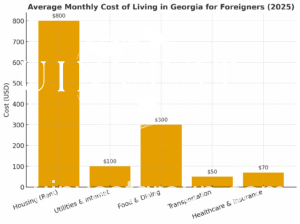
Georgia is meaningfully cheaper than most of Europe without feeling like a hardship posting. Here is a realistic monthly budget for one person and for a couple, in Tbilisi, living comfortably rather than frugally:

Item One person Couple
Rent, 1-bed, good district $500 – $900 $500 – $900
Utilities (power, water, heating, refuse) $60 – $110 $60 – $110
Internet and mobile $18 – $32 $25 – $45
Groceries $120 – $180 $200 – $300
Eating out $60 – $150 $120 – $300
Transport $15 – $40 $30 – $70
Private health insurance $30 – $80 $60 – $160
Typical monthly total $800 – $1,500 $1,000 – $1,900

Two honest caveats about any number in that table. Rent is the line that moves most, and it has been moving upward in the districts foreigners actually want. And heating is seasonal — a Tbilisi winter bill is not a Tbilisi summer bill, so the utilities range is an average rather than a monthly constant.

Food, transport and daily costs in detail

Everyday item Typical price
Metro or minibus ticket Under $0.20
Monthly transport pass $15 – $20
Taxi within Tbilisi $2 – $5
Petrol $1.00 – $1.20 per litre
Meal at a local restaurant $3 – $6
Mid-range dinner for two with wine $25 – $45
Private clinic consultation $20 – $50
Private health insurance $30 – $80 per month

Public transport is close to free by European standards and genuinely usable in Tbilisi. Outside the capital it thins out quickly, which matters if you are considering a hillside or coastal address rather than a central one — a car stops being optional.

One structural point about all of these figures: you will earn or hold in one currency and spend in another. Prices for property, and increasingly for rent in the districts foreigners favour, are quoted in US dollars, while salaries, utilities, groceries and service charges are paid in lari. If the lari weakens against the dollar, a dollar-denominated income goes further and dollar-quoted rent gets relatively more expensive for locals; if it strengthens, the reverse. Anyone living on foreign income should treat that as a real variable rather than background noise, and anyone letting a property should remember that dollar-quoted rent collected in lari is a currency position whether or not they intended to take one.

Housing: what renting and buying actually cost

Market Rent, 1–2 bed Buy, per m²
Tbilisi, prime districts (Vake, Saburtalo) $500 – $900 ≈ $1,300 average, +4% YoY
Tbilisi, premium new-build up to $1,200 Above city average
Tbilisi, Soviet-era districts (Gldani) $250 – $400 Below city average
Batumi and secondary cities $250 – $700 ≈ $1,400 – $1,900

Those purchase figures come from Colliers and Galt & Taggart market data. Note the counter-intuitive result: Batumi averages more per square metre than Tbilisi, because the coastal market is dominated by new-build and branded stock aimed at investors, while Tbilisi’s average is dragged down by a large older housing base. Neither city is forecast to see prices fall this year.

Where to live in Tbilisi

District 1-bed rent Who it suits
Vake $500 – $900 Families, international schools, established expats
Saburtalo $500 – $900 Modern blocks, business access, good value
Vera $500 – $850 Quieter and leafier, close to the centre
Old Town Premium for renovated stock Walkability and character, less space per dollar
Gldani and Soviet-era districts $250 – $400 Budget-focused, students, long-stay savers

Beyond the capital

City Character Trade-off
Tbilisi Capital; best mix of amenities, culture and business Highest rents, no sea
Batumi Black Sea coast, tourism, strongest new-build pipeline Sharply seasonal; thinner winter
Kutaisi Cheapest of the three; low-cost flights to Europe Fewest services and international options

On the coast the choice is really between city-centre and resort-style stock. Central options like Mardi City Center put you in walking distance of everything; hillside developments such as Mardi Hills trade that for quiet and a view but assume you drive; and branded beachfront schemes like Wyndham Gonio Family Club sit at the top of the price range. You can see the full range of apartments for sale in Georgia to compare.

Renting or buying?

Rent first. This is the single most useful piece of advice in this guide and it costs us a commission to give it. Georgian rental contracts are short and flexible, the transaction costs of buying are low but not zero, and a winter in Tbilisi or a February in Batumi will tell you more about whether you want to live there than any number of viewings in August.

Buy when you know which district you want, or when the purchase is doing a second job — an investment position, or the residency route below. Our legal checklist for buying in Georgia covers the due diligence to insist on before you sign anything.

Tax: the 1% regime, and what it does not cover

Georgia’s territorial tax system is one of the strongest reasons people move here, and unlike any yield forecast it is written in law.

Tax Rate Condition
Individual Entrepreneur, Small Business Status 1% On gross turnover up to GEL 500,000 (≈ $190,000) a year
Standard personal income tax 20% flat Outside the IE regime
Rental income, residential, to individuals 5% If no deductions are claimed
Capital gain on an apartment 5% Standard rate for individuals
Property tax up to 1% Of annual value, banded by household income
VAT registration threshold GEL 100,000 turnover in any 12 months

A registered Individual Entrepreneur paying 1% on turnover is close to the lowest effective rate available anywhere for a legitimately registered business, and it is the structure most freelancers and consultants here use. Rates and conditions are set out in the PwC summary of Georgian personal income tax.

Two limits worth stating plainly. The 1% regime covers business turnover, not employment — and as noted above, remote employment for a foreign employer has had a less clear-cut status since the March 2026 rule change. And the regime is a Georgian answer to a Georgian tax question; it says nothing about whether your home country still considers you tax-resident. That second point catches more people than the first. Take advice in both jurisdictions before restructuring anything.

Residency: the threshold rose to $150,000 on 1 March 2026

Georgia has offered a temporary residence permit to foreign buyers of non-agricultural property since 2019. For six years the qualifying value was $100,000. From 1 March 2026 it is $150,000, a fifty per cent increase under amendments passed in June 2025.

Feature Position
Qualifying value USD 150,000 from 1 March 2026
Previous value USD 100,000 (2019 – 29 Feb 2026)
Valuation By accredited appraiser, not purchase price
Combining properties Permitted — the threshold applies to total holdings
Property type Non-agricultural
Permit Temporary, renewable annually
Family Spouse and minor children on the same investment
Minimum stay None
Language test None
Processing ≈ 30 calendar days; expedited options exist
Existing holders Generally renew under the old threshold while they keep the property

Three details do most of the work here. The threshold is assessed on an accredited appraisal, not your invoice, and an appraisal can come in below what you paid — so buy with headroom rather than exactly at the line. Multiple properties can be combined to reach $150,000, provided each is properly registered and valued. And existing permit holders are not forced to top up retroactively; the new figure applies to new applicants.

The change is documented in the June 2025 amendments, and our Georgian residency guide walks through the application itself.

The other residency routes

Permit type Who it is for
Property investment Buyers at or above $150,000 by appraised value
Work Those with a Georgian employment contract
Business Entrepreneurs and company owners
Student Enrolled international students
Family reunification Family of Georgian citizens or residents

Applications go to the Public Service Development Agency, and title itself registers at the National Agency of Public Registry — often within one to three working days, which is among the fastest processes in any market we deal with.

How the $150,000 threshold compares

Market Property threshold Notes
Georgia $150,000 ≈30-day processing, no minimum stay
UAE (Dubai Golden Visa) AED 2,000,000 (≈ $545,000) 10-year renewable
Oman See our Golden Residency vs Owner Visa guide Two distinct routes, often conflated

Even after the increase, Georgia remains the cheapest property-linked residency route among the markets we cover — roughly 3.6 times below the Dubai threshold — with faster processing and no requirement to be physically present. If you are weighing several markets, that combination makes it an efficient first step even where the underlying property market moves more slowly.

Healthcare, schools and banking

Foreigners can use both public and private healthcare, and in practice most use private clinics: a consultation runs $20–$50 and private insurance $30–$80 a month. Standards in Tbilisi’s private hospitals are good for routine and mid-complexity care. For anything highly specialised, people tend to travel — Istanbul and Vienna are the usual destinations — which is worth factoring in if you are relocating with a chronic condition.

International school Curriculum
British International School of Tbilisi English National Curriculum, IGCSE and A-Level
International School of Georgia Full IB, ages 3–18
European School IB
QSI International School American-style, English-language

Tbilisi has around ten international schools, so families have genuine choice rather than a single option. Fees typically start around GEL 7,000 a year and rise with grade level — well below equivalent schools in Western Europe or the Gulf. Several Tbilisi universities also run English-language degree programmes.

Banking is straightforward by regional standards. TBC Bank and Bank of Georgia both offer English-language online banking, the lari is freely convertible, and account opening for foreigners is routine, though it has become more document-heavy than it was a few years ago. Budget time for it rather than assuming it happens on day one.

A note on how quickly this is changing. The cost figures above are current, but Georgia has not been a static market: rents in the districts foreigners actually want have risen noticeably since 2022, driven by a large influx of remote workers and relocating families, and the cheapest listings you will find in older guides no longer exist at those prices. Budget against today’s numbers rather than the ones that made the country famous, and assume the gap between Tbilisi’s prime districts and its outer ones keeps widening rather than narrowing.

Lifestyle, safety and community

Georgia is one of the safer countries in the region, with low violent crime and a strong culture of hospitality that foreigners consistently mention as the thing that made them stay. The expat and nomad community is well established: more than 34,000 digital nomads were registered in Georgia as of early 2026, and coworking spaces and nomad-friendly cafés are now a fixture in Vake and Saburtalo in Tbilisi and along the Batumi seafront.

Outside the cities the country is the real draw — skiing at Gudauri and Bakuriani, the Kakheti wine region, the Black Sea coast at Batumi and Kobuleti, and a set of UNESCO World Heritage sites within a few hours’ drive of the capital. For a country of this size the variety is unusual, and it is a large part of why people who come for the tax regime end up staying for other reasons.

The buying process, step by step

Buying here is genuinely simpler than in most of the markets we work in, and the low transaction costs are real money rather than a marketing line.

Stage What happens Typical position
1. Reservation Unit fixed, deposit paid Confirm what secures the money
2. Due diligence Title, encumbrances, developer checks Do this before, not after
3. Appraisal Accredited valuation Only needed for the residency route
4. Contract Sale agreement, translation, notarisation Insist on a language you read
5. Registration Title entered at the Public Registry Often 1–3 working days
6. Residency application Submitted to the PSDA ≈ 30 calendar days

There is no stamp duty at Turkish or Cypriot levels, which matters more than buyers expect at the lower end of the market: on a purchase in the $45,000–$65,000 range, transaction costs that run to several per cent elsewhere would outweigh the price difference between two competing projects. Registry fees are small and fixed, notary costs are modest and transaction-dependent, and the agency commission is a question to settle in writing rather than assume.

The step people skip is the third one. If residency is any part of your reason for buying, commission the accredited appraisal before you commit, because the appraised figure and the price on your invoice are two different numbers and only one of them counts toward the $150,000.

Two practical notes that rarely make it into relocation guides. First, pharmacies here are unusually capable — a great deal that would require an appointment elsewhere is handled over the counter, which is a genuine quality-of-life difference for everyday complaints. Second, the administrative culture is fast but paper-heavy: the Public Service Hall model means most bureaucracy happens in one building, in one visit, and quickly, but you will be asked for originals, translations and notarised copies far more often than you would in Western Europe. Keep a document folder and get things notarised in batches rather than one at a time.

What Georgia is not good at

Every guide to this country lists the advantages. Here are the things worth knowing before you commit, because they are the ones that actually cause people to leave.

  • Seasonality on the coast. Batumi runs hot in summer and thin from November to March. If you are buying there to let, the winter months are where the plan is tested.
  • Currency mismatch. Property is priced in dollars; rent and salaries arrive in lari. A weaker lari cuts your dollar income without the asset doing anything wrong.
  • A shallow resale market. Demand is driven substantially by foreign buyers. That is fine over a decade and uncomfortable if you need to sell quickly.
  • Air quality and traffic in Tbilisi. Both are worse than the marketing photographs suggest, particularly in winter.
  • Regulatory movement. The residency threshold has risen three times and the work rules changed in March 2026. Plan for the rules to keep moving.
  • Language. Georgian uses its own alphabet. English is common in Tbilisi’s centre and among younger people, and much less so elsewhere.

None of these is a reason not to move here. They are reasons to arrive with a twelve-month plan rather than a five-year assumption.

How Georgia compares on cost with the region

Absolute numbers matter less than the shape of the comparison. Against the other markets we sell, Georgia’s position is consistent: cheapest to enter, cheapest to run, lightest to tax, and thinnest on liquidity.

Factor Georgia How it compares
Monthly living cost, couple $1,000 – $1,900 Well below Dubai or Western Europe
Tax on business turnover 1% under the IE regime Among the lowest available anywhere
Tax on rental income 5% flat Very low by European standards
Residency threshold $150,000 ≈3.6× below the Dubai Golden Visa
Minimum stay for residency None Rare — most programmes require presence
Registration speed 1–3 working days Among the fastest we deal with
Transaction costs Low, no heavy stamp duty Cheaper than Türkiye or Cyprus
Market depth and liquidity Thin The main weakness
Seasonality Sharp on the coast More pronounced than Dubai or Istanbul

The last two rows are the price of the first seven. Tbilisi is a city of just over a million people and Batumi around 170,000, and property demand in both is driven substantially by foreign buyers and summer visitors rather than by deep domestic demand. That is a perfectly reasonable trade if you are buying for a decade and a genuinely uncomfortable one if you might need to exit in a hurry in February.

It also explains why the cheaper end of the market is the more liquid end here. The pool of buyers who can write a $50,000 cheque is far larger than the pool who can write a $400,000 one, so in a thin market a modest apartment is often the easier position to leave — the opposite of the instinct most investors bring from larger markets.

The property market outlook

Market Forecast growth Long-term gross yield
Tbilisi ≈ 3.2% for the year ≈ 7 – 9%
Batumi, primary market 4 – 6% year-on-year ≈ 7 – 9%

Neither city is expected to see prices fall this year, according to Colliers’ latest market review. The distinction that matters is character rather than headline growth: Tbilisi is the steadier, more established market with year-round tenant demand from professionals and students, while Batumi is the higher-growth, higher-volatility coastal alternative, still working through an earlier oversupply-driven slowdown and far more dependent on the summer.

Long-term rental yields are broadly comparable at roughly 7–9% gross, with Tbilisi edging ahead on consistency. Treat any short-let projection for Batumi with more caution: annualised occupancy figures smooth a very peaked curve into one comfortable number, and your cash flow does not arrive smoothed.

Community is the variable people underestimate in both directions. The established expat and nomad networks make a soft landing genuinely easy — there are ready-made social structures in Tbilisi and Batumi, and you can build a life in English without much friction. The flip side is that it is entirely possible to spend two years here inside that bubble and never learn the language or make Georgian friends, and the people who end up leaving after eighteen months are disproportionately the ones who did exactly that. The country rewards a bit of effort at integration more than most, largely because the hospitality is real and reciprocated.

A realistic first-year budget

Setting up costs more than living does. A rough first-year picture for a couple renting in Tbilisi, before any property purchase:

Item Estimate
Flights and shipping $1,000 – $4,000
Rental deposit and agency fee 1–2 months’ rent
Furnishing a semi-furnished flat $1,500 – $4,000
Living costs, 12 months $12,000 – $22,800
Health insurance, 12 months $720 – $1,920
IE registration and accounting Modest; budget for a local accountant
Contingency (10–15%) Recommended

If you are also buying, add the purchase price, an accredited appraisal if you are pursuing residency, notary and registry fees — all low by regional standards — and confirm in writing who pays the agency commission.

Relocation checklist

  • Arrive visa-free and give yourself a winter before deciding anything permanent.
  • Open a bank account early; allow more time and documents than you expect.
  • Take tax advice in both Georgia and your home country before restructuring income.
  • If you will work, resolve your status properly rather than relying on the visa-free period.
  • Rent in the district you think you want before buying in it.
  • If residency is the goal, size the purchase against $150,000 appraised, with headroom.
  • Commission the accredited appraisal before you commit, not after.
  • Register title at the Public Registry — usually one to three working days.
  • Budget for the first year at roughly double your steady-state monthly costs.

Frequently asked questions

How much do you need to live comfortably in Georgia? Roughly $800–$1,500 a month for one person in Tbilisi and $1,000–$1,900 for a couple, including rent, utilities, food, transport and private health insurance. Outside the capital it is lower.

Can foreigners buy property in Georgia? Yes, with no nationality restriction, no local partner, no minimum holding period and no exit permission. The one restriction is on agricultural land, which non-citizens generally cannot own. You do not need residency in order to buy.

How much property do I need to buy for residency? $150,000 by accredited appraisal since 1 March 2026, up from $100,000. Multiple properties can be combined to reach it, and the permit covers your spouse and minor children.

Can I keep my old permit if I bought under the $100,000 rule? Generally yes. Existing holders can normally continue renewing under the previous threshold while they keep the qualifying property. The $150,000 figure applies to new applicants.

How long can I stay without a visa? Up to 365 days for citizens of more than 95 countries, on a valid passport, with no application required.

Can I work remotely on the visa-free stay? This became a grey area after the March 2026 update, which separated visa-free entry from the right to work. Take local advice; if you are freelancing or running a business, register as an Individual Entrepreneur instead.

What tax will I pay? A registered Individual Entrepreneur with Small Business Status pays 1% on turnover up to GEL 500,000 a year. Standard personal income tax is a flat 20%. Residential rental income and capital gains on apartments are taxed at 5%.

Is Tbilisi or Batumi better? Tbilisi for year-round living, steadier prices and a deeper tenant market. Batumi for the sea, higher forecast growth and a sharper seasonal curve. Tbilisi is the safer default for a first move.

Related reading

Join The Discussion

Compare listings

Compare
Oman flag
HEADQUARTERS MUSCAT