




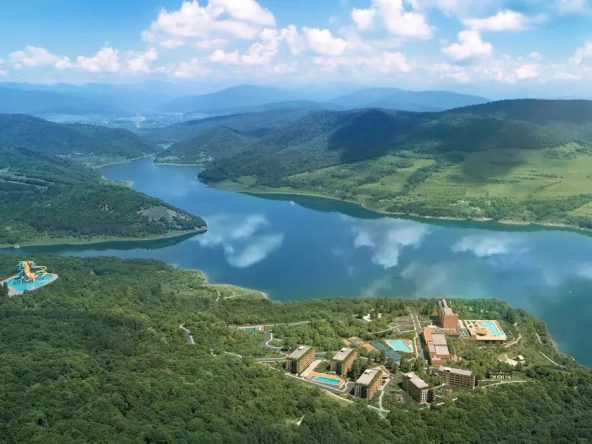
This guide, last checked on 12 November 2026, sets out what official statistics, statutes, a World Bank study, national weather normals and routing data say about property in Sioni, the lakeside settlement on the Sioni Reservoir in Tianeti Municipality, Mtskheta-Mtianeti, Georgia. It covers where Sioni lies and how far it is by road from Tbilisi, Tianeti, the airport and the neighboring towns; how many people live in Sioni, Tianeti and the region; the dam, volume, water level and operator of the reservoir; the 1991 to 2020 climate normals of the Tianeti weather station; the natural hazards and utilities documented for the area; and the price data that exist, and do not exist, for property in Sioni.
It then reads the one project listed on this site, sets out the rules a foreign buyer meets (ownership, registration fees, the reservoir-shore and protected-area provisions, building permits, taxes, the residence-permit threshold and mortgage limits) and ends with running costs. Every figure carries a source and a date. Lari amounts are converted to US dollars only at the National Bank of Georgia (NBG) official rate of GEL 2.5933 per US dollar, valid from 12 November 2026 (NBG: official exchange rates). One project is listed here as of 12 November 2026, so comparisons rest on published statistics and not on a set of listings. In this guide Sioni means the settlement and reservoir in Tianeti Municipality; it is a different place from Sioni Cathedral in Tbilisi and from the Ateni Sioni church.
Where property in Sioni sits: Tianeti Municipality and the two shores of the reservoir
Sioni is a settlement on the Sioni Reservoir in Tianeti Municipality, in the Mtskheta-Mtianeti region of eastern Georgia. Geostat, the national statistics office, lists the municipality among Georgia’s self-governed units, lists Tianeti as a borough and Sioni as a separate borough in its table of cities and boroughs (Geostat: population by self-governed unit; Geostat: population by cities and boroughs). Wikipedia describes Tianeti as the administrative center of a municipality with an area of 906.3 km² and 9,468 residents at the 2014 census, and describes Sioni as a townlet that arose in 1951 during the construction of the reservoir, received townlet status in 1960 and was called Sionmsheni until the 1970s (Wikipedia: Tianeti Municipality; Wikipedia: Sioni). OpenStreetMap holds the village area as way 79484670 with its center at 41.9913 N, 45.0278 E and an elevation tag of 1,000 m, and the reservoir as way 1195123245 (OpenStreetMap: Sioni; OpenStreetMap: Sioni Reservoir).
The name Sioni covers more than one point on the map, and that matters for anyone reading a location line. The village center and the north-west shore of the reservoir, where the project listed on this site gives its coordinates (42.01766 N, 44.980419 E, per the developer’s page, Archi: project page), are 4.9 km apart in a straight line, but the OpenStreetMap-based router used for this guide returns 20.0 km and 48 minutes between them by road, because the road network goes around the water. Distances “from Sioni” therefore depend on which shore is meant, and the next section gives both.
| Item | Figure | Source and date |
|---|---|---|
| Region | Mtskheta-Mtianeti | Geostat, 1 January 2026 |
| Local government | Tianeti Municipality; boroughs Tianeti and Sioni | Geostat, 1 January 2026 |
| Municipality area | 906.3 km² | Wikipedia, 12 November 2026 |
| Municipality residents, 1 January 2026 | 8,576 | Geostat |
| Density (calculated) | 9.5 residents per km² (8,576 / 906.3) | Geostat and Wikipedia |
| Sioni village center (OSM way 79484670) | 41.9913 N, 45.0278 E; ele tag 1,000 m | OpenStreetMap, 12 November 2026 |
| Tianeti town (OSM way 95067936) | 42.1098 N, 44.9682 E | OpenStreetMap, 12 November 2026 |
| Project coordinate (north-west shore) | 42.01766 N, 44.980419 E | Archi project page, 12 November 2026 |
| WMO climate station Tianeti (37439) | 42°06′ N, 44°58′ E; height 1,105 m | WMO normals 1991 to 2020 |
The Georgian National Tourism Administration (GNTA) lists the road time from Tbilisi to Tianeti as 1 hour 40 minutes and to Sioni village as 1 hour 20 minutes, with 6 hours 20 minutes from Batumi and 4 hours 10 minutes from Kutaisi to Sioni, and describes Sioni as 45 km from the capital (GNTA: Tianeti; GNTA: Sioni). Wikipedia gives 80 km from the Tbilisi railway station, and the developer’s pages give 50 km. These printed figures do not agree with each other, and the routed figures below sit between the shortest and the longest of them.
Routed distances from Sioni to Tbilisi, Tianeti and the airport
Road distances below were routed on 12 November 2026 with the public OSRM routing service on OpenStreetMap data (Project OSRM). There are two start points: the Sioni village center and the north-west shore at the project coordinate, which the router snapped to a road 310 m away. End points are OpenStreetMap features: the Tianeti town area, the Freedom Square area in Tbilisi, the Tbilisi International Airport aerodrome (relation 967676), the Didube bus station (way 471078555) and the town areas of Mtskheta, Rustavi, Sagarejo and Telavi. Durations are the router’s free-flow estimates and take no account of traffic, winter conditions or the state of the mountain road, so they are lower bounds. Straight-line distances are calculated here with the haversine formula from the same coordinates.
| To | From the village center: straight line / road / time | From the north-west shore: straight line / road / time |
|---|---|---|
| Tianeti town | 14.1 km / 36.1 km / 41 min | 10.3 km / 20.6 km / 47 min |
| Freedom Square, Tbilisi | 38.1 km / 74.2 km / 74 min | 39.0 km / 61.6 km / 95 min |
| Tbilisi International Airport | 36.4 km / 64.2 km / 66 min | 38.9 km / 77.6 km / 103 min |
| Didube bus station, Tbilisi | 33.9 km / 59.6 km / 69 min | 34.2 km / 54.3 km / 86 min |
| Mtskheta | 30.2 km / 64.2 km / 73 min | 28.8 km / 59.0 km / 90 min |
| Rustavi | 49.9 km / 73.0 km / 73 min | 52.8 km / 86.5 km / 110 min |
| Sagarejo | 37.6 km / 57.9 km / 60 min | 42.3 km / 71.3 km / 97 min |
| Telavi | 37.5 km / 61.2 km / 76 min | 41.9 km / 74.6 km / 114 min |
Three readings follow from the arithmetic. First, the road distance to central Tbilisi is 61.6 to 74.2 km depending on the shore, which is 1.6 to 1.9 times the 38 to 39 km straight line; a figure of 45 or 50 km for property in Sioni describes neither the road nor, strictly, the straight line. Second, the router gives different roads for the two shores: from the village center it returns 74 minutes to Freedom Square for 74.2 km, and from the north-west shore 95 minutes for 61.6 km, which suggests slower mountain sections on the second route. Third, GNTA’s printed 1 hour 20 minutes from Tbilisi to Sioni village is longer than the 74-minute routed figure from the village but shorter than the 95 minutes from the north-west shore.
GNTA’s Tianeti page says the road from the Gldani district of Tbilisi passes through 8 km of the Sabaduri forest and the village of Ghulelebi before the first view of the lake, and names other approaches from Jinvali, Saguramo and Kakheti (GNTA: Tianeti). Wikipedia’s entry on Tbilisi National Park states that the paved road between Tbilisi and Tianeti crosses the central part of the park over the Saguramolalno Range (Wikipedia: Tbilisi National Park). The site’s guide to Tbilisi real estate prices covers the market at the end of that road, and the Tbilisi city page covers the capital itself; the Georgia country page lists the other Georgian locations on this site.
Population: Sioni, Tianeti and Mtskheta-Mtianeti
Geostat publishes population estimates for the municipality, for the boroughs of Tianeti and Sioni and for the region. Its series was recalculated after the 2024 census: a note in the published tables states that, based on the results of the 2024 population census, the population size as of 1 January 2025 was recalculated, so the 2025 and 2026 figures and the recalculated earlier years are the ones to use (Geostat: population by self-governed unit). On 1 January 2026 Tianeti Municipality had 8,576 residents, of whom 2,946 lived in urban settlements and 5,630 in rural ones; the borough of Tianeti had 2,560 and the borough of Sioni 386 (Geostat: population by cities and boroughs). Mtskheta-Mtianeti had 93.2 thousand residents, about 2.4 percent of Georgia’s 3,941.1 thousand (Geostat: population as of 1 January 2026).
| Year (1 January) | Tianeti Municipality | Borough of Tianeti | Borough of Sioni |
|---|---|---|---|
| 2015 | 9,729 | 2,706 | 287 |
| 2018 | 9,262 | 2,635 | 291 |
| 2021 | 8,859 | 2,565 | 316 |
| 2024 | 8,739 | 2,607 | 357 |
| 2025 | 8,671 | 2,559 | 374 |
| 2026 | 8,576 | 2,560 | 386 |
| Change 2015 to 2026 (calculated) | -11.9 percent | -5.4 percent | +34.5 percent |
The census counts give a second reference. The 2014 census recorded 9,468 residents in Tianeti Municipality (Geostat: 2014 census main results), and the World Bank study of the Sioni watershed reproduces the Geostat census table by settlement, in which Daba Sioni, the urban settlement, had 371 residents and the territorial body of Sioni, which adds the surrounding villages, had 920 (World Bank: Sioni Reservoir watershed assessment, Annex 2). The 2026 estimate for the borough of Sioni, 386, is therefore 4.0 percent above the 2014 census count of 371 (386 / 371), while the municipality as a whole is 9.4 percent below its census count of 9,468 (8,576 / 9,468 = 0.906).
Two points are worth separating. The permanent population of Sioni is small: 386 people are 4.5 percent of the municipality (386 / 8,576), and Tianeti borough holds 29.9 percent (2,560 / 8,576). And the figures describe residents, not seasonal occupants; the World Bank study says that the settlement hosts thousands of holiday-makers during the year, but no source read for this guide counts them. The municipality’s own register differs from Geostat’s: the study cites about 13,800 people registered by Tianeti Municipality in December 2021 against Geostat’s then-published estimate of about 10,300, and the study itself notes that local governments and the statistics office often report different numbers.
The Sioni Reservoir: dam, volume, water level and operator
The reservoir is the reason for the settlement and the main physical fact about property in Sioni. The World Bank’s 2022 assessment of the Sioni watershed describes a multi-purpose reservoir operated since 1963 and supported by an earth dam designed as 84.8 m high and 780 m long, with a useful volume of 315 million m³ and a dead volume of 10.0 million m³, a normal flood level of 1,068.3 m and a forced flood level of 1,070.3 m (World Bank: Sioni Reservoir watershed assessment). Adding the two volumes gives 325 million m³ in total. GNTA gives the same year, 1963, and adds a depth of 67 m at the deepest point and an area of 12.8 km² (printed there as “12.8 km”), with the Iori River feeding the reservoir and regulating its discharge (GNTA: Sioni; GNTA: Lake Sioni).
| Item | Figure | Source |
|---|---|---|
| In operation since | 1963 | World Bank 2022; GNTA |
| Dam | Earth dam, designed 84.8 m high, 780 m long; average height 73 m | World Bank 2022 |
| Useful volume / dead volume | 315 million m³ / 10.0 million m³ (325 million m³ together, calculated) | World Bank 2022 |
| Normal / forced flood level | 1,068.3 m / 1,070.3 m | World Bank 2022 |
| Outlets | Two gates of 25 m³/s each (hydropower and irrigation); emergency spillway 600 m³/s | World Bank 2022 |
| Stated purposes | Regulate Iori runoff; irrigate 68,400 ha in Kakheti and Kvemo Kartli; fill the Tbilisi Sea; five hydropower plants on the Sioni-Paldo-Tbilisi Sea tract | World Bank 2022 |
| Area as printed | 12.8 km²; maximum depth 67 m | GNTA |
| Area of the OpenStreetMap outline | About 4.9 km² (calculated from the polygon tagged “Low water level”) | OpenStreetMap, 12 November 2026 |
| Seasonal level | Highest in the second half of July, lowest in March | GNTA |
| Irrigation infrastructure manager | Georgia Amelioration, a state-owned company | World Bank 2022 |
| Hydropower | Sioni HPP, 9 MW, operated by Energo-Pro Georgia; about 33 million kWh a year | World Bank 2022 |
The shoreline of a reservoir is not fixed, and the sources show how much is at stake. The GNTA page states that the level peaks in the second half of July and falls to its minimum in March. The OpenStreetMap polygon for the reservoir carries the tag “Low water level”, and the area enclosed by it, calculated here with the shoelace formula on its 542 nodes, is about 4.9 km², against the 12.8 km² printed by GNTA; the two figures describe different states of the water and different sources, and neither is a survey of the reservoir at a stated date. The practical meaning is that a unit described as lakefront sits next to a water body whose edge moves through the year and whose volume is managed for irrigation and power.
The World Bank study adds the operating context. The reservoir supplies water to the Sioni HPP and, through the Paldo headworks, to the Upper and Lower Samgori irrigation systems; the study states that in recent years, with a sharp decline in precipitation in eastern Georgia, the reservoir has not been filled to capacity and water is mainly released during the irrigation season. It also reports that sedimentation shortens the life of the reservoir and that a bathymetric survey of 2016 showed the reservoir had already lost approximately 75 percent of its volume. Upstream of the lake the sediment has raised the riverbed by 3 to 5 m, and since 2015 the Iori has overflowed its banks during annual floods and freshets, causing damage in the riverine area. The study calls for landscape restoration, a 15 m vegetated buffer zone on the left shore, sediment capture ponds and forest restocking in the ravines that drain to the lake.
Those statements come from a 2022 assessment, and the study does not say what was done afterward. They are included because they describe the water body that a buyer in Sioni would live beside: a working reservoir with an operator (Georgia Amelioration for the irrigation infrastructure, Energo-Pro Georgia for the power plant), a seasonal level cycle and a documented sediment problem.
History and heritage around Sioni
Wikipedia dates the settlement to 1951, when the reservoir was under construction, and gives it townlet status from 1960. Before the water rose, a basilica from the second half of the 5th century stood in the valley, together with several medieval monuments; a large part of those monuments was submerged, and the basilica was dismantled and moved to Tbilisi (Wikipedia: Sioni). GNTA’s page on the Sioni burial vault adds that an archaeological expedition in 1962 unearthed more than 100 graves and a 5th to 6th century sarcophagus around the basilica, that the graves of nobles and of poorer people dated to the 4th and 5th centuries, and that the basilica and the tomb were taken apart and moved to the Tbilisi ethnographic museum so that the reservoir would not engulf them (GNTA: Sioni burial vault).
The relocated church is known as the Ertso Sioni basilica. A Tbilisi State University art-history database records it as a domeless three-aisled basilica of the second half of the 5th century with renovation in the 8th to 9th centuries and two layers of murals, notes that the second layer was badly damaged in dismantling and transfer, and gives its present location as the Giorgi Chitaia Open Air Museum of Ethnography of the Georgian National Museum (Tbilisi State University: Ertso Sioni Church). Wikipedia’s entry on the museum also lists an early Christian “Sioni” basilica from Tianeti and a family burial vault with a sarcophagus (Wikipedia: Tbilisi Open Air Museum of Ethnography). In other words, the church that gave the reservoir settlement its name is in Tbilisi, not on the shore.
| Site or event | What the source says | Source |
|---|---|---|
| Settlement founded | 1951, during construction of the reservoir; townlet status 1960; named Sionmsheni until the 1970s | Wikipedia |
| Reservoir in operation | 1963 | World Bank 2022; GNTA |
| Excavation of the basilica area | 1962: more than 100 graves and a 5th to 6th century sarcophagus | GNTA |
| Ertso Sioni basilica | Second half of the 5th century; dismantled and moved to the Open Air Museum of Ethnography, Tbilisi | Tbilisi State University; Wikipedia |
| Around Tianeti | About 100 medieval churches and fortresses, including Bochorma church, Bodoji castle, Jaleti church, the King Archil monastery in Nadokra (8th century) and the Kveteri fortified city (10th to 11th centuries) | GNTA |
| Tianeti town | Historical Museum of Tianeti with finds from the early Bronze Age to the late medieval period; Kujana Garden and the Tianetoba festival | World Bank 2022 |
GNTA’s Tianeti page counts around 100 medieval churches and fortresses around the town and names Bochorma church, Bodoji castle and Jaleti church, the King Archil monastery of the 8th century in the village of Nadokra, and, east of Tianeti on the way to Kakheti, the Kveteri fortified city of the 10th to 11th centuries (GNTA: Tianeti). The World Bank study lists the Historical Museum of Tianeti, the house-museum of the poet Mirza Gelovani, the Kujana Garden and the Tianetoba festival (World Bank: Sioni Reservoir watershed assessment). None of these is a property-market fact, but they are the cultural content of the area that surrounds property in Sioni.
Climate and natural hazards at 1,000 meters
Sioni sits at roughly 1,000 to 1,100 m: the OpenStreetMap elevation tag for the village is 1,000 m, the reservoir’s normal flood level is 1,068.3 m and the developer gives 1,100 m for its site. The nearest station with World Meteorological Organization 1991 to 2020 climate normals is Tianeti (WMO 37439) at 1,105 m, about 14 km in a straight line from the village center. The normals below come from the NOAA archive of the WMO file for the station (WMO normals: Tianeti 1991 to 2020). Tbilisi (WMO 37445, 432 m) is the comparison (WMO normals: Tbilisi 1991 to 2020).
| Month (Tianeti, 1,105 m) | Precipitation, mm | Days with 1 mm or more | Mean daily maximum, °C | Mean daily minimum, °C | Days with snow depth above 0 cm | Days with minimum below 0 °C |
|---|---|---|---|---|---|---|
| January | 26.5 | 5.6 | 3.1 | -7.8 | 23.1 | 30.1 |
| February | 28.7 | 5.4 | 4.7 | -6.6 | 19.4 | 26.6 |
| March | 41.2 | 7.0 | 8.8 | -1.8 | 10.9 | 19.2 |
| April | 73.3 | 10.0 | 13.8 | 3.2 | 1.1 | 5.0 |
| May | 90.8 | 11.8 | 18.9 | 8.0 | 0.0 | 0.3 |
| June | 85.5 | 9.4 | 23.3 | 11.8 | 0.0 | 0.0 |
| July | 57.5 | 6.9 | 26.3 | 14.3 | 0.0 | 0.0 |
| August | 56.4 | 6.3 | 26.4 | 13.9 | 0.0 | 0.0 |
| September | 50.6 | 6.1 | 21.6 | 9.7 | 0.0 | 0.0 |
| October | 62.0 | 7.6 | 16.2 | 5.0 | 0.1 | 2.4 |
| November | 36.5 | 5.5 | 9.7 | -1.0 | 3.2 | 17.2 |
| December | 30.1 | 5.1 | 4.9 | -6.0 | 13.4 | 27.8 |
| Year | 639.2 | 86.7 | 14.8 | 3.6 | 71.2 | 128.6 |
The table shows a spring and early-summer rainfall peak: May has the most precipitation at 90.8 mm, June follows at 85.5 mm, and January the least at 26.5 mm, for 639.2 mm a year and 86.7 days with 1 mm or more. Snow lies for 71.2 days a year at the station, with 23.1 days in January and 19.4 in February, and the minimum temperature falls below 0 °C on 128.6 days a year. July and August are the warmest months, with mean daily maxima of 26.3 and 26.4 °C. The file also lists the extremes of the 1991 to 2020 period: a highest daily maximum of 40.0 °C in August and a lowest daily minimum of -26.1 °C in January.
| Annual normal, 1991 to 2020 | Tianeti (1,105 m) | Tbilisi (432 m) |
|---|---|---|
| Precipitation | 639.2 mm | 511.5 mm |
| Days with 1 mm or more | 86.7 | 71.4 |
| Mean daily maximum | 14.8 °C | 19.4 °C |
| Mean daily minimum | 3.6 °C | 9.5 °C |
| Days with snow depth above 0 cm | 71.2 | 9.2 |
| Days with minimum below 0 °C | 128.6 | 46.5 |
| Days with maximum of 25 °C or more | 62.9 | 128.4 |
| Days with maximum of 30 °C or more | 10.7 | 65.7 |
Set beside the capital, the Tianeti station, 673 m higher than the Tbilisi station (1,105 m against 432 m), records 4.6 °C lower mean maxima, 5.9 °C lower mean minima, 7.7 times as many days of snow cover and 2.8 times as many days of frost (128.6 / 46.5), while the number of days with a maximum of 30 °C or more is 10.7 against 65.7. The sources give no station record for the lake shore itself, so the Tianeti normals are the nearest station data and not a measurement at the reservoir. The World Bank study also lists an older Sioni station (1,047 m, observation years 1927 to 1988) and notes a Geography Institute station near the reservoir operating since 2018, but publishes only a partial monthly series for 2020 for the latter, which is not a climate normal.
Natural hazards documented for Tianeti Municipality
The World Bank study states that Tianeti Municipality is one of Georgia’s most high-risk areas in terms of geological activity, with flash floods, mudflows and landslides frequent across the municipality, and that extreme precipitation causing floods and landslides has been increasing because of climate change. Citing the National Environmental Agency bulletin on natural geological processes in 2020 and the forecast for 2021, it names sections of the Tianeti-Akhmeta road and the Sagami River gorge among the high-risk areas and records 1,120 m of riverbank being washed away in the municipality (World Bank: Sioni Reservoir watershed assessment). A buyer reading a plot or a building in Sioni cannot take these municipality-wide statements as a statement about a given parcel; they are the reason the geological and flood information in a project’s permit file matters.
Services, roads and utilities in Sioni
The most detailed public description of utilities in Sioni is the 2022 World Bank study, which relied on municipal and company letters dated 2021. Its findings, as of that report, were as follows. Central water supply managed by the United Water Supply Company of Georgia (UWSCG) serves the town of Sagarejo and the settlements of Tianeti and Sioni, but only a few residential districts of Sioni, especially those newly built up with summerhouses, were not covered, and water supply for those districts was expected in the short to medium term within a plan for a large-scale urban overhaul of Sioni. Natural gas in Tianeti Municipality was supplied only to several settlements, including Sioni and Tioni. There were no sewage treatment facilities in the town of Sioni, and collected sewage was discharged directly into creeks, drainage canals and the tributaries of the Iori. Internet access was limited in Tianeti and Sioni, while mobile telephone networks had good coverage in Tianeti Municipality. An unregulated dumpsite of 4,078 m² in Sioni had been closed by the Solid Waste Management Company of Georgia after two formal landfills were established, with the Tianeti landfill receiving about 198 m³ of waste a month (World Bank: Sioni Reservoir watershed assessment).
| Service | Position stated in the 2022 World Bank study | Note |
|---|---|---|
| Piped water | Central supply by UWSCG in Sioni; some newly built summerhouse districts not covered | Expansion was described as expected |
| Natural gas | Supplied to several settlements in the municipality, including Sioni | Connection of a given building is a separate matter |
| Sewage treatment | None in Sioni; sewage discharged into creeks and canals | Relevant to water quality of the Iori |
| Internet | Limited in Tianeti and Sioni | Mtskheta-Mtianeti household internet 77.8 percent (Geostat 2021, cited) |
| Mobile network | Good coverage in Tianeti Municipality | |
| Waste | Sioni dumpsite closed; municipal landfill in Tianeti; regional landfills expected 2025 to 2026 | Status after 2022 not read |
On public transport, the only official statement found is on the Tbilisi National Park page of the Agency of Protected Areas, which says minibuses toward the national park leave the Didube bus station every half hour and that travelers can also use public transport toward Tskvarichamia-Tianeti, which departs from the same station (National Parks of Georgia: how to get to Tbilisi National Park). It gives no timetable or fare for Tianeti or Sioni, and the 2022 World Bank study does not describe a regular service to Sioni. The nearest international airport by the routed figures above is Tbilisi International Airport, 64.2 km from the village center and 77.6 km from the north-west shore by road. The study describes the Tbilisi-Bakurtsikhe-Lagodekhi road as the road of international importance in the southern part of its study area, with Sagarejo 50 km (45 minutes) from Tbilisi.
Schools, hospitals and shops
A description of Tianeti in the Wikipedia entry, adapted from a 2012 academic chapter that reports on 2008, lists two secondary schools, two kindergartens, a vocational school, a library, a hospital, an ethnographic museum, a post office, a police station, a bank office and a farmers’ market in the town, and says that none of the Soviet-era factories and farms was working (Wikipedia: Tianeti). That is a 2008 snapshot and is not a current service list. No Geostat or ministry source read for this guide gives a current count of facilities in Sioni itself, so the practical reading is that Tianeti, 14 km away in a straight line and 36 km by road from the village center, is the nearest town with the public institutions listed.
Running costs: electricity, water and gas
The Georgian National Energy and Water Supply Regulatory Commission (GNERC) publishes the end-user tariffs. For household electricity it lists two universal service providers. For EP Georgia Supply the tariffs valid from 1 July 2026 to 1 January 2027, including VAT, are 19.731 tetri per kWh for 0 to 101 kWh, 23.731 tetri for 101 to 301 kWh and 28.227 tetri above 301 kWh; for Telmico the same bands are 20.261, 24.053 and 28.537 tetri (GNERC: end-user tariffs). The commission’s page does not map the supplier to municipalities, so which of the two serves a Sioni address is shown on the electricity contract. In the first band, 100 kWh at 19.731 tetri costs GEL 19.73 (100 times 0.19731), about $7.6.
For water, GNERC’s page lists the United Water Supply Company of Georgia with household tariffs including VAT that have applied since 1 November 2011: GEL 0.499 per cubic meter if metered (0.419 for drinking water and 0.080 for wastewater) and GEL 2.395 per person a month if not metered (GNERC: water supply tariffs). At the metered rate, 10 cubic meters in a month cost GEL 4.99 (10 times 0.499), about $1.92. GNERC’s natural-gas table is organized by distribution company and the sources read do not state which company serves Sioni, so no gas tariff is given here. The site’s cost guide living in Georgia as a foreigner sets utilities beside rent and food.
| Cost | Tariff | Source and period |
|---|---|---|
| Electricity, 0 to 101 kWh (EP Georgia Supply) | 19.731 tetri/kWh | GNERC, 1 July 2026 to 1 January 2027 |
| Electricity, 101 to 301 kWh | 23.731 tetri/kWh | GNERC, same period |
| Electricity, above 301 kWh | 28.227 tetri/kWh | GNERC, same period |
| Electricity, 0 to 101 kWh (Telmico) | 20.261 tetri/kWh | GNERC, same period |
| Water, UWSCG, metered household | GEL 0.499/m³ including VAT | GNERC, in force since 1 November 2011 |
| Water, UWSCG, un-metered household | GEL 2.395 per person a month | GNERC, same |
Tourism, building activity and the local economy
The World Bank study describes the Sioni settlement as a health and wellness resort where tourist camps, vacation houses and sports facilities host thousands of holiday-makers all year, and says many vacationers, especially from Tbilisi, Tianeti, Telavi and Akhmeta, choose Sioni for the summer because of its proximity, the mild climate and the combination of lake, mountains and forest. It treats agriculture, forestry, sand and gravel extraction, hydropower and tourism as the human activities of the study area, and states that the area does not carry large industrial facilities (World Bank: Sioni Reservoir watershed assessment). GNTA’s Sioni pages add summer swimming, fishing for carp and other fish, forest walks and mushroom and berry foraging, and describe the climate as humid, with cold snowy winters and hot summer days with cool evenings (GNTA: Sioni). No Geostat table read for this guide counts visitors to Sioni or to Tianeti Municipality, so the extent of seasonal use is described by the sources in words and not in numbers.
Geostat’s construction statistics are published by region. Its 2025 release states that 13.0 percent of completed buildings in Georgia in 2025 were in Mtskheta-Mtianeti, behind Tbilisi at 34.4 percent, and that the region held about 2.4 percent of the population (Geostat: permits and completed objects, 2025; Geostat: population as of 1 January 2026). The release counts objects, not floor area or dwellings, and it does not break the figure down by municipality, so it cannot be read as activity in Sioni; it shows only that the region’s share of completed buildings is about 5.5 times its share of the population (13.0 / 2.36).
| Indicator | Mtskheta-Mtianeti | Georgia | Source |
|---|---|---|---|
| Population, 1 January 2026 | 93.2 thousand | 3,941.1 thousand | Geostat |
| Share of population (calculated) | 2.4 percent | 100 percent | Geostat |
| Share of completed buildings, 2025 | 13.0 percent | 100 percent | Geostat |
| Rural share of population, 2026 (calculated) | 76.1 percent (70.9 / 93.2) | 37.3 percent (1,468.6 / 3,941.1) | Geostat |
| Tianeti Municipality residents, 2026 | 8,576 | Geostat |
Prices for property in Sioni: what is published
The official price statistics in Georgia do not cover Tianeti Municipality. Geostat’s Residential Property Price Index covers only the market of new dwellings in Tbilisi, flats and detached houses, and is built from advertised offer prices scraped from listing sites; for the third quarter of 2026 it recorded a rise of 1.5 percent on the previous quarter and 5.9 percent on a year earlier, with flats up 5.6 percent and detached houses up 7.0 percent year on year (Geostat: Residential Property Price Index, third quarter of 2026). Those are Tbilisi numbers, and they say nothing about Sioni. Galt & Taggart’s quarterly market watch of 14 August 2026 reports sales counts and average turnkey prices by zone for Batumi and for Kobuleti, and has no zone for Sioni or Tianeti (Galt & Taggart: Batumi residential real estate, 2Q26). The site’s Georgia real estate market page and the Batumi city page use those sources for the coast.
For Sioni the available price information is therefore of three kinds, and none is a statistic. First, developers print asking prices on their own pages. The developer of the project listed here prints no price, handover date or payment plan on its project page as of 12 November 2026, and every price field in its public flats feed reads zero. Second, brokers and listing portals print asks that change without notice, and any ask copied here would be a single dated advertisement and not a market price. Third, ministries and the statistics office publish no per-square-meter series for the municipality. The honest summary is that a reader looking for a market price for property in Sioni will find advertised asks and no registry-based average; the Tbilisi index above is the nearest official series, and it describes a different market at a lower altitude.
| Source | Coverage | Covers Sioni? |
|---|---|---|
| Geostat Residential Property Price Index (23 October 2026) | New flats and detached houses in Tbilisi; offer prices | No |
| Galt & Taggart quarterly market watch (14 August 2026) | Batumi zones and Kobuleti; primary-market turnkey apartments | No |
| Geostat population, hotels and construction releases | Region or national level | Region only |
| Developer pages and portals | Single projects or single advertisements | Asks only, no average |
For a buyer this means that comparing a quoted price in Sioni with the Tbilisi or Batumi averages compares different locations, altitudes, building types and, often, finishing standards. The Tbilisi price guide and the market overview set out the reference series on this site.
Property in Sioni listed on this site: Sioni Lake Resort and Spa
One project is listed under Sioni as of 12 November 2026: Sioni Lake Resort and Spa by Archi, on the north-west shore of the reservoir. The table sets out what the developer’s page prints on 12 November 2026 (Archi: Sioni Lake Resort & Spa); the site’s guide to the project reads the developer, the design studio and the press side by side and is the place for the detail.
| Item | As the developer prints it (archi.ge, 12 November 2026) |
|---|---|
| Developer | Archi |
| Location | North-west shore of the Sioni Reservoir; page coordinates 42.01766 N, 44.980419 E; about 1,100 m above sea level, about 50 km from Tbilisi (developer’s wording) |
| Format | Five apartment hotels with studios and larger apartments, sold furnished |
| Blocks with sales data | A, B and C, each shown as ongoing at 56 percent construction progress |
| Units | 271 in blocks A to C: 104 marked sold, 167 for sale |
| Unit types in the public flats feed | 1-room (82 units, 32.8 to 66.3 m²), 2-room (39, 64.2 to 73.0 m²), 3-room (45, 85.5 to 95.7 m²), 5-room (1, 118.3 m²) |
| Price, handover date, payment plan | No figure printed |
Set against the place facts above, three things stand out. The developer’s “about 50 km from Tbilisi” compares with 61.6 km by the routed road from the project coordinate to Freedom Square, which is 1.2 times the printed figure, and with 39.0 km in a straight line. The developer’s “about 1,100 m” is consistent with the reservoir level of 1,068.3 m given by the World Bank and the 1,105 m of the Tianeti station. And the project’s north-west shore is 20.0 km by road from the Sioni village center, so the services described in the 2022 study for the town of Sioni (water, gas, no sewage treatment) are those of the village, not statements about the shore where the project stands.
Buying property in Sioni: ownership, land category and registration
Under the Civil Code, to acquire an immovable thing the transaction must be made in writing and the acquirer’s ownership right must be registered in the Public Registry (Civil Code of Georgia, Article 183). Article 312 presumes that the Registry’s records are accurate until proved incorrect and that an entry is deemed accurate in favor of a person who acquires a right from the registered transferor, unless a complaint has been filed against the entry or the acquirer knows it is wrong. Ownership therefore arises on registration, not on payment. The site’s explainers Can foreigners buy property in Georgia and How to buy property in Georgia take the steps in order, and buying property in Georgia from abroad covers a buyer who does not travel.
The nationality condition in the statutes read for this guide concerns agricultural land. Article 4 of the Organic Law on Agricultural Land Ownership lists who may own it: the state, an autonomous republic, a municipality, Georgian citizens and Georgian-registered companies whose dominant partner is one of those; an alien may hold it if inherited, and a company with an alien dominant partner may hold it on an investment plan approved by the Government (Organic Law on Agricultural Land Ownership, Article 4). That matters in a rural municipality like Tianeti, where a house plot, a field and a forest strip can sit side by side: an apartment in a building stands on non-agricultural land, while a plot sold as farmland is governed by the agricultural-land rules. The Law on the Legal Status of Aliens itself assumes that an alien holds a property right in non-agricultural immovable property when it describes the residence permit tied to real estate (Law on the Legal Status of Aliens and Stateless Persons, Article 15).
The National Agency of Public Registry (NAPR) publishes its fees. Registering the change, origin or termination of a right to immovable property costs GEL 150 within 4 working days, GEL 270 within 1 working day and GEL 350 on the day of filing (NAPR: immovable property registration fee). Confirming the parties’ signatures on a transaction submitted for registration costs GEL 7. A registry extract costs GEL 20 for one working day or GEL 13 if requested online, with GEL 26 added for an English version (NAPR: informational services fee). The dollar column below is arithmetic at the NBG rate of 2.5933.
| NAPR service | Fee | About, in US dollars |
|---|---|---|
| Registration of a change of right, within 4 working days | GEL 150 | $57.8 |
| Registration of a change of right, within 1 working day | GEL 270 | $104.1 |
| Registration of a change of right, on the day of filing | GEL 350 | $135.0 |
| Confirmation of the parties’ signatures | GEL 7 | $2.7 |
| Registry extract, 1 working day | GEL 20 | $7.7 |
| Registry extract, 1 working day, online | GEL 13 | $5.0 |
| English version of an extract, added | GEL 26 | $10.0 |
Reservoir-shore, protected-area and permit rules near Sioni
Three bodies of law bear on a plot beside the reservoir, and each is read here from its text. The first is the Law on the Regulation and Engineering Protection of the Sea, Water Bodies and River Banks (No. 576-IIs of 27 October 2000, most recently amended by Law No. 1862/8 of 16 September 2026). Its Article 2(e) defines the shore engineering protection zone of a water body as the space that includes the water area and a land strip of not more than 100 m in width, made up of a strict-supervision strip and a permanent-monitoring strip. Under Article 5 the boundaries of such zones are drawn up by the department with the interested bodies and municipalities and approved by the minister of regional development and infrastructure in a subordinate act. Article 6 provides that private land in the strict-supervision strip stays in private ownership (Law on the engineering protection of the sea coast, water bodies and river banks, Articles 2, 5, 6 and 9).
For construction in such a zone Article 9 requires the body that issues the permit to involve the department as an interested administrative body and send it the documentation for a mandatory opinion, and requires the project of a building in the zone to provide for the costs of compensating the expected damage to the bank. It allows the use of the territory in the strict-supervision strip for placing temporary structures, and bans extraction of inert material in the strict-supervision strips of the sea, water bodies and rivers except for shore-forming management and river regulation. Article 9(3) also says that use of the beach for health and recreational purposes is not restricted and that fencing a beach off with capital or impassable structures is not allowed; the provisions read here do not say how that sentence applies to the edge of a reservoir whose level changes by season, and none of the sources read publishes the approved boundary of the zone around the Sioni Reservoir.
UNEP’s legal database summarizes the Law on Water Resources Management of 2023 as defining water protection zones, including water protection strips and sanitary protection zones, within which specific restrictions apply, and as regulating the use of land associated with water bodies (UNEP LEAP: Law of Georgia on Water Resources Management, 2023). The same database lists the earlier Government Resolution No. 440 of 2013 on water protection zones as repealed. The widths and restrictions that apply to a particular plot are shown in the permit file and the planning documents, not in the summary.
The second body is the Law on the System of Protected Areas. Article 12 provides that the State is the sole owner of the territories of state reserves, national parks, natural monuments and managed reserves, and that transferring them to natural and legal persons is inadmissible except for the narrow cases the article lists; Article 16 allows support (buffer) zones to be created around them (Law of Georgia on the System of Protected Areas, Articles 12 and 16). Tbilisi National Park, established in 1973 and covering 243 km² according to Wikipedia, lies north of Tbilisi, and the Tbilisi-Tianeti road crosses it (Wikipedia: Tbilisi National Park). The third is the Code on Spatial Planning, Architectural and Construction Activity: a building must correspond to the type of use allowed in the functional sub-zone of its plot (Article 92), the legal ground for construction is a building notice or a construction permit (Article 93), and buildings of Classes III and IV need a construction permit while Class I needs a simple building notice (Article 94) (Spatial Planning, Architectural and Construction Activity Code, Articles 92 to 94).
| Rule | What the statute says | Where |
|---|---|---|
| Shore zone of a water body | Water area plus a land strip of not more than 100 m; strict-supervision and permanent-monitoring strips | Law 576, Art. 2(e) |
| Zone boundaries | Drawn up by the department with municipalities; approved by the minister in a subordinate act | Law 576, Art. 5 |
| Private land in the strict-supervision strip | Remains private property | Law 576, Art. 6 |
| Construction permit in the zone | Department involved; mandatory opinion; compensation costs for expected bank damage in the project | Law 576, Art. 9(1) and (2) |
| Inert material extraction | Banned in the strict-supervision strips except for shore-forming management and river regulation | Law 576, Art. 9(5) |
| National parks and reserves | State is sole owner; transfer to private persons inadmissible save listed cases | Protected Areas Law, Art. 12 |
| Buffer zones | May be created around protected areas as multi-purpose use areas | Protected Areas Law, Art. 16 |
| Permitted use | Building must match the use allowed in the functional sub-zone | Spatial Code, Art. 92 |
| Legal ground for building | Building notice or construction permit; Classes III-IV need a permit | Spatial Code, Art. 93-94 |
Which sub-zone, which class and which permit apply to a plot in Sioni is a matter for the municipal planning documents and the permit file, and none of the sources read for this guide publishes them plot by plot. The statutes explain why the registry extract, the building permit and the documentation of the department’s opinion are the documents that settle those questions, and why a plot at the water’s edge is a different case from one on the slope above it.
Taxes, residence permit and mortgage limits for property in Sioni
The Tax Code taxes a natural person on real estate that he or she owns. The text of the Code on the legislative portal was changed by Law No. 1874 of 30 September 2026. Article 202(5) sets the tax on taxable property other than land of a natural person at not less than 0.8 percent and not more than 1 percent of the market value of the property at the end of the year preceding the current calendar year, and Article 206(1)(a) exempts a natural person’s taxable property other than land if the family’s income in the year preceding the current calendar year does not exceed GEL 100,000 (Tax Code of Georgia, Articles 202, 205 and 206). The Revenue Service’s property-tax page asks only whether family income did not exceed or exceeded GEL 100,000 (Revenue Service: property tax). Guides written before 30 September 2026 may therefore show the earlier GEL 40,000 exemption.
A worked illustration shows the range, with an assumed value and not a Sioni price: for taxable property with a market value of GEL 200,000 ($77,122 at the NBG rate), a family with income above GEL 100,000 faces a tax of 0.8 to 1 percent, which is GEL 1,600 to GEL 2,000 a year ($617 to $771); a family whose income did not exceed GEL 100,000 is exempt under Article 206. The market value for tax purposes is not necessarily the contract price. A natural person files a property tax return by 1 November and pays by 15 November (Article 205(12) and (14)), and the page property tax in Georgia covers the declaration steps.
| Tax | What the Tax Code says | Article |
|---|---|---|
| Property tax, family income above GEL 100,000 | 0.8% to 1% of market value at the end of the preceding year | 202(5) |
| Exemption, family income up to GEL 100,000 | Natural person’s taxable property other than land | 206(1)(a) |
| Return and payment dates | Return by 1 November; payment by 15 November | 205(12), (14) |
| Income from renting out residential space, no deductions | 5% income tax | 81(2) |
| General personal income tax rate | 20% | 81(1) |
| Surplus from selling a residential apartment (house) | 5%; exempt if owned for more than two years | 81(3), 82(1)(f.a) |
| VAT rate | 18% | 166 |
For rent, Article 81(2) taxes at 5 percent the income that a natural person receives from renting out residential space for residential purposes when no deductions are made from it. For a sale, Article 81(3) taxes at 5 percent the surplus income from the supply of a residential apartment or house and its attached land, while Article 82(1)(f.a) exempts that surplus when the apartment or house and land were owned for more than two years. Article 166 sets the VAT rate at 18 percent, and whether VAT is included in a developer’s price is a term of the sale contract. These articles apply in every town of Georgia, including Sioni.
Residence permit tied to real estate
The Public Service Development Agency lists a short-term residence permit for an alien who holds title to immovable property in Georgia, other than agricultural land, with a market value exceeding USD 150,000 equivalent in lari, and for the spouse and children. The market value is set by a certified assessor of an accredited body, so the figure in the application is the appraised value and not necessarily the contract price (Public Service Development Agency: residence permits). At the NBG rate of 2.5933 the threshold is GEL 388,995. The state fee depends on how quickly the application is decided: GEL 300 for a decision on the 30th calendar day ($115.7), GEL 450 on the 20th ($173.5) and GEL 600 on the 10th ($231.4). A purchase does not by itself give a permit; the permit is a separate application and a separate decision. The investment residence permit has a higher test, a title to immovable property (other than agricultural land) with a market value exceeding USD 300,000 equivalent in lari (GEL 777,990). The step-by-step page residence permit in Georgia gives the same threshold.
| Item | Official position, 12 November 2026 |
|---|---|
| Property for the short-term permit | Non-agricultural immovable property; market value above USD 150,000 equivalent in lari (GEL 388,995) |
| Valuation | Certified assessor of an accredited body |
| Family members | Spouse and child or children |
| Fee by decision day | 30th day GEL 300; 20th day GEL 450; 10th day GEL 600 |
| Investment permit route | Property above USD 300,000 equivalent (GEL 777,990) or USD 300,000 invested |
Mortgage limits
On financing, the NBG sets loan-to-value and payment-to-income limits for lenders. As published on its page on 12 November 2026, the loan-to-value limit is 90 percent for lari loans and 70 percent for foreign-currency loans, and the payment-to-income limit depends on monthly net income and currency (NBG: PTI and LTV requirements). The monetary policy rate stood at 8.25 percent after the Monetary Policy Committee decision of 21 October 2026, and annual inflation was 5.6 percent in September 2026 by the same release (NBG: monetary policy decision, 21 October 2026). Which banks lend against a house or an apartment in a rural municipality, at what down payment and in which currency is set by each bank, not by the NBG limits; mortgage in Georgia for foreigners compares published bank terms with dates. The developer of the listed project publishes no financing offer on its page.
| NBG limit | Lari loans | Foreign-currency loans |
|---|---|---|
| Loan to value | 90% | 70% |
| Payment to income, monthly net income under GEL 1,500 | 25% | 20% |
| Payment to income, monthly net income GEL 1,500 or more | 50% | 30% |
Frequently Asked Questions
Where is Sioni and how far is it from Tbilisi?
Sioni is a settlement on the Sioni Reservoir in Tianeti Municipality, Mtskheta-Mtianeti. The routed road distance on 12 November 2026 from the village center to the Freedom Square area in Tbilisi was 74.2 km (74 minutes free-flow), and from the north-west shore, where the listed project stands, 61.6 km (95 minutes). GNTA prints 1 hour 20 minutes from Tbilisi to Sioni village, so anyone weighing property in Sioni should drive the route in the season they intend to use it.
How many people live in Sioni?
Geostat’s estimate for 1 January 2026 is 386 for the borough of Sioni and 8,576 for Tianeti Municipality, of which Tianeti borough has 2,560. The borough of Sioni had 287 in 2015, so the figure rose by 34.5 percent, while the municipality fell by 11.9 percent from 9,729. The 2014 census counted 371 in Daba Sioni, so property in Sioni sits in a settlement of a few hundred permanent residents.
How big is the Sioni Reservoir?
The World Bank study gives a useful volume of 315 million m³ and a dead volume of 10.0 million m³, an earth dam designed as 84.8 m high and operation since 1963. GNTA prints an area of 12.8 km² and a depth of 67 m, while the OpenStreetMap outline tagged as low water level encloses about 4.9 km². The study also reports a loss of roughly 75 percent of the volume to sediment, as shown by a 2016 survey.
Does the water level change through the year?
Yes. GNTA states that the reservoir reaches its maximum level in the second half of July and its minimum in March, and the World Bank study says water is mainly released during the irrigation season and that the reservoir has not recently been filled to capacity. A buyer of property in Sioni next to the water should expect the shore to look different between those months.
What is the weather like in Sioni?
The nearest station with 1991 to 2020 WMO normals is Tianeti at 1,105 m. It records 639.2 mm of precipitation a year, mean daily maxima of 26.3 and 26.4 °C in July and August, a mean daily minimum of -7.8 °C in January, snow cover on 71.2 days a year and frost on 128.6 days. That is the climate to read for property in Sioni; the station is in Tianeti town and not on the shore.
Is there a price per square meter for property in Sioni?
Not from an official source. Geostat’s price index covers new dwellings in Tbilisi only, Galt & Taggart’s zone averages cover Batumi and Kobuleti, and the developer of the listed project prints no price on its page. Any figure for property in Sioni is therefore an advertised ask on a given date, not a registry-based average.
Can a foreigner buy property in Sioni?
The statutes read for this guide restrict foreign ownership of agricultural land and contain no equivalent restriction for an apartment on non-agricultural land. Under Civil Code Article 183 a purchase needs a written transaction and registration of the acquirer’s right in the Public Registry, and NAPR charges GEL 150, 270 or 350 for registration depending on the speed chosen. The rules for property in Sioni are the national rules, applied to the plot’s land category.
Do rules limit building near the reservoir shore?
Law 576 defines the shore engineering protection zone of a water body as the water area plus a land strip of not more than 100 m, requires the department’s mandatory opinion on a construction permit in the zone and requires the project to provide for compensation of expected bank damage. The approved zone boundary for a given plot is shown in the permit file, so the text does not say what applies to a specific plot of property in Sioni.
Does buying property in Sioni give a residence permit?
No purchase gives a permit by itself. The Public Service Development Agency issues a short-term permit on a separate application to an alien who holds non-agricultural property with an appraised market value above USD 150,000 equivalent in lari (GEL 388,995 at 2.5933), and the permit ends if the ownership ends. The state fee is GEL 300, 450 or 600 depending on the decision day.
What does the listed project state about price and handover?
The developer of Sioni Lake Resort and Spa prints no price, handover date or payment plan on its project page as of 12 November 2026. It shows blocks A, B and C at 56 percent construction progress and 271 units, of which 104 are marked sold and 167 are for sale. The project guide sets out what the developer, the architect and the press print.
Last checked: 12 November 2026. Sources: Geostat population by self-governed unit; Geostat population by cities and boroughs; Geostat population 2026; Geostat 2014 census; Geostat construction permits and completed objects 2025; Geostat RPPI Q3 2026; NAPR registration fees; NAPR information fees; Public Service Development Agency; Tax Code; Civil Code; Law on the Legal Status of Aliens; Agricultural Land Ownership Law; Protected Areas Law; Spatial Planning Code; Law 576 on shore protection; Revenue Service; NBG exchange rates; NBG PTI and LTV; NBG monetary policy; GNERC electricity tariffs; GNERC water tariffs; GNTA Lake Sioni; GNTA Sioni; GNTA Tianeti; GNTA Sioni burial vault; World Bank Sioni watershed assessment 2022; WMO normals Tianeti; WMO normals Tbilisi; National Parks of Georgia; OpenStreetMap Sioni; OpenStreetMap Sioni Reservoir; Project OSRM; Wikipedia Tianeti Municipality; Wikipedia Sioni; Wikipedia Tianeti; Wikipedia Tbilisi National Park; Wikipedia Open Air Museum; Tbilisi State University Ertso Sioni; UNEP LEAP Water Resources Management Law; Archi project page; Galt & Taggart 2Q26.
