




This guide, last checked on 12 November 2026, sets out what official statistics, statutes, timetables and price listings say about property in Kutaisi, the capital of the Imereti region in western Georgia and the third-largest city of the country. It covers where the city lies and how far it is from Tbilisi, Batumi, Poti and Kutaisi International Airport; how many people live there according to the 2014 and 2024 censuses and the Geostat estimate for 1 January 2026; the Georgian Railway timetable for the stop at the airport and for Kutaisi I station; the heritage sites, caves and universities around the city; the climate normals of the Qutaisi weather station; and the asking prices that portals print for new-build and resale flats.
It then reads the one project listed on this site, W2 Kutaisi, sets out the rules a foreign buyer meets (ownership, registration fees, building permits and heritage zones, property tax, the residence-permit threshold and mortgage limits) and ends with running costs. Every figure carries a source and a date. Lari amounts are converted to dollars (USD) only at the National Bank of Georgia (NBG) official rate of GEL 2.5933 per dollar, valid on 12 November 2026 (NBG: official exchange rates). One project is listed here as of 12 November 2026, so comparisons with other places rest on published listings and statistics and not on a set of listings of ours.
Where property in Kutaisi sits: the capital of Imereti on the Rioni
Kutaisi lies on both banks of the Rioni River in the Imereti region of western Georgia. The OpenStreetMap relation for the city places its centre point at 42.2716° N, 42.7054° E (OpenStreetMap: Kutaisi), and English Wikipedia gives the municipal area as 67.7 square kilometres (Wikipedia: Kutaisi). The WMO weather station in the city, Qutaisi (number 37395), sits at 42°15′ N, 42°37′ E and a height of 109 m (WMO normals 1991-2020, Qutaisi station 37395). Geostat lists the city as its own self-governed unit, “C. Kutaisi Municipality”, separate from the surrounding Imereti municipalities such as Tskaltubo, Zestaponi and Baghdati (Geostat: population by self-governed unit). The City Hall text adds that the position of state representative for Imereti was created in 1995 and that Kutaisi is its centre.
The Georgian National Tourism Administration (GNTA) states the road times from Kutaisi as 2 hours 15 minutes to Batumi, 3 hours 30 minutes to Tbilisi and 4 hours 20 minutes to Mestia, and records that the city has also been called Aia, Kutaia and Kutatisiumi (GNTA: Kutaisi). The City Hall history page, which is the municipality’s own text, calls the city more than 3,500 years old, links ancient Aia and the Colchis of the Argonaut legend to Kutaisi, and describes it as the capital of the Kingdom of Georgia in 1008-1122 and of the Kingdom of Imereti from the 15th century until the Russian Empire abolished that kingdom in 1810. The same page lists the Kutaisi Governorate as existing from 14 December 1846 to 10 April 1921 (Kutaisi City Hall: about Kutaisi). These are the municipality’s statements of its own history; the practical meaning for property in Kutaisi is a dense historic centre with many protected buildings, which the permits section below returns to.
The parliament years and the building today
The City Hall page states that Kutaisi was the parliamentary capital of Georgia in 2012-2019. English Wikipedia dates the inauguration of the parliament building to 26 May 2012 and says that the constitution adopted under the later government moved Parliament back to Tbilisi from January 2019 (Wikipedia: Kutaisi). The consolidated Constitution on the legislative portal, which carries amendments up to 23 March 2018, states in Article 2 that Tbilisi is the capital of Georgia (Constitution of Georgia, Article 2). On 30 July 2026 Georgia Today reported that the former parliament building had opened as the Kutaisi Technology Hub, run by the Georgian Innovation and Technology Agency, with laboratories, startup workspaces, a science and technology museum, an artificial-intelligence computing centre and a TUMO education centre for school students (Georgia Today, 30 July 2026).
Distances from Kutaisi to Tbilisi, Batumi, Poti and the airport
The table gives routed road distances from the OpenStreetMap city point of Kutaisi, calculated on 12 November 2026 with the public Project OSRM routing service in free-flow conditions, which means without live traffic, so a journey in heavy traffic takes longer. Straight-line figures are great-circle distances calculated from the coordinates. Tbilisi Freedom Square is placed at 41°41’36” N 44°48’06” E by Wikipedia: Freedom Square; Tbilisi Central railway station, Tbilisi airport, Batumi, Batumi airport, Poti, Zugdidi, Tskaltubo, Kutaisi I railway station and the Kutaisi airport terminal are taken at their OpenStreetMap points.
| From the Kutaisi city point to | Straight line | Road | Free-flow time |
|---|---|---|---|
| Kutaisi I railway station | 1.3 km | 1.7 km | 3 min |
| Tskaltubo | 10.3 km | 13.8 km | 19 min |
| Kutaisi International Airport (terminal) | 20.0 km | 22.7 km | 31 min |
| Poti | 86.1 km | 111.9 km | 1 h 34 min |
| Zugdidi | 73.3 km | 114.6 km | 1 h 53 min |
| Batumi (city centre) | 112.2 km | 152.4 km | 2 h 16 min |
| Batumi International Airport | 117.3 km | 161.6 km | 2 h 25 min |
| Tbilisi, Freedom Square | 184.8 km | 219.0 km | 2 h 56 min |
| Tbilisi Central railway station | 183.5 km | 217.3 km | 2 h 54 min |
| Tbilisi International Airport | 197.8 km | 236.2 km | 3 h 17 min |
The airport terminal is 20.0 km from the city point in a straight line and 22.7 km by road, about 31 minutes without traffic. Measured from the airport instead, the road to Batumi city centre is 124.1 km (114 minutes), to Batumi airport 133.3 km (123 minutes) and to Tbilisi Freedom Square 242.8 km (191 minutes). The routing graph is community-maintained map data, and the Tbilisi time of 2 hours 56 minutes is shorter than the 3 hours 30 minutes that GNTA states for the same pair of cities; the GNTA figure carries no date and no stated method, and the section on the East-West highway below lists what changed on that road in December 2025.
Population of Kutaisi: census counts and Geostat estimates
The 2014 census counted 147,635 people in the city of Kutaisi, all urban (Geostat: 2014 census release). The 2024 census release says that the cities of Kutaisi (+9.0 percent) and Rustavi (+5.6 percent) grew against 2014 while Imereti as a region fell 4.3 percent, from 533,906 to 510,741 people, and that Batumi grew 54.2 percent to 235,668 (Geostat: main results of the 2024 census). Applying 9.0 percent to the 2014 count gives about 160,900 for Kutaisi, a calculation and not a printed figure. Geostat’s yearly series of 1 January estimates by city runs as follows (Geostat: population by cities and boroughs).
| Date | Kutaisi city | Source |
|---|---|---|
| 2014 census | 147,635 | Geostat census release |
| 1 January 2015 | 147,318 | Geostat series |
| 1 January 2020 | 150,448 | Geostat series |
| 1 January 2022 | 149,950 | Geostat series |
| 1 January 2023 | 155,227 | Geostat series |
| 1 January 2024 | 157,910 | Geostat series |
| 1 January 2025 | 160,095 | Geostat series |
| 1 January 2026 | 153,799 | Geostat series, based on the 2024 census and 2025 movement |
Geostat’s release of 24 April 2026 states that the figure for 1 January 2026 is calculated from the 2024 census results and the 2025 natural and mechanical movement, and the series therefore steps down from 160,095 to 153,799 between the last two dates (Geostat: number of population as of 1 January 2026). The release gives Georgia a population of 3,941.1 thousand and Imereti 492.5 thousand, of whom 264.0 thousand live in urban settlements. At 153.8 thousand the city holds about 31 percent of the region (153,799 divided by 492,505). In the same Geostat table Tbilisi has 1,369,356 residents, Batumi 246,267 and Rustavi 130,174, which puts Kutaisi third.
For a buyer the population series is context and not a price signal. It shows a city of about 154,000 to 160,000 residents inside a region whose population fell between the two censuses, and the sections on prices and rents below show what asking prices look like in that setting. The site’s guide to the market in the whole country, Georgia real estate market, sets the national figures beside each other.
Getting around: the airport, Georgian Railway and the East-West highway
Kutaisi International Airport
The airport operator, United Airports of Georgia (UAG), states that Kutaisi International Airport was rebuilt in 2011-2013 on the site of a Soviet airport, opened a new extended terminal in 2021 that is six times larger than the old one, is the second-largest airport in Georgia and serves as a base for Wizz Air, with Pegasus, FlyArystan, Belavia and Redwings named among the other carriers (UAG: Kutaisi International Airport). GNTA’s Georgian Tourism in Figures 2025, which takes the aviation numbers from the Georgian Civil Aviation Agency, prints 1,824,720 passengers at Kutaisi in 2025, against 1,722,804 in 2024 and 1,671,198 in 2023, and states an annual terminal capacity of more than 2.5 million passengers (GNTA: Georgian Tourism in Figures 2025). The same report counts 466,001 international visitor trips entering Georgia through Kutaisi airport in 2025, 6.1 percent more than in 2024 and 6.8 percent of all 6,856,809 trips.
The report names two Wizz Air launches of 2025 from Kutaisi, to Lyon and to Venice. English Wikipedia’s destination table for the airport, which is a secondary source and not an operator timetable, lists 24 Wizz Air destinations on 12 November 2026, among them Athens, Barcelona, Berlin, Budapest, Larnaca, Madrid, Milan Malpensa, Prague, Rome Ciampino, Thessaloniki, Venice, Vilnius and Warsaw (Wikipedia: Kutaisi International Airport). On 6 September 2026 the Economy Minister said that a completely new 3.5-kilometre runway is under construction at Kutaisi (Imedi, 6 September 2026).
Georgian Railway
The Georgian Railway ticketing system at gr.com.ge lists, for 12 November 2026, trains that stop at a station named Kutaisi International Airport (code 57450) as well as at Kutaisi I (code 57530). The times below are local (UTC+4) and come from the ride details of each train. The timetable is the operator’s own; fares are shown at the point of purchase on the same site.
| Train | Route and direction | Departure | At the airport station | Arrival |
|---|---|---|---|---|
| 802 | Tbilisi to Batumi | Tbilisi 08:05 | 10:40-10:42 | Batumi 12:06 |
| 870 | Tbilisi to Zugdidi | Tbilisi 08:15 | 11:22-11:24 | Zugdidi 13:36 |
| 804 | Tbilisi to Batumi | Tbilisi 17:10 | 19:45-19:47 | Batumi 21:11 |
| 874 | Tbilisi to Poti | Tbilisi 17:30 | 20:34-20:36 | Poti 22:04 |
| 803 | Batumi to Tbilisi | Batumi 08:00 | 09:25-09:27 | Tbilisi 12:00 |
| 873 | Poti to Tbilisi | Poti 08:10 | 09:42-09:44 | Tbilisi 12:51 |
| 853 | Ozurgeti to Tbilisi | Ozurgeti 09:20 | 12:16-12:18 | Tbilisi 15:46 |
| 801 | Batumi to Tbilisi | Batumi 18:30 | 19:55-19:57 | Tbilisi 22:30 |
| 869 | Zugdidi to Tbilisi | Zugdidi 18:00 | 20:14-20:16 | Tbilisi 23:27 |
The shortest listed journeys are 2 hours 35 minutes from Tbilisi to the airport station on trains 802 and 804, and 2 hours 33 minutes from the airport station to Tbilisi on trains 803 and 801. The other listed trains take longer: 870 and 874 need 3 hours 7 minutes and 3 hours 4 minutes from Tbilisi to the airport station, and 873 and 869 need 3 hours 7 minutes and 3 hours 11 minutes from the airport station to Tbilisi. Four further trains start or end at Kutaisi I: 682 leaves Kutaisi I at 06:25, passes the airport station at 07:21 and reaches Batumi at 10:25, and 684 leaves at 16:55 for Batumi at 20:56; 683 leaves Batumi at 08:50 for Kutaisi I at 12:52 and 681 leaves Batumi at 19:20 for Kutaisi I at 23:33. The airport station is outside the city, so the timetable gives a rail link to the airport and to Kutaisi I and not a rail line into the centre.
The East-West highway
The E60 crosses Georgia for 392 kilometres from the Azerbaijani border to the Black Sea coast, and the Rikoti Pass sections between Tbilisi and the west are its most recent works. Civil Georgia reported on 30 December 2025 that the 52-kilometre four-lane Rikoti route, with 51 tunnels and 97 bridges, was inaugurated on 29 December 2025, at a cost of about GEL 2.6 billion financed through loans from the World Bank, the European Investment Bank and the Asian Development Bank. The Prime Minister said that the route shortens the distance by eight kilometres and cuts travel time by about half (Civil Georgia, 30 December 2025). The article does not give a Tbilisi-to-Kutaisi time, and a driver’s time depends on the section and the traffic. The site’s overview Georgia Black Sea coast property sets Kutaisi beside the coastal towns it connects to.
Heritage, caves, universities and visitor numbers around Kutaisi
UNESCO inscribed the joint property “Bagrati Cathedral and Gelati Monastery” on the World Heritage List in 1994 and put it on the List in Danger in 2010. At its 41st session in Krakow, on 9 July 2017, the World Heritage Committee removed it from the danger list, reduced the boundaries sharply and excluded Bagrati Cathedral from the new boundaries because major reconstruction there had harmed its integrity and authenticity, while keeping Gelati Monastery on the List (UNESCO: Gelati Monastery removed from the List in Danger). Georgia Today reported on 9 November 2026 that the Culture Minister described the main church of Gelati as in stable condition after emergency conservation, with phased restoration of the wider complex under way (Georgia Today, 9 November 2026). The City Hall text credits King David IV the Builder with founding the monastery.
Two protected areas lie in Tskaltubo Municipality, next to Kutaisi. Sataplia, in the village of Banoja, holds dinosaur footprints and a karst cave and opens daily from 10:00 to 18:00 in spring and summer and to 17:00 in autumn and winter (National Parks of Georgia: Sataplia). Prometheus Cave, in the village of Kumistavi, has 22 halls of which 6 are open to visitors, a walkable route of about 1,420 metres that includes a boat trip on the river, and the same opening hours (National Parks of Georgia: Prometheus Cave). The Agency of Protected Areas, as reported by Georgia Today on 16 January 2026, counted 1,250,417 visitors to protected areas in 2025: Prometheus Cave 285,883, Martvili Canyon 275,475 and Sataplia 105,389 (Georgia Today, 16 January 2026). GNTA’s report adds that the Imereti cave areas earned GEL 7,256,591, 58.4 percent of all protected-area revenue, and the Martvili and Okatse monuments GEL 4,434,431.
Universities
The City Hall text names three universities in the city: Akaki Tsereteli State University, Kutaisi International University and Kutaisi University, together with the Gelati Theological Academy and Seminary and several colleges. It describes Akaki Tsereteli State University as having nine faculties and approximately 12,000 students. The university’s own history page says the pedagogical institute continued its work in Kutaisi from 13 February 1933, became Kutaisi Akaki Tsereteli State University in 1990 and was merged with Kutaisi N. Muskhelishvili State Technical University by a government decree of 23 February 2006 (Akaki Tsereteli State University: information). Kutaisi International University says it opened to its first students in fall 2020, offers English-language programmes such as BSc Computer Science, Management and Mathematics and Applications and MSc Finance and Information Management, works with the Technical University of Munich, the University of Naples Federico II and the University of Bamberg, and has a campus near Kutaisi 25 km from the airport (Kutaisi International University: admission).
What GNTA records about visitors to Kutaisi
GNTA’s 2025 report is the official visitor source for the city. Among visited destinations in Georgia, Kutaisi was the most popular after Tbilisi and Batumi, with 9.6 percent of international visitors, and Imereti received 10.1 percent of visits against 57 percent for Tbilisi and 40.4 percent for Adjara (shares overlap because a trip can include several places). For domestic tourism, 10 percent of trips went to Kutaisi, behind 21.7 percent for the capital and ahead of Batumi at 7.3 percent, and Imereti drew 22.2 percent of domestic trips. The accommodation register counted 292 facilities with 7,738 beds in Imereti.
| GNTA 2025 indicator | Kutaisi / Imereti | Comparison |
|---|---|---|
| International visitor trips through Kutaisi airport | 466,001 (+6.1%) | Tbilisi airport 1,867,086; Batumi airport 521,325 |
| Share of international visitors who visited Kutaisi | 9.6% | Tbilisi 57%; Batumi 39.5% |
| Share of international visits to Imereti | 10.1% | Adjara 40.4%; Kvemo Kartli 9.4% |
| Share of domestic trips to Kutaisi | 10% | Tbilisi 21.7%; Batumi 7.3% |
| Accommodation facilities, Imereti | 292 | Tbilisi 607; Adjara 550 |
| Beds, Imereti | 7,738 | Adjara 33,400; Tbilisi 32,870 |
Climate: the Qutaisi station normals
The World Meteorological Organization (WMO) 1991-2020 normals archived by the United States NOAA include a Kutaisi station, listed as Qutaisi (WMO 37395, 109 m). The table gives its monthly values (WMO normals 1991-2020, Qutaisi station 37395). The file prints 205 for the July mean minimum, which is read here as 20.5 °C, and an annual mean-minimum figure that does not fit its monthly values, so the Year row shows the mean of the twelve monthly minima.
| Month | Mean max °C | Mean min °C | Mean °C | Precipitation mm | Days with 1 mm or more |
|---|---|---|---|---|---|
| January | 9.7 | 3.7 | 6.1 | 138.2 | 12.5 |
| February | 10.9 | 3.6 | 6.5 | 117.0 | 11.1 |
| March | 14.7 | 6.2 | 9.6 | 133.8 | 12.5 |
| April | 19.9 | 9.7 | 13.9 | 86.0 | 9.9 |
| May | 24.5 | 14.0 | 18.4 | 84.7 | 9.2 |
| June | 27.6 | 17.8 | 22.0 | 101.1 | 8.9 |
| July | 29.4 | 20.5 | 24.3 | 86.4 | 8.8 |
| August | 30.2 | 20.7 | 24.8 | 77.6 | 7.4 |
| September | 27.0 | 17.6 | 21.6 | 116.5 | 8.3 |
| October | 22.3 | 13.8 | 17.3 | 144.9 | 9.5 |
| November | 16.0 | 8.8 | 11.7 | 129.2 | 10.4 |
| December | 11.6 | 5.5 | 8.0 | 142.8 | 11.4 |
| Year | 20.3 | 11.8 (mean of months) | 15.3 | 1358.2 | 119.9 |
The same file counts on average 133.9 days a year with a maximum of 25 °C or more, 52.5 days with 30 °C or more, 9.5 days with 35 °C or more and 0.6 days with 40 °C or more, most of them between May and September. It counts 12.0 days a year with a minimum below 0 °C, 15.5 days with snow on the ground and a lowest daily minimum of -9.8 °C in February over the period. October is the wettest month at 144.9 mm and August the driest at 77.6 mm, and annual precipitation of 1,358.2 mm is more than double the 511.5 mm that the Tbilisi station records in its own normals (WMO normals 1991-2020, Tbilisi station 37445). January is mild, with a mean of 6.1 °C against 2.7 °C at Tbilisi, and the number of rain days, 119.9 a year, is the figure that distinguishes the Kutaisi climate from the capital’s. The utility tariffs in the last section are the inputs for a household heating estimate, which depends on the building and is not computed here.
Prices for property in Kutaisi: what is published
No official series gives a price per square metre for Kutaisi. Geostat’s Residential Property Price Index for the third quarter of 2026, released on 23 October 2026, rose 1.5 percent on the previous quarter and 5.9 percent on a year earlier, and its release states that it covers the market of new residential property in Tbilisi, in both the flats and detached-houses segments (Geostat: Residential Property Price Index, III quarter of 2026). The index does not describe Kutaisi. The National Agency of Public Registry (NAPR) publishes its fees and the register extract but no Kutaisi-level series of registered sales prices appears among the statistics read for this guide. For the capital, the site’s Tbilisi real estate prices page sets out district prices.
What exists for Kutaisi is asking prices on the Korter portal and on developer pages. On 12 November 2026 the Korter list of Kutaisi developments with handover in 2026 showed 17 developments, 16 of them with a lowest-price figure per square metre (Korter: new projects in Kutaisi due in 2026). These are “from” prices, meaning the lowest layout price a developer lists, not averages and not transaction prices. They run from $750 to $1,300 per m², with a median of $1,000.
| Development (Korter name or address) | Lowest listed price | Per m² |
|---|---|---|
| Panorama Gardens Chavchavadze, Ilia Chavchavadze Ave, 6/1 | from $81,750 | $750 |
| White Square Kutaisi, Lado Asatiani St, 96 | from $55,350 | $800 |
| Tsakheli St, 1 | from $37,230 | $850 |
| Inside Bukhaidze, Bukhaidze St, 2nd microdistrict 1a | price upon request | $900 |
| 1st lane Mikhail Bukhaidze, 1 | from $126,000 | $900 |
| Mikheil Bukhaidze St, 4z | price upon request | $950 |
| AIM Aia, Ivane Javakhishvili St, 59 | from $44,175 | $950 |
| Panorama Park, Severian Isiani St, 14 | from $53,170 | $1,000 |
| Lado Asaiani St, 96 (second Korter entry) | from $49,800 | $1,000 |
| Tavisupleba St, 58 | from $46,800 | $1,170 |
| Ticiani, David Aghmashenebeli Ave, 109 | price upon request | $1,190 |
| Episode Tsereteli, Akaki Tsereteli Ave, 179 | from $36,240 | $1,200 |
| Vivkini Balakhvani, Mikhail Lomonosov St, 5 | from $68,288 | $1,250 |
| Shota Rustaveli St, 23 | price upon request | $1,300 |
| Rustaveli 40, Shota Rustaveli Ave, 40 | from $59,540 | $1,300 |
| Merab Kostava St, 23 | from $144,300 | $1,300 |
| Episode Rioni, Levan Sagharadze St, 3 | coming soon | none printed |
On the same page Korter prints “from” prices for new buildings in other places: Tbilisi $1,648, Batumi $1,757, Kobuleti $1,516, Rustavi $955, Zugdidi $1,183, Gori $854 and Poti $783 per m². Set beside the Kutaisi range of $750 to $1,300, the top of the Kutaisi range is below each of the Tbilisi, Batumi and Kobuleti figures, Zugdidi at $1,183, Rustavi at $955 and Gori at $854 fall inside it and Poti at $783 is near its bottom; the figures compare lowest listed prices on one day and not market averages. The coastal comparison is developed on the site’s Batumi apartment prices per square metre page and the city page for Batumi.
The portal’s Kutaisi sale page of 12 November 2026 showed 311 listings, of which 306 were apartments (Korter: apartments for sale in Kutaisi). Its first page carried 20 cards with a price per square metre, running from $689 to $1,931, with a median of $1,156. The cards show their age in days, which is the posting date the portal discloses; they are asking prices of private sellers and developers, and Korter sorts them by its own recommendation, so the first page is not a sample.
| Address on the card | Unit | Asking price | Per m² | Age of the ad on 12 Nov 2026 |
|---|---|---|---|---|
| Petre Melikishvili St, 8 | 2 rooms, 51 m², floor 7 of 8 | $90,000 | $1,765 | 2 days |
| Galaktion Tabidze St, 72 (Block B) | 3 rooms, 71.3 m², floor 6 of 6 | $103,385 | $1,450 | 2 days |
| Nikea military settlement, 96 | 2 rooms, 90 m², floor 4 of 5 | $61,999 | $689 | 2 days |
| Lado Asatiani St | 2 rooms, 37 m², floor 2 of 5 | $52,000 | $1,405 | 6 days |
| Zurab Anjaparidze St, 1 | 2 rooms, 77 m², floor 2 of 9 | $112,000 | $1,455 | 7 days |
| Ioane Petritsi St | 2 rooms, 54 m², floor 5 of 6 | $60,000 | $1,111 | 8 days |
| Akaki Tsereteli St, 10 | 4 rooms, 135 m², floor 3 of 4 | $122,000 | $904 | 26 days |
| Mshvidoba St, 6 | 2 rooms, 40 m², floor 4 of 5 | $44,000 | $1,100 | 35 days |
| Mikhail Bukhaidze St | 1 room, 40 m², floor 8 of 13 | $32,000 | $800 | 38 days |
The spread from $689 to $1,931 per m² on one page shows why a single average would mislead: floor, finish, building age, district and whether a unit is new or resale differ between cards. The same portal’s rental page showed 196 listings on that day, of which 156 were apartments (Korter: apartments for rent in Kutaisi). Its first page carried 20 monthly asking rents from $309 to $650, with a median of $463, for flats of 35 to 100 m² posted between one hour and two days earlier. These are asking rents in dollars as the portal displays them; the page states no occupancy or vacancy figure, and this guide draws no rent-to-price ratio from them.
Construction statistics exist for the region. Geostat’s 2025 permit release states that 11,578 construction permits were granted in Georgia in 2025, 4.2 percent fewer than in 2024, and its charts give Imereti 5.6 percent of the permits, about 650 by calculation, and 7.8 percent of the 3,393 completed objects, about 265 (Geostat: construction permits and completed objects, 2025). The release splits permits by region and not by city, so the Kutaisi share is not stated, and the permits cover all building types, not only housing.
Property in Kutaisi listed on this site: W2 Kutaisi
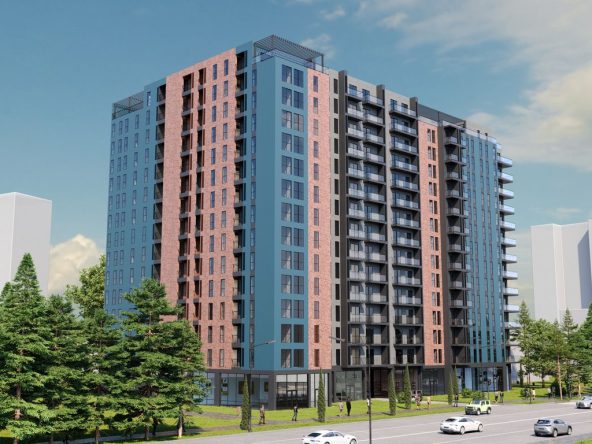
One project is listed here as of 12 November 2026: W2 Kutaisi, a 15-storey block on Lado Asatiani Street 96 on the right bank of the Rioni, built by the developer w2 (Tetri Kvadrati, “White Square”). According to the developer’s own pages, read on 12 November 2026, the building has 307 apartments as well as commercial and office space, the floor selector shows 17 flats that are not marked sold, of which the per-apartment data gives 12 as available and 5 as reserved, and the other floors read “all apartments sold”. The developer prints asking prices of USD 700 to 900 per m², and the lowest available flat is 61.5 m² at $55,350. It prints no handover date. The project page on this site gives the full unit, floor and price record, which this city guide does not repeat.
| Item | What is stated | Source and date |
|---|---|---|
| Developer | w2 (Tetri Kvadrati, “White Square”) | w2.ge, 12 Nov 2026 |
| Address | Lado Asatiani Street 96, Kutaisi (right bank of the Rioni) | w2.ge, 12 Nov 2026 |
| Building | One block, 15 floors; 307 apartments plus commercial and office space | w2.ge, 12 Nov 2026 |
| Flats not marked sold | 17: 12 available and 5 reserved | w2.ge per-apartment data, 12 Nov 2026 |
| 1-bedroom flats | 61.5 to 87.4 m², $55,350 to $74,290; 6 available | w2.ge, 12 Nov 2026 |
| 2-bedroom flats | 124.6 to 165.9 m², $105,910 to $116,130; 3 available | w2.ge, 12 Nov 2026 |
| 3-bedroom flats | 135 m² at $121,500 and 311.5 m² at $218,050; 2 available | w2.ge, 12 Nov 2026 |
| 4-bedroom flat with terrace | 476.8 m² at $333,760; 1 available | w2.ge, 12 Nov 2026 |
| Price per m² | $700 to $900 | w2.ge, 12 Nov 2026 |
| Handover | No date printed by the developer | w2.ge, 12 Nov 2026 |
Two calculations show what the printed prices imply. The lowest available flat, $55,350, is GEL 143,539 at the NBG rate of 2.5933, and the same flat sits inside the $750 to $1,300 range of the Korter table of the previous section, where Korter prints this building as White Square Kutaisi from $55,350 at $800 per m² in its list of developments due in 2026. That statement is Korter’s and not the developer’s: the developer prints a price of $900 per m² for that flat and no handover date. Broker and portal pages for the building print other figures for floors, handover and starting prices, so the developer’s own page is the reference for the table above. The statement is about listed starting prices and not about quality or value.
Ownership and registration: what Georgian law says for a foreign buyer
Under the Civil Code, to acquire an immovable thing the transaction must be made in writing and the acquirer’s ownership right must be registered in the Public Registry (Civil Code of Georgia, Article 183). Article 312 presumes that the Registry’s records are accurate and complete until proved otherwise. Ownership of an apartment in a block in Kutaisi therefore arises on registration and not on payment, and the registry extract is the document that shows the registered owner, any mortgage and other registered burdens. The nationality condition in the statutes read for this guide concerns agricultural land: Article 4 of the Organic Law on Agricultural Land Ownership lists the state, the autonomous republic, municipalities, Georgian citizens and Georgian-registered companies whose dominant partner is one of them, allows an alien to hold it if inherited, and allows a company with an alien dominant partner to hold it on an investment plan approved by the Government (Organic Law on Agricultural Land Ownership, Article 4). An apartment stands on non-agricultural land, and the Law on the Legal Status of Aliens itself assumes that an alien holds a right to non-agricultural immovable property when it describes the residence permit tied to real estate (Law on the Legal Status of Aliens and Stateless Persons, Article 15).
The site’s explainer Can foreigners buy property in Georgia sets out the same point with examples, and the country page Georgia gathers the other listings. The land category matters around Kutaisi because the surrounding municipalities are largely rural: in Geostat’s table for 1 January 2026, Imereti has 264.0 thousand urban and 228.5 thousand rural residents, and the city itself is entirely urban. A plot outside the city boundary may be agricultural, and the category is printed in the registry extract for each plot.
The National Agency of Public Registry publishes its fees. Registering the change, origin or termination of a right to immovable property costs GEL 150 within 4 working days, GEL 270 within 1 working day and GEL 350 on the day of filing, and the registration of an obligation tied to an ownership right, such as a mortgage, carries the same three fees (NAPR: immovable property registration fee). Confirming the parties’ signatures on a transaction submitted for registration costs GEL 7, immediately. A registry extract costs GEL 20 for one working day or GEL 13 if requested online, with GEL 26 added for an English version (NAPR: informational services fee). The dollar column is arithmetic at the NBG rate of 2.5933.
| NAPR service | Fee | About, in dollars |
|---|---|---|
| Registration of a change of right, within 4 working days | GEL 150 | $57.8 |
| Registration of a change of right, within 1 working day | GEL 270 | $104.1 |
| Registration of a change of right, on the day of filing | GEL 350 | $135.0 |
| Confirmation of the parties’ signatures | GEL 7 | $2.7 |
| Registry extract, 1 working day | GEL 20 | $7.7 |
| Registry extract, 1 working day, online | GEL 13 | $5.0 |
| English version of an extract, added | GEL 26 | $10.0 |
The step-by-step page How to buy property in Georgia walks through the extract check, the contract and the registration, and buying property in Georgia from abroad covers a buyer who does not travel. The fees above are the state’s part of the process; notary, translation and appraisal charges are separate and are not set by NAPR. Buyers who prefer to compare off-plan terms on the coast will find them on off-plan property in Batumi.
Building permits, heritage zones and what to check on a new Kutaisi project
The Code on Spatial Planning, Architectural and Construction Activity governs what may be built where. Article 92 provides that in a functional sub-zone intended for development a building that complies with the type of use allowed in the sub-zone is permitted, and that construction may still be refused if its location, dimensions and function run against the specificity of the sub-zone or the interests of adjacent zones. Article 93 makes a building notice or a construction permit the legal ground for construction. Article 94 requires a construction permit for buildings of Classes III and IV and a simple building notice for Class I, and Article 96 divides buildings into five classes, I to V, by risk to human health and the environment. Article 107 sets 20 working days for the decision on a construction permit and allows the authority to extend the period by up to 20 working days, and by up to 30 working days for a cultural heritage protection zone (Spatial Planning, Architectural and Construction Activity Code, Articles 92 to 96 and 107).
Kutaisi adds a second layer because much of the city is historic. The Law on Cultural Heritage divides buffer zones around heritage sites into primary zones, which arise automatically when an immovable object receives the status of cultural property, and secondary zones such as the buffer zone of a historical development area, a historical landscape protection zone and an archaeological buffer zone (Article 34). Article 41 provides that construction permits for projects inside buffer zones are issued by the competent body with the consent of the Ministry of Culture (Law of Georgia on Cultural Heritage, Articles 34 and 41). Which buffer zone, if any, covers a given plot in Kutaisi is shown in the municipal planning documents and the permit file, and none of the sources read for this guide prints it plot by plot. The City Hall text lists the Bagrati Cathedral, the Motsameta Monastery and the Geguti complex among the monuments around the city, and the developer of the listed project describes a view of Bagrati Cathedral to the north of its building, so the zone question is a practical one for this city.
For a buyer of an apartment in a block under construction, the practical reading is that three documents exist in public or semi-public form: the construction permit issued by the municipality for the building, the registry extract for the land plot and the sale contract. The statutes explain why the class of the building, the permitted use of the sub-zone, any buffer zone and the registered owner of the plot are the points a document check settles. The developer of the listed project names the address and the blocks on its pages and prints no permit number, so the permit is a document to request.
| Rule | What the statute says | Where |
|---|---|---|
| Permitted use | A building must match the use allowed in the functional sub-zone; construction may be refused if it runs against the sub-zone or adjacent zones | Spatial Code, Art. 92 |
| Legal ground for building | Building notice or construction permit | Spatial Code, Art. 93 |
| Permit or notice | Classes III-IV need a construction permit; Class I a simple building notice | Spatial Code, Art. 94 |
| Classes | Five classes, I to V, by risk | Spatial Code, Art. 96 |
| Permit decision time | 20 working days; extension up to 20 more, up to 30 more in a cultural heritage protection zone | Spatial Code, Art. 107 |
| Heritage buffer zones | Primary zones arise with cultural-property status; permits inside buffer zones need the Ministry’s consent | Cultural Heritage Law, Art. 34, 41 |
| Agricultural land | May not be owned by an alien except by inheritance; companies with an alien dominant partner only on an approved investment plan | Agricultural Land Law, Art. 4 |
| Acquisition of immovables | Written transaction and registration in the Public Registry | Civil Code, Art. 183 |
| Accuracy of the register | Entries presumed accurate until proved otherwise | Civil Code, Art. 312 |
Taxes on property in Kutaisi: ownership, rent and sale
The Tax Code taxes a natural person on real estate that he or she owns. The text of the Code on the legislative portal was changed by an amendment of 30 September 2026. Article 202(5) sets the tax on taxable property other than land of a natural person at not less than 0.8 percent and not more than 1 percent of the market value of the property at the end of the year preceding the current calendar year, and Article 206(1)(a) exempts a natural person’s taxable property other than land if the family’s income in the year preceding the current calendar year does not exceed GEL 100,000 (Tax Code of Georgia, Articles 202, 205 and 206). EY’s tax brief for the third quarter of 2026 reports the same change, states that the previous exemption threshold was GEL 40,000 and notes that the rate for a household above the threshold is determined by the location of the property within the 0.8 to 1 percent band (EY: Georgia Tax and Law Brief, July to September 2026). Guides written before 30 September 2026 may therefore show the earlier GEL 40,000 exemption; the Revenue Service’s property-tax calculator for 2026 asks only whether family income did not exceed or exceeded GEL 100,000 (Revenue Service: property tax).
A worked illustration shows the range. The lowest available flat of the listed project, 61.5 m² at $55,350, is GEL 143,544 at the NBG rate of 2.5933 (55,350 times 2.5933). For a family with income above GEL 100,000 the Code allows a tax of 0.8 to 1 percent, which is GEL 1,148 to GEL 1,435 a year ($443 to $554). For a family whose income did not exceed GEL 100,000, Article 206 exempts the apartment. The Code states the band and the amount owed depends on the rate applied within it, so the figures are the range the Code allows and not a tax bill, and the market value used for tax is not necessarily the asking price. A natural person files a property tax return by 1 November and pays by 15 November of the calendar year (Article 205(12) and (14)), and the page property tax in Georgia covers the declaration steps.
| Tax | What the Tax Code says | Article |
|---|---|---|
| Property tax, family income above GEL 100,000 | 0.8% to 1% of market value at the end of the preceding year | 202(5) |
| Exemption, family income up to GEL 100,000 | Natural person’s taxable property other than land | 206(1)(a) |
| Return and payment dates | Return by 1 November; payment by 15 November | 205(12), (14) |
| Income from renting out residential space, no deductions | 5% income tax | 81(2) |
| General personal income tax rate | 20% | 81(1) |
| Surplus from selling a residential apartment | 5% (Article 81(3)); exempt if owned over two years | 81(3), 82(1)(f.a) |
| VAT rate | 18% | 166 |
For rent, Article 81(2) taxes at 5 percent the income that a natural person receives from renting out residential space for residential purposes when no deductions are made from it. For a sale, Article 81(3) taxes at 5 percent the surplus income a natural person gains from supplying a residential apartment and its attached land, while Article 82(1)(f.a) exempts that surplus when the apartment and land were owned for more than two years. Article 166 sets the VAT rate at 18 percent, and whether VAT is included in a developer’s price is a term of the sale contract. The Tax Code articles apply to any town; short-term letting of apartments in resort towns is summarised for Batumi on the page about short-term rental.
The residence permit linked to real estate and mortgage limits
The Public Service Development Agency lists a short-term residence permit for an alien who holds title to immovable property in Georgia, other than agricultural land, with a market value exceeding USD 150,000 equivalent in lari, and for the spouse and children. The market value is set by a certified assessor of an accredited body, so the figure in the application is the appraised value and not necessarily the contract price (Public Service Development Agency: residence permits). Article 16 of the Law on the Legal Status of Aliens provides that this permit may be extended each time for one year and that it ends if the ownership right ends. At the NBG rate of 2.5933 the threshold is GEL 388,995.
The state fee depends on how quickly the application is decided: GEL 300 for a decision on the 30th calendar day ($115.7), GEL 450 on the 20th ($173.5) and GEL 600 on the 10th ($231.4). A purchase does not by itself give a permit; the permit is a separate application and a separate decision. The investment residence permit has a higher test, a title to immovable property with a market value exceeding USD 300,000 equivalent in lari (GEL 777,990) or an investment of USD 300,000. Read against the listed project’s printed prices, the 1-bedroom and 2-bedroom flats ($55,350 to $116,130) and the 135 m² three-bedroom flat ($121,500) are below the USD 150,000 line, the 311.5 m² flat at $218,050 is above it and below USD 300,000, and the 476.8 m² flat at $333,760 is above both lines, though each test applies to the appraised value and the contract is set per flat. The page residence permit in Georgia gives the same threshold.
| Item | Official position, 12 November 2026 |
|---|---|
| Property for the short-term permit | Non-agricultural immovable property; market value above USD 150,000 equivalent in lari (GEL 388,995 at 2.5933) |
| Valuation | Certified assessor of an accredited body |
| Family members | Spouse and child or children |
| Fee by decision day | 30th day GEL 300; 20th day GEL 450; 10th day GEL 600 |
| Validity | Extended each time for one year; ends if ownership ends |
| Investment permit route | Property above USD 300,000 equivalent or USD 300,000 invested |
On financing, the NBG sets loan-to-value and payment-to-income limits for lenders. As published on its page on 12 November 2026, the loan-to-value limit is 90 percent for lari loans and 70 percent for foreign-currency loans, and the payment-to-income limit depends on monthly net income and currency (NBG: PTI and LTV requirements). The monetary policy rate stood at 8.25 percent after the Monetary Policy Committee decision of 21 October 2026, annual inflation was 5.6 percent in September 2026 and the next meeting is on 16 December 2026 (NBG: monetary policy decision, 21 October 2026). Which banks lend to non-residents, at what down payment and in which currency is set by each bank and not by the NBG limits, and mortgage in Georgia for foreigners compares published bank terms with dates.
| NBG limit | Lari loans | Foreign-currency loans |
|---|---|---|
| Loan to value | 90% | 70% |
| Payment to income, monthly net income under GEL 1,500 | 25% | 20% |
| Payment to income, monthly net income GEL 1,500 or more | 50% | 30% |
Running costs: electricity, water and gas
The Georgian National Energy and Water Supply Regulatory Commission (GNERC) publishes the end-user tariffs. For household electricity its table lists two universal service providers. For Telmico the tariffs valid from 1 July 2026 to 1 January 2027 including VAT are 20.261 tetri per kWh for 0 to 101 kWh, 24.053 tetri for 101 to 301 kWh and 28.537 tetri above 301 kWh. For EP Georgia Supply they are 19.731, 23.731 and 28.227 tetri (GNERC: end-user tariffs). The commission’s page does not map the two providers to cities, so which one applies to a Kutaisi address is shown on the electricity contract. In the first band, 100 kWh at 20.261 tetri costs GEL 20.26 (100 times 0.20261), about $7.8, and at 19.731 tetri GEL 19.73, about $7.6.
For water, GNERC prints household tariffs for Georgian Water and Power LTD, GEL 0.500 per cubic metre metered for customers outside Rustavi in 2024 to 2026, made up of drinking water at GEL 0.379 and wastewater at GEL 0.121, and GEL 4.517 per person a month un-metered. It prints a separate set for the United Water Supply Company of Georgia, valid from 1 November 2011: GEL 0.499 per cubic metre metered, with drinking water at 0.419 and wastewater at 0.080, and GEL 2.395 per person a month un-metered (GNERC: water supply tariffs). The page does not name the municipalities of each company, so the water bill of a Kutaisi address shows which tariff applies. At 0.500 per cubic metre, 10 cubic metres in a month cost GEL 5.00 (10 times 0.500), and at 0.499 GEL 4.99; a household of three on the un-metered rate pays GEL 7.19 (3 times 2.395) or GEL 13.55 (3 times 4.517).
For natural gas, GNERC lists a marginal consumer tariff per licensee for 2026 to 2027 including VAT: Tbilisi Energy 53.971 tetri per cubic metre, Socar Georgia Gas 56.928 and Sakorggazi 56.990. The table does not state which licensee serves Kutaisi, and the gas contract names it. Together with the climate table, in which the Qutaisi station records a mean temperature of 6.1 °C in January and 6.5 °C in February, these tariffs are the inputs for a household heating estimate. The site’s cost guide living in Georgia as a foreigner sets utilities beside rent and food.
| Cost | Tariff | Source and period |
|---|---|---|
| Electricity, 0 to 101 kWh (Telmico / EP Georgia Supply) | 20.261 / 19.731 tetri per kWh | GNERC, 1 July 2026 to 1 January 2027 |
| Electricity, 101 to 301 kWh | 24.053 / 23.731 tetri per kWh | GNERC, same period |
| Electricity, above 301 kWh | 28.537 / 28.227 tetri per kWh | GNERC, same period |
| Water, Georgian Water and Power, metered household (outside Rustavi) | GEL 0.500 per m³ (0.379 drinking, 0.121 wastewater) | GNERC, 2024 to 2026 |
| Water, Georgian Water and Power, un-metered household (outside Rustavi) | GEL 4.517 per person a month | GNERC, 2024 to 2026 |
| Water, United Water Supply Company, metered household | GEL 0.499 per m³ (0.419 drinking, 0.080 wastewater) | GNERC, from 1 November 2011 |
| Water, United Water Supply Company, un-metered household | GEL 2.395 per person a month | GNERC, from 1 November 2011 |
| Natural gas, marginal consumer tariff (Tbilisi Energy / Socar Georgia Gas / Sakorggazi) | 53.971 / 56.928 / 56.990 tetri per m³ | GNERC, 2026 to 2027 |
Frequently Asked Questions
Can a foreigner buy property in Kutaisi?
Yes for an apartment or a house on non-agricultural land: the Civil Code requires a written transaction and registration in the Public Registry, and the nationality limits in the statutes read for this guide concern agricultural land (Organic Law on Agricultural Land Ownership, Article 4). A plot may be agricultural, and the registry extract prints the category, which is why a document check precedes any contract for property in Kutaisi. The site’s explainer Can foreigners buy property in Georgia gives the same rule with examples.
How many people live in Kutaisi?
For anyone sizing up property in Kutaisi, the 2014 census counted 147,635 in the city, the 2024 census release reports growth of 9.0 percent since 2014, and Geostat’s estimate for 1 January 2026 is 153,799. That makes Kutaisi the third-largest city after Tbilisi (1,369,356) and Batumi (246,267), and it holds about 31 percent of the population of Imereti.
How far is Kutaisi from Tbilisi and Batumi?
Routed on 12 November 2026 from the OpenStreetMap city point, the road to Tbilisi Freedom Square is 219.0 km (about 2 hours 56 minutes without traffic) and to Batumi city centre 152.4 km (about 2 hours 16 minutes). GNTA states 3 hours 30 minutes to Tbilisi and 2 hours 15 minutes to Batumi. The distance matters to anyone weighing property in Kutaisi against the coast, which the page on Georgia Black Sea coast property compares.
Can I reach Kutaisi by train from Tbilisi?
For property in Kutaisi the rail access is as follows: the Georgian Railway timetable of 12 November 2026 lists trains from Tbilisi that stop at Kutaisi International Airport station, the fastest taking 2 hours 35 minutes (trains 802 and 804), and trains between Batumi and Kutaisi I. The airport station is outside the city, and fares are shown on gr.com.ge at purchase.
What do new apartments cost per square metre in Kutaisi?
Korter’s list of 17 Kutaisi developments due in 2026 printed “from” prices of $750 to $1,300 per m² on 12 November 2026, with a median of $1,000. The first page of the portal’s sale listings showed asking prices of $689 to $1,931 per m². Both are asking prices and not transaction prices, and no official source prints a price per square metre for property in Kutaisi.
What does it cost to register an apartment?
Registering property in Kutaisi carries the same state fees as elsewhere in Georgia: NAPR charges GEL 150 for registration within 4 working days, GEL 270 within 1 working day and GEL 350 on the day of filing, GEL 7 for confirming the parties’ signatures and GEL 13 to 20 for a registry extract, plus GEL 26 for the English version. Notary and translation costs are separate.
How much is property tax?
For property in Kutaisi owned by a natural person, the Tax Code sets 0.8 to 1 percent of market value, and exempts a family whose income in the preceding year did not exceed GEL 100,000, a threshold raised from GEL 40,000 by an amendment of 30 September 2026. Rent received by an individual with no deductions is taxed at 5 percent. The property tax in Georgia guide explains the filing.
Does buying an apartment give a residence permit?
No purchase gives a permit by itself. The Public Service Development Agency issues a short-term residence permit on a separate application to an alien who holds title to non-agricultural immovable property with an appraised market value above USD 150,000 equivalent in lari, and the permit ends if the ownership ends. Of the flats listed on this site for property in Kutaisi, the printed prices of the larger units exceed that figure and the smaller ones do not.
What does the listed project state about price and handover?
For the one project of property in Kutaisi listed here, the developer of W2 Kutaisi prints asking prices of USD 700 to 900 per m², a lowest available flat of $55,350 (61.5 m²) and 12 available plus 5 reserved flats in a block of 307 apartments on 12 November 2026, and prints no handover date.
What is the weather like in Kutaisi?
The Qutaisi station normals for 1991-2020 give a mean of 15.3 °C a year, 6.1 °C in January and 24.8 °C in August, 1,358.2 mm of precipitation and 119.9 days with 1 mm or more, with 133.9 days a year at 25 °C or above and 12.0 days with frost. Anyone comparing property in Kutaisi with Tbilisi will see a wetter and milder winter.
Last checked: 12 November 2026. Sources: NBG exchange rates; OpenStreetMap; Wikipedia Kutaisi; WMO normals Qutaisi; Geostat population by self-governed unit; GNTA Kutaisi; Kutaisi City Hall; Constitution of Georgia; Georgia Today, technology hub; Project OSRM; Wikipedia Freedom Square; Geostat 2014 census; Geostat 2024 census; Geostat population by cities and boroughs; Geostat population 1 January 2026; United Airports of Georgia; GNTA Tourism in Figures 2025; Wikipedia Kutaisi airport; Imedi, airport runway; Georgian Railway; Civil Georgia, Rikoti; UNESCO; Georgia Today, Gelati; National Parks of Georgia, Sataplia; National Parks of Georgia, Prometheus Cave; Georgia Today, protected areas; Akaki Tsereteli State University; Kutaisi International University; WMO normals Tbilisi; Geostat RPPI Q3 2026; Korter new projects 2026; Korter sales; Korter rentals; Geostat construction permits 2025; Civil Code; Agricultural Land Ownership Law; Law on the Legal Status of Aliens; NAPR registration fees; NAPR information fees; Spatial Planning Code; Law on Cultural Heritage; Tax Code; EY Georgia tax brief; Revenue Service; Public Service Development Agency; NBG PTI and LTV; NBG monetary policy; GNERC end-user tariffs; GNERC water tariffs.
