



The short answer, before anything else
Sohar is Oman’s industrial port city on the Al Batinah coast, roughly two hours north of Muscat and slightly closer to Dubai than to its own capital. It is not a resort, it is not a masterplanned lifestyle district, and nothing about it is aimed at tourists. It is a working city of about 280,000 people where nearly half the residents are expatriates who came for a job.
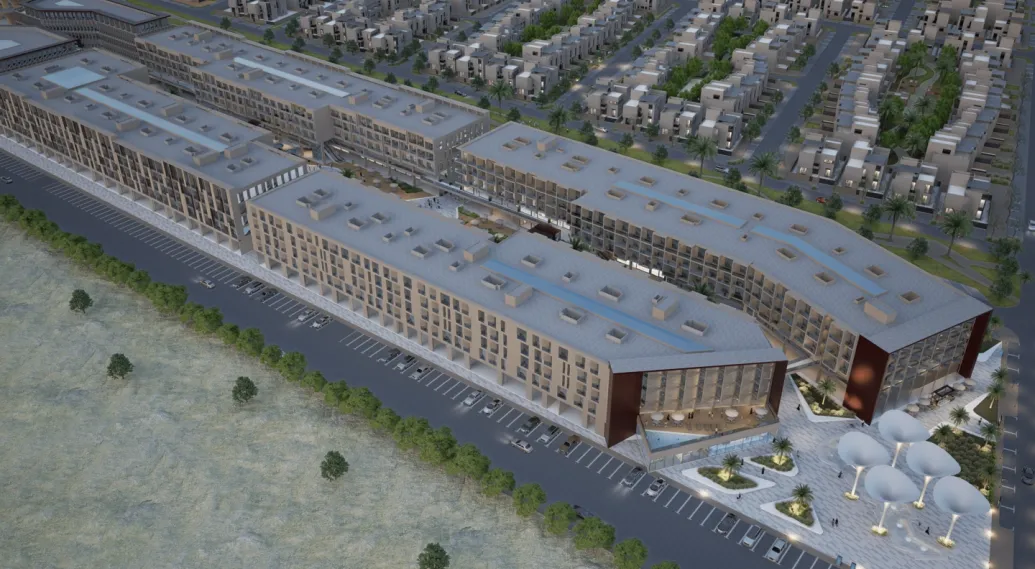
We list one project here: Plumeria, two apartment buildings in the Majd district, from $95,000 on freehold title, with 25% down and instalments running up to seven years.
Three things make this page different from every other city page on this site. It is the cheapest genuine freehold entry we sell outside Muscat — Duqm is cheaper at $76,700 but that is a 99-year lease, not ownership, and only Sultan Haitham City goes lower on freehold, at $82,160. It carries the longest payment plan in our portfolio, seven years against the three to five typical elsewhere. And it is the only project where we cannot tell you the price per square foot, because no floor area is published anywhere in the material.
There is a fourth thing, and it is the one that matters most. The Majd district is a Ministry of Housing “Surooh” neighbourhood, not a coastal Integrated Tourism Complex — which is the framework almost every other freehold project in Oman relies on. Freehold for all nationalities is what every brochure and every broker says, ours included. What none of them publish is the instrument that makes it true for your specific plot. That is not a reason to walk away. It is a reason to ask, in writing, before you pay anything.
Sohar at a glance
| Sohar | |
|---|---|
| Where | Al Batinah North governorate, on the Gulf of Oman, north-west of Muscat toward the UAE border |
| Character | Working port and industrial city — logistics, metals, manufacturing, free zone |
| Population | About 280,000, of which roughly 49% expatriate (2023) |
| Our projects | 1 — Plumeria, two buildings in the Majd district |
| Entry price | $95,000 (about OMR 36,527) |
| City-wide apartment range | OMR 35,000 – 80,000, roughly $91,000 – $208,000 |
| Per sq ft | Not computable — no floor area is published |
| Tenure | Marketed as 100% freehold for all nationalities; the designating instrument is not published |
| Golden Residency | No — no Sohar price comes within OMR 120,000 of the threshold |
| To Muscat | About 230 km, roughly 2 hours on the Batinah Expressway |
| To Dubai | About 200 km, roughly 2.5 – 3 hours including the border |
What Sohar actually is
Every other Omani city we cover sells a version of the same thing: coastline, or a golf course, or a marina, or a mountain view. Sohar sells none of them. It has a corniche and a long history as a trading port — this is the city classical geographers tied to the Sinbad voyages — but nobody is buying an apartment here for the view.
What Sohar has instead is a port and a free zone that between them anchor one of the largest concentrations of industrial employment in the country: steel, aluminium, petrochemicals, logistics, and a growing roster of international free-zone tenants. That employment is the entire investment case. If you cannot get comfortable with an industrial payroll as your demand engine, nothing else on this page will help.
It also shapes what the city is like to live in. The Majd district — where Plumeria sits — is a Ministry of Housing integrated neighbourhood of more than 1,000 homes launched in October 2023, built around schools, markets, health centres, a mosque, sports fields and more than 100,000 square metres of green space. It is a real neighbourhood with real infrastructure, which is more than several off-plan masterplans elsewhere in Oman can say. It is also emphatically inland-suburban rather than coastal-premium, and the price reflects that.
The one project here
| Plumeria, Majd district | |
|---|---|
| Developer | Sohar Real Estate Development LLC, in partnership with Majd |
| Built form | Two residential buildings around a boulevard |
| Product | One-, two- and three-bedroom apartments across several layouts |
| Floor areas | Not published — request per layout in writing |
| Entry price | $95,000 (about OMR 36,527) |
| Year | 2026 |
| Payment | 25% down, instalments up to 7 years |
| Instalment markup | Not published — ask what the seven-year plan costs |
| Amenities | Swimming pools, balconies over the boulevard; district schools, markets, health centres, green space |
| Service charge | Not published — owners’ association rate to be confirmed |
Notice how many rows in that table say “not published.” That is the honest shape of this listing, and it is not unusual for a secondary Omani market — but it does mean the diligence burden here is higher than at, say, Muscat Hills, where floor areas, service charges and payment terms are all on the page. Three of the four numbers you would need to compare Sohar against anywhere else are missing.
The number nobody publishes
Every page on this site compares price per square foot rather than headline price, because floor areas vary enormously and the headline hides that. Sohar is the one city where we cannot run that comparison, because the area is not stated.
We can bound it. At $95,000, the price per square foot depends entirely on how big the entry apartment is:
| If the entry one-bedroom is… | Then $95,000 works out at… | Which would place it… |
|---|---|---|
| 700 sq ft | ~$136 per sq ft | Just above Sultan Haitham City’s villa rate |
| 800 sq ft | ~$119 per sq ft | Level with the cheapest rate in Muscat |
| 900 sq ft | ~$106 per sq ft | The lowest freehold rate in the portfolio |
All three answers land in the same place: the bottom of the national range, somewhere near or below the $118 per foot a large villa costs at Sultan Haitham City, and roughly a fifth of the $537 per foot on the beach at Shatti Al Qurum.
So the conclusion — Sohar is cheap per foot — is safe. What is not safe is comparing two Sohar layouts against each other, or Plumeria against a specific competitor, without the number. Ask for the built-up area of your exact layout in writing, and ask whether it is gross or net. On a small apartment the difference between the two is often 15% or more, which is enough to move the per-foot figure by twenty dollars.
The cheapest freehold entry outside Muscat — with an asterisk
Ranked by the price of the cheapest unit we can sell you, Sohar sits second from the bottom. Ranked by the price of the cheapest unit you can actually own outright, it sits second — behind only Sultan Haitham City, where an apartment starts at $82,160.
| City | Entry price | What you get for it |
|---|---|---|
| Duqm | $76,700 | 99-year leasehold, not ownership |
| Sultan Haitham City | $82,160 | Freehold, government-anchored new city |
| Sohar | $95,000 | Freehold — basis marketed but not documented |
| Muscat (Uptown, Knowledge Oasis) | $106,900 | Freehold marketed; not a coastal ITC, eligibility unconfirmed |
| Salalah | $128,700 | ITC freehold |
| Jebel Sifah | $130,040 | ITC freehold |
| Muscat Hills | $163,600 | ITC freehold |
| Muscat Bay | $234,100 | ITC freehold |
| Shatti Al Qurum | $442,100 | ITC freehold, complete and furnished |
| Bidbid | — | Not available to foreign buyers at all |
Read the third column, not the second. The two cheapest entries in Oman are cheap for structural reasons, and the reasons are different. Duqm is cheap because you are buying a lease. Sohar is cheap because you are buying in a secondary industrial market with a thin resale record. Neither discount is free money, and neither is a defect — they are simply what you are being paid to accept.
Who can actually buy here
This is the question to settle first, and it is more nuanced in Sohar than anywhere else we cover.
Oman’s classic route to foreign freehold is the Integrated Tourism Complex: a designated coastal or resort development where a non-Omani gets outright registered title. Jebel Sifah, Muscat Bay, Al Mouj, Muscat Hills and Shatti Al Qurum all sit inside one. Royal Decree 38/2025 widened the map further by opening residential ownership inside Special Economic Zones and Free Zones.
Plumeria sits in neither. The Majd district is listed by the Ministry of Housing and Urban Planning under its Surooh integrated-neighbourhood programme — the same family of government housing scheme as Husn Al Zain in Bidbid, which foreigners cannot buy at all. It is also outside the Sohar Free Zone boundary, so Decree 38/2025 does not obviously reach it either.
And yet Plumeria is marketed as freehold for all nationalities by the developer and by multiple independent brokerages. That is not nothing — the same is true of Hay Al Wafa at Sultan Haitham City, another government-programme neighbourhood that genuinely is open to non-Omanis. Eligibility in Oman attaches to the specific parcel, not to the programme name, so a Surooh address neither confirms nor rules out your right to buy.
| The question | What to establish |
|---|---|
| 1. What is the plot’s designation? | Get the Ministry of Housing and Urban Planning classification for the Plumeria parcel in writing — not for “Sohar”, not for “Majd”, for the parcel. |
| 2. Can the title be registered in your own name? | Freehold, usufruct and company-held structures are all called “ownership” in marketing. Only one puts your name on the deed. |
| 3. Who confirmed it? | An independent Omani lawyer checking the land registry — not the sales office, and not us. |
If those three come back clean, the purchase is straightforward and Sohar’s price advantage is real. If they do not, no payment plan makes up for it. Get them before the reservation deposit, not after.
Residency: one route works, the other cannot
Oman has two property-linked residency routes, and marketing material routinely presents them as a pair. In Sohar they behave very differently.
| Route | Requirement | Sohar |
|---|---|---|
| Owner Visa | Sponsor-free, tied to ownership, renewable, covers spouse and first-degree relatives, no minimum value | Available on a valid freehold purchase at any price |
| Golden Residency | Ten-year renewable permit, requires OMR 200,000 (about $520,160) of qualifying property | Out of reach at every Sohar price |
The arithmetic is not close. The entry apartment at OMR 36,527 is short of the threshold by OMR 163,473. Even the very top of the city-wide apartment range — OMR 80,000, around $208,000 — falls short by OMR 120,000, which is to say it reaches only 40% of the bar. No apartment in Sohar has ever come close to the ten-year permit, and buying two would not obviously fix it either, since the qualifying-property test also turns on the designation question above.
So plan on the Owner Visa. It is genuinely useful — sponsor-free, renewable for as long as you hold the property, and it extends to your immediate family — and at this price point it is the cheapest way into it anywhere in our Oman portfolio. It is simply not the ten-year permit, and any material that implies otherwise is wrong. Our comparison of the two is in Golden Residency vs Owner Visa.
The port: what the numbers say, and what they don’t
Sohar Port and Freezone had a genuinely strong first half of 2026, and the figures are worth putting on the page because they are the reason anyone is building apartments here at all.
| Sohar Port and Freezone, H1 2026 | |
|---|---|
| Total cargo throughput | 52 million tonnes, up 52% year on year |
| Of which ship-to-ship transfer | 24.38 million tonnes |
| Container throughput | 545,000 TEU, up 40% |
| Breakbulk | 1.24 million tonnes |
| Vessel calls | 1,555 |
| New investment contracts signed | 5, worth OMR 226.47 million |
| Combined value, existing and expansion projects | OMR 2.62 billion |
Now the part the brochures leave out. Ship-to-ship transfer accounted for 24.38 of those 52 million tonnes — about 47% of the total. Ship-to-ship cargo is transferred between vessels; it does not come ashore, it does not pass through a warehouse, and it employs a fraction of the people that landed industrial cargo does. The port’s container growth was likewise described as driven primarily by transhipment.
That matters here specifically, because the entire housing thesis for Sohar rests on employment. A 52% jump in tonnage does not translate into a 52% jump in people who need somewhere to live. The growth is real; the share of it that produces tenants is smaller than the headline.
The same caution applies to the widely quoted 2028 target. Sohar’s $1.8 billion expansion programme is aimed at annual container capacity of 4.5 million TEU by 2028. At 545,000 TEU in a half-year, the port is currently running at roughly 1.1 million TEU annualised — so the target implies about a fourfold increase in two years. The specific terminal works described publicly, a 70-hectare expansion more than doubling yard space, lift capacity from 800,000 to 1.5 million TEU. 4.5 million is a capacity ambition, not a contracted volume, and the named construction gets to a third of it.
None of this makes Sohar a bad purchase. It makes it a purchase you should size against 1.1 million TEU and 280,000 residents, not against a 2028 press release.
Payment: 25% down and seven years
The payment plan is the single most commercially attractive feature of this project, and it is worth doing the arithmetic properly.
| On the $95,000 entry apartment | |
|---|---|
| Down payment (25%) | $23,750 |
| Balance over the plan | $71,250 |
| Spread over 7 years (84 months) | about $848 per month |
| Transfer fee for foreign buyers (3%) | $2,850 |
| Instalment markup | Not published — ask |
| Annual service charge | Not published — ask |
Seven years is genuinely longer than anything else we sell. For comparison, the completed branded residences at Shatti Al Qurum offer one, two and three years — and the three-year option there carries a 13% markup. That is the number to keep in mind: on the Omani market, a long payment plan usually costs something, and here the cost is not stated.
So ask the question directly: is $95,000 the cash price, the seven-year price, or both? If there is a markup, express it as a percentage of the purchase price and compare it against a mortgage from a bank lending to non-residents in Oman — around 6.00% a year is the going rate. And budget the 3% transfer fee separately, along with legal and registration costs and a check on whether 5% VAT applies to your first-sale purchase.
Getting there: closer to Dubai than to Muscat
| From Sohar | Distance | Notes |
|---|---|---|
| Muscat | ~230 km | About 2 hours on the Batinah Expressway |
| Muscat International Airport | ~230 km | The practical airport for international arrivals |
| Dubai | ~200 km | 2.5 – 3 hours, including the Khatmat Malaha border crossing |
| Sohar Airport | In the city | One airline, one destination — SalamAir to Salalah |
The headline fact is real and slightly surprising: Sohar is closer to Dubai than to its own capital. The 270-kilometre Batinah Expressway, running from Halban outside Muscat to Khatmat Malaha at the UAE border, is what makes both trips straightforward. For a buyer whose work spans Oman and the UAE, a Sohar base is a genuinely practical midpoint in a way that no other property we sell in Oman is.
The airport is the thing to be realistic about. Sohar has one — it is not a paper airport, it has a terminal and a rated capacity of about 70,000 passengers a year — but scheduled service in 2026 amounts to a single carrier, SalamAir, flying to a single destination, Salalah. There is no international route. You will be arriving through Muscat or Dubai and driving. Plan two hours each way into every visit, including the snagging inspection.
Letting a home here
Sohar is the only city on this site where the rental market is a payroll. That is worth spelling out against the alternatives, because it changes almost everything about how the investment behaves.
| City | What drives rental demand | Seasonality |
|---|---|---|
| Sohar | Port, free zone and industrial employment | None — year-round employment leases |
| Muscat | Corporate expatriates on annual contracts | Low |
| Shatti Al Qurum | Short-let and serviced apartments | Moderate |
| Muscat Bay / Jebel Sifah | Holiday and second-home demand | High |
| Salalah | Khareef tourism | Extreme — three months |
The upside is that an industrial city with roughly 139,000 expatriate residents produces steady, unglamorous, twelve-month tenancies from families who are here because of a contract. There is no khareef to wait for and no low season to underwrite. At this entry price the rent does not have to be large to work.
The downside is concentration. A tenant base tied to one port and one free zone is a single-employer risk wearing a city-sized costume. Ask what proportion of local tenants are connected to the port and freezone versus the wider city economy, and treat a very high answer as a reason to hold longer, not a reason to walk. Broader context is in our guide to rental yields in Oman — noting that published yield data for Sohar specifically is thin, which is itself informative.
Resale, and the thing thin markets do
Sohar’s freehold market is young and small. That has a specific, practical consequence that has nothing to do with whether the city grows: with few comparable transactions, there is no reliable way to price your unit when you come to sell it.
This is the same structural point we make about Duqm, and it is why both cities should be treated as holds rather than trades. It is not a prediction that values will fall; it is an observation that in a thin market the spread between what a buyer offers and what a seller expects is wide, and the time to close is long. If you might need the money back inside five years, this is the wrong city and Muscat is the right one, where our portfolio holds hundreds of comparable listings and an actual secondary market.
Who Sohar is for
It suits a buyer whose budget genuinely starts below $150,000 and who wants ownership rather than a lease; anyone whose work spans Oman and the UAE and who would use a midpoint base; an investor who prefers a boring twelve-month employment tenancy to a seasonal holiday let; and anyone who wants the sponsor-free Owner Visa at the lowest cost of entry available.
It does not suit a buyer chasing the ten-year Golden Residency, which is unreachable here by a wide margin. It does not suit anyone who needs coastline, resort amenity or a short airport transfer — Muscat Bay and Jebel Sifah exist for that. And it does not suit anyone who wants to be able to sell quickly, or who is not prepared to pay a lawyer to check the title designation before committing.
How to judge a secondary market anywhere
The transferable lesson applies to any city being sold on an industrial growth story rather than an existing property market — Duqm, Ras Al Khair, half the Gulf’s port towns.
| Question | What the answer tells you |
|---|---|
| 1. How much of the headline growth lands onshore? | Transhipment, ship-to-ship transfer and pipeline volumes inflate a port’s numbers without creating local jobs. Housing demand follows employment, not tonnage. |
| 2. What is the target versus the run rate? | A 2028 capacity ambition is not a 2026 volume. Size your purchase against what the place does now. |
| 3. How many comparable resales happened last year? | This is the single best measure of whether you can get out. In a young market the honest answer is often “very few” — which is fine if you plan to hold. |
Run those three and the growth story stops being a mood and becomes a number. In Sohar’s case the honest reading is that the fundamentals are real but roughly half as strong as the headline tonnage implies, and the discount you are being offered is about right for that.
Seven checks before you buy
- Get the plot designation in writing from the Ministry of Housing and Urban Planning, checked by your own Omani lawyer at the land registry.
- Get the floor area of your exact layout, and ask whether it is gross or net. Without it, no comparison is possible.
- Ask what the seven-year plan costs. If there is a markup, get it as a percentage and compare it with a bank loan.
- Ask for the annual service charge and what it covers. It has not been published.
- Do not budget for Golden Residency. The entry unit is OMR 163,473 short; the top of the market is OMR 120,000 short.
- Confirm the escrow arrangement named in the sale agreement, and ask for current construction progress on your specific building.
- Plan for the drive. Sohar Airport flies to one destination; every visit is a two-hour road trip from Muscat or three from Dubai.
Frequently asked questions
Can foreigners buy property in Sohar?
Plumeria is marketed as 100% freehold for buyers of any nationality, with no local sponsor or partner, and multiple independent brokerages describe it the same way. Because the Majd district falls under the Ministry of Housing’s Surooh neighbourhood programme rather than a coastal Integrated Tourism Complex, ask for written confirmation of the specific plot’s designation and have an independent Omani lawyer verify it at the land registry before paying anything.
How much does property in Sohar cost?
From $95,000, about OMR 36,527, for a one-bedroom apartment at Plumeria. Apartment pricing across the city generally runs between OMR 35,000 and OMR 80,000, roughly $91,000 to $208,000.
What is the price per square foot in Sohar?
It cannot be calculated from published material, because no floor areas are stated. At $95,000 the figure would be about $136 per foot for a 700 sq ft apartment and about $106 for a 900 sq ft one — either way the lowest band in our Oman portfolio, and around a fifth of beachfront Shatti Al Qurum. Ask for your layout’s area in writing.
Does buying in Sohar give you Oman residency?
A valid freehold purchase supports the sponsor-free Owner Visa, which is tied to ownership, renewable, covers immediate family and has no minimum value. The ten-year Golden Residency requires OMR 200,000 of qualifying property and no Sohar price reaches it — the entry apartment is short by OMR 163,473 and the top of the city-wide range is short by OMR 120,000.
Is Sohar cheaper than Duqm?
No — Duqm’s entry is $76,700 against Sohar’s $95,000. But Duqm is sold on a 99-year lease rather than freehold title, so Sohar is the cheapest place outside Muscat where you can own outright — only Sultan Haitham City, at $82,160, goes lower on freehold.
What is the payment plan at Plumeria?
25% down and instalments running up to seven years, the longest plan in our Oman portfolio. On the $95,000 entry apartment that is $23,750 down and roughly $848 a month over 84 months. The markup for using the plan is not published — ask for it.
How far is Sohar from Muscat and Dubai?
About 230 kilometres and two hours from Muscat on the Batinah Expressway, and about 200 kilometres and two and a half to three hours from Dubai including the Khatmat Malaha border crossing. Sohar is closer to Dubai than to its own capital.
Does Sohar have an airport?
Yes, but it is small. Sohar Airport has a rated capacity of around 70,000 passengers a year and its scheduled service in 2026 is a single carrier, SalamAir, flying to Salalah. There is no international route, so international buyers arrive through Muscat or Dubai and drive.
Is Sohar a good rental market?
It is a steady one rather than a high-yield one. Roughly 49% of the city’s 280,000 residents are expatriates working in the port, free zone and industrial economy, which produces year-round twelve-month tenancies with no seasonality. The risk is concentration in a single employment base, and published yield data specific to Sohar is thin.
Related pages on this site
Compare other Omani cities: Muscat, Duqm, Salalah, Sultan Haitham City, Sur, Bidbid. Coastal and resort alternatives: Jebel Sifah, Muscat Bay, Muscat Hills, Shatti Al Qurum, Al Mouj, Yiti. Rules and process: buying as a foreigner, freehold property in Oman, compare Oman’s ITCs, property tax in Oman, the Sohar investment guide, all Oman property.
The verdict
Sohar is the cheapest place outside Muscat where you can own a home outright, and the case for it is narrower and more honest than the price tag suggests. You are buying into a working industrial city with a real neighbourhood around it, a payment plan longer than anything else on the market, and a tenant base that turns up for work rather than for a holiday.
Two of those are genuinely valuable. The seven-year plan meaningfully lowers the cash needed to get in, and an employment-driven rental market has no season to survive — which is more than Salalah or the resort districts can say. If your budget starts below $150,000 and you want ownership rather than a lease, there is nothing else in our Oman portfolio that does this.
On the other side, be honest about the three blanks. The floor area, the instalment markup and the service charge are all unpublished, and the freehold basis is marketed rather than documented. None of those is a red flag on its own — secondary Omani markets routinely publish less than Muscat does — but together they mean the diligence here is not optional, and it costs a lawyer’s fee you should budget for now.
Two closing instructions. Do not buy this for the Golden Residency; nothing in Sohar comes within OMR 120,000 of the threshold, and the Owner Visa is the route that actually works. And size the investment against what the port does today — about 1.1 million TEU a year, roughly half of the tonnage growth never coming ashore — rather than against the 4.5 million TEU that 2028 is meant to bring. If the numbers still work on that basis, they will work on any other.
Ask us for Plumeria’s floor areas, plot designation and instalment terms
Further reading: the Ministry of Housing and Urban Planning registers title and classifies land; the Ministry of Heritage and Tourism licenses Integrated Tourism Complexes; the Central Bank of Oman publishes lending benchmarks.
