



























The short answer, before anything else
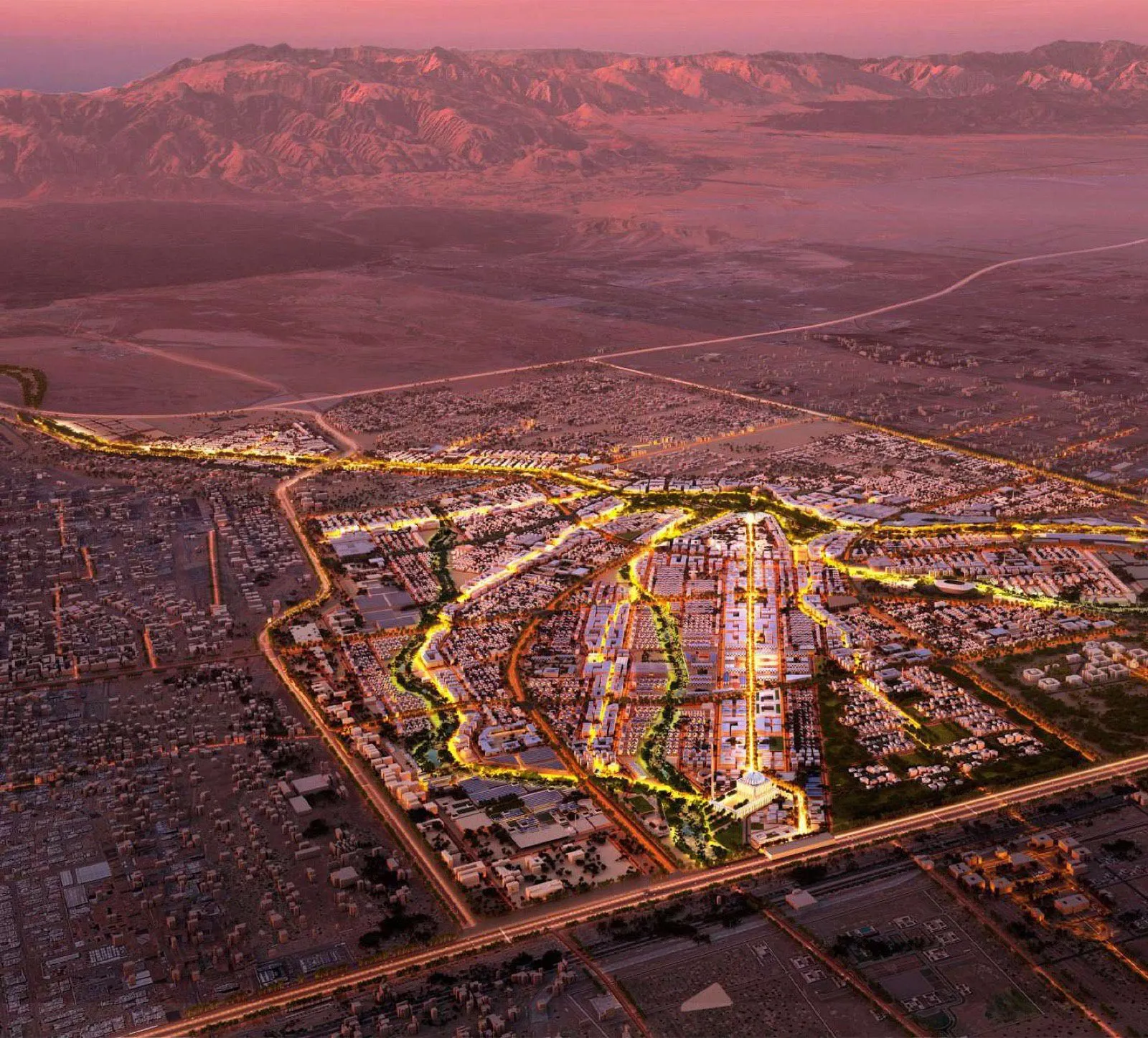
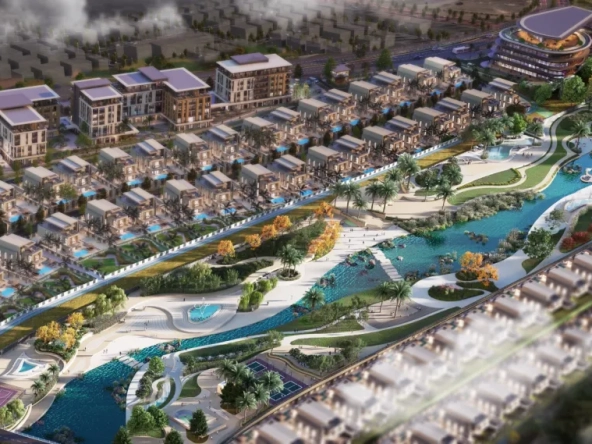
Sultan Haitham City is the largest thing happening in Omani real estate — a 14.8 million m² new city in the Wilayat of Al Seeb, west of Muscat, masterplanned by SOM and announced in 2023. When it is finished it will hold 20,000 homes and about 100,000 residents, with a target of 50,000 jobs. It is being built under Oman Vision 2040, and unlike almost everything else at this scale in the Gulf, it is open to foreign buyers on freehold title.
We list seven projects inside it, from $82,160 for an apartment to $499,100 for a villa. That range is not the interesting part. The interesting part is that price per square foot inside this single district runs from about $100 to about $317 — a 3.2× spread, which means the cheapest headline price is nowhere near the cheapest square foot, and two projects a few minutes apart can be priced as though they were in different countries.
Three things are worth knowing before you read another brochure. Hay Al Wafa’s apartments at roughly $100 per square foot are the cheapest new-build freehold homes we can find anywhere in Muscat, and they hand over first, in Q4 2027. Nothing here is finished — the earliest completion in the district is Q1 2027 and the latest is Q1 2030, so every purchase is off-plan. And the ten-year Golden Residency is reachable at exactly one price point in the district, which is not where most buyers are looking.
The rest of this page sets out all seven projects side by side, the construction progress as of August 2026, what the foreign-ownership rules actually say versus what brokers quote, and the questions to ask before you pay a deposit.
Sultan Haitham City at a glance
| Sultan Haitham City | |
|---|---|
| Where | Wilayat Al Seeb, Muscat governorate — several kilometres west of central Muscat |
| Announced | 2023, under Oman Vision 2040 |
| Masterplanner | SOM (Skidmore, Owings & Merrill) |
| Total area | 14.8 million m² (14.8 km²) |
| Planned homes | 20,000 |
| Planned population | 100,000, with a target of 50,000 jobs |
| Phase one | ~5 million m² city centre, 6 neighbourhoods, 6,743 homes, 35,000+ residents, running 2024 – 2030 |
| Phase one mix | 608 detached villas, 872 semi-detached villas, 1,156 townhouses, 4,107 apartments |
| Foreign ownership | Yes — freehold, marketed to buyers of any nationality |
| Our projects | 7, from Sarooj Oasis apartments at $82,160 to Al Ahlam villas at $499,100 |
| Entry price | $82,160 (about OMR 31,600) |
| Per sq ft | $100 – ~$317 depending on the project |
| To Muscat airport | About 25 – 30 minutes |
Is it actually being built? The August 2026 numbers
This is the first question a serious buyer asks about any new city, and it is usually answered with a render. Here are percentages instead. As of August 2026, site preparation and levelling across the masterplan are complete, and the major infrastructure packages stand as follows.
| Infrastructure package | Progress, August 2026 |
|---|---|
| Three primary electricity substations | 99.5% |
| Bridges — structural works | 92% |
| Main sewerage line | 89% |
| Main and secondary roads | 58% |
| Infrastructure services overall | ~50% |
| Site preparation and levelling | Complete |
Read that table the way a lender would. Power and drainage — the two things that decide whether a district can be occupied at all — are essentially done. Roads, which are what make it feel like a city rather than a construction site, are just over half built. That profile is exactly what you would expect of a masterplan whose first handovers land in 2027 and whose phase one runs to 2030.
It also tells you something the brochures do not: the earliest buyers will move into a district where the roads are still being finished around them. If you are buying to live in from day one rather than to let or to hold, that matters, and Q1 2027 at Al Ahlam is a very different proposition from Q1 2030 at Jood.
Every project in the district, side by side
This is the comparison the individual project pages cannot give you. Prices are entry points for each scheme and move with floor, plot, orientation and phase.
| Project | Developer | Product | From | Handover |
|---|---|---|---|---|
| Sarooj Oasis Apartments (Azha) | Sarooj Development (group from 1976) | Apartments | $82,160 | Q3 2028 |
| Wadi Zaha | Al Ahly Sabbour (1994) | Studios to villas | $157,000 | Q1 2028 |
| Hay Al Wafa | Al Abrar Real Estate (2008) | Apartments, townhouses, villas | $170,600 | Q4 2027 |
| Yenaier Residences | Adanté Realty (Al Adrak Group) | Apartments and penthouses | $174,800 | Q4 2027 |
| Jood | Talaat Moustafa Group (1970) | Apartments and villas | $204,000 | Q1 2030 |
| Sarooj Oasis Villas | Sarooj Development | Villas | $447,800 | Q4 2029 |
| Al Ahlam District | Dream Villa (2010) | Villas only | $499,100 | Q1 2027 |
Two structural facts jump out of that table. The developers are not one type. Sarooj is an Omani contractor whose group history runs back to 1976; Talaat Moustafa Group is the Egyptian giant behind Madinaty; Al Ahly Sabbour is another major Egyptian name; Adanté is the property arm of Oman’s Al Adrak Group; Dream Villa and Al Abrar are smaller Omani houses. You are not buying “Sultan Haitham City” — you are buying one developer’s execution risk inside it.
And the scale gap between schemes is enormous. Al Ahlam is 47 villas. Jood is 7,746 homes on 2.7 million m² — on its own, more than the entire 6,743-home first phase of the city, and roughly 39% of the 20,000 homes planned across the whole masterplan. Those two purchases have almost nothing in common except a postcode.
The price ladder: $100 to $317 per square foot
Every page on this site compares price per square foot rather than headline price, because floor areas vary enormously and the headline hides that. In Sultan Haitham City the exercise is unusually revealing.
| Home | Size from | Price from | ~ Per sq ft |
|---|---|---|---|
| Hay Al Wafa — apartment | 1,700 sq ft | $170,600 | ~$100 |
| Al Ahlam — villa | 4,216 sq ft | $499,100 | ~$118 |
| Hay Al Wafa — villa | 4,627 sq ft | $629,400 | ~$136 |
| Hay Al Wafa — townhouse | 1,722 sq ft | $263,200 | ~$153 |
| Jood — 4-bed apartment | 1,981 sq ft | $318,800 | ~$161 |
| Jood — villa | 2,400 sq ft | $412,400 | ~$172 |
| Jood — 2-bed apartment | 1,141 sq ft | $204,000 | ~$179 |
| Sarooj Oasis — villa | 2,307 sq ft | $447,800 | ~$194 |
| Yenaier — entry apartment | 677 sq ft | $174,800 | ~$258 |
| Wadi Zaha — entry studio | 496 sq ft | $157,000 | ~$317 |
One caveat before you use those last two rows. For Yenaier and Wadi Zaha we have paired the published entry price with the published smallest size, and the developer has not confirmed that they are the same unit. If the entry price actually refers to a larger unit, the real rate is lower. That is precisely the question to put to the sales office — and the fact that it has to be asked at all is why we publish the arithmetic rather than the headline.
What the table shows unambiguously is this: a large apartment at Hay Al Wafa costs about $100 per foot and a small studio elsewhere in the same district costs three times that. Small units carry a per-foot premium everywhere in the world, but a 3.2× spread inside one masterplan is unusual, and it means the cheapest way into Sultan Haitham City by headline price is one of the most expensive ways in by square foot.
Cheapest is not cheapest: what the entry price hides
The district’s lowest headline price is the Azha apartment collection at Sarooj Oasis, from $82,160 — about OMR 31,600. That is the cheapest freehold home in our entire Oman portfolio, cheaper than anything in Sohar, Salalah or the rest of Muscat, and cheaper even than leasehold Duqm once you account for what you actually own.
Two things are missing from it, and both matter. No floor area is published, so the per-foot rate cannot be calculated — the one number this site uses to compare everything. And at OMR 31,600 it sits below the minimum purchase value that brokers routinely quote for foreign buyers in this district, which is covered in the next section.
Sarooj Oasis itself is substantial: an OMR 30 million gated community across 86,000 m² with 210 homes, built around a central park with a lagoon, cycling paths, basement parking, a daycare and a business and commercial zone of more than 11,000 m². The community splits into the Azha apartments and the Ahed and Al Thuraya villa neighbourhoods. Note that our two Sarooj listings give different completion dates — Q3 2028 for the apartments and Q4 2029 for the villas — so confirm the target date for your specific phase in writing rather than for the community as a whole.
Who can actually buy here
Sultan Haitham City is genuinely open to foreign buyers, and that is what makes it different from the government housing programmes elsewhere in Oman. In June 2023 the Housing Minister confirmed the city would allow foreign ownership, alongside a commitment to allocate 5% of its residential units to the government housing-assistance programme. Every developer selling here markets full freehold title to buyers of any nationality, with no Omani sponsor and no local company required.
There is a detail that most pages skip. Brokers across the market consistently quote a minimum purchase value of OMR 50,000 for foreign buyers in Sultan Haitham City, together with a minimum 30% payment of the purchase price. Those conditions were not in the ministerial announcement, and we have not found them published by the Ministry of Housing and Urban Planning.
| What is established | What is quoted but unpublished |
|---|---|
| The city allows foreign ownership (Housing Minister, June 2023) | A minimum purchase value of OMR 50,000 for foreign buyers |
| 5% of homes reserved for the housing-assistance programme | A minimum 30% payment of the purchase price |
| Developers sell full freehold to all nationalities | Whether the district counts as qualifying property for the ten-year permit |
Why this matters concretely: the district’s cheapest apartment, at OMR 31,600, is well below the OMR 50,000 figure brokers quote. If that threshold is real and current, the entry-level Azha apartment is not available to a foreign buyer at all — and if it is not real, it should stop being repeated. Either way, ask for the current minimum in writing, against a named unit, before you pay a reservation deposit, and have an independent Omani lawyer confirm the title designation at the land registry. Our general guide is at buying property in Oman as a foreigner.
Residency: one route always works, the other at one address
Oman has two property-linked residency routes and they behave very differently here.
The Owner Visa is sponsor-free, tied to ownership, renewable for as long as you hold the property, extends to a spouse and first-degree relatives, and has no minimum purchase value. Any valid freehold purchase in the district supports it.
The Golden Residency is a ten-year renewable permit requiring OMR 200,000 — about $520,160 — of qualifying property. Here is how the district’s published prices measure against it.
| Home | Price | In OMR | Against OMR 200,000 |
|---|---|---|---|
| Hay Al Wafa — 5-bed villa | $629,400 | OMR 242,004 | Clears |
| Al Ahlam — villa | $499,100 | OMR 191,903 | Short by just OMR 8,097 |
| Sarooj Oasis — villa | $447,800 | OMR 172,178 | Short by OMR 27,822 |
| Jood — villa | $412,400 | OMR 158,566 | Short by OMR 41,434 |
| Hay Al Wafa — townhouse | $263,200 | OMR 101,200 | Short by OMR 98,800 |
| Sarooj Oasis — apartment | $82,160 | OMR 31,600 | Short by OMR 168,400 |
The second row is the one to look at twice. Al Ahlam’s entry villa misses the threshold by OMR 8,097 — about $21,000, or 4% of the bar. The collection runs from 4,216 to 4,464 sq ft, so a villa at the top of that band is very likely to clear it. That is a specific, answerable question worth putting to the developer, and it is far more useful than the generic advice to “buy a higher-value unit”.
One honest caveat. The Golden Residency has historically been anchored to property inside a designated Integrated Tourism Complex, and Sultan Haitham City is a government-anchored new town rather than a coastal ITC. Our own listings and the wider market treat the district as qualifying, but the Ministry has not published a designation for it. Meeting the OMR 200,000 value test is necessary; whether this district satisfies the location test is a question for your lawyer, in writing, before you commit. The two routes are compared in Golden Residency vs Owner Visa.
Handover dates: 2027 to 2030
Nothing in Sultan Haitham City is finished. Every purchase here is off-plan, and the three-year spread between the first and last handover is the single biggest practical difference between the projects.
| Handover | Project | What that means |
|---|---|---|
| Q1 2027 | Al Ahlam District | Earliest in the district — roads still finishing around you |
| Q4 2027 | Hay Al Wafa and Yenaier Residences | Rent or occupancy can start almost three years before Jood |
| Q1 2028 | Wadi Zaha | Mid-cycle, with the district partly populated |
| Q3 2028 | Sarooj Oasis Apartments | Model villas targeted for mid-2026 |
| Q4 2029 | Sarooj Oasis Villas | Later than the apartments in the same community |
| Q1 2030 | Jood | Aligned with the end of the city’s phase one |
Three years of waiting is three years of rent you do not collect and three years of capital you cannot redeploy. A Jood apartment has to be meaningfully cheaper, or meaningfully better, than a Hay Al Wafa one to justify that gap — and on a per-foot basis it is not cheaper, it is 79% more expensive. What Jood offers instead is scale, near-50% green and open space, and the depth of a 7,746-home community. Whether that is worth three years is the actual decision.
Payment plans compared
Three of the projects publish their structure. The differences are large enough to change which one you can afford.
| Project | Structure | On the entry home |
|---|---|---|
| Hay Al Wafa | 20% down, 80% over 36 months — monthly, semi-annual or annual, your choice. EOI of OMR 500–1,000 holds a unit. | $34,120 down, then about $3,791 a month |
| Jood | 4.5 years, opening at 2.5% on booking | The lowest entry cash requirement in the district |
| Al Ahlam District | Two stages — 2 years (Stage 1, first instalment 15%) or 3 years in twelve quarterly payments (Stage 2) | Depends which stage the remaining villas sit in |
| Sarooj Oasis, Yenaier, Wadi Zaha | Not published | Ask for the schedule and any markup |
The contrast between the top two rows is the sharpest trade-off in the district. Jood asks for 2.5% to book and spreads the rest over four and a half years; Hay Al Wafa asks for 20% and clears the balance in three. Jood is far easier on cash flow. Hay Al Wafa gets you the asset almost three years sooner. Neither is better in the abstract — but you should be choosing between them deliberately, not because one salesperson got to you first.
Wherever a plan is not published, ask whether the headline price is the cash price, the instalment price, or both. Long plans on this market frequently carry a markup, and it should be expressed as a percentage you can compare against a bank loan — non-resident lending in Oman runs around 6.00% a year.
Running costs, and the two published service charges
Most off-plan listings cannot tell you what the building will cost to run. Two projects here can.
| Project | Service charge | On a large apartment |
|---|---|---|
| Hay Al Wafa | OMR 300 – 500 per year, flat by unit type | About 0.46% of a $170,600 apartment per year |
| Wadi Zaha | OMR 5 – 6 per m² per year | OMR 790 – 948 on a 158 m² apartment |
| All other projects | Not published | Ask before you commit |
Those two are not the same deal, and the difference is easy to miss because they are quoted in different units. Hay Al Wafa’s flat OMR 300–500 is roughly half to a third of what Wadi Zaha’s per-metre rate produces on a comparable apartment. For context across Muscat, the branded residences at Shatti Al Qurum charge OMR 3.25 per m², Telal Al Qurm OMR 4.5 and Alef Qurum OMR 5 — which puts Wadi Zaha’s 5–6 at the top of the range for the city.
Gulf service charges commonly land between 1% and 2% of value annually, so Hay Al Wafa’s 0.46% is genuinely low, and because it is published rather than estimated you can underwrite it. Beyond the service charge there is very little: Oman levies no annual property tax and no personal income tax on rental income, so holding costs are close to the service charge alone. Purchase costs are set out in our property tax in Oman guide — budget the 3% transfer fee for foreign buyers plus legal and registration costs.
One more line worth money: Hay Al Wafa hands over with fully fitted kitchens, where most schemes in the district hand over tiled but bare. On an apartment that is several thousand dollars you do not spend.
Location and drive times
| Destination | By car |
|---|---|
| Main Seeb highway | 5 minutes |
| Al Seeb Street | 10 minutes |
| Al Firdous Private School | 15 minutes |
| Mall of Muscat | 20 minutes |
| Shifa Hospital | 20 minutes |
| Seeb Beach Park | 22 minutes |
| Seeb Beach | 24 minutes |
| Muscat International Airport | 25 – 30 minutes |
| Central Muscat | About 30 minutes |
The honest summary is that Sultan Haitham City is well connected but not central, and it is not coastal. Seeb Beach is a 24-minute drive; the airport is closer than the city centre. Compare that with Shatti Al Qurum, where you are on the sand and twenty minutes from the airport — and paying $537 per square foot for the privilege, five times the Hay Al Wafa rate.
That five-to-one ratio is the clearest way to understand what this district is. You are buying planned, spacious, well-serviced inland housing at a fraction of coastal pricing, in a city that does not exist yet. Everything else on this page is detail around that trade.
Letting a home here
Sultan Haitham City is being built for residents, not tourists, and its rental market will behave accordingly: twelve-month tenancies from families and professionals working in and around Muscat, with no seasonality to underwrite. That places it alongside Muscat‘s mainstream rental market rather than the holiday-let dynamics of Muscat Bay or the khareef spike in Salalah.
Two things distinguish it, one good and one to watch. In its favour: the homes are unusually large for the money. A 1,700 sq ft two-bedroom apartment at $170,600 is a bigger home than most Gulf markets offer at twice the price, and space is what families rent. Parking allocations are generous too — two covered spaces per apartment at Hay Al Wafa where most Muscat schemes give one.
The thing to watch is supply. Phase one alone delivers 6,743 homes, and Jood on its own is 7,746. That is a great deal of new stock arriving in a compressed window between 2027 and 2030, in a district with no existing rental track record. Model your yield on Muscat comparables, not on district-specific data, because district-specific data does not yet exist — and expect the first two years after each handover wave to be the most competitive. Broader context is in our guide to rental yields in Oman.
Which project fits which buyer
| If you want… | Look at | Because |
|---|---|---|
| The lowest possible entry price | Sarooj Oasis Apartments | $82,160 — but check the foreign-buyer minimum and get the floor area |
| The best value per square foot | Hay Al Wafa apartments | ~$100 per sq ft, the lowest new-build rate we can find in Muscat |
| To take handover soonest | Al Ahlam (Q1 2027) or Hay Al Wafa (Q4 2027) | Nearly three years ahead of Jood |
| The lowest cash to get started | Jood | Opens at 2.5% on booking, spread over 4.5 years |
| A villa at the best rate | Al Ahlam District | ~$118 per sq ft, and only 47 villas in the enclave |
| The ten-year Golden Residency | Hay Al Wafa 5-bed villa | The only published price in the district that clears OMR 200,000 |
| Predictable running costs | Hay Al Wafa | Published service charge at about 0.46% of value per year |
| Scale and amenity depth | Jood | 7,746 homes, nearly 50% green and open space, 15% building coverage |
The risks nobody writes down
Four, and they are all manageable if you know about them before you sign rather than after.
Everything is off-plan and nothing has ever been resold here. There is no transaction history for the district, so there is no reliable way to price your home when you come to sell. Treat this as a hold, not a trade — the same point we make about Duqm and Sohar.
Supply is heavily concentrated in a short window. Six thousand seven hundred homes in phase one, most handing over between 2027 and 2030, into a rental market that does not yet exist. That is not a reason to avoid the district; it is a reason to prefer earlier handovers and to model rent conservatively.
The eligibility conditions are quoted more precisely than they are published. The OMR 50,000 minimum and 30% payment appear everywhere and are documented nowhere official. Get them confirmed against your unit.
Published figures disagree with each other. Our own two Sarooj Oasis listings give different completion dates, and one project page describes the city as 2.9 million m² when the masterplan is 14.8 million. Verify dates and areas against the specific sale agreement, not against marketing copy — ours included. Broader market risks are in risks of the Oman market.
Eight checks before you buy
- Get the current foreign-buyer minimum in writing, against a named unit, from the developer — and have a lawyer confirm it.
- Get the floor area of your exact layout, and whether it is gross or net. Two projects here do not publish areas at all.
- Confirm the handover date for your phase, not for the community. Sarooj Oasis alone spans Q3 2028 to Q4 2029.
- Ask whether the headline price is the cash price or the instalment price, and get any markup as a percentage.
- Ask for the service charge if the project does not publish one — five of the seven do not.
- If residency is the goal, get the arithmetic in OMR. Only the Hay Al Wafa villa clears OMR 200,000 on published prices; Al Ahlam misses by OMR 8,097.
- Confirm the escrow structure named in the sale agreement, and ask for current construction progress on your specific building.
- Have an independent Omani lawyer verify the title designation at the land registry. Not the sales office, and not us.
Frequently asked questions
What is Sultan Haitham City?
It is a new city Oman announced in 2023 and is building in the Wilayat of Al Seeb, west of Muscat, under Oman Vision 2040. The masterplan by SOM covers 14.8 million square metres and is planned for 20,000 homes and about 100,000 residents, with a target of 50,000 jobs. Phase one covers roughly 5 million m² and 6,743 homes, running from 2024 to 2030.
Can foreigners buy property in Sultan Haitham City?
Yes. The Housing Minister confirmed in June 2023 that the city would allow foreign ownership, and every developer selling here markets full freehold title to buyers of any nationality with no Omani sponsor or local company required. Brokers commonly quote a minimum purchase value of OMR 50,000 and a minimum 30% payment for foreign buyers; those conditions are not in the ministerial announcement, so confirm the current rule in writing against a named unit.
How much does property in Sultan Haitham City cost?
From $82,160 (about OMR 31,600) for an apartment at Sarooj Oasis to $499,100 for a villa at Al Ahlam District, with villas running to $629,400 at Hay Al Wafa. Per square foot the district spans roughly $100 to $317 depending on the project and unit size.
Which is the cheapest project in Sultan Haitham City?
By headline price, the Azha apartment collection at Sarooj Oasis from $82,160. By price per square foot, Hay Al Wafa’s apartments at about $100 — the lowest new-build freehold rate we can find anywhere in Muscat. Those are two different answers to two different questions, and most buyers want the second one.
When will Sultan Haitham City be completed?
Phase one runs from 2024 to 2030. Individual projects hand over between Q1 2027 (Al Ahlam District) and Q1 2030 (Jood). As of August 2026 the three primary electricity substations are 99.5% complete, bridge structures 92%, the main sewerage line 89% and main and secondary roads 58%.
Does buying in Sultan Haitham City give you Oman residency?
A valid freehold purchase supports the sponsor-free Owner Visa, which is tied to ownership, renewable, covers immediate family and has no minimum value. The ten-year Golden Residency requires OMR 200,000 of qualifying property — on published prices only the five-bedroom villa at Hay Al Wafa (OMR 242,004) clears it, and Al Ahlam’s entry villa misses by OMR 8,097. Confirm with a lawyer that district property satisfies the programme’s location test as well as the value test.
Who are the developers in Sultan Haitham City?
The seven projects we list are by Sarooj Development (Omani, group history from 1976), Al Abrar Real Estate (Omani, 2008, part of Al Siyabi International Group), Adanté Realty (the property arm of Oman’s Al Adrak Group), Talaat Moustafa Group (Egyptian, 1970, behind Madinaty), Dream Villa (Omani, 2010) and Al Ahly Sabbour (Egyptian, 1994) at Wadi Zaha.
Where exactly is Sultan Haitham City?
In the coastal Wilayat of Al Seeb in Muscat governorate, several kilometres west of central Muscat. It is about five minutes from the main Seeb highway, 25 to 30 minutes from Muscat International Airport, roughly 30 minutes from central Muscat and 24 minutes from Seeb Beach.
Is Sultan Haitham City a good investment?
It offers the largest homes per dollar in Muscat, genuine freehold for foreigners, no annual property tax and no income tax on rent. Against that, everything is off-plan with handovers from 2027 to 2030, there is no resale history to price against, and phase one alone brings 6,743 homes to a rental market that does not yet exist. It suits a buyer holding for the medium term, not one who may need to sell quickly.
What are the service charges in Sultan Haitham City?
Only two projects publish them. Hay Al Wafa charges OMR 300–500 per year depending on unit type — about 0.46% of the price of a $170,600 apartment, which is low by Gulf standards. Wadi Zaha charges OMR 5–6 per square metre per year, which on a 158 m² apartment works out at OMR 790–948. The other projects have not published a rate.
Is there anything ready to move into?
No. Every project in Sultan Haitham City is off-plan, with the earliest handover in Q1 2027. If you need a completed home in Oman today, the finished stock is at Shatti Al Qurum and Muscat Bay.
How does Sultan Haitham City compare with Al Mouj or Muscat Bay?
They are different products. Al Mouj and Muscat Bay are coastal Integrated Tourism Complexes with marinas, beaches and established rental markets, priced from about $234,100 and up to $387 per square foot. Sultan Haitham City is an inland planned city with larger homes at roughly a third of that rate, no coastline, and no track record yet. You are trading amenity and liquidity for space and price.
Related pages on this site
Compare other Muscat districts: Muscat, Al Mouj, Muscat Bay, Muscat Hills, Shatti Al Qurum, Yiti, Al Seeb. Other Omani cities: Sohar, Salalah, Duqm, Sur, Jebel Sifah, Bidbid. Rules and process: buying as a foreigner, freehold property in Oman, compare Oman’s ITCs, property tax in Oman, mortgages for foreigners, the full Sultan Haitham City investor guide, all Oman property.
The verdict
Sultan Haitham City is the most consequential thing being built in Omani residential real estate, and the case for buying into it is stronger and narrower than the marketing suggests. You are buying the largest homes per dollar available anywhere in Muscat, on genuine freehold title open to any nationality, in a masterplan whose power and drainage are already 90–99% built and whose first residents move in during 2027.
Two of those advantages are real and rare. A 1,700 sq ft apartment at about $100 per square foot does not exist anywhere else in the capital, and freehold ownership open to all nationalities outside a coastal ITC is genuinely unusual in Oman. If space and price are your criteria, this district is the answer and the rest of our portfolio is not.
Be equally honest about the other side. Nothing is finished, nothing has ever been resold here, and phase one alone puts 6,743 homes into a rental market with no history. The foreign-buyer minimum that everyone quotes is documented nowhere official. And the spread inside the district is wide enough — $100 to $317 per square foot — that picking the wrong project can cost you three times the right one for the same home.
Three closing instructions. Compare per square foot, not by headline price, because the cheapest entry here is among the most expensive per foot. Prefer the earlier handovers unless the cash-flow advantage of a longer plan genuinely outweighs three years of lost rent. And if the ten-year residency is the point, ask about the top of the Al Ahlam size band — it misses the threshold by OMR 8,097, which is the smallest gap in Oman and the one most likely to close with a larger plot.
Compare all seven projects on price per square foot, handover date and residency eligibility
Further reading: the Ministry of Housing and Urban Planning is the authority for the Sultan Haitham City masterplan and registers title; the Ministry of Heritage and Tourism licenses Integrated Tourism Complexes; the Central Bank of Oman publishes lending benchmarks.
