




























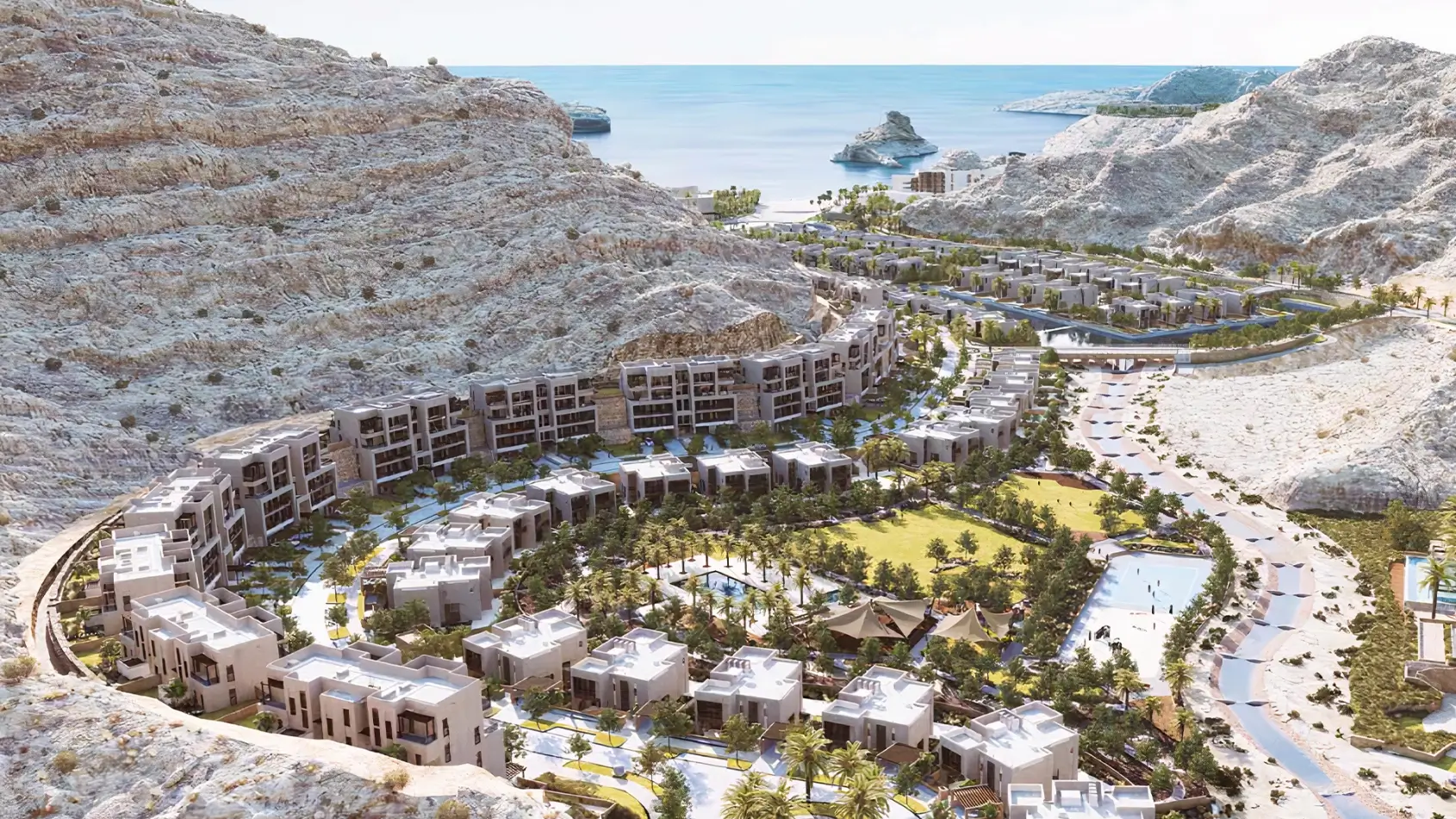
Oman’s real estate price index rose 15.9% in Q1 2026, transaction values reached RO 678.1 million by March — up 18.4% year-on-year — and foreign buyers now account for roughly a quarter to a third of all sales in the country’s freehold zones. Behind those numbers sits a market at a genuinely early stage of its growth curve: a government actively opening the country to foreign ownership through Royal Decree 38/2025, a national strategy (Vision 2040) directing billions of dollars into the exact tourism and infrastructure corridors where freehold property sits, and entry prices still a fraction of comparable freehold markets like Dubai. This guide covers where the Oman market actually stands in 2026, which areas and project types are driving growth, what foreign buyers need to know before purchasing, and how to think about Oman as part of a wider regional portfolio.
Oman Real Estate Market Overview 2026
Oman’s real estate sector is growing from a smaller base than its Gulf neighbors, which is precisely why the growth rates look so strong. The residential market is estimated at USD 5.29 billion in 2026 and is projected to reach USD 7.34 billion by 2031 — a 6.74% compound annual growth rate — while the commercial segment is expected to grow from USD 2.34 billion to USD 3.06 billion over the same period. The price index’s 15.9% year-on-year rise in Q1 2026 is being driven disproportionately by the freehold Integrated Tourism Complex (ITC) segment, where foreign demand is concentrated, rather than by the broader domestic housing market, which is growing at a steadier, more typical pace.
Foreign Direct Investment stock in Oman reached USD 69.3 billion by Q3 2024, up 17.6% over five years, with real estate consistently ranked among the country’s top 20 investment opportunities by government economic planners. That capital isn’t spread evenly — it’s concentrated in a specific set of government-designated zones, which is the single most important structural fact to understand before buying.
Why Oman, and Why Now
Three forces are converging on Oman’s property market at the same time, which is unusual and worth taking seriously as a window rather than assuming it will always be this favorable:
- Regulatory opening. Royal Decree 38/2025 expanded the areas where non-Omanis can acquire freehold property, broadening the international buyer pool beyond the original handful of ITCs designated when the freehold law first launched.
- National strategy backing. Vision 2040’s diversification agenda — backed by a USD 5.2 billion Future Fund and a USD 15 billion national railway network — is directing infrastructure spending straight into the tourism and logistics corridors where freehold developments sit. We break down exactly how this works in Oman Vision 2040 and Real Estate: How National Strategy Shapes Where to Invest.
- Ground-floor pricing. Entry points in Oman’s ITCs start from roughly $135,000, low enough to also qualify as a residency-by-investment threshold — a fraction of what comparable freehold real estate costs in Dubai, Abu Dhabi, or most European residency-by-investment programs.
Structural Advantages Beyond the Price Tag
Lower entry prices get the attention, but Oman’s investment case rests on more than just being “cheaper than Dubai”:
- A currency pegged to the US dollar (the Omani Rial, one of the highest-valued currencies in the world by unit), which removes exchange-rate risk for USD-denominated investors in the same way Dubai’s dirham peg does.
- No annual property tax and no capital gains tax on individual resale profit, matching Dubai’s tax efficiency at a fraction of the entry cost.
- Political and social stability that has made Oman one of the more consistently low-risk jurisdictions in the wider Gulf and Middle East region over the past three decades, a factor institutional and family-office investors weigh heavily alongside pure return metrics.
- A genuinely different lifestyle proposition — mountains, fjord-like coastline, and a slower-paced, more traditionally Arabian character — that has started attracting a segment of buyers actively seeking an alternative to the density and pace of Dubai and Abu Dhabi.
- Government alignment. Because Vision 2040 and the freehold expansion are coordinated national priorities rather than isolated developer projects, infrastructure spending and regulatory support tend to track together in the same corridors — a dynamic that reduces the risk of buying into a development the government later deprioritizes.
Best Areas to Invest in Oman Real Estate
| Area | Best For | Entry Price Level |
|---|---|---|
| Al Mouj Muscat | Established liquidity, marina lifestyle | High |
| Muscat Bay | Luxury waterfront living | High |
| Jebel Sifah | Resort lifestyle, diving | Mid |
| Sultan Haitham City | Ground-floor pricing, long-term growth | Low-Mid |
| Hawana Salalah | Khareef-season tourism yield | Mid |
We cover the full area-by-area breakdown in Best Areas to Invest in Oman Real Estate in 2026: The Complete Guide, but the headline picture in 2026 looks like this:
- Al Mouj Muscat — the country’s flagship waterfront ITC, with a marina, golf course, retail strip, and the deepest resale liquidity of any freehold community in Oman. See our full Al Mouj Muscat investment guide.
- Muscat Hills, Muscat Bay, and central Muscat — established, amenity-rich communities with the strongest rental demand from the city’s professional and diplomatic population.
- Sultan Haitham City — Oman’s flagship new smart-city development and one of the largest master-planned projects in the Sultanate’s history; full details in our Sultan Haitham City investor guide.
- Jebel Sifah — a marina-and-golf community roughly 40 minutes from Muscat, positioned as a lower-density, more resort-style alternative to Al Mouj; see our complete Jebel Sifah guide.
- The Sustainable City – Yiti — Oman’s entry in the Sustainable City brand’s regional portfolio, combining net-zero design ambitions with freehold ownership; covered in full in our Yiti investor guide.
- Hawana Salalah — the Sultanate’s premier freehold beach and marina resort in the south, benefiting from Salalah’s unique khareef (monsoon) tourism season; full breakdown in our Hawana Salalah guide.
- Duqm — the Special Economic Zone anchoring Oman’s industrial and logistics diversification, and an emerging frontier for investors thinking five to ten years out rather than for immediate rental yield; see Duqm Special Economic Zone: Oman’s Next Real Estate Investment Frontier.
For a direct comparison of the two dominant lifestyle and investment hubs, our Muscat vs Salalah guide walks through the tradeoffs between the capital’s scale and liquidity versus Salalah’s tourism-driven seasonal upside.
Understanding Freehold and ITC Zones
Foreign ownership in Oman is not blanket nationwide freehold — it’s structured around designated Integrated Tourism Complexes and, following Royal Decree 38/2025, an expanding list of additional freehold zones. Buying inside one of these zones gives a foreign investor the same ownership rights as an Omani national: full freehold title, the right to sell, lease, or bequeath the property, and — critically — eligibility for residency through the purchase. We explain exactly how the ITC framework works, what qualifies, and what doesn’t in Freehold Property in Oman: A Guide to Integrated Tourism Complexes (ITCs) in 2026, and compare the leading ITCs head-to-head in Comparing Oman’s Integrated Tourism Complexes: Which ITC Should You Buy In?
Residency Through Property: Golden Residency and the Owner Visa
Golden Residency thresholds and eligible investment categories are set by Oman’s Ministry of Housing and Urban Planning, which administers property-linked residency applications.
Oman currently runs two distinct residency-through-property pathways, and conflating them is one of the most common mistakes we see prospective buyers make. The established Golden Residency requires a unified minimum property investment of OMR 200,000 (roughly $520,000) and grants long-term renewable residency. Alongside it, a newer sponsor-free Owner Visa route (introduced under Decision 87/2026) offers a separate, more accessible pathway tied directly to property ownership rather than a fixed high-value threshold, without requiring a local sponsor. We walk through both routes side by side — eligibility, required investment, family inclusion, and renewal terms — in Oman Residency Through Property in 2026: Golden Residency vs. the New Owner Visa.
What You Can Actually Buy
Budget determines property type and location more than almost any other factor in Oman’s freehold market. We map out realistic options across three common budget bands in What Can You Buy in Oman for $200,000, $400,000, and $600,000 in 2026? — broadly, $200,000 buys a well-located studio or one-bedroom apartment in an established ITC; $400,000 opens up larger apartments and entry-level townhouses; and $600,000 and above reaches into villas, branded residences, and premium waterfront units. At the top of the market, developments partnered with international hospitality brands — St. Regis, Mandarin Oriental, and others — are reshaping what “luxury” means in the Omani context; see our comparison in Branded Residences in Oman: St. Regis vs Mandarin Oriental vs Nikki Beach.
Financing for Foreign Buyers
Mortgage terms for foreign buyers are set by individual banks operating under rules from the Central Bank of Oman, and vary by lender and property zone.
Yes — foreign buyers can obtain mortgage financing from Omani banks, typically at loan-to-value ratios in the 60–75% range, though terms vary meaningfully between lenders and depend on the specific ITC and developer. We cover the practical details — which banks lend to non-residents, typical rates, and the documentation required — in Can Foreigners Get a Mortgage in Oman? Bank Financing Guide 2026.
Property Tax and Ownership Costs
Population and construction data from the National Centre for Statistics and Information underpins much of the demand forecasting behind Oman’s current development pipeline.
Oman has no annual property tax and no capital gains tax on individual resale profit, which — alongside Dubai — makes it one of the more tax-efficient freehold markets an investor can access. Buyers should still budget for a one-time transfer fee (typically around 3% of the purchase price), agency commission, and ongoing service charges set by the ITC’s management company for shared facilities and maintenance. The full breakdown, including what’s genuinely tax-free versus what buyers commonly overlook, is in Property Tax in Oman 2026: What Buyers and Investors Actually Pay.
Rental Yields in Oman
Rental yields across Oman’s established ITCs typically run in the 6–8% gross range, competitive with Dubai and ahead of most mature global property markets, with the strongest yields concentrated in well-located apartments in Al Mouj and Muscat Hills where corporate and diplomatic tenant demand is deepest. We maintain a full area-by-area yield breakdown in Oman Real Estate Rental Yields 2026: Where Investors Get the Best Returns. Because Oman’s tenant pool skews toward longer-term corporate and expatriate leases rather than short-term tourism turnover (with Salalah and the coastal resort communities being the main exception), rental income here tends to be more predictable and lower-maintenance than short-term-let-driven markets.
Who Can Buy: Nationality-Specific Guidance
Freehold ownership rules apply broadly to foreign nationals of all countries buying within designated zones, but the practicalities — documentation, remittance rules, and financing access — vary by home country. We’ve written dedicated guides for our largest buyer nationalities: can Indians buy property in Oman, and the general framework in Buying Property in Oman as a Foreigner: Complete Guide 2026.
The Step-by-Step Buying Process
Buying freehold property in Oman as a foreigner is a more structured process than in Dubai, but it’s well established for the main ITCs and typically completes within four to eight weeks:
- 1. Select your property and pay a reservation deposit. Most developers require 5,000–10,000 OMR (or a percentage of the purchase price) to reserve a unit while contracts are prepared.
- 2. Sign the Sale and Purchase Agreement (SPA). This sets out the payment schedule, handover date (for off-plan), and the specific unit specifications.
- 3. Make staged payments. Off-plan purchases follow a construction-linked payment plan similar to Dubai’s, typically 10–20% at signing with the balance tied to build milestones; ready property is usually paid in full or via mortgage disbursement at transfer.
- 4. Register with the Ministry of Housing and Urban Planning. Freehold title for foreign buyers is registered through the ministry, which also issues the documentation used to apply for residency under the Golden Residency or Owner Visa routes.
- 5. Receive your title deed. Once registration completes, you hold the same freehold title rights as an Omani national within that designated zone — full ownership, with the right to sell, lease, or pass the property to heirs.
Ownership Costs and Service Charges
Beyond the roughly 3% one-time transfer fee, owners in Oman’s ITCs pay an annual service charge to the community’s management company, covering shared facilities, landscaping, security, and building maintenance — comparable in structure to Dubai’s system, though typically at a lower absolute cost given Oman’s lower overall price base. These charges vary by development and amenity level: a basic apartment community carries a lighter service charge than a full marina-and-golf ITC like Al Mouj or Jebel Sifah, where the fee also funds the marina, golf course, and resort-grade landscaping that underpin the community’s premium positioning. As with any freehold market, it’s worth reviewing a development’s service-charge history and reserve fund before buying — well-capitalized management companies protect resale value far better than ones running on thin maintenance budgets.
Infrastructure Driving the Next Phase of Growth
Oman’s real estate growth story is inseparable from its infrastructure pipeline. The USD 15 billion national railway network, once operational, will connect Muscat to Sohar, Duqm, and eventually the wider GCC rail network, fundamentally changing the investment case for logistics-adjacent freehold zones. Muscat International Airport’s continued expansion has already lifted tourist arrivals meaningfully year-on-year, directly supporting the short-term rental economics of coastal resort communities like Hawana Salalah and Jebel Sifah. And the Madinat Al Irfan project — a new mixed-use urban district near the airport — represents one of the largest single real estate developments in Oman’s history, expected to reshape demand patterns across the wider Muscat metropolitan area as it delivers over the coming years. Investors who position early in the corridors around confirmed infrastructure spending have historically captured the strongest appreciation in comparable Gulf markets.
Who Oman Real Estate Suits Best
Oman tends to suit a specific investor profile particularly well: buyers prioritizing capital growth potential over immediate maximum yield, given the market’s earlier stage relative to Dubai; families seeking a residency pathway at a lower capital threshold than most comparable Gulf or European programs; and investors who value Oman’s political stability, low crime rate, and distinct cultural and natural-landscape appeal — mountains, coastline, and a more traditional Gulf character than the hyper-modern skylines of Dubai or Abu Dhabi. It suits less well investors who need maximum transaction liquidity on a tight timeline, or who are unwilling to do due diligence on individual developer track records in a market still building out its full regulatory maturity. For most of our clients, the right answer isn’t Oman instead of Dubai — it’s Oman alongside Dubai, with each market doing a different job in the portfolio.
Frequently Asked Questions
Can foreigners own property outright in Oman, or only inside special zones?
Freehold ownership for non-Omanis is available within designated Integrated Tourism Complexes and, following Royal Decree 38/2025, an expanding list of additional freehold zones — not nationwide. Buying inside one of these zones grants full, permanent freehold title.
Is there a minimum property value to qualify for residency?
Yes, but it depends on the pathway. The established Golden Residency requires a unified minimum of OMR 200,000 across your property holdings. The newer Owner Visa route, introduced under Decision 87/2026, offers a more accessible sponsor-free pathway tied to ownership rather than a single fixed high-value threshold.
How long does it take to receive a title deed after purchase?
For ready property, registration through the Ministry of Housing and Urban Planning typically completes within a few weeks of the sale agreement. For off-plan purchases, full title transfers only after the development receives its completion certificate.
Do I need to be a resident of Oman to buy property there?
No — foreign buyers do not need existing Omani residency to purchase freehold property in a designated zone; the property purchase itself is what can then be used to apply for residency.
Risks and What to Watch
Oman’s growth story is genuine, but it comes with the risks typical of an earlier-stage market: liquidity is thinner than Dubai’s — resale timelines in less-established ITCs can run longer, and buyers should factor that into their exit planning. Not every ITC has the same trajectory; developments with strong government backing and proven developer delivery (Al Mouj, Muscat Hills, Sultan Haitham City) carry materially less execution risk than newer, less-tested projects. And because much of the current growth is policy-driven — freehold expansion, Vision 2040 spending, residency incentives — it’s worth tracking regulatory continuity as closely as price data itself. We address these considerations directly in Is 2026 Still a Good Time to Buy Property in Oman?
Oman vs Dubai: How to Think About Both
| Factor | Oman | Dubai |
|---|---|---|
| Entry price | Lower | Higher |
| Golden Residency threshold | OMR 200,000 (~$520,000) | AED 2 million (~$545,000) |
| Annual property tax | None | None |
| Market liquidity | Thinner, developing | Deep, established |
Rather than treating this as an either-or decision, most of our clients use the two markets for different jobs in the same portfolio: Dubai for liquidity, brand-name resale value, and immediate lifestyle use; Oman for lower entry pricing, higher relative growth potential given its earlier market stage, and a residency threshold roughly a quarter of Dubai’s Golden Visa requirement. The full side-by-side comparison — pricing, tax, yields, and risk — is in Oman vs Dubai Real Estate Investment: Which Is Better in 2026?
2026–2027 Outlook
With the price index up nearly 16% year-on-year, transaction value growth accelerating past 18%, and Royal Decree 38/2025 still in its early implementation phase, most indicators point to continued double-digit growth through 2027 as freehold access widens and Vision 2040 infrastructure spending matures. The Madinat Al Irfan and Yiti mega-projects in particular are expected to reshape demand patterns over the next several years as they move from announcement to delivery — early positioning in the corridors around these projects has historically been where the strongest returns in comparable Gulf markets were captured.
Building a Regional Portfolio Around Oman
Investors who already hold property elsewhere in the Gulf, in Europe, or in Turkey and Cyprus frequently ask how an Oman purchase fits alongside those existing assets rather than replacing them. The short answer: Oman works best as a growth-and-diversification allocation rather than a sole holding. Its correlation with more established Gulf markets like Dubai is imperfect — Oman’s growth is driven more by domestic policy and infrastructure delivery than by the global capital flows that move Dubai — which means an Oman position can genuinely diversify a portfolio rather than simply duplicating exposure to the same macro drivers. Combined with a lower absolute entry cost, that makes it realistic to hold a meaningful Oman position alongside other regional and international real estate without concentrating an outsized share of capital in a single small market.
How Uinvest Group Can Help
Our team is based in Al Mouj, Muscat, and works exclusively across Oman’s freehold ITCs day to day — we know which developers deliver on schedule, which units in which buildings command the strongest resale premiums, and how to structure a purchase around the residency pathway that actually fits your situation. Browse current listings on our Oman property page, or get in touch via our contact page for a personalized consultation.
Sources: Mordor Intelligence, Oman Observer.