



















Oman is truly building an entirely new city from scratch, a short drive from Muscat International Airport. Sultan Haitham City, a multi-billion-dollar 14.8 square kilometre masterplan designed for 100,000 residents, is quickly becoming genuinely one of the most talked-about property stories in the Gulf. For investors watching Oman real estate, understanding Sultan Haitham City is now the single biggest indicator clearly and unmistakably of where the country’s infrastructure spending and freehold opportunities are heading over the next two decades. This guide breaks down what Sultan Haitham City actually is fully, what has been announced in 2026, and how you can invest in it today clearly.
What Is Sultan Haitham City?
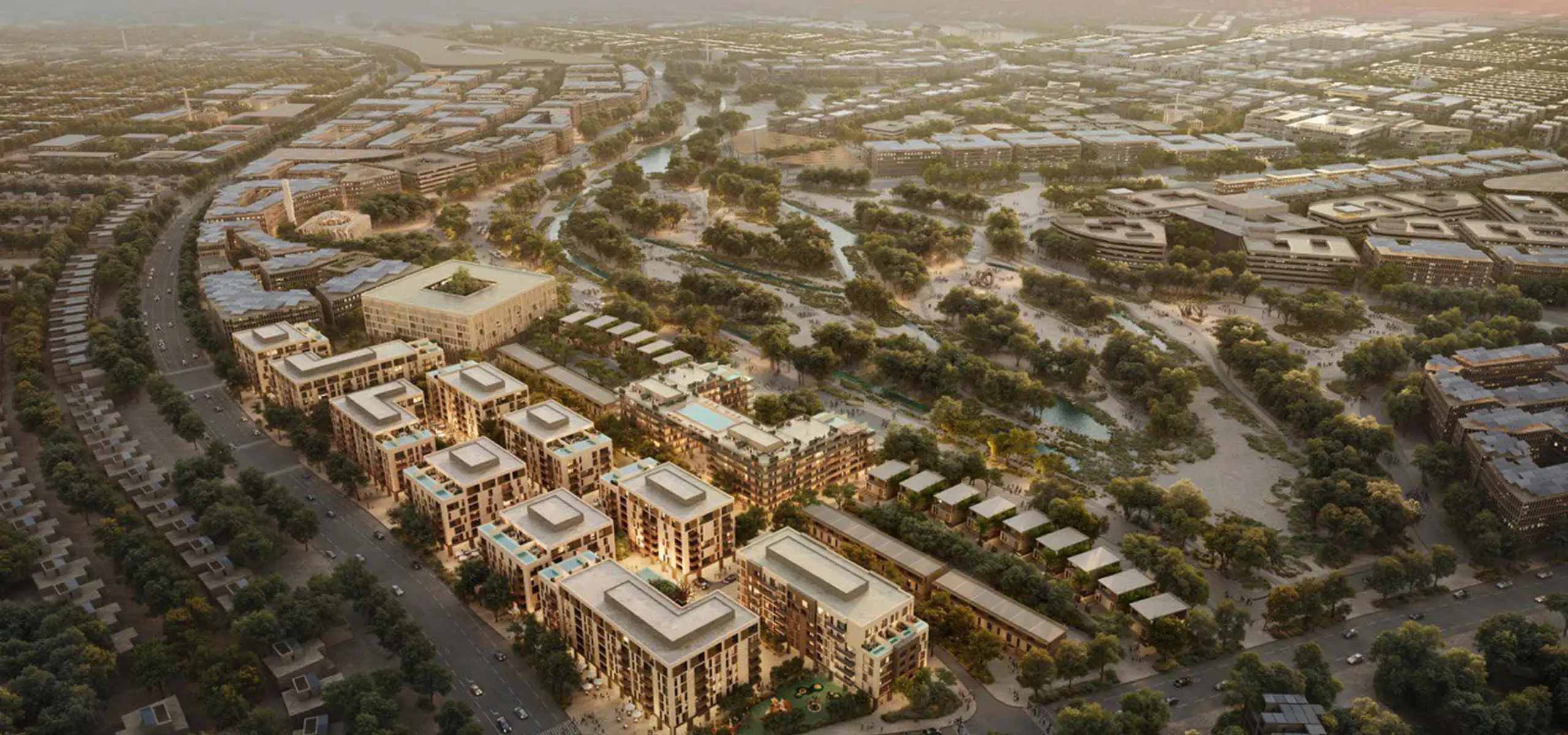
Sultan Haitham City is Oman’s flagship new-city project, commissioned by the Ministry of Housing and Urban Planning as a cornerstone of Oman Vision 2040. Named after Sultan Haitham bin Tariq, the project is being built on a largely undeveloped 14.8 square kilometre site in the Wilayat of Al Seeb, roughly 12 to 15 minutes from Muscat International Airport.
Designed by the internationally renowned architecture firm SOM (Skidmore, Owings & Merrill), the studio behind the Burj Khalifa and One World Trade Center, the masterplan blends traditional Omani design elements like mashrabiya screens with smart-city infrastructure, renewable energy systems and a 7.5 kilometre wadi transformed into a public green spine running through the city.
On completion, Sultan Haitham City will house:
- 100,000 residents
- Approximately 20,000 residential units across 19 integrated neighbourhoods
- 39 schools
- 11 health facilities
- 25 mosques
- A central park plus retail, cultural and commercial districts
Development Timeline: Four Phases to 2045
Sultan Haitham City is being delivered in four phases:
- Phase 1: 2024 to 2030
- Phase 2: 2028 to 2034
- Phase 3: 2033 to 2040
- Phase 4: 2038 to 2045
Construction is already moving at pace. The government has confirmed delivery is progressing at roughly 1,000 residential units per year, with more than 1,700 units already sold in the first phase alone.
| Phase | Target | Focus |
|---|---|---|
| Phase 1 | Initial delivery | First residential neighbourhoods, core infrastructure |
| Phase 2 | Mid-term | Expanded housing, schools and clinics |
| Phase 3 | Long-term | Commercial districts and civic amenities |
| Phase 4 | To 2045 | Full build-out of all 19 neighbourhoods |
What’s New in 2026
Sultan Haitham City has seen major momentum in 2026:
- A RO 185 million (about $480 million) development contract was signed for a new phase of construction
- The Ministry of Housing and Urban Development signed an agreement with Al Adrak Group to build residential units and a shopping arcade on a 450,000 square metre plot within the city
- Oman’s national real estate expo highlighted Sultan Haitham City as a centrepiece of the country’s push to attract foreign investment
These are not just announcements on paper. Contracts of this size signal that the government is actively accelerating delivery, which is exactly the kind of infrastructure commitment investors look for before prices catch up.
Why Investors Are Watching Sultan Haitham City
A handful of factors make this project stand out from typical off-plan launches:
- Government-backed, not developer-speculative. Sultan Haitham City is a state masterplan under Oman Vision 2040, not a single private developer’s project, which reduces the risk of stalled construction.
- Freehold ownership for foreigners. Select communities inside the city offer full freehold ownership open to all nationalities, a rare structure outside Oman’s traditional Integrated Tourism Complexes.
- Ground-floor pricing. With studios starting from around $125,000, entry prices are still well below comparable new-city projects in Dubai or Abu Dhabi.
- Built-in demand. A 100,000-resident target, 39 schools and a relocating government workforce create a natural pool of future tenants and buyers.
- Golden Visa eligibility. Qualifying property purchases in Oman, including in Sultan Haitham City, can support a renewable 10-year residency application.
How to Invest in Sultan Haitham City Today
The clearest way for foreign investors to enter Sultan Haitham City right now is Wadi Zaha, a 760-home freehold community developed by Al Ahly Sabbour, a developer with more than 30 years and 50+ delivered projects across the region.
Wadi Zaha highlights:
- Freehold ownership open to all nationalities
- Studio apartments from OMR 48,125 (about $125,000)
- 15% down payment, with the balance spread over 4 to 5 years
- Handover scheduled for 2026 to 2027
- Largest frontage onto the city’s central park
- OMR 90 million developer investment
For a wider view of what your budget can get you across Oman right now, see our guide on what you can buy in Oman for $200,000, $400,000 and $600,000 in 2026.
| Development | Unit Types | Ownership |
|---|---|---|
| Wadi Zaha | Apartments, houses | Freehold, ITC |
| Sarooj Oasis Apartments | Apartments | Freehold, ITC |
| Sarooj Oasis Villas | Villas | Freehold, ITC |
| Yenaier Residences | Apartments | Freehold, ITC |
| Hay Al Wafa | Apartments, townhouses | Freehold, ITC |
Is Sultan Haitham City a Good Investment?
For buyers asking whether now is the right time to enter the Oman market, Sultan Haitham City is arguably the strongest single data point in favour of yes. It combines confirmed government funding already in the hundreds of millions of dollars, a fixed and published delivery timeline, freehold access for foreign buyers, and entry prices still at pre-completion, off-plan levels.
That combination of government backing, foreign freehold access and early pricing does not come around often in Gulf real estate. For a deeper look at market timing and risk, read our analysis on whether 2026 is still a good time to buy property in Oman.
Sultan Haitham City’s 19 Neighbourhoods Explained
The masterplan’s 19 integrated neighbourhoods are designed as walkable, mixed-use districts rather than isolated residential blocks, each combining housing with local retail, schools, and green space within a short walk of home. This structure, drawn from SOM’s broader urban planning philosophy, aims to reduce residents’ dependence on cars for daily errands, a departure from the more car-centric layout typical of older Gulf developments. Wadi Zaha, the primary freehold community currently open to foreign buyers, sits along the city’s central park frontage, giving early buyers direct access to what is planned as the development’s main public green space once later phases complete. As additional neighbourhoods release for sale in future phases, buyers who entered early through Wadi Zaha are positioned to benefit from the broader city’s amenity build-out around them.
Wadi Zaha In Detail: Pricing And Unit Types
Wadi Zaha, developed by Al Ahly Sabbour, represents the clearest entry point into Sultan Haitham City for foreign investors today. Studio apartments start from OMR 48,125 (about $125,000), with a 15% down payment and the balance spread over 4 to 5 years — a payment structure that meaningfully lowers the upfront cash requirement compared with all-cash purchases common in more established communities. The development’s largest frontage onto the city’s central park is a genuine differentiator, since park-facing inventory typically commands a premium once a masterplan matures, and Wadi Zaha buyers are securing that position at current, still-early pricing. With handover scheduled for 2026 to 2027 and an OMR 90 million developer investment behind the project, Wadi Zaha offers a rare combination in the Omani market: a private, experienced developer’s execution capability layered onto a government-backed masterplan’s infrastructure guarantee.
Other Freehold Developments in Sultan Haitham City
Wadi Zaha is not the only way in. Three further freehold releases are now open within the city’s neighbourhoods, each with a different unit mix and price point:
- Yenaier Residences — smart freehold apartment towers, aimed at buyers wanting a more urban, amenity-led building.
- Sarooj Oasis Apartments — freehold apartments in the Sarooj Oasis neighbourhood, a lower entry point for buyers prioritising price.
- Sarooj Oasis Villas — freehold villas within the same Sarooj Oasis neighbourhood, for buyers wanting a family-sized unit with private outdoor space.
Buyers comparing all four should weigh unit type and neighbourhood against their own budget and timeline — UInvest can advise on current pricing and availability across Wadi Zaha, Yenaier, and both Sarooj Oasis releases.
Understanding The Risk: Off-Plan Investment In A New City
Investors should approach Sultan Haitham City with the same diligence appropriate to any large-scale, multi-phase masterplan still under construction. The government-backed nature of the project meaningfully reduces — but does not eliminate — the execution risk typical of off-plan purchases, since Sultan Haitham City still depends on continued government funding, contractor delivery, and demand materialising as later phases release. The confirmed pace of roughly 1,000 units delivered per year and more than 1,700 units already sold provides real evidence of momentum, but buyers should still budget for the possibility that infrastructure like schools, retail, and healthcare facilities in Wadi Zaha’s immediate surroundings may take longer to fully mature than the published phase timeline suggests, particularly for later-delivered neighbourhoods beyond Phase 1.
Rental And Resale Potential As The City Matures
Sultan Haitham City’s rental and resale potential is fundamentally tied to how quickly the surrounding city fills in with residents, schools, and daily infrastructure. In the near term, with Phase 1 still under construction and limited established tenant demand, rental yields are more speculative than in mature communities like Al Mouj or Jebel Sifah — though this is also precisely why entry pricing remains low relative to Oman’s established ITCs. As the government workforce relocation associated with the new capital district materialises and Phase 1’s 39 schools and 11 health facilities come online, demand for both rental and resale inventory is expected to strengthen considerably, following a similar trajectory to how Al Mouj matured from a construction site into a fully tenanted, actively traded community over its first decade. Investors specifically targeting capital appreciation over immediate rental income are the best-positioned buyer profile for Sultan Haitham City today.
| Risk | Why It Matters | How To Mitigate |
|---|---|---|
| Construction delay | Off-plan delivery can slip | Check developer track record on prior phases |
| Escrow handling | Payments must be protected | Confirm escrow account is registered before deposit |
| Immature amenities | Retail and services arrive in stages | Match your horizon to the phase you buy in |
| Thin resale market | Few comparable sales early on | Plan a longer hold, not a quick exit |
How Sultan Haitham City Compares To Oman’s Established ITCs
Sultan Haitham City occupies a distinct position in Oman’s freehold market relative to established communities like Al Mouj and Jebel Sifah. Where those communities offer proven infrastructure, active resale markets, and immediate rental income at a higher entry price, Sultan Haitham City offers ground-floor pricing and outsized government backing at the cost of a longer wait for the surrounding city to fully materialise. This makes it less a direct substitute for Al Mouj or Jebel Sifah and more a complementary addition to a diversified Oman property portfolio — many of our clients hold a stake in an established community for immediate rental income alongside an early Sultan Haitham City purchase for longer-term capital growth. This dual-track approach is one of the most common strategies our clients pursue when balancing growth potential against near-term rental income. See our Al Mouj Muscat investment guide for a direct comparison against Oman’s most mature freehold address.
| Community | Maturity | Entry Price | Best For |
|---|---|---|---|
| Sultan Haitham City | New, phased build | Lowest of the four | Capital growth, capital proximity |
| Al Mouj Muscat | Fully mature | Highest | Liquidity and predictable rental yield |
| Jebel Sifah | Established resort | Mid | Lifestyle and seasonal letting |
| Hawana Salalah | Established resort | Mid | Seasonal tourism demand |
Who Is Behind Sultan Haitham City?
Sultan Haitham City’s government backing extends beyond a single ministry announcement. The Ministry of Housing and Urban Planning commissioned the masterplan as a cornerstone of Oman Vision 2040, the country’s long-term economic diversification strategy away from oil dependence and toward tourism, logistics, and knowledge-economy sectors. Delivery partners bring their own track records to specific parcels within the city — Al Ahly Sabbour, the developer behind Wadi Zaha, brings more than 30 years and over 50 delivered projects across the region, while the RO 185 million construction contract signed in 2026 and the Al Adrak Group agreement for a 450,000 square metre plot demonstrate the government’s willingness to bring in established, well-capitalised private partners rather than attempting to deliver the entire masterplan through a single entity. This layered structure — government-backed land and infrastructure, private-developer execution on individual parcels — is broadly similar to how Hawana Salalah and Jebel Sifah were delivered through Muriya, giving Sultan Haitham City a template with real precedent in the Omani market.
Title for completed units is registered at the Ministry of Housing and Urban Planning, which maintains Oman’s official property register and administers the ITC framework the city is delivered under.
Financing A Sultan Haitham City Purchase
Wadi Zaha’s payment structure — a 15% down payment with the balance spread over 4 to 5 years — is itself a form of financing that lowers the barrier to entry compared with an all-cash purchase. Buyers who prefer traditional mortgage financing can also approach Oman-based banks, though lenders may apply more conservative terms to off-plan purchases in a still-developing masterplan compared with ready property in an established ITC. Buyers should factor the total cost of financing, whether through the developer’s instalment plan or a bank mortgage, into their overall return calculation, and confirm current terms directly with Al Ahly Sabbour or their broker, since payment plan structures can evolve as later phases of Wadi Zaha and the wider city release. We recommend confirming the exact terms of your reservation agreement in writing before making any deposit, and having an independent legal review of the sale contract regardless of how established the developer’s track record is.
Mortgage lending to foreign buyers is regulated by the Central Bank of Oman, which sets the lending rules Omani banks operate under. Loan-to-value limits differ between banks and are typically stricter for off-plan purchases than for completed units.
What Happens After Phase 1 Delivers?
Phase 1’s 2024–2030 delivery window is when the bulk of Sultan Haitham City’s foundational infrastructure — the initial neighbourhoods, schools, and health facilities — comes online. For early buyers, this phase transition is the key inflection point to watch: as Phase 1 neighbourhoods fill in with residents and daily infrastructure begins operating at full capacity, rental demand and resale activity for Wadi Zaha and other Phase 1 communities should strengthen meaningfully, similar to how Al Mouj’s early phases matured once its marina and golf course became fully operational. Phases 2 through 4, running from 2028 through 2045, will continue adding neighbourhoods and inventory, meaning Sultan Haitham City will remain a multi-decade growth story even after Phase 1 fully delivers, rather than a project that completes and then plateaus, which is precisely why we encourage clients to think of this as a long-term holding rather than a quick flip.
Is Sultan Haitham City Only For Off-Plan Buyers, Or Can I Buy Resale?
Given the city’s early stage, most current inventory, including at Wadi Zaha, is off-plan or newly delivered rather than resale. As Phase 1 units are progressively handed over from 2026 through 2027 and beyond, a genuine resale market is expected to develop, though it remains considerably thinner today than at established communities like Al Mouj or Jebel Sifah. This is the same pattern we’ve seen play out at Al Mouj, Jebel Sifah, and Hawana Salalah, each of which took years to move from early construction to a fully active resale market.
How Does The Government Ensure Sultan Haitham City’s Delivery Stays On Track?
The project’s confirmed funding, published phase timeline, and the pace of roughly 1,000 units delivered annually provide the clearest evidence of continued execution, backed by Oman Vision 2040’s broader national priority status. As with any large infrastructure project, buyers should still monitor delivery milestones directly rather than assuming the published timeline is guaranteed, and factor realistic delivery risk into their investment decision.
Does Wadi Zaha Qualify For Oman’s Golden Residency?
Larger or higher-value units at Wadi Zaha can clear the OMR 200,000 Golden Residency threshold, though the entry-level studios starting from OMR 48,125 do not qualify on their own. Buyers specifically targeting Golden Residency should confirm which Wadi Zaha unit types clear the threshold with their broker before reserving and confirm it directly with our team.
What Is Oman Vision 2040 And Why Does It Matter For This Project?
Oman Vision 2040 is the country’s long-term national strategy to diversify the economy away from oil dependence toward tourism, logistics, and knowledge-sector growth. Sultan Haitham City’s status as a flagship project under this vision signals sustained national priority and funding commitment, which is part of why the project carries lower execution risk than a comparable purely private masterplan elsewhere in the region.
How Does Sultan Haitham City Compare To Buying Off-Plan In Dubai?
Sultan Haitham City’s studios starting from roughly $125,000 sit well below comparable off-plan entry pricing in Dubai’s newer masterplan communities, while offering a similar government-backed infrastructure guarantee and a more accessible Golden Residency pathway than Dubai’s higher-threshold Golden Visa programme. a distinction worth understanding before comparing headline prices between the two countries. Investors comparing both markets should weigh Dubai’s more mature off-plan resale market against Sultan Haitham City’s earlier-stage pricing and lower entry cost.
Can I Visit Wadi Zaha Before Buying?
Yes, and given the project’s early construction stage, an in-person visit or a detailed video walkthrough with your broker is particularly valuable and one we’re happy to arrange for prospective clients for understanding current progress against the published timeline. Many international buyers combine a visit with viewings at established communities like Al Mouj or Jebel Sifah to compare the risk-return trade-off directly before deciding where to allocate their budget.
Population and housing indicators for the capital region are published by the National Centre for Statistics and Information, which provides the demographic baseline behind the city’s long-term absorption assumptions.
Frequently Asked Questions
What Is Sultan Haitham City?
Sultan Haitham City is a government-led new-city masterplan in the Wilayat of Al Seeb, about 12 to 15 minutes from Muscat International Airport. Commissioned by the Ministry of Housing and Urban Planning under Oman Vision 2040, it is designed to house 100,000 residents across roughly 20,000 residential units by 2045.
Can Foreigners Buy Property in Sultan Haitham City?
Yes. Select freehold communities within Sultan Haitham City, including Wadi Zaha, are open to full foreign ownership, with no requirement to partner with an Omani national or company.
When Will Sultan Haitham City Be Finished?
The masterplan is being delivered in four phases running from 2024 to 2045. Phase 1 is already under construction, with roughly 1,000 residential units being delivered per year and more than 1,700 units sold so far.
Who Designed Sultan Haitham City?
The masterplan was designed by SOM (Skidmore, Owings & Merrill), the architecture firm behind the Burj Khalifa and One World Trade Center, blending traditional Omani design with smart-city infrastructure and a 7.5 kilometre green wadi spine.
Does Buying in Sultan Haitham City Qualify for Oman Residency?
Qualifying property purchases in Sultan Haitham City can support a renewable 10-year residency application under Oman’s Golden Residency programme, in addition to standard freehold ownership rights.
What Is Wadi Zaha And How Is It Different From The Rest Of Sultan Haitham City?
Wadi Zaha is the 760-home freehold community developed by Al Ahly Sabbour within Sultan Haitham City, currently the clearest and most accessible entry point for foreign buyers into the wider masterplan. It benefits from the city’s overall government-backed infrastructure while being delivered and sold by an experienced private developer with a 30-year regional track record.
What Are The Total Closing Costs For A Sultan Haitham City Purchase?
Buyers should budget the standard Omani closing costs of roughly 5–6% on top of the purchase price, covering the 3% government transfer fee, agency commission, and legal or admin costs. New-build units like those at Wadi Zaha may also carry 5% VAT on the developer’s first sale — see our full property tax in Oman guide for a complete breakdown.
How Risky Is Buying Off-Plan In A New City Compared To An Established ITC?
Off-plan purchases in a new city carry more construction and delivery-timeline risk than buying ready property in an established ITC like Al Mouj, though Sultan Haitham City’s government backing and confirmed delivery pace meaningfully reduce that risk relative to a purely private, unproven off-plan project. Buyers uncomfortable with any construction-timeline risk should generally favour established communities instead.
Ready to Invest in Sultan Haitham City?
Sultan Haitham City is one of the clearest infrastructure-backed opportunities in Oman real estate today, combining confirmed government funding, foreign freehold access and early-stage pricing rarely found together in the Gulf. Explore our full range of Oman properties, including live availability in Sultan Haitham City, or get in touch with our team for a personalised recommendation. Reach out to our team today to discuss current availability and reservation terms.