
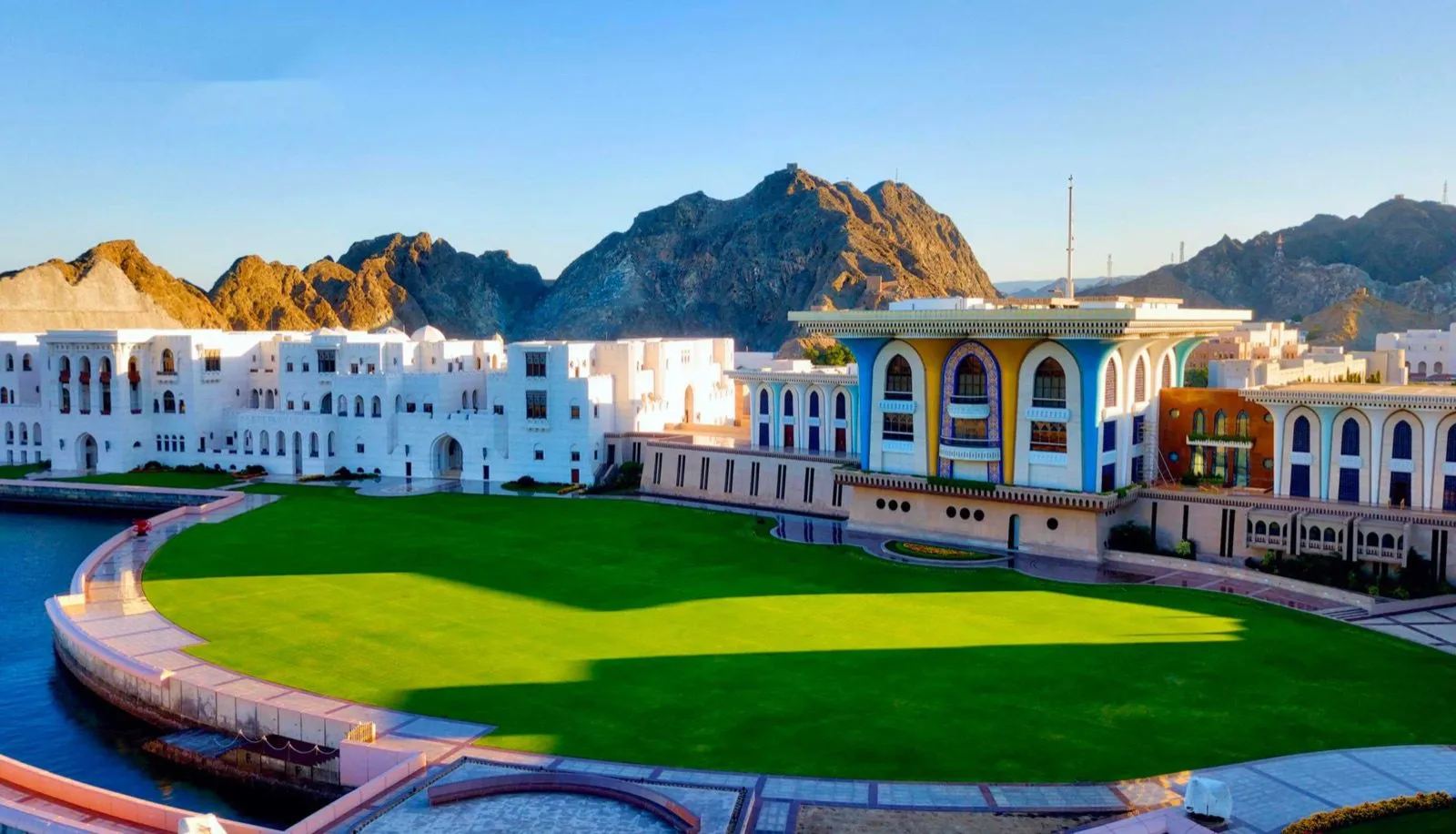
On 10 March 2026 Oman replaced almost its entire property rulebook in one move. Royal Decree 79/2025, the Real Estate Regulation Law, repealed the 1986 brokerage law, the 1989 apartments and floors ownership system, and the 2018 escrow account system, and put a single framework in their place. For anyone buying a home in Oman from abroad, the part that matters most is what now happens to your money between the day you sign and the day you get keys.
That question is not academic. Of the 43 Oman projects we list, 27 hand over between 2027 and 2029, and several ask for the entire purchase price before a single key changes hands. This guide explains what the new law actually requires, how much of your money is exposed under each payment structure, and the specific questions to put to a developer before you sign.
What Royal Decree 79/2025 Changed, and When
The decree was issued on 10 September 2025 and published in Official Gazette 1613. It came into force 180 days after publication, in March 2026 — law firm commentary from BSA gives the effective date as 10 March 2026. The executive regulations, which will carry most of the operational detail, are due within one year of entry into force, so by March 2027.
That timing matters when you read anything about buying in Oman. A guide written before March 2026 describes a system that no longer exists, and the detailed rules that will sit underneath the new law have not all been published yet. Anyone who tells you the new regime is fully settled is overstating it.
The three regimes it replaced
| Repealed law | What it governed | Where those rules live now |
|---|---|---|
| Royal Decree 78/86 | Real estate brokerage | Brokerage licensing inside RD 79/2025 |
| Royal Decree 48/89 | Ownership of apartments and floors (jointly owned property) | Owners’ associations chapter of RD 79/2025 |
| Royal Decree 30/2018 | Escrow accounts for real estate development projects | Escrow and developer licensing chapter of RD 79/2025 |
The 2018 escrow law was the one that first required off-plan money to sit in a project account rather than in the developer’s general funds. It has not been abolished in spirit; it has been absorbed into a wider law that also covers brokers, jointly owned buildings and a new registry.
How Escrow Is Supposed to Protect an Off-Plan Buyer
The principle is simple and worth stating plainly, because it is the single biggest protection a foreign buyer has in an Integrated Tourism Complex purchase.
- A licensed developer must open an independent escrow account for each project, in the name of that project.
- Buyer payments go into that account, not into the developer’s operating funds.
- Money comes out against verified construction progress, not on the developer’s say-so.
- The account is intended to be insulated from the developer’s other creditors, so the money tracks the building rather than the company’s balance sheet.
- Developers must hold a Real Estate Developer licence from the Ministry of Housing and Urban Planning before selling, provide financial guarantees for completion, and file periodic disclosures.
Under the previous escrow system, withdrawals required sign-off from a project monitor appointed for that development. The new law keeps supervision with the Ministry and adds explicit enforcement powers, including administrative and criminal penalties, fines and licence revocation.
Escrow is not an insurance policy. It does not guarantee your project finishes, it does not guarantee a handover date, and it does not refund you automatically if a developer stalls. What it does is make it much harder for your instalments to be spent on something other than the building you are buying into.
How Much of Your Money Is Exposed Before Handover
This is where an abstract legal protection becomes a number. Our analysis of the published payment plans across the Oman portfolio found that the share of the purchase price due before handover ranges from 30% to 100%. The difference decides how much of your capital is sitting inside someone else’s construction project at any moment.
| Project | Developer | Due before handover | Handover |
|---|---|---|---|
| The Sustainable City – Yiti | SDIC (Omran + Diamond) | 30% | Q1 2027 |
| Mira Ocean Estates | Mira Developments | 50% | Q4 2028 |
| Luma Residence | Muscat Bay | 50% | Q1 2029 |
| AIDA | DarGlobal | 50% | Q1 2027 – Q4 2028 |
| Solaris | Muriya | 85% | Q4 2027 |
| Raya | Muriya | 85% | Q4 2027 |
| Lubana Island | Muriya | 92.5% | Disputed |
| Olive Farms | Muriya | 100% | Q4 2028 |
| Al Mina | Muscat Bay | 100% | Q1 2027 |
Read that table as a risk ladder rather than a quality ranking. A 30/70 plan at Yiti means that at the moment of handover, 70% of your money is still yours; if the project stalls at 80% built, your exposure is limited to what you have paid. A 100%-before-handover plan at Olive Farms or Al Mina means you have financed the entire building and hold nothing back.
Why the Muriya numbers differ from each other
Four Muriya schemes publish an identical formula — 10% on booking plus 7.5% per quarter — yet reach different totals before handover. That is arithmetic, not inconsistency: the pre-handover share is simply a function of how many quarters the build runs. Ten quarters reaches 85%, eleven reaches 92.5%, twelve reaches 100%. When you compare two projects from the same developer, compare build length, not just the headline instalment.
We worked the cash-flow cost of these structures in our guide to Oman property payment plans: on a $300,000 purchase over a three-year build at a 5% opportunity cost, a 30/70 plan is worth roughly $15,500 more to the buyer than paying everything before handover. That is about 5% of the price — which happens to land inside the 3–13% uplift that Mandarin Oriental openly charges for deferred instalments.
The Preliminary Real Estate Registry
The new law introduces a preliminary registry for off-plan units. In practice this means an off-plan sale is recorded officially before the building exists, rather than existing only as a contract between you and the developer. Commentary on the law indicates that dispositions made before the law took effect also had to be brought onto the register within six months of entry into force — a deadline that fell in September 2026. We have not been able to confirm that six-month window in the official text, so treat it as a question for the ministry rather than a settled fact.
The practical takeaway for a buyer is straightforward: ask whether your unit has been registered, and ask to see the evidence. A registered off-plan interest is a far stronger position than a signed contract in a drawer, particularly if a developer later disputes what was sold or tries to sell the same unit twice.
Owners’ Associations: Who Will Control Your Service Charge
The chapter that will matter most after handover is the one almost nobody reads. RD 79/2025 requires an owners’ association for jointly owned and multi-unit developments, gives it legal personality with financial and administrative independence, and places it under ministerial supervision. The association manages common areas, maintains shared facilities and represents owners before the authorities.
Until now, service charges in Omani resort communities have effectively been set by the developer or its management company, with owners having little formal standing. A properly constituted association changes who decides, who audits the budget and who can be held to account. If you own in a community where charges have risen without explanation, this is the mechanism to ask about.
The stakes are real. In our review of service charges in Oman the spread between projects is wide, and the ratio of annual charge to purchase price is what quietly decides whether a small unit ever pays for itself. A studio carrying a 1.15% annual charge is in a very different position from a two-bedroom apartment in a mature community at roughly 0.8%.
Developer Licensing and Financial Guarantees
Three requirements sit together and are worth checking as a set:
| Requirement | What to ask for | Why it matters to you |
|---|---|---|
| Developer licence | The licence number issued by the Ministry of Housing and Urban Planning | Selling off-plan without one is a breach; an unlicensed seller is a red flag before price is even discussed |
| Project escrow account | The account details named for this project, written into your sale agreement | Payments into a company account rather than the project account defeat the protection entirely |
| Financial guarantee / completion undertaking | Confirmation of the guarantee lodged for the project | It is the backstop if the developer cannot finish |
Put each answer in writing and attach it to the contract. A developer with nothing to hide will supply all three without friction. If any of the three produces vagueness, that tells you more about the project than any brochure.
What Is Still Unknown
Honesty about the gaps is more useful than false certainty:
- The executive regulations are not fully published. They are due by March 2027 and will carry the operational detail — thresholds, forms, timelines, and how the registry works day to day.
- Transitional treatment is unclear in places. Projects that started selling under the 2018 escrow regime are moving into a new framework mid-build.
- Enforcement is untested. The law provides penalties and licence revocation; how aggressively the ministry uses them will only be visible over time.
- ITC-specific interaction. Most foreign-eligible freehold sits inside Integrated Tourism Complexes, and how association rules interlock with existing ITC community rules will need the regulations to settle.
A Practical Checklist for Foreign Buyers
If you are buying off-plan in Oman right now, this is the sequence that protects you best:
- Confirm the unit is foreign-eligible before anything else. Not every Omani project is open to non-Omanis — see our guide to Oman property foreigners cannot buy, and confirm the designation in writing for your specific unit.
- Get the developer licence number and verify it with the ministry rather than the sales office.
- Insist the escrow account is named in the sale and purchase agreement, and pay only into it.
- Match the payment schedule to construction milestones, not to calendar dates. A plan tied to dates pays out whether or not the building rises.
- Ask what share of the price falls due before handover and compare it against the table above.
- Ask whether your unit is on the preliminary register and request evidence.
- Read the service charge and association provisions before signing, not at handover.
- Book an independent snagging inspection and make final payment conditional on the list being cleared, where the contract allows.
- Take independent legal advice. A lawyer who is not connected to the developer or the agent is the cheapest insurance in the transaction.
How This Interacts With Residency
Buyers frequently assume that signing an off-plan contract starts a residency clock. It does not. Oman’s two property-linked routes both rest on ownership, not on a contract to buy: the Golden Residency requires a qualifying investment of at least OMR 200,000 in ITC real estate with a valid title deed, while the newer Owner Visa attaches to a property you already own and ends if you transfer it. Our comparison of the Golden Residency and the Owner Visa sets out which is which.
The practical consequence for an off-plan buyer is that residency generally follows completion and registration, so the handover date in your contract is also, in effect, your residency date. When you compare a Q1 2027 handover with a Q1 2030 one, you are comparing three years of residency eligibility as well as three years of construction risk.
Frequently Asked Questions
Does Royal Decree 79/2025 apply to property I already own?
The law governs the sector as a whole, including jointly owned property and the associations that manage it, so existing owners are affected even though the escrow rules matter most to new off-plan purchases.
Is my money safe in an Omani escrow account?
Escrow protects against your instalments being spent outside the project and against the developer’s other creditors reaching them. It does not guarantee completion, a handover date or a refund. Treat it as a strong control, not a warranty.
Can a developer still ask for 100% before handover?
Yes. The law regulates where your money sits and how it is released, not what payment structure a developer offers. Two of the projects we list ask for the full price before completion, which is precisely why the payment schedule deserves as much scrutiny as the price.
What happens if a project is never finished?
That is where the licence, the escrow balance and the financial guarantee matter together, and where the outcome depends on the specific facts. Get independent legal advice early rather than after a missed milestone.
Do I need to be in Oman to buy?
Not necessarily, but do not treat a remote purchase as a reason to skip verification. Everything in the checklist above can be requested and confirmed in writing from abroad.
Where can I read the law itself?
The decree is listed publicly at decree.om, and the Ministry of Housing and Urban Planning publishes sector information at housing.gov.om. Law firm commentary is useful for orientation, but the executive regulations will be the operative detail.
Why Oman Reformed Now
The reform did not arrive in isolation. Oman has spent the past two years widening who may own property and on what basis, and the regulatory framework had to catch up with the sales activity it created.
Royal Decree 38/2025, in force since April 2025, opened foreign residential ownership beyond the coastal Integrated Tourism Complexes into designated Special Economic Zones and Free Zones. The Golden Residency was relaunched in August 2025 on a single OMR 200,000 threshold. A sponsor-free Owner Visa followed in mid-2026. Each of those moves invites more non-resident money into off-plan projects, and off-plan money is exactly what the escrow rules exist to protect.
Read alongside Vision 2040’s push to grow non-oil investment, RD 79/2025 looks less like a crackdown and more like the missing half of a growth strategy: if a government wants foreign buyers to commit years ahead of completion, it has to make the commitment safe enough to be rational.
Key dates in one place
| Date | Event | Why it matters to a buyer |
|---|---|---|
| April 2025 | RD 38/2025 widens foreign ownership into SEZs and free zones | More projects become foreign-eligible — but eligibility is still unit by unit |
| 31 August 2025 | Golden Residency relaunched at a unified OMR 200,000 | Replaces the old two-tier thresholds still quoted on many sites |
| 10 September 2025 | RD 79/2025 issued, published in Official Gazette 1613 | The new Real Estate Regulation Law enters the statute book |
| March 2026 | RD 79/2025 in force (180 days after publication) | Brokerage, joint ownership and escrow rules replaced in one step |
| June 2026 | Owner Visa (ROP Decision 87/2026) | Sponsor-free residency tied to owning property, no published minimum value |
| By March 2027 | Executive regulations due | The operational detail most buyers actually need |
How Oman’s Protections Compare With Dubai
Most buyers looking at Oman have already looked at Dubai, so the comparison is worth making carefully rather than competitively.
Dubai has run a project escrow regime since 2007 and pairs it with pre-registration of off-plan sales on a central register maintained by the Dubai Land Department, so an off-plan interest is recorded from the outset. That combination — escrow plus registration plus an established regulator — is roughly the destination Oman is now heading toward with project escrow, ministry licensing and a preliminary registry.
The honest differences today are maturity and track record. Dubai’s system has been tested through a full property cycle, including a crash; Oman’s new framework has not been tested at all yet, and its executive regulations are still being written. That is not a reason to avoid Oman — the entry prices, the payment structures and the residency thresholds are different propositions entirely — but it is a reason to do the verification work yourself rather than assuming the system will catch every problem. If you are weighing the two markets, our side-by-side on Oman vs Dubai real estate investment covers the commercial differences, and the Dubai off-plan buyer’s guide sets out how the Emirati process runs in practice.
If You Are Mid-Purchase Right Now
Buyers who signed before March 2026 are in the awkward middle: contracts written under the old escrow system, completing under the new one. Three practical steps help.
- Re-read your payment schedule against progress. If instalments are calendar-linked and the build has slipped, you are paying ahead of construction. Ask, in writing, for the current completion percentage and the escrow position.
- Ask whether the project and your unit have been brought onto the preliminary register. Commentary points to a six-month window from the law’s entry into force for pre-existing dispositions, which would have fallen in September 2026.
- Ask who will run the owners’ association and when it will be constituted. If handover is close, that answer decides who sets your service charge in the first year of ownership.
What Good Answers Look Like
It helps to know what a solid reply sounds like before you ask, because vagueness is the signal you are testing for.
| Your question | A good answer | A warning sign |
|---|---|---|
| What is your developer licence number? | A number, plus the issuing ministry, supplied without hesitation | “We are part of a licensed group” or a change of subject |
| Which escrow account do I pay into? | A project-named account written into the sale agreement | A company account, a personal account, or a foreign account |
| What triggers each instalment? | Named construction milestones, verified by the monitor or engineer | Fixed calendar dates unrelated to progress |
| Is my unit on the preliminary register? | Yes, with evidence you can keep | “It will be registered at handover” |
| What is the current service charge, and who sets it? | A per-square-metre figure, a budget, and the association’s status | “It will be confirmed later” |
| What happens if handover slips? | A contractual remedy: penalty, interest, or a right to withdraw | Silence in the contract |
None of these questions is aggressive. They are the ordinary due diligence any lawyer would run, and the difference between a developer that answers them in a morning and one that cannot is the most reliable signal available to a buyer working from another country.
Worked Example: The Same Home on Two Payment Plans
Take a $300,000 apartment with a three-year build, and assume your money would otherwise earn 5% a year.
| Structure | What you pay before keys | Present value of the payments | Effective cost vs headline price |
|---|---|---|---|
| 30% before handover, 70% on completion | $90,000 | $264,112 | 88.0% |
| 50% before handover, 50% on completion | $150,000 | $267,419 | 89.1% |
| 10% booking, then 7.5% quarterly to 100% | $300,000 | $279,641 | 93.2% |
The spread between the best and worst structure is about $15,500, or 5.2% of the purchase price — before any consideration of risk. Add the risk dimension and the gap widens: in the 30/70 case a stalled project exposes $90,000, while in the fully front-loaded case it exposes the entire $300,000. Two buyers paying the same headline price are not making the same investment.
This is also why a discount for early payment deserves arithmetic rather than gratitude. If a developer offers 5% off for paying everything up front, that is roughly the value of the deferral you are giving up — and you are taking on all of the construction exposure in exchange for breaking even.
The Short Version
Oman has moved from a patchwork of 1980s statutes plus a 2018 escrow law to a single modern framework, and the direction of travel favours buyers: licensed developers, project-level escrow, milestone-linked releases, a preliminary register for off-plan units, and owners’ associations with real standing. The detail is still arriving, and the enforcement record does not exist yet.
Until it does, the protection that is fully under your control is the payment schedule you agree to. A plan that keeps money in your hands until handover is worth real money and limits what you can lose. If you want to see how that plays out across current inventory, start with property in Oman, or read our step-by-step guide to buying off-plan property in Oman and the companion analysis of selling property in Oman for the exit side of the same decision. The Muscat and Salalah pages show what is actually available in each market today, and the best areas to invest in Oman and freehold property in Oman are built from the same project data used in the tables above.