

























The two lowest-priced square feet among the Omani projects reviewed on this page appear not to be open to foreign buyers. Not because they are sold out, or expensive in disguise — but because, on our own review, the schemes are for Omani citizens entitled to residential land.
At $56 per square foot in Sur and $66 per square foot in Bidbid, they undercut the lowest-priced foreign-eligible project reviewed below (Hay Al Wafa, at $100) by roughly 44% and 34%. Both appear on property portals. Both have brochures, floor plans and prices. On our own review, neither appears to be open to non-Omani buyers on any of the routes we checked, although the Ministry of Housing and Urban Planning’s June 2026 statement names Surooh-type neighbourhoods among areas where foreigners may own, so the question is project by project.
This page sets out a three-question test you can run yourself on any Omani project. It is not legal advice — only a lawyer and the land registry can confirm what a specific deed says — but it should help you decide which listings are worth a lawyer’s time and which are not.
The three questions
| # | Question | What the answer means |
|---|---|---|
| 1 | What land does it sit on? | Inside a designated Integrated Tourism Complex (ITC) → foreign freehold is available. Ordinary land → generally not, unless it sits in another designated area (a Ministry-listed future city or integrated neighbourhood, or a zone project; see below). |
| 2 | If not an ITC, is it in a Special Economic Zone or free zone — and what title is this project selling today? | Royal Decree 38/2025 (Art. 42) allows freehold unit sales to non-Omanis there, in the manner the regulation specifies. Legal framework and issued deed are different things. |
| 3 | How many floors, and is any of it bare land? | Four or more floors → the 2020 expat usufruct route may apply (2026 status unconfirmed). Two-storey villas and townhouses → generally closed on that route. Bare serviced plots outside an ITC → generally closed. |
Three questions, asked in that order, should help classify most residential listings in Oman, though they are a screening tool rather than a legal determination. The rest of this page shows them applied to real projects.
One more layer sits alongside the three questions. In a statement of 28–29 June 2026 the Ministry of Housing and Urban Planning said that foreign ownership is permitted only in designated areas, and named integrated tourism complexes, the future cities of Sultan Haitham City, Al Thuraya City and Al Jabal Al Aali, and integrated residential neighbourhoods such as Surooh. As reported, the statement does not say whether title in those areas is freehold or usufruct, or which projects, phases or units qualify, and it adds that non-Omanis cannot purchase real estate across the Sultanate. GCC nationals are treated separately (Ministerial Decision 292/2020), and Royal Decree 29/2018 excludes Musandam, Buraimi, Dhahirah, Wusta, Dhofar outside Salalah, Liwa, Shinas, Masirah, mountain areas such as Jabal Akhdar and Jabal Shams, islands and agricultural land from non-Omani ownership, with ITCs exempt. For the wider picture, see our guide on whether foreigners can buy property in Oman.
Question 1: is it inside an ITC?
The Integrated Tourism Complex is the long-established route (Royal Decree 12/2006, as amended). It is the designation under which a non-Omani, non-GCC individual has historically obtained freehold, and it is the only real estate route we found that feeds Oman’s Golden Residency (OMR 200,000, ITC units with a valid title deed). ITC licences are granted by the Ministry of Heritage and Tourism, and title is registered at the Ministry of Housing and Urban Planning.
| Established ITC | Projects listed there |
|---|---|
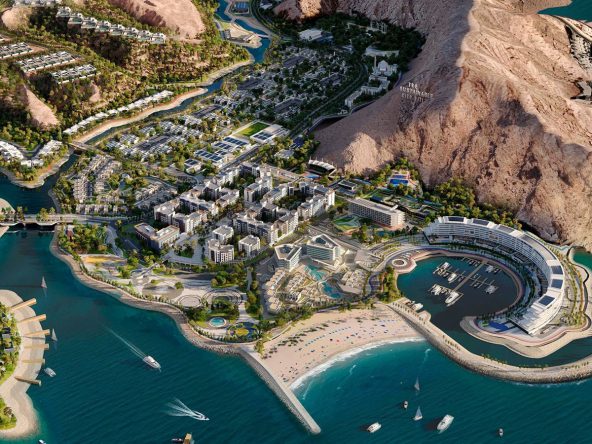
| Al Mouj, Muscat | Bellevue, Azura Beach Residences, Vistal, The St. Regis Residences |
| Muscat Bay / Barr Al Jissah | Muscat Bay, Zen Residences, Luma Residence |
| Jebel Sifah | Olive Farms, Raya, Solaris |
| Hawana Salalah | Lubana Island, Amazi |
| Muscat Hills | Golf Hills, Opal Residences |
| Telal Al Qurm (licence reported as July 2024) | Telal Al Qurm, Alef Qurum Residence |
One change is worth flagging. Central Muscat is reported to have an ITC. Telal Al Qurm was reported as licensed in July 2024 (the licence date is not confirmed from an official source, and one search summary gives March 2026) — reportedly 164,900 m² between Wattayah and Qurum, around OMR 230 million, over 1,500 apartments, 46 townhouses, 190 serviced apartments and two four-star hotels, phased over roughly fifteen years. Whether third-party buildings inside it carry the ITC freehold basis should be confirmed parcel by parcel. So the old rule of thumb that central Muscat means no foreign freehold may no longer be reliable.
If the answer to question one is yes, you can usually stop. Confirm the parcel is genuinely inside the licensed boundary — ITC status attaches to the specific parcel, not to the developer or the brand — and move on to price.
Question 2: is it in an SEZ or free zone, and what is being sold today?
This is where the map changed recently.
Royal Decree 38/2025, promulgated on 7 April 2025 and reported as effective 14 April (KPMG gives the gazette date, 13 April), opened foreign residential ownership in Special Economic Zones and free zones. Article 42 permits developers there to sell to non-Omanis as freehold, “in the manner specified by the regulation”. OPAZ Regulation 81/2026, reported as issued on 20 September 2026, sets that manner; we have not seen its text, so the eligible zones, projects and dates are unconfirmed. So freehold outside the coastal ITCs is now legal in a way it was not before.
The trap is the gap between a legal framework and an issued deed. Legislation permitting freehold is not the same as a project having converted to it. Conversion is an administrative act, project by project, and it either has happened for the unit you are buying or it has not.
| Maysan, Duqm | |
|---|---|
| Price | From $76,700 |
| What the listing sells | 99-year leasehold, not full freehold |
| Legal position | RD 38/2025 Art.42 makes SEZ freehold lawful |
| Conversion date for this project | None published |
| Golden Residency | No — needs OMR 200,000 and an ITC |
| Claimed tax saving (unverified) | 0% VAT + 0.5% registration vs 5% VAT + 3% registration fee on a first supply of new residential property in Muscat ITCs — roughly 7.5% on a $100,000 purchase, illustrative only. The 0.5% figure and the zero-rating could not be verified (VAT in special zones may be zero-rated subject to conditions). |
Maysan is listed as a 99-year lease today, with a legal pathway to freehold under RD 38/2025 and no conversion date found (no text of the OPAZ regulation was available to us). On that basis it is a leasehold, not a freehold.
Weigh it against the alternative: Sarooj Oasis at Sultan Haitham City starts at $82,160 and is listed as freehold — about $5,500 more for what may be a different title. Sultan Haitham City is a future city named by the Ministry in June 2026 as an area where foreign ownership is permitted; the form of title should be confirmed per project.
Question 3: how many floors, and is any of it bare land?
Outside an ITC and outside an SEZ, the route most often cited for resident expatriate individuals is usufruct. Ministerial Decision 357/2020 (October 2020) covers apartments in multi-storey buildings in approved Muscat areas, with an initial term of up to 50 years, renewable to a maximum of 99 (Trowers; the Oman Observer in 2021 described a 99-year lease). The conditions below match Trowers and the Observer, but the rule’s 2026 status is unconfirmed: the Ministry’s June 2026 list of designated areas does not mention it. It is narrower than most buyers realise.
| Usufruct condition | Requirement |
|---|---|
| Building height | At least four floors |
| Buyer age | 23 or over |
| Residency | At least two years’ residence in Oman (as reported) |
| Units per buyer | One |
| Cap per building | No more than 40% of units foreign-owned, and 20% for any one nationality (as reported) |
| Minimum price | OMR 45,000 (Muscat) / OMR 35,000 (other governorates), reported by Trowers and the Observer in 2021 only |
| Registration fee | Sources conflict: 3% seller + 5% buyer (Trowers) vs 3% each (Observer) |
Read the first row again, because it is what rules out most low-rise stock on this route. Two-storey villas and townhouses fall outside this usufruct route, which is written for buildings of four or more floors.
And there is a further category. Bare serviced plots — land sold for you to build on — are generally not covered by the usufruct route and are subject to the RD 29/2018 exclusions and ownership rules; ITC plots are the exception, and ITC owners must build within 4 years. Where part of a scheme outside a designated area is sold as plots, that portion is likely to be closed even if apartments in the same district are not.
The routes that exist outside all three questions
If a project fails all three questions, individual freehold is generally not available — but ownership in some form is not always impossible. GCC nationals may own outside the RD 29/2018 exclusion areas, except agricultural land, with Ministry approval (Ministerial Decision 292/2020). The other remaining structures are corporate or contractual rather than personal.
| Route | What it is | Practical note |
|---|---|---|
| Usufruct | Long-term right of use, initial term up to 50 years, renewable to 99 (as reported) | Ministerial Decision 357/2020; needs four-plus floors |
| Commercial lease | A lease rather than a title | Straightforward, but you own a contract, not an asset |
| Omani-registered company | The company holds the property | Company ownership of land outside ITCs is restricted (a 2017 law-firm source, not re-verified); ask a lawyer and an accountant first |
| FCIL usufruct | Foreign Capital Investment Law route, tied to an investment project | For a genuine business, not a holiday home |
None of these should be treated as a workaround for a citizen-only project. Where a scheme is restricted to citizens entitled to residential land, the restriction attaches to who the housing is for, not to the wrapper the buyer arrives in. Whether a given Surooh-type project is open to foreigners is decided project by project.
The honest use of this table is narrower: if you want an Omani address for a business, or a long stay in a building that happens to sit outside the ITC map, one of these may fit. If you want a home you own outright, start with question one and the Ministry-listed areas above.
The two projects that fail: Surooh
Surooh is a Ministry of Housing and Urban Planning programme. The government supplies land and utilities; private developers build and sell whole neighbourhoods to citizens entitled to residential land. It is affordable housing policy rather than an investment product. The Ministry’s June 2026 statement names integrated residential neighbourhoods such as Surooh among the areas where foreigners may own, without saying which projects, so eligibility has to be checked project by project; on our own review the two projects below were citizen-only and a third (Hay Al Wafa, below) was open.
| Nismat Zain, Sur | Husn Al Zain, Bidbid | |
|---|---|---|
| Programme | Surooh (MHUP) | Surooh (MHUP) |
| Developer | Zain Property Development | Zain Property Development |
| Entry price | $104,000 | $123,500 |
| Entry size | 1,862 sq ft | 1,862 sq ft |
| Per sq ft | $56 | $66 |
| Q1 — inside an ITC? | No | No |
| Q2 — SEZ / free zone? | No | No |
| Q3 — four floors? | No — two-storey | No — two-storey |
| Bare plots in the offer? | Yes | No |
| Routes failed | All three | Two |
| Golden Residency | Fails both tests | Fails both tests |
| Handover | Q4 2033 | Earlier |
Nismat Zain, on our own review, fails every foreign-ownership route we checked (confirm this with the Ministry or a lawyer, since the June 2026 list names Surooh-type neighbourhoods as areas where foreigners may own, project by project). It is also the lowest-priced built space among the listings reviewed here, and its handover is Q4 2033 — three years later than the other projects reviewed. At OMR 40,000 it also sits at a fifth of the OMR 200,000 Golden Residency threshold, so neither the ownership test nor the residency test is close.
Husn Al Zain in Bidbid, Ad Dakhiliyah, is the same structure: 639 homes, ordinary land, two-storey villas and townhouses. It fails questions one and three, and therefore fails both Golden Residency tests too.
There is a timing point buried in that table that deserves its own line. Nismat Zain hands over in Q4 2033. Even for an Omani buyer entitled to purchase it, that is seven years of waiting from today, against handovers of 2026 to 2029 across the rest of the portfolio. When a price looks impossible, the explanation is usually somewhere in the terms rather than in the market, and here there are two explanations stacked on top of each other: an entitlement you may not have, and a delivery date many buyers would not accept.
One more caution on the paperwork, and it applies to any government-scheme listing you encounter. On Nismat Zain, two documented figures do not reconcile: the developer states 358 homes while the Ministry register lists 407, and the same sales sheet carries both a $104,000 headline and an August 2026 starting price of OMR 44,500. Neither discrepancy is sinister on its own — registers lag, and prices move — but a project you cannot buy is also a project nobody has had to reconcile the numbers for. Treat unreconciled paperwork as a signal to ask more questions, not fewer.
How to recognise the pattern yourself
Government housing stock has tells, and once you know them you will spot it from the brochure cover.
- A ministry crest or programme logo on the brochure — Surooh or Hai branding rather than a developer’s own identity.
- Prices far below the market: roughly $56–$66 per square foot against $166–$261 in Muscat’s ITCs. A 60–75% discount is more likely to reflect the restriction than an arbitrage a foreigner can capture.
- Two-storey villas and townhouses, often on generous plots, in inland wilayats rather than coastal tourism zones.
- Sold through “a broker’s account” rather than the developer’s own website.
- No published payment terms — possibly because the terms are set by an entitlement process rather than a sales process.
None of these is conclusive on its own. Together they are a signal to run the three questions before you get attached to the price.
The exception that stops you generalising: Hay Al Wafa
Here is why the programme name is not the answer.
| Hay Al Wafa, Sultan Haitham City | |
|---|---|
| Programme family | Same government neighbourhood model |
| Inside a coastal ITC? | No |
| Four-plus floors? | Not on the usufruct basis |
| Sold freehold to non-Omanis? | Yes |
| Entry price | $170,600 |
| Per sq ft | $100 |
Hay Al Wafa is the same family of government-backed neighbourhood scheme as the two projects above. It does not fit the ITC or SEZ questions, but Sultan Haitham City is one of the future cities the Ministry of Housing and Urban Planning named in June 2026 as an area where foreign ownership is permitted (the statement does not say which form of title applies, so confirm it per project). Hay Al Wafa is listed as freehold to all nationalities. On our own review, some Hai neighbourhoods at Sultan Haitham City were open to non-Omanis and others were not.
Eligibility is decided project by project and parcel by parcel, not by the programme name, the developer or the city alone. That is the single most important sentence on this page. The three questions tell you where to look and what to ask. Only the title deed and a lawyer tell you what is true.
The tenure that is not stated at all: Taqah
Two beachfront buildings on the Dhofar coast, roughly 31 to 34 kilometres east of Salalah, three kilometres apart on the same beach, same developer, same brochure template. They are priced as sea-front homes at the lower end of the listings reviewed here, and their ownership positions differ from each other.
| The Sea Front Residences | Taqah Long Beach Boutique | |
|---|---|---|
| From | $128,700 | $224,700 |
| Size | 592 sq ft | 915–1,163 sq ft |
| Units | 94 | 24 |
| Handover | 2027 | 2026 |
| Service charge | OMR 300/year flat | To be specified |
| Payment | Staged | 50% on reservation |
| Stated tenure | “99 years leasehold renewable for life” | Not stated anywhere |
The Sea Front Residences states its position plainly in its own brochure, and a 99-year renewable lease is a perfectly legitimate asset. It is simply not the ITC freehold sold at Al Mouj, Muscat Bay or Hawana Salalah, and the difference matters for inheritance, for resale, and for whether the property supports the residency route at all. Taqah is also in Dhofar outside the wilayat of Salalah, an area that, as we read RD 29/2018, is closed to non-Omani ownership unless the project holds ITC status.
Taqah Long Beach Boutique is the one that raises more questions. Its brochure and sales sheet say nothing about ownership — not freehold, not leasehold, not usufruct, not title. And half the purchase price falls due at reservation. Get the developer’s own tenure document, in writing, against a named unit, before any money moves.
The case that is unconfirmed rather than closed
Not every hard case resolves to yes or no, and it would be dishonest to write this page as though it does.
Uptown Muscat and Central 7 sit in Knowledge Oasis Muscat, a Madayn technology estate. That is neither a coastal ITC nor an OPAZ free zone, and Madayn estates do not automatically inherit OPAZ ownership treatment — so RD 38/2025 does not obviously reach them. Yet the developer and several brokerages market both as freehold with a residency visa, and trade press has described Central 7 as offering freehold office space.
Our position is that eligibility here is unconfirmed, not excluded. We are not going to tell you it is impossible, because the marketed claim may well be correct and we cannot see the deeds. We are also not going to repeat the claim as though we had verified it. Ask for the title designation and the residency entitlement in writing against a named unit, and have an independent lawyer check it at the land registry. That advice is not a formality here; it is the whole answer.
What this does to residency
Eligibility to own and eligibility for residency are different tests, and a project can pass the first while failing the second.
| Golden Residency | Owner Visa | |
|---|---|---|
| Instrument | Relaunched 31 Aug 2025 via Invest Oman | ROP Decision 87/2026, Official Gazette 1653 of 21 June 2026 (effective 22 June) |
| Threshold | OMR 200,000 (≈ USD 520,000), single unified tier | No minimum value specified |
| Property must be… | ITC units with a valid title deed (ITC) | Owned — certificate from the competent authority |
| Validity | 10 years, renewable | 6 months to 1 year, renewable |
| Stay | Long-term residency | Up to 3 months per entry |
| Family | Included | Spouse and first-degree relatives |
| If you sell | Not stated in the sources we reviewed | Permits end on transfer (ROP Decision 87/2026), family permits included |
These are two different things and they are constantly conflated. The Golden Residency is a ten-year investor residency with a real threshold and an ITC requirement. The Owner Visa is a shorter, sponsor-free “I own a home here, let me use it” permit tied to continued ownership. Our Golden Residency vs Owner Visa guide sets out the difference in full.
Note the practical consequence for everything above: because the Golden Residency property route runs through ITC real estate, every project that fails question one also fails the Golden Residency property route, regardless of price. A leasehold in Duqm and a Surooh townhouse in Sur are both outside it, for different reasons.
The price of eligibility, in one table
Here is the cost of the restriction, stated as plainly as we can. Price per square foot across our Omani listings, cheapest first, with the eligibility answer beside it:
| Project | Per sq ft | Can a foreigner buy it? |
|---|---|---|
| Nismat Zain, Sur | $56 | Not on our review — fails all three |
| Husn Al Zain, Bidbid | $66 | Not on our review — fails two |
| Hay Al Wafa, Sultan Haitham City | $100 | Yes — listed freehold; Ministry-listed city |
| Al Ahlam District, Sultan Haitham City | $118 | Yes — Ministry-listed city; confirm title |
| Alef Qurum Residence, Telal Al Qurm | $166 | Yes — ITC (licence reported) |
| Jood, Sultan Haitham City | $179 | Yes — Ministry-listed city; confirm title |
| Taqah Long Beach Boutique | $195 | Tenure not stated |
| Telal Al Qurm | $209 | Yes — ITC (licence reported) |
| The Sea Front Residences, Taqah | $217 | 99-year leasehold |
| Opal Residences, Muscat Hills | $220 | Yes — ITC |
| Yamal, Al Seeb | $223 | Yes — ITC |
| Uptown Muscat, Knowledge Oasis | $261 | Unconfirmed |
| Muscat Bay | $275 | Yes — ITC |
| Al Mina, Barr Al Jissah | $387 | Yes — ITC |
The shape of that table is the argument. The two lowest-priced entries appear to be closed, and the lowest-priced project in the list that a foreigner can buy costs 79% more per square foot than the lowest-priced on the list. That gap appears to reflect an entitlement restriction rather than a market inefficiency waiting to be exploited.
It also explains why “cheapest property in Oman” is a misleading search. The cheapest Omani property and the cheapest Omani property available to you are different assets in different governorates at different prices.
Why the restriction exists at all
It is worth understanding the policy behind citizen-only housing stock, because it helps explain why some of these projects are priced as they are.
Oman’s housing programmes exist to deliver homes to citizens entitled to residential land, and the land grant is the subsidy. The government supplies serviced plots and infrastructure; private developers build and sell into a controlled market. The price you see — $56 a square foot in Sur against $166 to $261 in Muscat’s tourism complexes — is the visible edge of that subsidy. Opening the stock to foreign capital would transfer the subsidy to buyers it was never intended for and price out the households it was built for, which is a plausible reason the restriction is structural rather than administrative; the sources we reviewed do not state the Ministry’s reasoning.
The foreign-ownership map has widened in specific places. The ITC framework (Royal Decree 12/2006) put freehold where the state wanted resort investment. Royal Decree 38/2025 extended it into Special Economic Zones and free zones. Telal Al Qurm was reported as licensed as an ITC in central Muscat. In June 2026 the Ministry of Housing and Urban Planning also named the future cities of Sultan Haitham City, Al Thuraya City and Al Jabal Al Aali and integrated residential neighbourhoods such as Surooh as areas where foreigners may own, while stating that ownership remains limited to designated areas. Each is an opening in a defined place; none is general permission to own across the Sultanate.
Read that way, the three questions are not obstacles. They are a screening aid for where Oman has permitted foreign ownership, a map that has grown since Royal Decree 38/2025 and the Ministry’s June 2026 list. Official orientation on the investment framework is published at oman.om.
What to ask, and what to get in writing
- Is this parcel inside a licensed ITC? If yes, which one, and can you show the licence covers this plot?
- What title is being issued for this specific unit — freehold, usufruct, or leasehold? If leasehold, how many years and what happens at the end?
- If the project is in an SEZ, has it converted to freehold under RD 38/2025 — and on what date? “It is permitted” is not an answer.
- How many floors is the building? Below four, the 2020 usufruct route is unlikely to apply.
- Is any part of what I am buying bare land?
- If the project is in a future city or an integrated neighbourhood, which title is issued (freehold or usufruct), and are the phase and unit open to non-Omanis?
- Does this property qualify for the Golden Residency, and is that because of its ITC status or only because of its price?
- Will you put the tenure position in writing against a named unit number?
- May my own lawyer verify the designation at the land registry before I pay a deposit? A no here is the answer to every other question.
Frequently asked questions
Can foreigners buy property anywhere in Oman? No. Foreign ownership is limited to designated areas: freehold inside licensed Integrated Tourism Complexes; freehold unit sales in Special Economic Zones and free zones under Royal Decree 38/2025 Article 42 (the OPAZ regulation text was not seen); and the areas the Ministry of Housing and Urban Planning named in June 2026 — the future cities of Sultan Haitham City, Al Thuraya City and Al Jabal Al Aali and integrated neighbourhoods such as Surooh, where the form of title is not stated. GCC nationals are treated separately, a usufruct scheme for resident expatriates in multi-storey buildings was reported in 2020 (current status unconfirmed), and Royal Decree 29/2018 bars non-Omani ownership in a list of excluded areas outside ITCs. Some government housing projects for Omani citizens appear closed to foreigners, project by project.
Why are the two lowest-priced listings here not open to foreign buyers? On our review they are Surooh stock — Ministry of Housing neighbourhoods built for citizens entitled to residential land. The low price appears to reflect that entitlement, not a market opportunity. The Ministry’s June 2026 statement names Surooh-type neighbourhoods among areas where foreigners may own, so eligibility must be checked project by project.
Is Duqm freehold now? Legally, RD 38/2025 Article 42 permits freehold sales to non-Omanis in SEZs. In practice, Maysan is currently sold on a 99-year leasehold and no conversion date has been published for the project. Freehold is the framework; the lease is the deed.
Does a 99-year lease qualify for the Golden Residency? No. The property route to Golden Residency requires ITC real estate with a valid title deed, at OMR 200,000 or above. A leasehold outside an ITC fails on both counts.
All the Surooh projects are closed, then? No, and this is the point. Hay Al Wafa at Sultan Haitham City is the same family of government scheme and is listed as freehold to all nationalities (Sultan Haitham City is a Ministry-listed future city). Eligibility is decided project by project and parcel by parcel.
What is the minimum I need to spend? There is no single published figure, and an OMR 50,000 minimum has been quoted without a source we can point to. A minimum price of OMR 45,000 (Muscat) or OMR 35,000 (other governorates) was reported for the 2020 usufruct scheme by Trowers and the Observer in 2021 only. What is documented is the Golden Residency threshold of OMR 200,000 in an ITC. Below that you may still own; you simply may not get the ten-year residency.
Can I buy through an Omani company instead? An Omani-registered company is one of the structures sometimes used outside the ITC framework, although company ownership of land outside ITCs is restricted (a 2017 source, not re-verified), along with commercial lease and FCIL usufruct for an investment project. Whether it makes sense depends on your purpose, and it is a question for a lawyer and an accountant rather than an agent.