























Sultan Haitham City, Oman: Projects, Prices and Ownership (2026)
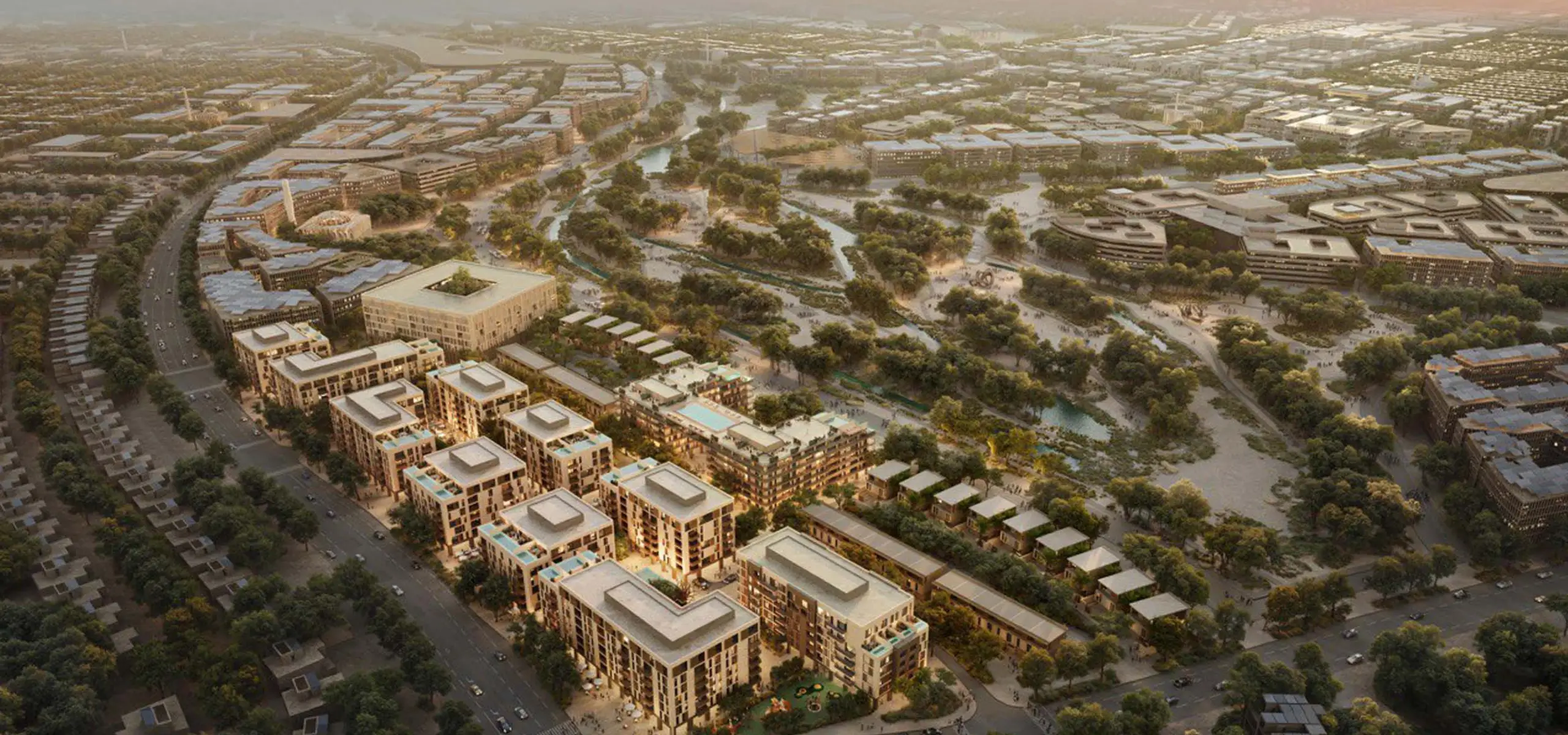
Sultan Haitham City is a government-led new city in the Wilayat of Al Seeb, west of Muscat, planned for about 100,000 residents in about 20,000 homes on 14.8 million square meters and delivered in four phases between 2024 and 2045. As of 23 October 2026 the Ministry of Housing and Urban Planning reports more than 1,700 homes sold to buyers from more than 35 nationalities, and the first residents are expected to move into the Hay Al Wafa district by the end of 2026. Foreigners can buy in Sultan Haitham City only in projects that the developer and the Ministry have opened to non-Omanis, and the six projects on our site start from OMR 60,366 ($157,000).
This guide is written for readers who are weighing a purchase in Sultan Haitham City and want the facts in one place, dated and attributed. It sets out what the city is and where it sits, how far construction has actually progressed, who is building each neighborhood, what the Ministry says about foreign ownership, how residency rules apply, what the six projects on our site cost per square meter, how their payment plans work in dollars and rials, which fees and taxes apply, and which risks are specific to a city that is still being built. Every price is a developer or listing figure as of 23 October 2026, quoted in Omani rials (OMR) with US dollars in brackets at the fixed peg of OMR 1 = $2.6008.
Sultan Haitham City at a Glance: Key Facts
| Item | Position as of 23 October 2026 | Source |
|---|---|---|
| Location | Wilayat of Al Seeb, western edge of Muscat Governorate | MEED, June 2023 |
| Launched | 31 May 2023, at Al Barakah Palace, Muscat | Oman Observer, July 2024 |
| Land area | 14.8 million square meters | MEED; Oman Observer |
| Planned population | About 100,000 (residential capacity 106,463 in the Ministry’s 2024 figures) | MEED; Oman Observer |
| Planned homes | About 20,000 across 19 neighborhoods | Oman Observer, February 2026 |
| Masterplan | Skidmore, Owings and Merrill (SOM), built around a 7.5 km wadi turned into a park | SOM |
| Phases | Four, from 2024 to 2045; phase one runs 2024 to 2030 | MEED, June 2023 |
| Homes sold | More than 1,700; buyers from more than 35 nationalities | Housing Minister, 23 February 2026; Muscat Daily, 13 April 2026 |
| Investment reported | More than RO 2.4 billion | Muscat Daily, 13 April 2026 |
| Infrastructure | Sewage network over 90% and bridges over 90% complete; utilities and roads 64% (mid-September 2026) | Ministry, via TradeArabia, 29 September 2026 |
| First residents | Expected in Hay Al Wafa by the end of 2026 | Ministry, via Muscat Daily and TradeArabia |
| Foreign ownership | Named by the Ministry as a designated area; applies project by project | Gulf News, 28 to 29 June 2026 |
| Entry prices on our site | From OMR 60,366 ($157,000) for a Wadi Zaha studio to OMR 191,902 ($499,100) for an Al Ahlam villa | Our listing pages |
| Metro | Proposed first line of about 55 km and 42 stations linking the city to Ruwi; at planning stage | Gulf News, 30 June 2026 |
What Is Sultan Haitham City?
Sultan Haitham City is a state-planned city, not a single developer’s project. The Ministry of Housing and Urban Planning leads the masterplan and the shared infrastructure, such as roads, bridges, power and sewage networks, and signs development agreements with private developers who build and market the homes in each neighborhood. It was announced on 31 May 2023 and is named after Sultan Haitham bin Tarik. It is being developed under Oman Vision 2040, the national plan to diversify the economy.
The design came from the American firm SOM. According to SOM, an existing 7.5-kilometer dry river bed, or wadi, runs through the site and is reworked into a continuous green park with shaded plazas, so that homes sit within walking distance of public space. The Ministry’s July 2024 figures put the landscaped area at 2.9 million square meters, of which 1.64 million square meters is the central park and wadi. The same plan describes the park as a way to capture flood water, which matters in a country where wadis can flow after heavy rain.
MEED reported at the June 2023 launch that the city would have 19 neighborhoods, 39 schools, 11 healthcare facilities and 25 mosques. These are planned facilities. Only some government schools in Hay Al Wafa and the Muscat Private International School were reported as connected to the new power network in September 2026, so a buyer today is buying into a building site that is gradually becoming a city.
Is Sultan Haitham City the same as Muscat?
No. Sultan Haitham City is a new city in the Wilayat of Al Seeb, on the western border of Muscat Governorate, linked to Muscat by the Muscat Expressway and Sultan Qaboos Street. Muscat’s established districts, such as Al Khuwair, Ruwi and Qurum, sit to the east. Developers inside the city quote drive times to Muscat International Airport of roughly 20 to 30 minutes, depending on the neighborhood.
Where Is Sultan Haitham City? Location, Roads and Drive Times
The city sits in Al Seeb, near Al Barakah Palace, at roughly 23.68 degrees north and 58.09 degrees east according to Wikipedia. MEED’s 2023 report names the Muscat Expressway and Sultan Qaboos Street as the main road links. In September 2026 the Ministry’s Nasser Al Hadrami, executive director of future projects, said the twelfth roadworks package had started. It includes a new connection to the Muscat Expressway via Al Ma’abilah Exit 2, improvements for traffic from Mabela Exit 3, an underpass, and bridges giving direct access from the expressway and from Halban Road.
Each project’s own listing page gives drive times. They are developer estimates and move with traffic, but they show how the neighborhoods differ.
| Project | Airport | Nearest supermarket or mall | Hospital | School |
|---|---|---|---|---|
| Wadi Zaha | 20 min | LuLu Hypermarket, 8 min | Shifa Hospital, 13 min | Indian School Al Maabela, 15 min |
| Hay Al Wafa | About 30 min | Almajarrah Supermarket, 11 min; Mall of Muscat, 13 min | Shifa Hospital, 13 min | Al Firdous Private School, 9 min |
| Yenaier Residences | About 25 min | Almajarrah Supermarket, 6 min; Mall of Muscat, 20 min | Shifa Hospital, 20 min | Al Firdous Private School, 15 min |
| Jood | About 24 km by road | Al Meera Hypermarket and Oman Avenues Mall, 4 min | The Royal Hospital, 6 min | Al Ibdaa International Private School, 6 min |
| Al Ahlam District | 25 min | Al Qout Supermarket, 4 min; Mall of Muscat, 11 min | Delmar Medical Center, 2 min | Al Firdous Private School, 7 min |
Will the Muscat metro reach Sultan Haitham City?
It is proposed, not built. At the Transport Ministry’s annual press briefing on 12 January 2026, reported by Times of Oman, Minister Saeed bin Hamoud Al Maawali said that a metro of about 50 kilometers and 36 stations would link Sultan Haitham City and Ruwi, passing the airport. When Oman and France signed a memorandum of understanding on transport in late June 2026, the ministry gave the first line as roughly 55 kilometers with about 42 stations, seven of them major interchanges, still at feasibility and planning stage. No construction start date has been announced, so the metro cannot be treated as part of the city’s current transport. Our Muscat metro guide tracks the route as it develops.
Sultan Haitham City Masterplan: Phases, Neighborhoods and Numbers
The city is split into four phases. MEED’s 2023 report gave the first three in detail, and the Ministry’s July 2024 update, reported by the Oman Observer, revised the first phase upward.
| Phase | Years | Scope |
|---|---|---|
| Phase 1 | 2024 to 2030 | City centre of about 5 sq km and six neighborhoods. MEED (2023): 6,743 homes and about 2.2 million sq m built-up. Ministry (2024): 7.05 million sq m of land, 9,924 homes, population of 50,091 |
| Phase 2 | 2028 to 2035 | About 2.6 sq km, 4,200 homes, over 23,000 people (MEED) |
| Phase 3 | 2033 to 2040 | About 2.3 sq km, 3,500 homes, over 21,000 people (MEED) |
| Phase 4 | To 2045 | Remaining neighborhoods; completes the 20,000-home plan |
Two points follow from these numbers. First, the phases overlap: phase two starts in 2028 while phase one is still under way, so the nearest neighborhoods will be building sites for years after the first residents arrive. Second, 20,000 homes at the pace the Housing Minister cited in February 2026, roughly 1,000 homes a year, would take about 20 years, which is consistent with the 2045 end date and is a reason the city is described as a multi-decade project.
The Ministry also reserves a share of the city for citizens. Minister Khalfan bin Said Al Shueili said in June 2023 that 5% of the city’s homes would be allocated to the housing assistance program, and in February 2026 he put investor pricing at around RO 900 per square meter against about RO 400 per square meter for Omani families, with state support for Omani households above 50%. Prices quoted to Omani families and to investors therefore sit on different scales, and the figures in this guide are the investor and foreign-buyer prices on our listing pages.
How Far Has Construction in Sultan Haitham City Progressed?
Construction of the city’s shared infrastructure is advancing, but it is not finished. The clearest way to read the pace is to compare the Ministry’s own percentages over time. The measures are not identical from one report to the next, so the table shows each figure as it was worded.
| Date | What the Ministry reported | Source |
|---|---|---|
| 23 Feb 2026 | About 1,700 homes sold; 70% of phase one and two tenders under execution; infrastructure investment for phases one and two about RO 300 million | Oman Observer, 24 Feb 2026 |
| 13 Apr 2026 | Site preparation and land levelling complete; bridges about 75%; infrastructure nearing 40%; power stations about 94%; investment over RO 2.4 billion | Muscat Daily |
| 30 May 2026 | Infrastructure 40% complete; 70% of tenders awarded; awarded packages total RO 280 million across 10 packages | Oman Observer |
| 3 Aug 2026 | Three primary substations 99.5%; bridge structures 92%; main sewerage 89%; roads 58%; services about half complete | Muscat Daily |
| Mid-Sep 2026 | Sewage network over 90%; utilities and roads 64%; bridges over 90%; three substations (160 MVA, over RO 12 million) commissioned; 12th road package started | Muscat Daily, 15 Sep; TradeArabia, 29 Sep |
| 12 Oct 2026 | Tender for the Integrated Operations and Control Centre building; bids due 9 November 2026 | Reuters, via TradingView |
Reading across the rows: bridges moved from about 75% in April to over 90% by September, and the sewage network from 89% in August to over 90% in September. The single “infrastructure” figure of 40% in April and May and the “utilities and roads” figure of 64% in September are not the same measure, so they should not be subtracted from each other.
What the numbers mean for a buyer is concrete. Power is switched on for the first neighborhood: the three substations already supply Hay Al Wafa’s government schools, the Muscat Private International School, street lighting and the district cooling network, and they will serve Sarooj Oasis, Yenaier Residences, Wadi Tala, Jood and Wadi Safa. Roads and utilities, at 64%, remain the least advanced measured item. The Oman Observer reported on 30 May 2026 that October 2026 was expected to mark the start of a gradual move-in, and in September the Ministry said the first residents were expected in Hay Al Wafa by the end of 2026. A date for occupancy in the other neighborhoods has not been given by the Ministry, which is why each developer’s handover date matters.
Who Is Building Sultan Haitham City? Developers and Neighborhoods
The Ministry builds the city in neighborhoods and signs a development agreement for each one. A developer takes a neighborhood, builds the homes, sets its own price list and payment plan, and sells off-plan. That is why one city can hold a villa district of 47 homes and a tower neighborhood of more than 700 apartments with different owners, handover dates and rules.
The clearest public record of the first wave is the Ministry’s July 2024 summary, reported by the Oman Observer. It showed 6,986 homes signed with eight developers in the city’s first year, worth about RO 1,126 million by the sum of the listed figures.
| Neighborhood | Developer | Homes | Investment (RO million) |
|---|---|---|---|
| 10 (Hay Al Wafa) | Al Siyabi International Group | 1,644 | 208.0 |
| 12C, 12E, 12F | Al Ahly Sabbour Developments | 2,219 | 439.0 |
| 12 B and A | Rumman International | 1,001 | 204.9 |
| 8 | ASAAS | 1,333 | 184.2 |
| 12D | Adrak Developers LLC | 339 | 38.7 |
| A13 | Sarooj Construction | 287 | 31.6 |
| 6A | Tibiaan | 116 | 13.4 |
| 6B (Al Ahlam District) | Dream Villa Development | 47 | 6.6 |
| Total | Eight developers | 6,986 | 1,126.4 (sum of rows) |
The same report said Hay Al Wafa sold 513 homes in its first year and reached 78% of sales for its first and second phases within three months. Neighborhood 6B, now Al Ahlam District, sold 10 villas within a month of its sales launch.
Further agreements have followed. Talaat Moustafa Group and Al Muhaidib Group launched Jood in Sultan Haitham City, together with the separate coastal Yamal project, on 2 December 2025. In January 2026 Al Adrak Group signed a mixed-use development agreement with the Ministry worth RO 185 million, about $481 million at the peg, for part of Neighborhood 6 covering roughly 460,000 square meters, according to Muscat Daily; that deal is a separate agreement from Yenaier Residences, which belongs to Al Adrak’s real estate arm, Adanté Realty. In May 2026 the Ministry announced an agreement with the Saudi developer Retal for neighborhoods 3, 15 and 17, with investment above RO 320 million.
The public contractors are named too. In October 2024 the Ministry signed a RO 82.7 million utilities package with Towell Infrastructure Company (24 months) and a RO 63.2 million roads and tunnels package with Sarooj Construction Company (30 months). The Oman Observer reported in May 2026 that infrastructure contracts for roads, bridges, landscaping and site preparation had gone to Al Tasnim Group, Strabag Oman and GDS.
Our Oman developer guide and the Oman developers hub profile the companies behind the projects on our site.
Can Foreigners Buy Property in Sultan Haitham City?
Yes, in projects that are open to non-Omanis, but not automatically in every neighborhood. On 28 and 29 June 2026 the Ministry of Housing and Urban Planning said foreign ownership remains limited to designated areas and named three groups: integrated tourism complexes, the future cities Sultan Haitham City, Al Thuraya City and Al Jabal Al Aali, and integrated residential neighborhoods such as Surooh. The decision for a given unit rests on its project.
The Ministry’s statement was a clarification. A change to the executive regulations of the Foreigners’ Residence Law had led some reports to suggest that foreigners could now buy anywhere in Oman. The Ministry said the amendments relate solely to residency and do not widen ownership rights, according to Gulf News on 28 June 2026. The statement also noted that citizens of Gulf Cooperation Council states are subject to separate agreements and Omani regulations in approved areas.
The city’s openness to foreign buyers was signaled earlier. In June 2023 Minister Khalfan bin Said Al Shueili said the city targeted eligible people under the government residential land grant system and opened the way to foreign ownership, with 5% of homes going to the housing assistance program. MEED reported the same month that some areas would be open to foreign ownership. Neither report named a project.
What do the Ministry’s project pages say about ownership?
The Ministry publishes a page for each neighborhood, and the wording differs. The table compares four of them with what our listing pages, drawn from developer materials, say. It is a reason to ask for the title designation of the exact unit in writing before paying a reservation fee.
| Project | Ministry project page | Our listing page (developer materials) |
|---|---|---|
| Hay Al Wafa | Freehold ownership offered to Omanis and non-Omanis; about 1,800 homes on over 1 million sq m | Freehold, open to all nationalities |
| Sarooj Oasis | “Flexible ownership opportunities” for citizens and residents; 350 or more units | Freehold, open to all nationalities |
| Yenaier Residences | No ownership statement; 723 homes in six towers on 56,000 sq m | Freehold, open to all nationalities |
| Al Ahlam District | No ownership statement; 47 villas on 33,000 sq m | Freehold, open to all nationalities |
The pattern is that Hay Al Wafa carries the clearest government wording on non-Omani freehold, while the other pages either describe ownership more loosely or are silent on it. Developers market all of these projects to buyers of any nationality, and the Ministry’s June 2026 list does include the city as a whole. What remains is the contract: the sale and purchase agreement, the title document and the Ministry’s registry entry decide a buyer’s rights, not the brochure. Our guide to Omani property foreigners cannot buy sets out a three-question test that applies here.
Is Sultan Haitham City an integrated tourism complex?
No. The Ministry lists the city separately from integrated tourism complexes (ITCs). An ITC is a tourism-led development licensed under the framework of Royal Decree 12/2006, such as Al Mouj Muscat, Jebel Sifah or Hawana Salalah. Sultan Haitham City is a state housing and urban development, and the Ministry groups it with other future cities. Some marketing materials describe projects in the city with ITC wording; the Ministry’s June 2026 statement does not.
The difference matters for residency, because the Golden Residency property route refers to ITC property. It also matters for the buyer’s reading of other guides: rules written for ITCs, including the freehold ITC framework, cannot be assumed to apply unchanged inside the city.
What should a buyer have in writing before paying a deposit?
Five items settle most of the ownership question for a specific unit.
- The unit number, floor area and price on the reservation form, with the project’s licence reference.
- A statement of the form of title (freehold or another right) and the registry that will issue it.
- Confirmation that the neighborhood is approved for ownership by the buyer’s nationality.
- The escrow bank and account named for the project, as required for licensed developers under Royal Decree 79/2025.
- The dated payment schedule and handover date in the sale and purchase agreement.
Does Buying in Sultan Haitham City Give Residency?
Not by itself. Three different things get called “residency” in marketing for the city: the Golden Residency, the Owner Visa, and a residency advertised by some developers once 30% of a unit’s price is paid. Each has its own condition, and the only one with a published property-value test is the Golden Residency.
| Route | Basis | Condition on property | Notes for Sultan Haitham City |
|---|---|---|---|
| Golden Residency | Invest Oman programme announced at the end of August 2025; 10-year renewable permit for the investor and family | Investment of at least OMR 200,000 ($520,160); the real-estate route refers to property in an integrated tourism complex; decided by the Royal Oman Police | The Ministry lists the city separately from ITCs, so a price above OMR 200,000 does not by itself establish eligibility |
| Owner Visa | Royal Oman Police Decision 87/2026, in force from 22 June 2026 | Sponsor-free permit tied to ownership; no minimum value is reported; issued on a certificate from the competent authority | Covers registered property and certain unregistered property; visas for unregistered property run six months to one year, renewable; ends if the property is transferred |
| Developer-advertised residency | Statement by the developer, for example Al Ahly Sabbour on 10 May 2026 | Payment of 30% of the unit value, “subject to applicable regulations” | Enterprise reported on 30 September 2026, citing a secondary source, a September 2025 decision with a minimum price of OMR 50,000; the conditions are those of the regulations |
The Golden Residency is described in our Golden Residency versus Owner Visa guide. Applications go through Invest Oman, the decision on the property route is made by the Royal Oman Police, and Gulf News reported on 1 September 2025 that the threshold is OMR 200,000 for a permit valid for 10 years and extendable to spouses, children and first-degree relatives.
The Owner Visa is newer. Royal Oman Police Decision 87/2026, published in the Official Gazette and in force from 22 June 2026 according to press reports, lets eligible foreign owners obtain visas and residency without an Omani sponsor. Owners and first-degree relatives are covered, as are legal representatives of companies that own property. Gulf News reported on 22 June 2026 that the permit lapses when the property is sold or transferred. It is a residency permit, not a right to own; on 28 June 2026 the Ministry said the amendments do not change where foreigners may own.
Which Sultan Haitham City prices cross the OMR 200,000 line?
Only one entry price on our site does. The Hay Al Wafa five-bedroom villa, at $629,400 or about OMR 242,000, is above OMR 200,000. The Al Ahlam District entry villa at $499,100, or OMR 191,902, falls OMR 8,098 short at the peg. Every other entry price is lower, from OMR 60,366 for a Wadi Zaha studio to OMR 172,178 for a Sarooj Oasis villa.
Because the Golden Residency refers to ITC property, being above the line is not the same as qualifying. A buyer who needs a specific residency route should obtain the Royal Oman Police’s written position for the exact unit before paying more than the reservation fee.
Sultan Haitham City Property Prices in 2026: What the Six Projects Cost
Entry prices for the six projects on our site run from OMR 60,366 ($157,000) for a Wadi Zaha studio to OMR 191,902 ($499,100) for an Al Ahlam District villa. Price per square meter is a more useful yardstick than the headline price, because floor areas differ by a factor of eight between the smallest studio and the largest entry villa. The table below converts each listing’s entry price for the main unit types, using the sizes and prices on our listing pages as of 23 October 2026.
| Project | Entry unit | Size | Price | USD per sq ft | OMR per sq m | Handover (per developer) |
|---|---|---|---|---|---|---|
| Wadi Zaha | Studio | 54 sq m (581 sq ft) | OMR 60,366 ($157,000) | 270 | 1,118 | Q1 2028 |
| Wadi Zaha | 2-bedroom | 99 sq m (1,066 sq ft) | OMR 91,433 ($237,800) | 223 | 924 | Q1 2028 |
| Wadi Zaha | 3-bedroom | 150 sq m (1,615 sq ft) | OMR 146,993 ($382,300) | 237 | 980 | Q1 2028 |
| Hay Al Wafa | 2-bedroom apartment | 158 sq m (1,700 sq ft) | OMR 65,595 ($170,600) | 100 | 415 | Q4 2027 |
| Hay Al Wafa | Townhouse | 160 sq m (1,722 sq ft) | OMR 101,200 ($263,200) | 153 | 632 | Q4 2027 |
| Hay Al Wafa | 5-bedroom villa | 430 sq m (4,627 sq ft) | OMR 242,002 ($629,400) | 136 | 563 | Q4 2027 |
| Yenaier Residences | Studio | 85 sq m (920 sq ft) | OMR 67,210 ($174,800) | 190 | 786 | Q4 2027 |
| Yenaier Residences | 3-bedroom | 176 sq m (1,897 sq ft) | OMR 129,153 ($335,900) | 177 | 733 | Q4 2027 |
| Jood | 2-bedroom apartment | 106 sq m (1,141 sq ft) | OMR 78,437 ($204,000) | 179 | 740 | Q1 2030 |
| Jood | Villa | 223 sq m (2,400 sq ft) | OMR 158,567 ($412,400) | 172 | 711 | Q1 2030 |
| Sarooj Oasis | Villa | 214 sq m (2,307 sq ft) | OMR 172,178 ($447,800) | 194 | 803 | Q4 2029 |
| Al Ahlam District | Villa | 392 sq m (4,216 sq ft) | OMR 191,902 ($499,100) | 118 | 490 | Q1 2028 |
Four readings of this table are useful.
First, the cheapest ticket is not the cheapest space. The Wadi Zaha studio costs OMR 60,366 for 54 square meters, or OMR 1,118 per square meter. The Hay Al Wafa two-bedroom apartment costs OMR 5,229 more, OMR 65,595, for 158 square meters, or OMR 415 per square meter. That is roughly 2.7 times less per square meter, for nearly three times the floor area.
Second, the spread inside one city is wide. Across the entry units on our listings the rate runs from OMR 415 to OMR 1,264 per square meter (the Sarooj Oasis one-bedroom, at 52.7 square meters and $173,200 on the Sarooj Oasis Villas listing page), a ratio of about 3 to 1. In dollars per square foot the same range is $100 to $305.
Third, the Ministry’s own benchmark sits inside that range. In February 2026 the Housing Minister put investor pricing at around RO 900 per square meter. At the peg that is $2,341 per square meter, or about $217 per square foot. Three Wadi Zaha rows in the table, and the Sarooj Oasis one-bedroom mentioned above, sit higher, while the other rows in the table run from OMR 415 to OMR 803. The comparison is for orientation only: the minister was describing average pricing, not a unit’s price list.
Fourth, handover dates matter as much as prices. The earliest developer targets, Q4 2027 for Hay Al Wafa and Yenaier, are nine quarters ahead of Jood’s Q1 2030. A buyer comparing OMR per square meter across these projects is also comparing a wait of between about 14 months and about 41 months from today to handover, counting to the end of each target quarter. Our handover calendar places these dates beside other Oman projects, and the price-per-square-meter guide ranks 29 projects across the country.
Sultan Haitham City Projects Compared Side by Side
The six projects differ in building type, scale and developer, and the table summarizes the facts on each listing page as of 23 October 2026. It does not rank them.
| Project | Developer | Formats | Scale | Entry price | Payment plan (summary) | Service charge |
|---|---|---|---|---|---|---|
| Hay Al Wafa | Al Abrar Real Estate (Al Siyabi International Group) | Apartments, townhouses, villas; three storeys | About 1,800 homes (Ministry page); 52 units available | OMR 65,595 ($170,600) | 20% on booking, 80% over 36 months | OMR 300 to 500 a year |
| Wadi Zaha | Al Ahly Sabbour | Studios to three-bedrooms, penthouses, townhouses, villas, retail | 824 residential and commercial units (developer, Oct 2026) | OMR 60,366 ($157,000) | EOI OMR 1,000, 20% on booking, 80% monthly or quarterly | OMR 5 to 6 per sq m a year |
| Yenaier Residences | Adanté Realty (Al Adrak Group) | Studios to three-bedrooms, penthouses; six towers up to eight storeys | 723 homes (Ministry page); 38 units available | OMR 67,210 ($174,800) | Four plans, from 50/50 to a 10-year plan | OMR 3 to 4 per sq m a year (studios) |
| Sarooj Oasis | Sarooj Development | Villas (Ahed, Al Thuraya) and Azha apartments | 210 homes (listing); 350 or more (Ministry page) | Villas OMR 172,178 ($447,800) | 20% to 50% down, then monthly instalments to month 36 | See sale agreement |
| Jood | Talaat Moustafa Group with Al Muhaidib Group | Apartments, quatro villas, standalone villas | 7,746 homes on 2.7 million sq m (per developer sales material) | OMR 78,437 ($204,000) | 4.5 years; 2.5% on booking, 20% in the first month | See sale agreement |
| Al Ahlam District | Dream Villa | Villas only, 3 to 5 bedrooms plus staff room | 47 villas; 23 available | OMR 191,902 ($499,100) | Two-year or three-year schedules; 15% or 10% opening payment | See sale agreement |
Hay Al Wafa
Hay Al Wafa is neighborhood 10, the first district to be sold and the one the Ministry expects to receive the first residents. Al Abrar Real Estate, founded in 2008 and wholly owned by Al Siyabi International Group, is the developer. The Ministry’s project page describes about 1,800 homes on more than one million square meters, with a mosque, a commercial area, green spaces, a public school complex and a community plaza. Sales launched at Panorama Mall on 3 March 2024, when Times of Oman reported a first phase of 375 homes projected for completion by 2026; the listing now gives Q4 2027 as the target for the units on sale.
The entry prices are an apartment from $170,600 (OMR 65,595), a townhouse from $263,200 (OMR 101,200) and a five-bedroom villa from $629,400 (OMR 242,002). In March 2024 Times of Oman reported starting prices of OMR 101,000 for non-eligible Omanis and foreign nationals, which is where today’s townhouse entry price sits. Al Abrar publishes a service charge of OMR 300 to 500 a year, which on the apartment is 0.46% to 0.76% of the price. Our Hay Al Wafa listing has the full unit table.
Wadi Zaha
Wadi Zaha is Al Ahly Sabbour’s first project in Oman. The Egyptian developer was founded in 1994 and, per the company, has delivered more than 65 communities. Wadi Zaha launched on 16 January 2025, the foundation stone was laid in February 2026, and in October 2026 the developer reported a RO 10 million financing agreement with Bank Dhofar, about 80% of units sold and buyers from 48 nationalities. The company gave the scheme as 824 residential and commercial units that month. On 10 May 2026 it said the final residential building was being released.
Prices on our Wadi Zaha listing run from a $157,000 studio to a $402,000 penthouse, with townhouses and villas priced individually. According to a company statement reported in October 2026, apartments are planned to be handed over fully finished and semi-furnished, with selected kitchen appliances, air conditioning and built-in wardrobes.
Yenaier Residences
Yenaier Residences is a six-tower development by Adanté Realty, established in 2024 as the real estate arm of Al Adrak Group, an Omani construction and infrastructure group. The Ministry’s page gives 723 homes on 56,000 square meters plus a 5,000 square meter commercial area, and the developer launched the project on 13 January 2025. The towers rise to eight storeys, the homes carry integrated smart-home systems, and parking includes electric-vehicle charging. The studio starts at 920 square feet for $174,800; the three-bedroom starts at 1,897 square feet for $335,900. See the Yenaier listing for all four plans.
Sarooj Oasis
Sarooj Oasis is a gated, park-centered community by Sarooj Development on about 86,000 square meters, launched for sale in early February 2025 with a stated value of RO 30 million. The villas are split into Ahed (56 homes) and Al Thuraya (40 homes), with Azha apartments in a separate building. Villas start at $447,800 for 2,307 square feet, with five to seven bedrooms and parking for three cars; the handover target on the villa listing is Q4 2029. The Ministry’s project page describes 350 or more units, including villas, townhouses, apartments and commercial space. Details are on the Sarooj Oasis Villas and Sarooj Oasis Apartments listings.
Jood
Jood is the largest project listed. Talaat Moustafa Group, the Egyptian developer founded in 1970, launched it with Al Muhaidib Group on 2 December 2025. Per the developer’s sales material it covers 2.7 million square meters, with nearly half the site as landscaped or open space and buildings covering 15% of the land. Our Jood listing counts 7,746 homes, 5,352 apartments and 2,394 villas, with apartments from $204,000 and villas from $412,400 and a handover target of Q1 2030. Homes are handed over finished but unfurnished.
Al Ahlam District
Al Ahlam District is neighborhood 6B, a gated collection of 47 villas by Dream Villa, an Omani company founded in 2010. The Oman Observer reported the agreement as RO 6.6 million for 47 homes. The villas run from 4,216 to 4,464 square feet, with three to five bedrooms, a staff room, private terraces and a garage for two to four cars. Nine design concepts share one facade language around three parks. At OMR 191,902 ($499,100) the entry villa is the closest entry price on our site to OMR 200,000 without reaching it; the Al Ahlam listing has both payment schedules.
Payment Plans in Sultan Haitham City: Worked Examples in Rials and Dollars
Every developer in the city runs its own payment plan, and the plans differ more than the prices do. The structures below are the ones on our listing pages as of 23 October 2026; the sale and purchase agreement fixes the dates and amounts for a specific unit.
| Project | Opening payment | Schedule | Share paid before the last instalment |
|---|---|---|---|
| Hay Al Wafa | EOI of OMR 500 to 1,000, then 20% on booking | 80% over 36 months, monthly, semi-annual or annual | 100% over three years, ending around the Q4 2027 target |
| Wadi Zaha | EOI of OMR 1,000, then 20% on booking | 80% monthly or quarterly during construction; launch five-year plan with 5% discount on a limited release | 100% by handover on the standard plan |
| Yenaier Residences | EOI of OMR 1,000 plus 5% VAT on booking | Express (50% down, 50% on completion); five-year; Phase 2 cash; ten-year | 50% to 100% by completion, depending on the plan |
| Sarooj Oasis (villas) | 20%, 30%, 40% or 50% down | Monthly instalments in months 2 to 36 of 2.29%, 2.00%, 1.71% or 1.43% | 100% by month 36 |
| Jood | 2.5% on booking, 17.5% within a month | 15% at 12 months, 15% at 24 months, 45% every 6 to 8 months over two years, 5% on completion | 95% before completion |
| Al Ahlam District | 15% (Stage 1) or 10% (Stage 2) | Eight instalments over two years, or twelve quarterly over three years | 80% in instalments, 20% balance on the sale agreement’s schedule |
How does the Hay Al Wafa 20/80 plan work out?
On the entry apartment at OMR 65,595 ($170,600), the 20% booking payment is OMR 13,119 ($34,120). The remaining 80% is OMR 52,476 ($136,480). Spread evenly over 36 months that is about OMR 1,458 ($3,791) a month, or six semi-annual payments of $22,747, or three annual payments of $45,493. On the five-bedroom villa at $629,400 the same plan means $125,880 down and about $13,987 a month.
How does the Jood 4.5-year plan work out?
On the two-bedroom apartment at OMR 78,437 ($204,000), the 2.5% booking payment is $5,100 (OMR 1,961), and the 17.5% second instalment due within a month is $35,700 (OMR 13,727). The first month therefore costs $40,800, or 20% of the price. Then 15% ($30,600) falls due at 12 months and again at 24 months, three further 15% instalments ($91,800 in total) follow every six to eight months over two years, and the last 5% ($10,200) is due on completion. The shares add up: 2.5 + 17.5 + 15 + 15 + 45 + 5 = 100. Because the last 5% is the only payment tied to completion, 95% of the price is paid while the building is still being built, which is the figure to weigh against the escrow protections described below.
How do the Al Ahlam District schedules work out?
On a villa at OMR 191,902 ($499,100), Stage 1 opens with 15% ($74,865, OMR 28,785), followed by three quarterly payments of 10% ($49,910 each), so the first four payments total 45% ($224,595). A further 15% and 10% payment follow after three months each, and two quarterly payments of 5% complete the 80% in instalments ($399,280, OMR 153,522). The remaining 20% ($99,820, OMR 38,380) completes the price on the date the sale agreement sets. Stage 2 opens with 10% ($49,910) and spreads twelve quarterly payments over three years to reach the same 80%.
How do the Yenaier plans compare on a studio?
On the studio at OMR 67,210 ($174,800) the express plan asks for $87,400 (OMR 33,605) down and the same amount on completion, after the OMR 1,000 expression-of-interest payment plus 5% VAT (OMR 1,050 in all). The five-year plan asks for 15% down ($26,220), three construction-stage instalments of 15% ($26,220 each), 20% on completion ($34,960) and a final 20% within 28 months after completion ($34,960). Under that plan 80% is paid by completion and 20% afterwards.
The ten-year plan asks for 5% on booking ($8,740) and 25% within 30 days of signing ($43,700), then monthly instalments of about 0.63% of the price. At $174,800, 0.63% is $1,101 (OMR 423) a month. Over 120 months that totals $132,149, or 75.6% of the price, against a balance of 70% ($122,360). The difference, $9,789 or 8.0% of the balance, is the amount a buyer should ask the sale agreement to explain, since the listing describes the instalments as equivalent to the residual value.
What does a five-percent discount at Wadi Zaha mean in numbers?
Where Wadi Zaha’s discount applies, 5% of the studio price of $157,000 is $7,850 (OMR 3,018), and the price after discount is $149,150. On 10 May 2026 the developer described an exhibition offer of 0% down, instalments of up to five years and a 5% direct discount, so the discount depends on which release and which offer a unit is sold under. The standard plan on the listing is the EOI, 20% on booking and the 80% balance monthly or quarterly: on the studio, $31,400 (OMR 12,073) and $125,600 (OMR 48,293).
How do the Sarooj Oasis down-payment tiers compare?
On the villa at OMR 172,178 ($447,800) the 20% tier means $89,560 down and about $10,255 a month for 35 months, while the 40% tier means $179,120 (OMR 68,871) down and $7,657 (OMR 2,944) a month, and the 50% tier means $223,900 down and about $6,404 a month. The monthly percentages are rounded to two decimals, so a schedule can differ from 100% by a fraction of a percentage point. Our Oman payment plans guide compares how much of the price is exposed before handover across projects.
What Does It Cost to Buy in Sultan Haitham City? Fees, VAT, Service Charges and Tax
The purchase price is not the full cost. A buyer in Sultan Haitham City should budget for a registration fee, possibly VAT, a recurring service charge and, from 2028, a personal income tax that reaches rental income above a threshold. The table lists the items, with the source for each.
| Item | Amount | Source and note |
|---|---|---|
| Registration fee on a sale | 3% of the asset value | Cut from 5% in November 2020 (Oman Observer, 8 November 2020); commercial guides say the buyer pays |
| VAT on a first sale of residential property | 5% | Oman Tax Authority real estate VAT guide, summarized by Deloitte (30 September 2021); resales and residential rentals are exempt |
| Expression of interest | OMR 500 to 1,000 (Hay Al Wafa); OMR 1,000 (Wadi Zaha); OMR 1,000 plus 5% VAT (Yenaier) | Our listing pages; terms are confirmed in the reservation form |
| Service charge | OMR 300 to 500 a year (Hay Al Wafa); OMR 5 to 6 per sq m (Wadi Zaha); OMR 3 to 4 per sq m (Yenaier studios) | Our listing pages; other projects set it in the sale agreement |
| Optional parking | OMR 3,500 per slot for Wadi Zaha studios and one-bedrooms | Our Wadi Zaha listing |
| Personal income tax | 5% on income above OMR 42,000 a year, from 1 January 2028 | Royal Decree 56/2025, as summarized by EY; rent from real estate is a listed income source |
Take the Hay Al Wafa apartment at OMR 65,595. A 3% registration fee is OMR 1,968. If 5% VAT is charged on top of the price, it is OMR 3,280. Together that is OMR 5,248, or 8.0% of the price, before any legal or agency costs. Whether VAT is already inside a quoted price varies by project, so the reservation form should state it. On the Wadi Zaha studio at OMR 60,366 the same two items come to OMR 1,811 and OMR 3,018, a total of OMR 4,829.
The recurring cost is the service charge. At Wadi Zaha a 54 square meter studio at OMR 5 to 6 per square meter carries OMR 270 to 324 a year, or 0.45% to 0.54% of its price. At Yenaier, a studio of 85 square meters at OMR 3 to 4 carries about OMR 256 to 342. At Hay Al Wafa, the developer’s OMR 300 to 500 is a fixed range. These are developer figures for a new community; service charges can change once the owners’ association and the building budgets are in place. Our service charges guide explains how they are set and billed.
Oman has no personal income tax today, and no annual property tax was found in the sources reviewed for our property tax guide. That changes in one respect on 1 January 2028, when Royal Decree 56/2025 introduces a 5% tax on individual income above OMR 42,000 a year. Rent from real estate and proceeds from disposal are listed income sources, residents are taxed on worldwide income and non-residents on income from Oman, and the executive regulations determine how deductions work. A homeowner whose rental income stays below the threshold stays outside the tax. The effect of the new tax on rented property in a city that has no tenants yet is a question for a tax adviser, not for a developer brochure.
How to Buy in Sultan Haitham City, Step by Step
The sequence below follows the steps on the Wadi Zaha and Hay Al Wafa listings and the off-plan protections in Royal Decree 79/2025, the Real Estate Regulation Law, which entered into force in March 2026 according to the law firm BSA.
- Confirm that the neighborhood is open to the buyer’s nationality, and obtain the project’s licence details.
- Request the current price list for the specific unit, including floor, orientation and whether the price includes VAT.
- Pay the expression of interest to hold the unit, and obtain the reservation form with the unit number, size and agreed price.
- Read the sale and purchase agreement: payment dates, handover date, specification, resale and cancellation terms.
- Pay the booking payment and instalments into the project’s escrow account, and keep the transfer confirmations as evidence of payment.
- Monitor construction against the dated schedule; the Ministry’s escrow rules link withdrawals to approved construction stages.
- Complete a snagging inspection before accepting handover, in person or through a representative.
- Register the title with the Ministry of Housing and Urban Planning, and apply for any residency permit that the title supports.
Royal Decree 79/2025 requires developers to hold a licence, to open separate escrow accounts for buyers’ payments with withdrawals tied to approved construction phases, and to register contracts, according to BSA. Our guide to Royal Decree 79/2025 explains each provision, and the off-plan buying guide adds the document checklist. The law protects instalments by directing them into a project account; it does not set a handover date, and a stalled project goes to the Ministry or the courts.
Can a buyer finance a purchase in Sultan Haitham City with a bank mortgage?
That depends on the bank, the project and the buyer’s residence. The developers’ own plans are the main form of finance on our listings. Wadi Zaha’s OMR 10 million facility from Bank Dhofar, reported in October 2026, is a developer construction loan, not a buyer mortgage. The Housing Minister said in February 2026 that bank alignment was good but that financing remained a sector challenge. Our mortgage guide covers what Omani banks ask of non-resident buyers.
Can a buyer resell or rent out a home in Sultan Haitham City?
Before completion, a buyer who wants to sell normally does so by assigning the contract, and the developer’s assignment policy and any fee form part of the reservation paperwork. After completion a resale of residential property is exempt from VAT but still carries the 3% registration fee. For renting, the city has no completed tenancies yet, because the first residents are expected only at the end of 2026, so there is no local rent history to quote. The absentee landlord guide and the guide to selling property in Oman cover the mechanics for a buyer who lives abroad.
What Are the Risks of Buying in Sultan Haitham City?
Buying off-plan in a city under construction combines the usual off-plan risks with risks that belong to a new city. None of them is hidden, and most can be checked before a deposit is paid. The table sets out each one against the record.
| Risk | What the record shows | What a buyer checks |
|---|---|---|
| Delivery timing | Developer targets run from Q4 2027 (Hay Al Wafa, Yenaier) to Q1 2030 (Jood); shared roads and utilities were 64% complete in September 2026 | The dated handover clause and the delay remedies in the sale and purchase agreement |
| Dates that move | Times of Oman reported in March 2024 that a 375-home first phase at Hay Al Wafa was projected for completion by 2026; the listing now gives Q4 2027 for the units on sale (the two may refer to different phases) | The date for the specific building, not the neighborhood |
| Services arrive in stages | The plan lists 39 schools and 11 health facilities; in September 2026 the new power network was serving government schools in Hay Al Wafa and one private school | Which facility is open, funded and dated near the specific project |
| Eligibility and title | The Ministry says foreign ownership is limited to designated areas and its project pages word ownership differently | Written title designation and nationality eligibility for the unit |
| Supply of new homes | About 1,700 of 20,000 planned homes sold by April 2026; Jood alone plans 7,746 homes and Retal more than 2,000 | How many comparable homes will complete in the same year as the unit |
| No rent or resale record | First residents are expected at the end of 2026; no completed tenancy history exists | Any rental figure used in a brochure and its source |
| Money paid before handover | 95% at Jood; 80% at Yenaier on the five-year plan; 100% within 36 months at Hay Al Wafa | Escrow account details and the stages that release funds |
| Tax change | Personal income tax on rent and disposal proceeds starts 1 January 2028 | Tax advice before modelling income |
Two aspects deserve a longer note. The first is supply. Housing Minister Al Shueili put sales at about 1,700 homes in February 2026 against a target of about 20,000, at a pace of roughly 1,000 homes a year. Phase two is scheduled to start in 2028, while the largest private project, Jood, hands over in 2030. A buyer who plans to let a home will be competing with every other home that completes in the same neighborhood; our handover calendar notes that Sultan Haitham City has several projects completing within months of each other.
The second is the gap between the plan and the pace. A 100,000-resident city implies thousands of tenants and owners arriving in waves between 2026 and 2045. The pace of occupancy will depend on completion of the roads, schools and employment that the masterplan describes, and the Ministry’s figures show these are in progress rather than finished. Our Oman market risks guide and the guide to the off-plan marketing threshold list the questions to put to any developer.
Is Sultan Haitham City a Good Investment in 2026?
This guide does not recommend buying or avoiding Sultan Haitham City, and it makes no forecast of rents or prices. The evidence that exists points in two directions and is more usefully read as a list of questions.
On one side are the facts of public commitment. The Ministry reports more than RO 2.4 billion of investment and awarded construction packages of RO 280 million, with substations commissioned and the first residents expected by the end of 2026. More than 1,700 homes had been sold to buyers from more than 35 nationalities by February 2026, and a developer such as Al Ahly Sabbour reports about 80% of its units sold and a bank facility for construction.
On the other side are the facts of timing and information. The city runs to 2045. There is no tenancy or resale history. Prices on the six projects differ by a factor of three per square meter for reasons that are not all visible from a brochure. Residency routes are narrower than some marketing suggests. For a buyer, the practical questions are therefore about the contract and the horizon: how long the money is committed, how much is paid before handover, what happens if the date moves, and what the buyer would do with the home when it is delivered.
How does Sultan Haitham City compare with established communities such as Al Mouj?
Established communities and Sultan Haitham City answer different questions. An integrated tourism complex such as Al Mouj Muscat has completed homes, residents and a resale record, and its ownership rules come from the ITC framework under Royal Decree 12/2006, which also underpins the Golden Residency property route. Sultan Haitham City has a state masterplan, a Ministry designation as a future city, project-by-project ownership terms and, for now, no residents. The price per square meter on our listings is also different from that in older communities; the price per square meter ranking sets them side by side.
Our Al Mouj guide, the Oman areas guide and the guide to buying as a foreigner compare the other places a foreign buyer can own.
Frequently Asked Questions
What is Sultan Haitham City?
Sultan Haitham City is a government-led new city in the Wilayat of Al Seeb, west of Muscat, announced on 31 May 2023. The masterplan, by SOM, covers 14.8 million square meters and is planned for about 100,000 residents in about 20,000 homes across 19 neighborhoods, delivered in four phases from 2024 to 2045.
Where is Sultan Haitham City located?
Sultan Haitham City is in Al Seeb on the western edge of Muscat Governorate, near Al Barakah Palace, with road links to the Muscat Expressway and Sultan Qaboos Street. Developer drive times to Muscat International Airport on our listing pages range from about 20 to 30 minutes, and Jood gives 24 kilometers.
Can foreigners buy property in Sultan Haitham City?
Yes, in projects open to non-Omanis. The Ministry of Housing and Urban Planning listed Sultan Haitham City among the future cities where foreign ownership is allowed in its 28 to 29 June 2026 statement, and its Hay Al Wafa page offers freehold to Omanis and non-Omanis. The right to buy depends on the project, so ask for the title designation and nationality eligibility of the exact unit in writing.
Is Sultan Haitham City freehold?
The Ministry’s Hay Al Wafa page states freehold ownership for Omanis and non-Omanis, and the developers of the other projects on our site describe freehold title open to all nationalities. The Ministry’s Sarooj Oasis page speaks of flexible ownership for citizens and residents. The title document and registry entry for the unit decide the form of right, so Sultan Haitham City buyers should read both before paying.
How much does property in Sultan Haitham City cost?
On the six projects on our site, entry prices run from OMR 60,366 ($157,000) for a Wadi Zaha studio to OMR 191,902 ($499,100) for an Al Ahlam villa, and OMR 242,002 ($629,400) for the Hay Al Wafa five-bedroom villa. Per square meter, entry units run from OMR 415 to about OMR 1,264. Prices are developer figures as of 23 October 2026.
Does buying in Sultan Haitham City give residency?
Not by itself. The Golden Residency needs an investment of at least OMR 200,000 and its property route refers to integrated tourism complex property, decided by the Royal Oman Police. The sponsor-free Owner Visa under Royal Oman Police Decision 87/2026 is tied to ownership and has no minimum value reported. Some Sultan Haitham City developers advertise residency after 30% is paid, subject to regulations.
When will Sultan Haitham City be finished?
The Ministry plans four phases from 2024 to 2045, with the first phase running to 2030. In mid-September 2026 sewage and bridge works were each over 90% complete and utilities and roads were 64% complete. Developer handover dates for projects on our site range from Q4 2027 to Q1 2030, so Sultan Haitham City will be a building site in some neighborhoods for years.
When do the first residents move into Sultan Haitham City?
The Ministry said in September 2026 that the first residents are expected to move into Hay Al Wafa by the end of 2026, following the commissioning of three substations with a combined capacity of 160 MVA. The Oman Observer had reported in May 2026 that October would begin a gradual move-in. Other Sultan Haitham City neighborhoods follow their own developers’ handover dates.
Who is developing Sultan Haitham City?
The Ministry leads the masterplan and infrastructure, and private developers build the neighborhoods. In its first year the Ministry signed eight developers for 6,986 homes, including Al Siyabi International Group, Al Ahly Sabbour, Rumman International, ASAAS, Adrak, Sarooj Construction, Tibiaan and Dream Villa; Talaat Moustafa Group (Jood) and Retal joined later.
What fees and taxes apply when buying in Sultan Haitham City?
Budget for a 3% registration fee on a sale and 5% VAT on the first sale of a new residential unit if it is not already in the price, plus a service charge such as OMR 300 to 500 a year at Hay Al Wafa. On the OMR 65,595 Hay Al Wafa apartment the first two come to OMR 5,248. A 5% income tax on rent and gains above OMR 42,000 starts in 2028.
Will the Muscat metro reach Sultan Haitham City?
A first metro line from Sultan Haitham City to Ruwi is proposed, at about 55 kilometers and 42 stations according to the Transport Ministry in June 2026, after Oman and France signed a memorandum of understanding. It remains at feasibility and planning stage with no construction date announced, so the metro should not be counted on when judging the city’s current transport.
How far is Sultan Haitham City from Muscat International Airport?
Developer drive-time estimates from Sultan Haitham City neighborhoods to the airport are 20 minutes from Wadi Zaha, about 25 minutes from Yenaier and Al Ahlam, and about 30 minutes from Hay Al Wafa. Jood lists 24 kilometers. Actual times depend on traffic, and the new connection to the Muscat Expressway via Al Ma’abilah Exit 2 is still being built.
Last checked: 23 October 2026. Sources: MEED, Oman releases more Sultan Haitham City details (20 June 2023); Times of Oman, housing minister on foreign ownership (20 June 2023); Oman Observer, 6,986 residential units signed in the first year; Oman Observer, first-phase agreements (7 October 2024); Oman Observer, first phase to launch this year (24 February 2026); Oman Observer, Al Wafa District to receive residents (30 May 2026); Oman Observer, real estate expo opens (10 May 2026); Muscat Daily, investments exceed RO 2.4 billion (13 April 2026); Muscat Daily, Al Adrak landmark project (19 January 2026); Muscat Daily, Sarooj Oasis goes on sale (5 February 2025); Gulf News, Adanté Realty launches Yenaier Residences; Muscat Daily, infrastructure progress (3 August 2026); TradeArabia, infrastructure gathers pace (29 September 2026); Reuters via TradingView, Oman invites bids for command and control centre (12 October 2026); Zawya, Sultan Haitham City powers up; Gulf News, Oman clarifies foreign property ownership (28 June 2026); Gulf News, sponsor-free visas for property owners (22 June 2026); Gulf News, 10-year Golden Residency (1 September 2025); Ministry of Housing and Urban Planning, Hay Al Wafa; Ministry of Housing and Urban Planning, Sarooj Oasis; Ministry of Housing and Urban Planning, Yenaier Residence; Ministry of Housing and Urban Planning, Al Ahlam District; Times of Oman, Hay Al Wafa first phase (3 March 2024); Times of Oman, Wadi Zaha retail launch (10 May 2026); TradeArabia, Al Ahly Sabbour and Bank Dhofar (7 October 2026); Al Muhaidib Group, Jood and Yamal launch (2 December 2025); Enterprise, residency incentives (30 September 2026); Times of Oman, Muscat metro (12 January 2026); Gulf News, Muscat Metro and France (30 June 2026); SOM, Sultan Haitham City design; Wikipedia, Sultan Haitham City; Deloitte, Oman Tax Authority real estate VAT guide (30 September 2021); Oman Observer, real estate transaction fees reduced (8 November 2020); EY, Oman personal income tax from January 2028; BSA, Real Estate Regulation Law 79/2025.