

























Farm for Sale in Oman: What Foreigners Can Legally Own
A farm for sale in Oman is, as of 6 November 2026, generally closed to foreign buyers. Royal Decree 29/2018 bars non-Omanis from using land they hold for agricultural purposes in every governorate. Foreigners can own freehold homes and plots inside licensed Integrated Tourism Complexes (ITCs), and farming projects run through state usufruct contracts with Omani companies.
This guide separates three things that adverts for a farm for sale in Oman mix together: agricultural land, a farm house, and an ITC villa with a garden. It reads the decree article by article, shows how state farmland is actually allocated, sets out water and well rules, compares four areas people search for (Seeb, Sohar, Nizwa and Salalah), tests the three farm-themed and land listings in our portfolio against the rules, and ends with a document checklist and a list of red flags. Every rule is dated and can change.
Farm for Sale in Oman: The Short Answers on 6 November 2026
The table gives the position before the detail. Each row names the instrument it rests on so that a reader can check the wording in the original.
| Question | Position on 6 November 2026 | Basis |
|---|---|---|
| Can a non-Omani own agricultural land? | No. The decree bars non-Omanis from using their land and properties for agricultural purposes in all governorates. | Royal Decree 29/2018, Article 2 (as reported by the Oman Observer) |
| Can a non-Omani hold farmland by lease or usufruct? | Only through a project route with ministerial approval; one law-firm summary describes a company at least 60% Omani-owned and a term of 1 to 10 years. | Ministerial Decision 292/2020 (CMS summary, 2020) |
| Can a foreigner own a freehold plot or villa in an ITC? | Yes, in licensed ITCs, with a duty to build on plots. | Royal Decree 12/2006 and Ministerial Decision 191/2007 (our land guide) |
| Does an ITC plot become farmland? | No. ITC plots are sold for building; the sale price of both Muriya plot releases includes a villa. | Our listing pages |
| Who allocates state farmland? | The Ministry of Housing and Urban Planning signs agricultural usufruct contracts, with the Ministry of Agriculture, Fisheries and Water Resources (MAFWR). | Oman Observer, 19 April and 11 August 2026 |
| Does a farm purchase give residency? | Not by itself. Golden Residency needs a single ITC property worth at least OMR 200,000 ($520,160); the Owner Visa (ROP Decision 87/2026) has no minimum value. | ROP Decision 87/2026; our residency guide |
Is a Farm for Sale in Oman Open to Foreigners? What Royal Decree 29/2018 Says
The decree is the starting point for every question about a farm for sale in Oman, and it is short. It was issued on 11 November 2018 and published in the attachment to Official Gazette 1268 of 18 November 2018, according to the decree.om entry. The decree itself has four short articles: it applies the attached law, tells the Minister of Housing to issue the implementing regulations, repeals anything in conflict, and takes effect the day after publication. The substance sits in the attached law.
Two Oman Observer reports from November 2018 describe that law. The first reports Article 1 as barring non-Omanis from owning land and real estate in Musandam, Buraimi, Dhahirah, Al Wusta, Dhofar (with Salalah excluded from the Dhofar ban), Liwa, Shinas, Masirah, Jebel Akhdar and Jebel Shams, plus strategically important mountains and islands and areas near palaces, security sites and archaeological lanes. The second, headlined “Expats can’t farm in land”, reports Article 2: non-Omanis are prohibited from using their land and properties for agriculture in all governorates of the Sultanate.
That distinction matters. Article 1 is a map: it removes whole regions from foreign ownership. Article 2 is a use restriction that is not tied to a region. A foreigner who bought an ordinary house in Salalah, where ownership is not barred, would still be barred from using the land for farming. Neither report names a penalty for the agricultural clause. The only consequence they describe is in Articles 3 to 5, which concern former Omanis who must transfer state-assigned land in the listed areas within two years (extendable by one year); if they do not, a court sells the property to Omanis and the price goes to the owner.
What the decree does and does not decide
| Provision | What it says | Source |
|---|---|---|
| Article 1 | Land and real estate ownership barred for non-Omanis in listed governorates and wilayats, and near palaces, security sites and archaeological lanes | Oman Observer, 18 November 2018 |
| Article 2 | Non-Omanis may not use their land and properties for agricultural purposes in all governorates | Oman Observer, 18 November 2018 |
| Article 3 | Former Omanis transfer state-assigned land in the listed areas to an Omani within 2 years; the Minister of Housing may extend by 1 year only | Oman Observer, 18 November 2018 |
| Articles 4 and 5 | If no transfer happens, a court sells to Omanis at the Minister’s request and pays the price to the owner | Oman Observer, 18 November 2018 |
| Implementing text | Ministerial Decision 292/2020 adds the detail, including the 500 m zone round security and military bodies | CMS legal update, 2 July 2020 |
The same implementing regulation, as summarised by CMS, lists “lands or properties for agricultural use in all the Governorates” among the places where ownership is prohibited, and sets a 500 m prohibited zone round security and military bodies and 1,000 m from royal palace walls. Our own guide to property foreigners cannot buy adds that GCC citizens may own outside the excluded areas with ministry approval, but not agricultural land.
Farm for Sale in Oman or a Farm House? Three Different Assets
A farm house for sale in Oman, as adverts use the term, is not a legal category. It usually means one of three different assets, and the answer for a foreigner differs for each.
- A house on agricultural land. The land is classed for agriculture, so the Article 2 bar applies. A foreigner cannot take it as an owner-occupier any more than as a farmer.
- A weekend house or rest house on a plot classed for residential use. The land-use class decides. Where the class is residential and the area is not on the Article 1 list, ownership is a question of whether a non-Omani can hold that parcel at all, which outside ITCs is narrow. Our guide to buying land in Oman as a foreigner explains why bare plots outside an ITC are generally closed.
- A villa with a garden inside an ITC. This is a freehold home, open to foreign buyers, but it is a residence, not a farm. The “Olive Farms” project in Jebel Sifah belongs here and is tested later in this guide.
The practical rule is to ask for the land-use class in writing, against a named plot, before any money moves. An advert for a farm for sale in Oman that says only “farm” tells a buyer nothing about that class, and the decree makes the class decisive.
Farm for Sale in Oman? How the State Actually Allocates Farmland
If a farm for sale in Oman is closed to foreign buyers, how are new farms created? The answer in 2026 is usufruct on state land. The government keeps ownership and grants the right to use a parcel for a defined project. The Ministry of Housing and Urban Planning signs the contracts, working with MAFWR, and the Oman Observer has reported several batches.
| Date reported | What was signed | Where | Size and value stated |
|---|---|---|---|
| 14 October 2024 | 87 land usufruct agreements | Dhofar Governorate | Over 7,000 acres; investment over OMR 5.9 million |
| 19 April 2026 | 18 agricultural usufruct contracts | Al Buraimi, North Al Sharqiyah, North and South Al Batinah, Al Wusta, Dhofar | About 300 acres of state land; investment over RO 1.9 million |
| 11 August 2026 | 10 agricultural usufruct contracts | Maqshin, Thumrait, Shaleem and the Hallaniyat Islands (Dhofar) | Over 2,000 feddans; investment over RO 2 million |
The sources are the October 2024 report, the April 2026 report and the August 2026 report. The reports use acres in two cases and feddans in the third, so the rows cannot be added together. None of them states contract duration or rent. The August batch was signed during the 2026 Food Security Forum and Exhibition in Salalah. The April projects range from grape farming in North Al Sharqiyah to fodder and field crops, guava, sapodilla and onion production, beekeeping and a frankincense project in Dhofar.
Worked arithmetic: what the stated investment implies
Dividing the stated investment by the stated number of contracts gives a rough size for each project. The “over” in each source means these are floors, not averages of exact totals.
- October 2024: OMR 5.9 million divided by 87 agreements is about OMR 67,800 per agreement.
- April 2026: RO 1.9 million divided by 18 contracts is about RO 105,600 per contract.
- August 2026: RO 2 million divided by 10 contracts is exactly RO 200,000 per contract.
Dividing the investment by land area for the two batches reported in acres gives about OMR 843 per acre for the 2024 Dhofar batch (5.9 million over 7,000 acres) and about OMR 6,333 per acre for the April 2026 batch (1.9 million over 300 acres). The gap reflects different crops and infrastructure rather than land price, because the land itself is not sold. The point for a buyer looking at any farm for sale in Oman is that agriculture grows through allocation, not through an open market in freehold farms.
What a Najd allocation cost in 2022
The most detailed public fee statement we read is dated. In August 2022 the Oman Observer reported that the Najd Agricultural Area in Dhofar allocates land to approved investors for an annual fee of RO 50 for the first 100 acres plus RO 5 for each additional acre. An investor submits a feasibility study, which specialists verify before land is allocated. On those 2022 terms a 250-acre allocation would cost RO 50 plus 150 acres at RO 5, which is RO 800 a year. The article did not say whether foreign investors qualify, and the fee may have changed since 2022.
How can a foreign investor farm in Oman legally?
There are two legal frameworks to read together. The first is the land rule above. The second is the Foreign Capital Investment Law (Royal Decree 50/2019), which lets foreign investors own up to 100% of a company in activities that are not on a prohibited list. The Oman Observer, reporting on 1 September 2024, said Ministerial Decision 435/2024 added 28 activities to the list first issued under Ministerial Decision 209/2020, leaving 123 activities closed to foreign investors. Of the new additions the article names, freshwater aquaculture is the only one touching food production; it names no farming or livestock activity.
A foreign-owned company therefore faces two separate tests. The activity must not be on the prohibited list, and the land must come by a route the land rules allow. The CMS summary of Ministerial Decision 292/2020 describes a usufruct or lease of agricultural land for a project that will develop Oman, requiring ministerial approval with a feasibility study, a company at least 60% Omani-owned, and a term of at least one year and not more than ten. That reading is a 2020 law-firm summary, not the regulation text, so any real project needs the current text and a written ministry position.
An older example shows how narrow the Omani-only rule can be in practice. A 2013 report on Ministerial Decision 15/2013, published by farmlandgrab.org from a Muscat Daily item, limited agricultural land leases in border areas of Al Buraimi to citizens and fully Omani-owned companies investing solely in agriculture, with annual renewal and a requirement to use at least half the land within three years. That decision concerns one governorate and is thirteen years old; it is cited only to show the pattern of use-it-or-lose-it conditions.
A separate regulation, Ministerial Decision 84/2020 on agricultural land use, has had a complicated history. The decree.om entry for Ministerial Decision 95/2023 shows that MAFWR suspended the acceptance of applications under that regulation in 2023. Buyers should not assume a regulation they read about in older articles is still taking applications.
Agricultural Land in Oman in Numbers
MAFWR gave a media briefing reported by the Oman Observer on 2 April 2026. It covers 2025 achievements, with land data as of the end of 2024. The ratios in the right-hand column are our arithmetic from those figures.
| Measure (MAFWR, end of 2024) | Figure | Ratio (our calculation) |
|---|---|---|
| Agricultural or cultivable land | 5.5 million feddans | About 7.5% of Oman’s total area, as MAFWR states |
| Total agricultural holdings | 355,000 feddans | 355,000 / 5,500,000 = 6.5% of cultivable land |
| Cultivated land | About 312,000 feddans | 312,000 / 355,000 = 87.9% of holdings; 5.7% of cultivable land |
| Natural grazing areas | 3.2 million feddans | Not available for purchase as farms |
| Research centres, stations and nurseries | 26 | Not applicable |
Two readings follow. First, most land that could be farmed is not yet held as an agricultural holding: holdings are about 6.5% of the cultivable total. That is consistent with the state allocating new parcels. Second, almost nine in ten feddans of existing holdings are in cultivation, so a holding that is idle stands out from the norm.
Investment pipelines point the same way. On 3 October 2026 the Oman Observer reported 12 secured food-sector projects worth RO 97.413 million and 13 prepared opportunities worth RO 122.849 million through Invest Oman. Six of the 13 are in the Najd Agricultural Area at Al Mazyouna in Dhofar, covering livestock fattening and dairy (RO 4.449 million), melons (RO 2.1 million), greenhouse leafy vegetables (RO 1.6 million), onions (RO 4.8 million), garlic (RO 2.3 million) and potatoes (RO 5.5 million). A RO 17 million smart agricultural complex in Quriyat is also listed. The article does not state who qualifies to invest. Larger schemes exist as well: a January 2025 Oman Observer report on the agriculture and fisheries sector describes Saham Agricultural City as 65 square kilometres with 70% devoted to agriculture.
Do You Need a Licence to Dig a Well on a Farm in Oman?
Yes. Water is the constraint that decides whether a farm works, and Oman licenses it tightly. In July 2022 MAFWR officials told the Oman Observer that digging an unlicensed well attracts a fine of up to RO 2,000 and up to one year in prison, or both, doubled for a repeat offence. Licensing follows Article 8 of the Water Resources Protection law, and the article adds that the ministry aims to prevent new wells for farms and other uses, with some exceptions.
The ministry still issues licences. A June 2023 report on 785 water licences issued in May 2023 breaks them down by governorate. The licences cover well registration and licensing, dam and aflaj construction, and well drilling contracts, so they are not all farm wells.
| Governorate | Licences, May 2023 | Share of 785 (our calculation) |
|---|---|---|
| Al Dhahirah | 248 | 31.6% |
| Al Dakhiliyah | 199 | 25.4% |
| North Al Sharqiyah | 92 | 11.7% |
| South Al Batinah | 86 | 11.0% |
| North Al Batinah | 77 | 9.8% |
| Al Buraimi | 34 | 4.3% |
| South Al Sharqiyah | 32 | 4.1% |
| Muscat | 6 | 0.8% |
| Dhofar | 6 | 0.8% |
| Al Wusta | 4 | 0.5% |
| Musandam | 1 | 0.1% |
The eleven figures sum to 785. Al Dhahirah and Al Dakhiliyah together account for 447 licences, or 56.9%. The pattern is a reminder that the water rights attached to a farm differ by region. In the interior, a farm can be tied to an aflaj (the traditional channel systems in which water is divided among shareholders) or to a licensed well, and a buyer must know which and who holds the share. An academic thesis in the Universiti Sains Malaysia repository, using the aflaj as a case study, describes legal recognition of water rights ownership as a gap, which is a further reason to ask for the water entitlement in writing, in the name of the seller, before paying.
Seeb Farm House, Sohar Farm House, Nizwa Farm House, Salalah Farm: What Differs by Area
People search for farm houses by town, but the legal rules are set by governorate and land class, not by town name. The table lines up the public figures we could read for the four areas. The land-price column measures residential land only, and no index in the sources covers farmland.
| Area | Governorate | Residential land price, Q2 2026 (year on year) | Water licences, May 2023 | Agricultural item in 2026 news |
|---|---|---|---|---|
| Seeb | Muscat | +40.6% | 6 | Ownership by foreigners is the ITC route, not farming |
| Sohar | North Al Batinah | +29% | 77 | Usufruct contracts reported in April 2026 for North and South Al Batinah |
| Nizwa | Al Dakhiliyah | +9.8% | 199 | Interior governorate with 25.4% of the May 2023 licences |
| Salalah | Dhofar | +16.4% | 6 | Ten usufruct contracts in August 2026; six Invest Oman opportunities in the Najd area |
The price column comes from the Times of Oman report of 19 September 2026 on the National Centre for Statistics and Information index. In the same release the overall real estate index rose 22.7% year on year, residential land rose 28%, and residential land in Al Wusta fell 16%. The index tracks residential land, so it says nothing direct about farms.
Seeb and the Muscat belt
Seeb sits in Muscat Governorate, where residential land rose 40.6% year on year in the second quarter of 2026. Foreign buyers who want a Muscat-area home with a garden usually look at ITC villa communities, covered in our guide to areas to buy in Muscat for foreign investors. A farm for sale in Oman near Seeb would still fall under Article 2 for a non-Omani, whatever the advert says.
Sohar and the Batinah coast
North Al Batinah recorded a 29% rise in residential land and 77 water licences in May 2023. The Saham Agricultural City described above sits in this governorate. The industrial and port economy of the area is covered in our Sohar real estate guide. The farmland itself remains an allocation matter, as the April 2026 contracts for North and South Al Batinah show.
Nizwa and the interior
Al Dakhiliyah had the second-highest number of licences in the May 2023 table, 199, and the lowest rise in residential land among the four areas, 9.8%. Interior farms are the category where aflaj shares and well licences matter most, so a document check there starts with water.
Salalah and the Dhofar plain
Salalah is the exception inside Dhofar, because the Article 1 ownership ban excludes it. That does not lift the agricultural bar. Farming in Dhofar is visible in two ways. First, the Najd contracts. Second, agri-tourism: the Oman Observer reported on 2 August 2026 that the Al Gharif farm on Al Muntazah Street in Salalah covers 35,000 square metres, with banana and coconut palms, a strawberry garden and greenhouses, as part of the Khareef Dhofar 2026 programme. For scale, a 1,000 m² Muriya plot is 2.9% of that farm’s area. Seasonal effects on ownership are covered in our Khareef season guide and the Salalah property guide.
Is Olive Farms in Jebel Sifah a Farm for Sale in Oman?
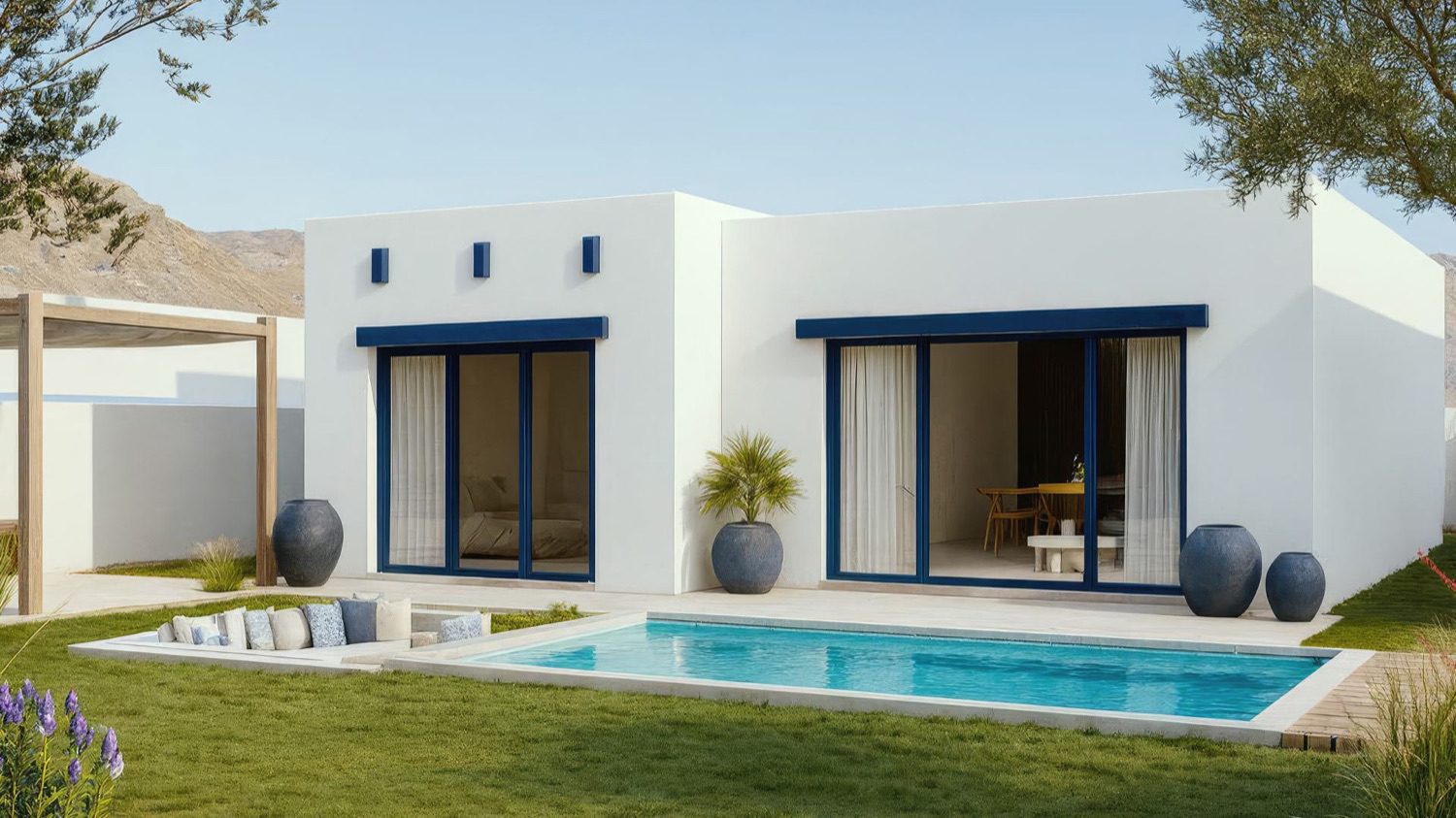
No. According to our Olive Farms listing page, it is a set of 46 standalone single-storey freehold villas (10 one-bedroom, 23 two-bedroom, 13 three-bedroom) inside the Jebel Sifah ITC, developed by Muriya. The page describes three architectural styles and landscaping options such as lawn, stone pathways, hedges and planting; it describes no olive groves, crops or livestock. The name refers to a Greek-style design theme, not agricultural use.
That is useful to a buyer for a clear reason. Because the project is an ITC villa scheme, the ITC freehold route applies and the title can be registered in the buyer’s name. Because it is not farmland, no agricultural purpose is claimed. Whether a particular planting scheme would ever be treated as “agricultural purposes” under Article 2 is a legal question that the listing does not address and a lawyer should answer.
| Item | Olive Farms | Jebel Sifah Land Plots | Salalah Land Plots (Hawana) |
|---|---|---|---|
| Starting price | OMR 75,000 ($195,060) | OMR 500,000 ($1,300,400) | Lagoon view OMR 750,000 ($1,950,600); sea view OMR 1,000,000 ($2,600,800) |
| Plot or villa size | Plots 260 to 350 m²; built-up 75 to 120 m² | From 1,000 m² | From 1,000 m² |
| Price per plot m² (our calculation) | OMR 288 on the 260 m² entry plot | OMR 500 | OMR 750 lagoon; OMR 1,000 sea view |
| Villa included in price | Yes, the villa is the product | Yes, 3+1 or 4+1 villa built to specification | Yes, 3+1 or 4+1 villa built to specification |
| Payment plan | 10% on booking, then 12 quarterly instalments of 7.5% | 20% on reservation, balance over 3 years | 20% on reservation, balance over 3 years |
| Handover | Q4 2028 (developer target) | Page gives no date | Page gives no date |
| Tenure | Freehold, Jebel Sifah ITC | Freehold | Freehold, Hawana ITC |
Reading the table with arithmetic
Olive Farms’ entry price is OMR 75,000, which the page says was quoted in January 2026. The payment plan sums correctly: 10% is OMR 7,500, and twelve instalments of 7.5% are OMR 5,625 each, or OMR 67,500, so the total is OMR 75,000. On the entry villa (75 m² built on a 260 m² plot) that is OMR 1,000 per built square metre. The page lists garden areas of 185 m², 177 m² and 230 m², which are 71%, 64% and 66% of the three plot sizes. The listing states that 3 villas remained available, with the project about 93% sold, and gives two annual service charges per square metre (the project charge and the Jebel Sifah master-community charge), with the billing basis stated in the reservation documents.
The two land releases differ in kind. Neither is bare land; the Jebel Sifah page says the price includes a villa built to Muriya’s specification, so the OMR 500 per square metre is the price of a finished home divided by plot area, not a land rate. Our Jebel Sifah Land Plots page and Salalah Land Plots page show the 20% reservation as OMR 100,000 for Jebel Sifah (balance OMR 400,000) and, for Salalah, OMR 150,000 on the lagoon-view plot (balance OMR 600,000) and OMR 200,000 on the sea-view plot (balance OMR 800,000). More background on the developer is in our Muriya developer profile, with the wider list on the Oman developers hub.
Does Buying a Farm or Plot in Oman Give Residency?
Residency depends on the property, not on the word “farm” in an advert. The Golden Residency real estate route requires a single ITC property worth at least OMR 200,000 ($520,160), decided by the Royal Oman Police. The Owner Visa under ROP Decision 87/2026, published in Official Gazette 1653, has no minimum value and no sponsor. The Oman Observer, 25 June 2026, reports that the decision covers buyers of a construction-ready land plot or a unit whose registration is incomplete, on a competent authority’s certificate; the visa lasts six months to one year, is renewable, and allows stays of up to three months per entry. It does not mention agricultural land.
Applying the threshold to the three listings above:
- Olive Farms entry villa, OMR 75,000, is 37.5% of OMR 200,000, so it does not meet the Golden Residency value on its own.
- The Jebel Sifah plot release, OMR 500,000, is 2.5 times the threshold.
- The Salalah releases, OMR 750,000 and OMR 1,000,000, are 3.75 and 5 times the threshold.
Meeting the value does not grant residency by itself; the Royal Oman Police decides the application. The comparison of the two routes is in our guide to Golden Residency and the Owner Visa, and family rules are in the family dependants guide.
What Do Fees and Tax Add to a Farm or Plot Purchase?
If the purchase is an ITC villa or plot rather than a farm for sale in Oman, our land guide gives a 3% registration fee (reduced from 5% in November 2020), 5% VAT on the first supply of new residential property and no VAT on undeveloped land. A mixed contract that sells a plot with a villa depends on how the price is split, so the total is a range. Applying those rates to the entry price of each listing, assuming the buyer bears both:
| Listing | Price | 3% registration | Total without VAT | Total with 5% VAT on the whole price |
|---|---|---|---|---|
| Olive Farms entry villa | OMR 75,000 | OMR 2,250 | OMR 77,250 | OMR 81,000 |
| Jebel Sifah plot | OMR 500,000 | OMR 15,000 | OMR 515,000 | OMR 540,000 |
| Salalah lagoon plot | OMR 750,000 | OMR 22,500 | OMR 772,500 | OMR 810,000 |
| Salalah sea-view plot | OMR 1,000,000 | OMR 30,000 | OMR 1,030,000 | OMR 1,080,000 |
These are our calculations, not quotes; who pays the registration fee is a contract matter. Two other tax points apply. Royal Decree 56/2025 sets a 5% personal income tax on income above OMR 42,000 a year from 1 January 2028, and rent is within scope. On the reading that the 5% applies to the slice above the threshold, rental income of OMR 50,000 would give 5% of OMR 8,000, which is OMR 400; our income tax guide for foreigners covers the wording. The Oman Observer’s June 2026 market piece also notes that Oman has no capital gains tax on real estate.
Financing is narrow for plots. Our land guide reports that under the ITC rules a plot cannot be sold before it is built and a mortgage is allowed only to finance construction. Bank terms for completed ITC homes are in the mortgage guide for foreigners, and the recurring costs of owning in a community are in the service charges guide.
Which Documents Should You Check Before Buying a Farm or Plot in Oman?
Royal Decree 56/2026, the Real Estate Registry Law, is the current backbone. It was issued on 13 May 2026, published in Official Gazette 1648 on 17 May 2026, and came into force the next day, repealing Royal Decree 2/98, according to decree.om. A Sanad guide to Ministry of Housing services states that only the title deed issued by the Real Estate Registry Office is accepted as proof of ownership (Article 35). The checklist below turns that into practical steps; the fees come from the same guide, which cites Ministerial Decision 570/2025 annexes and warns that official service cards and annexes disagree on some fees.
| Document or check | What it proves | Cost or authority |
|---|---|---|
| Title deed from the Real Estate Registry | The only accepted proof of ownership | Extraction OMR 10 (Sanad guide) |
| Survey map (kroki) | Boundaries and area of the plot | OMR 10 (Sanad guide) |
| Property data certificate | Registered details of the parcel | OMR 10 (Sanad guide) |
| Land-use class in writing | Whether the parcel is agricultural, residential or tourism | Ministry of Housing and Urban Planning |
| ITC licence and boundary | That the plot lies inside a licensed complex | Ministry of Heritage and Tourism |
| Well licence and water entitlement | Lawful water; unlicensed wells risk a fine of up to RO 2,000 | MAFWR |
| Seller identity and broker licence | That the person selling can sell and the agent is licensed | Royal Decree 79/2025 framework |
| Owner Visa certificate | Entitlement to the sponsor-free visa where it applies | Competent authority, ROP Decision 87/2026 |
For the underlying registration steps, see our guides to property registration in Oman and Real Estate Law 79/2025, and the sibling guide on how to buy property in Oman.
What Are the Red Flags in a Farm or Plot Advert in Oman?
Adverts for a farm for sale in Oman attract fraud as well as confusion. On 26 June 2025 the Royal Oman Police warned the public about fake social media adverts for farms and chalets, listing the pattern: invented phone numbers and photos, polished details that build trust, requests for bank or mobile-app transfers, demands for money upfront for reservations that do not exist, and sellers who vanish once paid. The ROP advice was not to transfer any amount before verifying the recipient’s identity and that the establishment is genuine. The warning concerned rentals, but the same pattern applies to sales.
| Red flag | Why it matters |
|---|---|
| “Farm for sale” with no land-use class or plot reference | Article 2 makes the class decisive for a foreign buyer |
| Price far below nearby ITC stock | Citizen-entitlement schemes such as Husn Al Zain and Nismat Zain sit well below market and are for eligible citizens, per our guide |
| Deposit by transfer to a personal account | Matches the ROP fraud pattern of June 2025 |
| Seller offers to hold the land in an Omani friend’s name | Leaves the buyer with no registered title; the deed is the only proof of ownership |
| Water described as “available” with no licence or share | Unlicensed wells can bring a fine of up to RO 2,000 and up to a year in prison |
| Resale promised “before building” | ITC plots carry a build-out duty and no-sale-before-completion rule, per our land guide |
Our sibling guide on buying property in Oman: mistakes and red flags goes through the wider list, and cheap property in Oman for foreigners explains why the lowest prices usually belong to stock that foreigners cannot buy. For comparison, the Surooh citizen scheme at Husn Al Zain in Bidbid is a useful example of a low-priced project that is not open to foreign buyers on our review.
What Can a Foreigner Do Instead of Buying a Farm?
Where no farm for sale in Oman is open to a foreign buyer, the decree still leaves several lawful routes that stay clear of Article 2. A foreign buyer can take freehold in an ITC villa or plot, which is the route the listings above use; our guides to freehold property in Oman and whether foreigners can buy property in Oman set out the full map. A company can pursue an agricultural project through the investment and usufruct route described above, with the Omani-ownership conditions that a law firm reported in 2020. Someone who only wants the outdoor lifestyle can look at ITC communities with large gardens, or at short stays: ROP’s warning shows farm and chalet rentals are advertised online, so the verification steps matter there too.
Owners of an ITC property who let it out should also read the guides on property management in Oman and property insurance in Oman, because a villa with a garden and a pool carries different upkeep and cover questions from an apartment. For a wider view of where the market stands, see the property prices guide.
Frequently Asked Questions
Can a foreigner buy a farm for sale in Oman?
No, in general. Royal Decree 29/2018 prohibits non-Omanis from using their land and properties for agricultural purposes in all governorates, as the Oman Observer reported in November 2018, and published legal summaries list agricultural land among the places where non-Omani ownership is prohibited. A company route for agricultural projects exists through approved usufruct or lease, with conditions set by ministerial decision. A farm for sale in Oman advertised to foreigners should be treated as unconfirmed until the land-use class is confirmed in writing.
Can foreigners buy farm land in Oman?
No, not as owners, so a farm for sale in Oman is not open to them. The agricultural bar applies in every governorate, and our guide reports that GCC citizens are also excluded from agricultural land. What foreigners can own are freehold homes and building plots inside licensed ITCs. State farmland is allocated by usufruct, for example the 10 contracts signed in Dhofar in August 2026.
Is there an Oman farm house for sale that expats can own?
Only if the farm house for sale in Oman is really a villa or home in a place open to foreign ownership, such as an ITC. The Olive Farms project in Jebel Sifah has 46 freehold villas starting at OMR 75,000 ($195,060) per our listing page, but it is a villa scheme with landscaping, not agricultural land. A farm house on agricultural land is covered by the Article 2 bar.
Is a farm house for sale in Oman available in Seeb, Sohar, Nizwa or Salalah?
Adverts for a farm for sale in Oman exist in all four areas, but the legal answer depends on the land class, not the town. Seeb is in Muscat, Sohar in North Al Batinah, Nizwa in Al Dakhiliyah and Salalah in Dhofar. Salalah is excluded from the Dhofar ownership ban, but the agricultural-use bar still applies there, and the Royal Oman Police has warned about fake farm and chalet adverts.
Can you rent a farm house in Oman?
Farm and chalet stays are advertised for rent, mostly online. The Royal Oman Police warned on 26 June 2025 against fake adverts that demand money upfront or transfers before any booking exists. Confirm the recipient’s identity and that the establishment is real before sending any amount. For long leases, the lease terms for non-Omanis depend on the area and land class.
Is Olive Farms in Jebel Sifah a farm?
No. Olive Farms is not a farm for sale in Oman in the agricultural sense; it is a villa project of 46 single-storey freehold villas inside the Jebel Sifah ITC, built by Muriya, with a Q4 2028 handover target according to our listing page. The name refers to a Greek-style design theme. The page describes landscaping options, not olive groves or crops.
Can a foreign company lease state farmland in Oman?
Possibly, by an approved project route. A 2020 CMS summary of Ministerial Decision 292/2020 describes usufruct or lease of agricultural land for a development project by a company at least 60% Omani-owned, for one to ten years, with ministerial approval. Foreign-owned companies must also avoid the 123 activities closed to foreign investment after Ministerial Decision 435/2024. The current text must be checked before any commitment.
Do I need a licence to dig a well on a farm in Oman?
Yes. Digging an unlicensed well attracts a fine of up to RO 2,000 and up to one year in prison, doubled for repeat offences, according to MAFWR officials quoted by the Oman Observer in July 2022. Licensing follows Article 8 of the Water Resources Protection law, and the ministry has said it aims to prevent new wells for farms, with some exceptions.
Does buying a farm give residency in Oman?
No, buying a farm for sale in Oman does not give residency by itself. Golden Residency needs a single ITC property worth at least OMR 200,000 ($520,160), decided by the Royal Oman Police, and the Owner Visa under ROP Decision 87/2026 is sponsor-free with no minimum value but ends if the property is transferred. Agricultural land is not mentioned in the reported decision.
What documents should I check before buying a plot or farm in Oman?
For any farm for sale in Oman, start with the title deed, because only the deed issued by the Real Estate Registry Office is accepted as proof of ownership under Royal Decree 56/2026. Add the survey map, the property data certificate (OMR 10 each per the Sanad guide), the written land-use class, the ITC licence boundary where relevant, and the well licence and water entitlement.
Last checked: 6 November 2026. Sources: decree.om, Royal Decree 29/2018; Oman Observer, restrictions on non-Omani land ownership; Oman Observer, expats can’t farm in land; CMS legal update; Sanad, Ministry of Housing services; decree.om, Royal Decree 56/2026; decree.om, Ministerial Decision 95/2023; Oman Observer, Ministerial Decision 435/2024; Oman Observer, MAFWR briefing; Oman Observer, food investments; Oman Observer, Dhofar usufruct contracts; Oman Observer, unlicensed wells; Times of Oman, Q2 2026 price index; Oman Observer, ROP fake farm adverts; Oman Observer, Owner Visa.