























Khareef Season Salalah: What It Means for Property Owners
The Khareef season Salalah receives every summer is the main seasonal swing in Dhofar’s property market. This guide, checked on 16 October 2026, uses the figures released by the National Centre for Statistics and Information (NCSI), the Civil Aviation Authority and the Ministry of Heritage and Tourism for the 2026 season, which ran from 21 June to 21 September. It sets them beside the Dhofar listings on our site, so that the monsoon is described with numbers rather than with adjectives.
You will learn how many people came in 2026 and in the three seasons before it, in which weeks they came, how they travelled, what the weather and the rainfall record actually look like, and how full hotels were inside and outside the season. You will then see which of our Dhofar listings sit in the Khareef market, what the payment plans and residency thresholds work out to in rials, how the Tourism Law and the 2028 income tax touch a seasonal let, and what the Mekunu and Tej cyclones mean for a calendar built around June to September. Prices are given in Omani rials with US dollars in brackets at the fixed peg of 2.6008 dollars per rial.
Khareef Season Salalah at a Glance
| Item | Position as of 16 October 2026 | Source |
|---|---|---|
| Season dates 2026 | 21 June to 21 September (Dhofar Municipality programme) | Dhofar Municipality, via Black and White Oman |
| Visitors, 21 June to 31 August 2026 | 1,116,051, up 8.6% on the same window of 2025 (preliminary) | NCSI, via Oman Observer |
| Full-season visitors, 2025 | 1,070,738 | NCSI, via Oman Observer |
| Share of 2026 visitors who were Omani | 73.2% (816,719) | NCSI, via Oman Observer |
| Share who arrived by land | 74.5% (831,384) | NCSI, via Oman Observer |
| Estimated visitor spending, 2025 | OMR 124.64 million ($324.2 million) | NCSI, via OERLive |
| Salalah Airport passengers, 1 June to 31 August 2026 | 686,808 arriving and departing | Civil Aviation Authority, via Oman Observer |
| Annual hotel occupancy in Dhofar, 2025 | 40.9% | OERLive, citing official statistics |
Two baselines for 2025 appear in the press and both are correct for what they measure. The figure of 1,070,738 is the full 2025 season. The figure of 1,027,255 is the 2025 count for the shorter window from 21 June to 31 August, which is the window the 2026 preliminary total of 1,116,051 is compared with. Mixing the two produces a growth rate that is wrong in one direction or the other, so this guide always compares like with like.
What the Khareef Is and When It Runs
The khareef is the south-west monsoon season on the Dhofar coast. For roughly three months, moisture-laden winds from the Arabian Sea bring mist, drizzle and cooler air to Salalah and the mountains behind it, while most of the Gulf stays hot. The Oman Observer, describing the 2026 season, notes that the winds bring mist, drizzle and lower temperatures, and the Khaleej Times travel guide for 2026 contrasts the low cloud over Dhofar with intense heat and humidity across the rest of the Gulf. The words khareef and monsoon are used interchangeably in Oman’s tourism material.
The official programme is longer than the weather. Dhofar Municipality announced 125 cultural, artistic, sporting and entertainment events for 21 June to 21 September 2026, held in Salalah, Taqah, Mirbat, Sadah, Samharam and Al Mughsail. Venues named in the programme include Ittin Square, the Modern Waterfront, Al Morooj Theatre and Awqad Public Garden. The Oman Observer’s report on airline capacity used the astronomical dates of 21 June to 20 September, a reminder that the season’s edges are administrative rather than meteorological.
Within the season, the peak is narrower. An operations officer at a Dhofar tour company told the Oman Observer in June 2026 that the peak normally starts in mid-July and runs until shortly before students return to school. The 2026 numbers below show how sharply that peak is concentrated, and that concentration is the reason the Khareef season Salalah property market behaves differently from a year-round city market.
Khareef Season Salalah Visitor Numbers, 2023 to 2026
The NCSI publishes a seasonal series for Dhofar that runs to 21 September each year. The table below combines the full-season figures for 2023 to 2025 with the preliminary 2026 count, which at the date of writing stops at 31 August.
| Season | Visitors | Visitor-nights (million) | Estimated spending (OMR million) | Spending in US dollars (million) |
|---|---|---|---|---|
| 2023 | 962,196 | 6.69 | 102.63 | 266.9 |
| 2024 | 1,047,751 | 7.10 | 120.52 | 313.4 |
| 2025 | 1,070,738 | 7.39 | 124.64 | 324.2 |
| 2026 (to 31 August, preliminary) | 1,116,051 | not yet released | not yet released | not yet released |
Reading the table with simple arithmetic: visitors rose from 962,196 in 2023 to 1,070,738 in 2025, an increase of 108,542 people or 11.3%. Spending rose faster, from OMR 102.63 million to OMR 124.64 million, which is 21.4% over two years. Dividing 2025 spending by 2025 visitors gives about OMR 116.4 per visitor, a calculation published by OERLive from the NCSI data rather than an official statistic. The same analysis puts the average stay at about 6.9 nights in 2025, up from about 6.8 in 2024.
The 2025 spending breakdown matters for owners because it shows where money goes. According to the NCSI figures as reported by the Oman Observer and OERLive, accommodation took OMR 49.24 million, food and beverages OMR 28.51 million, travel tickets OMR 19.22 million and other items such as shopping and entertainment OMR 27.67 million. Accommodation therefore accounted for 39.5% of the total, ahead of every other category.
| 2025 spending category | OMR million | US dollars (million) | Share of total |
|---|---|---|---|
| Accommodation | 49.24 | 128.1 | 39.5% |
| Food and beverages | 28.51 | 74.1 | 22.9% |
| Travel tickets | 19.22 | 50.0 | 15.4% |
| Other (shopping, entertainment) | 27.67 | 72.0 | 22.2% |
| Total | 124.64 | 324.2 | 100% |
These are visitor-spending estimates, not hotel revenue and not property income. OERLive states that the figure is gross visitor spending and should not be compared with tourism’s contribution to GDP. For an owner, the relevant reading is narrower: accommodation spending is the pool that hotels, serviced apartments and licensed holiday lets share.
The Peak Is Two Months Wide: 2026 Week by Week
The 2026 preliminary data lets us measure the shape of the season. Muscat Daily, citing NCSI estimates, reported 21,094 visitors from 21 to 30 June, 451,355 in July and 408,975 from 1 to 15 August. The Oman Observer later reported 643,602 for the whole of August, so the second half of August (16 to 31) accounts for 234,627.
| 2026 period | Visitors | Days | Average per day | Share of 1,116,051 |
|---|---|---|---|---|
| 21 to 30 June | 21,094 | 10 | 2,109 | 1.9% |
| July | 451,355 | 31 | 14,560 | 40.4% |
| 1 to 15 August | 408,975 | 15 | 27,265 | 36.6% |
| 16 to 31 August | 234,627 | 16 | 14,664 | 21.0% |
| Total to 31 August | 1,116,051 | 72 | 15,501 | 100% |
July and August together hold 98.1% of the visitors counted up to 31 August. The first half of August alone, a window of 15 days, accounts for more than a third. The daily average falls from 27,265 in the first half of August to 14,664 in the second half, which is consistent with the Oman Observer’s description of a peak that ends shortly before the school year resumes. A further observation in the Oman Observer’s September coverage is that July and August made up about 94% of arrivals in the 2025 season, so the 2026 pattern is not an outlier.
For anyone assessing the Khareef season Salalah calendar as a property matter, the arithmetic is the point. July and August are 62 days, or 17.0% of the calendar year, and they held 98.1% of the visitors counted to 31 August. Our Taqah Long Beach Boutique listing page says the same thing directly: letting demand in the Salalah area follows the khareef season.
Who Comes and How They Travel
The NCSI breakdown to 31 August 2026 shows a domestic and regional market. Omani residents and citizens made 816,719 of the 1,116,051 visits, or 73.2%. Visitors from the Gulf Cooperation Council countries made 183,861 visits (16.5%), and all other nationalities 115,471 (10.3%). The three groups sum exactly to the total.
| 2026 visitors to 31 August | Count | Share |
|---|---|---|
| Omani | 816,719 | 73.2% |
| GCC | 183,861 | 16.5% |
| Other nationalities | 115,471 | 10.3% |
| Arrived by land | 831,384 | 74.5% |
| Arrived by air | 284,667 | 25.5% |
By mode of arrival, 831,384 visitors came by land, up 7.6% on the same window of 2025, and 284,667 came by air. In the full 2025 season the split was 784,715 by land (73.3%) and 286,023 by air, of whom 195,744 were domestic and 90,279 international. The Oman Observer’s June 2026 preview describes the long road south from Muscat and other governorates as one of the season’s main road-traffic challenges, listing driver fatigue, changing weather, construction on parts of the national road network and heavy seasonal traffic.
The NCSI mix is therefore dominated by Omani and Gulf visitors, most of them arriving by road. Visitors of other nationalities made 115,471 visits in the first ten weeks of the 2026 count, 10.3% of the total.
Weather: What the Season Changes and What It Does Not
The Salalah Airport climate normals for 1991 to 2020, compiled on Wikipedia with humidity from NOAA’s 1961 to 1990 series, show the khareef as a dip in temperature rather than a wet season. Mean daily maximums fall from 32.8 degrees Celsius in May to 28.3 in July and 27.2 in August, then climb back to 29.5 in September and 31.2 in October.
| Month | Mean daily max (C) | Mean daily min (C) | Rainfall (mm) | Relative humidity (%) |
|---|---|---|---|---|
| January | 27.5 | 19.3 | 1.1 | 50 |
| April | 31.8 | 24.9 | 4.0 | 68 |
| May | 32.8 | 27.1 | 24.1 | 75 |
| June | 31.9 | 27.6 | 6.1 | 80 |
| July | 28.3 | 25.0 | 20.6 | 89 |
| August | 27.2 | 24.2 | 18.6 | 90 |
| September | 29.5 | 24.8 | 8.4 | 81 |
| October | 31.2 | 23.3 | 5.1 | 67 |
| December | 29.3 | 20.8 | 3.6 | 50 |
| Year | 29.9 | 23.5 | 99.1 | 69 |
Three details stand out. First, July and August bring 39.2 mm of rain between them, 39.6% of the annual mean of 99.1 mm, which is far less than the word monsoon suggests: most of the season is mist and drizzle, not downpour. Second, the cooling is modest in absolute terms. August’s mean maximum of 27.2 degrees is only 0.3 degrees below January’s 27.5; what changes is the summer baseline, which elsewhere on the Gulf coast sits far higher. Third, humidity peaks at 89% to 90% in July and August, against 50% in January and December. A property that is comfortable in winter is not necessarily comfortable in the humid midsummer weeks, and building-envelope questions such as air-conditioning capacity and damp control are legitimate items on a viewing checklist.
The Mekunu storm of May 2018 puts the rainfall record in perspective. Wikipedia’s account of the storm gives 617 mm at Salalah over four days, about 6.2 times the annual mean in the table. The monsoon and the cyclone are different weather systems that happen to hit the same coast, and a later section covers the cyclone calendar.
Getting to Salalah: Flights, Seats and Road
Air capacity is the clearest official signal of how the authorities expect the season to go. The Civil Aviation Authority said Oman Air would offer about 330,000 seats to Salalah in Khareef 2026, against 313,000 the previous year, an increase of 5.4%, and that SalamAir would offer 190,844 seats. Expected passengers were about 298,000 for Oman Air and 166,393 for SalamAir. Dividing expected passengers by seats gives implied fill of 90.3% for Oman Air and 87.2% for SalamAir, which is arithmetic on the authority’s projections rather than a reported load factor.
Oman Air planned up to 13 daily Muscat to Salalah flights at peak times, against 12 in 2025, and SalamAir up to 10 daily with 984 flights over the season against 962 in 2025. New routes included a three-weekly Dubai to Salalah service from Oman Air starting on 3 July, SalamAir flights from Dammam and Baghdad, and a twice-weekly Etihad Airways service from Abu Dhabi announced in May. Foreign carriers operate 68 weekly flights to Salalah in the season: 39 from the UAE (Air Arabia, flydubai, Etihad), 11 from Saudi Arabia (flynas), 14 from Qatar (Qatar Airways) and 4 from India (Air India Express). Fares quoted in June 2026 start at OMR 9.99 ($26) one way on SalamAir for early bookings.
Actual traffic through Salalah Airport between 1 June and 31 August 2026 is set out below, from the Civil Aviation Authority spokesperson as reported by the Oman News Agency and the Oman Observer.
| Month 2026 | Passengers (arriving and departing) | Share of total | Flights | Passengers per flight |
|---|---|---|---|---|
| June | 92,735 | 13.5% | 957 | 96.9 |
| July | 236,088 | 34.4% | 1,854 | 127.3 |
| August | 357,985 | 52.1% | 2,337 | 153.2 |
| Total | 686,808 | 100% | 5,148 | 133.4 |
Of the total, 355,045 were arriving passengers and 2,561 were inbound flights, an increase of 4% on 2025. An earlier Times of Oman report, based on Oman Airports data, had arrivals from 21 June to 31 July at 154,529 against 142,488 a year earlier, a rise of about 8%. The passengers-per-flight column shows the peak in another way: the average aircraft in August carried about 153 passengers, 58% more than the June average of 97.
The road is the other half of the story. According to the Oman Observer’s 2021 coverage, the Muscat to Salalah road is about 1,000 km and buses take about ten hours. Land travel carried 74.5% of 2026 visitors, so for most guests a Dhofar stay begins with an overland day.
Hotels, Occupancy and the Months After the Season
Hotel statistics show the same lopsided year. The OERLive analysis, citing NCSI statistics, gives Dhofar annual hotel occupancy of 37% in 2023, 39.1% in 2024 and 40.9% in 2025, with Dhofar hotel revenue of OMR 42.71 million ($111.1 million), OMR 47.44 million ($123.4 million) and OMR 56.91 million ($148.0 million) in those years. It also records 114 classified and other tourism establishments in 2025 against 64 in 2024 and 52 in 2023; most of the increase is in the “other” category, which grew from 37 to 85. During the 2025 season, the Oman Observer reported industry sources saying bookings in Salalah and surrounding wilayats had passed 90% since mid-July, with furnished apartments full on weekends and public holidays.
Put side by side, those two statements describe a single market with two speeds: occupancy above 90% in the peak weeks and an annual average of 40.9%. OERLive draws the same conclusion in its own words, noting that low annual occupancy means the Khareef must carry much of the year’s hotel economics.
The authorities are trying to widen the window. The Oman Observer reported on 5 September 2026 that the Ministry of Heritage and Tourism’s strategy aims to extend tourism across a 100-day window from 21 June to 10 October, with mid-July to late August as the peak and targeted packages around it. The NCSI figures quoted in the same article show occupancy at three- to five-star hotels in Dhofar of 49.3% in September 2025, against 35.3% in September 2024. September 2026 data had not been released at the time of that report. September programming in 2026 included the Tour of Salalah (5 to 9 September, 95 riders from 16 teams), the second Dhofar International Film Festival (32 films from 16 countries) and the Dhofar International Theatre Festival (14 to 22 September).
The same article quotes a Dhofar tour operator saying that in September and October the mix shifts towards individual travellers and couples, with European and winter visitors arriving from October for beaches, mountains and heritage sites. That is the off-season mix an owner meets from October to May: smaller groups, longer lead times, and no school-holiday surge.
Developers are responding to the same arithmetic. In a report published on 3 September 2026, the Oman Observer said that Muriya, the master developer of Hawana Salalah, said it plans about 1,000 more hotel rooms across Hawana Salalah and Jebel Sifah over three to five years, and that the aim is to reduce reliance on the highly seasonal Khareef market. The same report says its earlier Hawana Salalah hotels, including Salalah Rotana Resort, Fanar Hotel and Residences and Juweira Boutique Hotel, already added more than 1,000 rooms.
How the Khareef Season Salalah Market Reaches an Owner: Licences, Rules and Tax
Seasonal letting is where the khareef becomes a legal question. Short-term tourist accommodation in Oman falls under the Tourism Law, Royal Decree 69/2023, and its Executive Regulation, Ministerial Decision 1152/2/1/141/2026, which Trowers reports came into force on 17 April 2026, with existing licensees given six months, to roughly October 2026, to comply. Times of Oman, in a legal commentary of 3 October 2026, reports that operating a tourist or hotel establishment without a licence carries 10 days to 6 months’ imprisonment, a fine of OMR 6,000 to OMR 50,000 ($15,605 to $130,040), or both. Our listing page for Amazi states that short-term letting requires a tourism licence under Royal Decree 69/2023 and that community rules inside an integrated tourism complex may restrict it. Our separate post on whether you can Airbnb a property in Oman sets out the licensing sequence in detail.
Three further rules affect the owner of a Dhofar unit regardless of how it is used:
- Community and service charges. Royal Decree 79/2025, the Real Estate Regulation Law, was issued on 10 September 2025 and published in Official Gazette 1613 on 14 September 2025. It takes effect after 180 days, which is about 13 March 2026 on our count, and it repealed the 1989 apartment-ownership system and the 2018 escrow system. Law firm BSA describes owners’ associations under the new law as having legal personality and financial independence. Our guide to service charges in Oman real estate covers how they are set.
- Property tax. Our post on property tax in Oman sets out what buyers pay today.
- Personal income tax from 2028. Royal Decree 56/2025 was published in Official Gazette 1602 on 30 June 2025 and takes effect on 1 January 2028. It sets a flat 5% rate on individuals’ income above OMR 42,000 ($109,234) a year, and rental income is among the listed taxable sources, according to the Ramco summary of the decree. The tax does not apply before that date.
These three layers, a licence for tourist letting, community rules inside the complex, and a tax regime beginning in 2028, are why a seasonal income estimate built from the headline numbers above would be incomplete. The visitor statistics describe the market; they say nothing about what any individual owner is permitted to rent or what they would net.
Dhofar Listings Inside the Khareef Market
Our site lists six Dhofar properties that sit inside or near the Khareef visitor economy. The figures below come from each listing page as of 16 October 2026; prices are the entry prices stated on the page, and handover dates are the developer’s targets as stated there.
| Listing | Location | Entry price | Size or scale | Handover per listing page | Tenure per listing page |
|---|---|---|---|---|---|
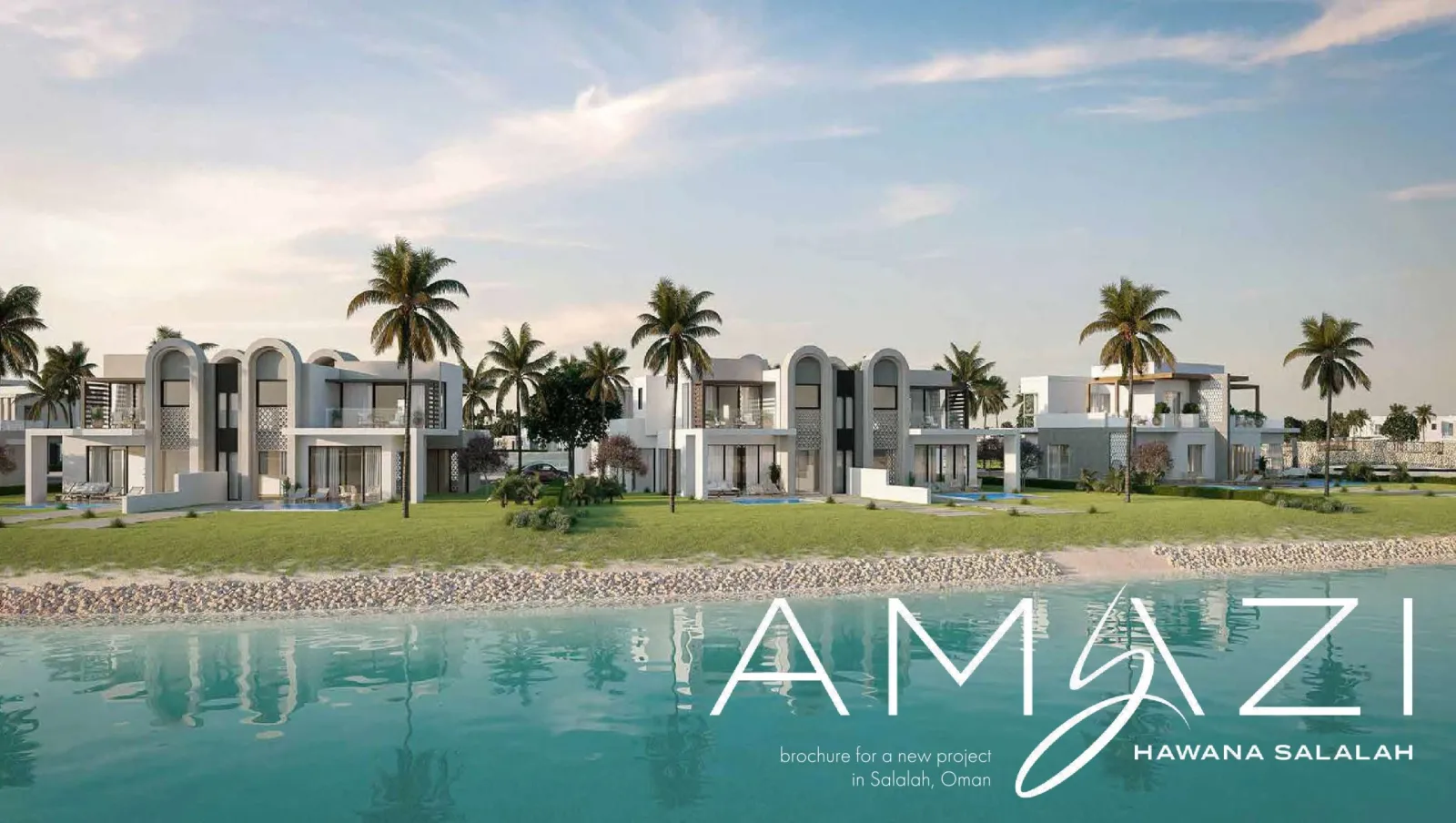
| Amazi | Hawana Salalah, about 8 km west of Salalah | OMR 78,000 ($202,862) for a 1-bedroom | 58 to 823 m² | First phase Q1 2027, per Muriya’s September 2026 update | Freehold, designated ITC |
| Lubana Island | Amazi, Hawana Salalah | OMR 99,508 ($258,800) apartments; OMR 135,612 ($352,700) villas | 67 to 145 m² | See listing page | Freehold, designated ITC |
| Mira Ocean Estates | Eastern edge of Hawana Salalah | OMR 57,574 ($149,738) for a studio, listed as AED 550,000 | 263 residences in total | Q4 2028 target | Freehold inside a designated ITC |
| The Sea Front Residences | Taqah, about 34 km east of Salalah | OMR 49,485 ($128,700) for a studio | 56 to 70 m² gross | Q4 2027 | Brochure: 99 years leasehold, renewable for life |
| Taqah Long Beach Boutique | Taqah, about 31 km east of Salalah | OMR 86,395 ($224,700) for a 1+1 apartment | 104 to 105 m² gross | Q3 2026 completion target | Recorded in the reservation documents |
| Salalah Land Plots | Hawana Salalah | OMR 750,000 ($1,950,600) lagoon view; OMR 1,000,000 ($2,600,800) sea view | Plots from 1,000 m², price includes a 3+1 or 4+1 villa | See listing page | Full freehold title |
The table shows two different geographies. The Hawana Salalah listings, Amazi, Lubana Island, Mira and the plots, sit about 8 km west of the city, within roughly 8.7 km of Salalah International Airport according to the Amazi and Mira pages. The two Taqah buildings are a different distance from the season’s centre: Sea Front is listed at 33.6 km from the airport and 41.6 km from Hawana Salalah, and Taqah Long Beach at about 31 km from Salalah. Taqah is therefore roughly 31 to 34 km from Salalah, against about 8 km for Hawana. Our Amazi listing gives Wadi Darbat at about 47 km from the project, so Hawana is not itself in the mountains; the khareef is something its owners drive to.
For fuller profiles of the master-planned resort, see our Hawana Salalah guide, and for the city comparison with the capital, our Muscat versus Salalah analysis. Our wider background on the governorate is in Salalah: a promising destination for tourism. Muriya, the developer of Hawana Salalah, is a partnership between Orascom Development and Oman Tourism Development Company (Omran Group), according to the Oman Observer.
Worked Arithmetic: Payment Plans and the OMR 200,000 Line
The listing pages give enough detail to work out what the Khareef season Salalah buyer actually pays and when. Take the three-bedroom villa at Amazi, listed at OMR 214,000 ($556,571). The page states a three-year plan with 10% on booking and 7.5% every three months.
- Booking payment: 10% of OMR 214,000 is OMR 21,400 ($55,657).
- Each quarterly instalment: 7.5% of OMR 214,000 is OMR 16,050 ($41,743).
- Number of instalments over three years: 4 per year for 3 years is 12.
- Instalments in total: 12 times OMR 16,050 is OMR 192,600 ($500,914).
- Check: OMR 21,400 plus OMR 192,600 is OMR 214,000, exactly 100% (10% plus 12 times 7.5%).
- Transfer fee at 3%: OMR 6,420 ($16,697). Value added tax at 5% on a first supply from the developer: OMR 10,700 ($27,829). Both are added to the price, bringing the cash total to OMR 231,120 ($601,097).
The Golden Residency position follows the same price. Our position is that Golden Residency requires a single ITC property worth at least OMR 200,000 ($520,160), a decision made by the Royal Oman Police; the Ministry of Commerce, Industry and Investment Promotion announced the 10-year scheme in Salalah in late August 2025, according to Gulf News. The Amazi page states that fees, VAT, legal costs and furnishings do not count towards the threshold. The three-bedroom villa clears it by OMR 14,000 ($36,411) on price alone. The Owner Visa under Royal Oman Police Decision 87/2026 has no minimum value, is sponsor-free and ends if title is transferred, according to the Oman Observer’s report on the decision.
| Listing and unit | Price | Against OMR 200,000 ($520,160) | Payment terms per listing page |
|---|---|---|---|
| Amazi 1-bedroom | OMR 78,000 ($202,862) | OMR 122,000 below | 10% on booking, then 7.5% every three months |
| Amazi 3-bedroom villa | OMR 214,000 ($556,571) | OMR 14,000 above | 10% on booking, then 7.5% every three months |
| Amazi 4-bedroom villa | OMR 321,000 ($834,857) | OMR 121,000 above | 10% on booking, then 7.5% every three months |
| Mira studio | OMR 57,574 ($149,738) | OMR 142,426 below | Seven stages ending with 50% at handover |
| Mira 2-bedroom | OMR 188,423 ($490,050) | OMR 11,577 below | Seven stages ending with 50% at handover |
| Taqah Long Beach 1+1 | OMR 86,395 ($224,700) | OMR 113,605 below | 50% on reservation, balance monthly until completion |
| Sea Front studio | OMR 49,485 ($128,700) | OMR 150,515 below | Schedule set out in the sale and purchase agreement |
The Mira plan is a good example of a back-loaded schedule. Its seven stages run 10% on booking, 10% on signing the sale and purchase agreement 45 days later, 5% at six months, 5% at twelve months, 10% at eighteen months, 10% at twenty-four months and 50% at the handover target of Q4 2028; the percentages add to 100. On the OMR 57,574 studio, that is OMR 5,757 on booking and OMR 28,787 at handover. The Taqah Long Beach schedule is front-loaded by comparison: the page works the reservation payment out at OMR 43,197.50 ($112,348), half of the OMR 86,395 price. Our comparison of Oman payment plans compares schedules like these across projects.
The Taqah Buildings and the Question of Tenure
The two Taqah buildings are the listings on our Dhofar list where the tenure line matters most. The brochure for The Sea Front Residences, according to our listing page, describes title as 99 years leasehold, renewable for life, which is distinct from the freehold granted inside a designated integrated tourism complex. For Taqah Long Beach Boutique, the page records tenure as recorded in the reservation documents, names Hawana Salalah as Dhofar’s designated ITC and does not identify Taqah as one. The same developer, Al Zaid Real Estate and Development, built both.
The practical consequence follows from our residency position. Golden Residency requires an ITC property, and a leasehold or undeclared-tenure studio at OMR 49,485 or OMR 86,395 is below the threshold in any case. Our post on beachfront property in Oman sorts the coast into freehold and non-freehold schemes.
Service charges are the other seasonal-cost item that can be calculated. The Sea Front page gives OMR 300 per year as a flat fee per unit, equal to OMR 5.36 per square metre on the 56 m² units and OMR 4.29 on the 70 m² units, about $780 a year. On the OMR 49,485 entry price, the flat charge is 0.6% a year. The Taqah Long Beach page says its schedule is issued with the reservation documents, and the Amazi page says its charge is quoted villa by villa, so a like-for-like comparison of the three is not possible from the listings alone.
Cyclones and the Khareef Calendar
The monsoon should not be confused with a cyclone, and the calendar for the two is different. Mekunu came ashore near Raysut on 25 May 2018, and Tej approached Dhofar in October 2023. Our post on cyclones and flash floods in Oman notes that major storms cluster in late May to June and in October, which are the shoulder months on either side of the Khareef season Salalah calendar.
Mekunu was the strongest storm to strike Dhofar since 1959, according to Wikipedia’s account. It killed seven people in Oman, caused about $1.5 billion of damage by an estimate from the insurer Aon, and generated insurance claims of OMR 155 million ($403 million) across 1,123 claims by the end of that year. Salalah recorded 617 mm of rain over four days, of which 278 mm fell in a single 24-hour period, and the airport was shut for 24 hours. For Tej in October 2023, Wikipedia’s summary records the temporary closure of Salalah port from 22 October and shelter prepared for 15,000 people in Dhofar.
The implication for owners is administrative rather than predictive. A handover scheduled for May, June or October falls in the storm shoulder; the snagging and inspection of a unit is easier to arrange outside those weeks; and buying or holding a coastal unit means asking the developer for the building insurance certificate, the finished-floor levels and the drainage arrangements. The documents our cyclone post lists, from planning approvals to the insurance certificate, apply directly to Hawana, Taqah and the plots.
Sites, Conduct and Road Conditions During the Season
The Khareef season Salalah visitors experience is partly an environmental management exercise. The Environment Authority issued a formal violation notice in July 2025 to a tourism company that had driven a convoy of four-wheel-drive vehicles and a heavy truck across the green meadows of Wadi Darbat, east of Salalah. The authority described the act as a direct violation of Article 21 of the Environmental Protection Law and said monitoring would continue for the rest of the season; the Oman Observer’s report gives no fine amount.
In 2026, Oman Daily reported that work at Wadi Darbat before the season included kiosk installation, boat preparation for the lake and walkway upgrades. The Oman Observer’s June 2026 preview names Wadi Darbat, Al Mughsail and Ittin as the traditional hotspots and suggests spreading activity away from them could ease pressure. The Khaleej Times guide lists Wadi Darbat, Mughsail Beach and its blowholes, Ain Razat and Jabal Samhan among the attractions and advises care on mountain roads, noting that fog, sharp turns, drizzle and camels crossing roads slow traffic.
For owners, three points follow. First, the attractions that make the season are outdoors, seasonal and subject to local conditions, so a stay can be affected by flowing water or fog that no property can influence. Second, access routes are shared with very large numbers of visitors: 20,761 a day on average across August 2026, as worked out above. Third, conditions at wadis and on mountain roads change with the weather from day to day, and official notices come from bodies such as the Environment Authority and Dhofar Municipality.
What Owners and Buyers Check Around the Season
The following checklist turns the sections above into items that can be verified against documents. It is a list of questions, not a recommendation.
| Item | What to ask for | Why the season matters |
|---|---|---|
| Tenure | Title deed or developer tenure document stating freehold, leasehold or other | Taqah buildings differ from ITC freehold at Hawana |
| Short-term letting | The tourism licence position and the community rules in writing | Royal Decree 69/2023 and the 2026 Executive Regulation; ITC rules may restrict letting |
| Service charge | The rate per square metre, or the flat sum, and the budget year | Amazi is quoted villa by villa; Sea Front is OMR 300 a year per unit |
| Handover date | The contractual date in the sale and purchase agreement | Storm shoulder months in May to June and October |
| Building insurance | Certificate and policy schedule for the building | Mekunu in May 2018 produced 1,123 insurance claims |
| Humidity and cooling | Air-conditioning capacity, damp control, window and door seals | Humidity of 89% to 90% in July and August |
| Residency route | Whether the unit is a single ITC property of at least OMR 200,000 | Only the Amazi 3-bedroom and 4-bedroom villas and the plots clear the line on price |
| Off-season use | Management and caretaking arrangements from October to May | Annual Dhofar hotel occupancy was 40.9% in 2025 |
Our guides to the Golden Residency and Owner Visa and to freehold in integrated tourism complexes explain the first and last items in more depth, and our ITC comparison sets Hawana beside the other complexes. Buyers comparing projects across developers can also use our developer guide, and those weighing off-plan against ready stock can read the handover calendar.
Frequently Asked Questions
When is the Khareef season Salalah residents and visitors talk about?
In 2026 the official Khareef Dhofar programme ran from 21 June to 21 September, according to Dhofar Municipality. The peak normally starts in mid-July and ends shortly before students return to school.
How many people visited Dhofar during the 2026 Khareef?
The NCSI preliminary estimate for the 2026 Khareef season Salalah is 1,116,051 visitors from 21 June to 31 August 2026, up 8.6% from 1,027,255 in the same window of 2025. A full-season 2026 total through 21 September had not been published at the time of checking. The full 2025 season recorded 1,070,738 visitors.
Which months matter most during the Khareef season Salalah property market?
July and August together account for 98.1% of the visitors counted to 31 August 2026, with August alone at 643,602 or 57.7%. The first fortnight of August averaged 27,265 visitors a day, nearly double the 14,664 a day of the second half.
Is the weather in Salalah wet during the Khareef?
Mostly misty and humid rather than wet. The 1991 to 2020 airport normals show 20.6 mm of rain in July and 18.6 mm in August, against an annual mean of 99.1 mm, with humidity of 89% to 90% and mean maximum temperatures of 28.3 and 27.2 degrees Celsius.
Do foreigners buying near Salalah get residency?
Not by purchase alone. Golden Residency requires a single ITC property worth at least OMR 200,000 ($520,160), decided by the Royal Oman Police. The Owner Visa under Royal Oman Police Decision 87/2026 is sponsor-free, has no minimum property value and ends if title transfers. Among our Dhofar listings, the Amazi three-bedroom villa at OMR 214,000 and the plots clear the Golden Residency line on price.
Can an owner let a Dhofar apartment during the Khareef season Salalah attracts?
Tourist letting needs a licence under Royal Decree 69/2023 and its 2026 Executive Regulation, and community rules inside an ITC may restrict it. Fines for operating without a licence run from OMR 6,000 to OMR 50,000, according to Times of Oman. Check the licence position and the community rules before any booking.
How do people reach Salalah in the season?
Most Khareef season Salalah visitors arrive by road: 831,384 of 1,116,051 visitors in 2026 came by land, and 284,667 by air. Oman Air planned up to 13 daily Muscat to Salalah flights and SalamAir up to 10, and Salalah Airport handled 686,808 passengers between 1 June and 31 August 2026.
Is a cyclone the same as the Khareef?
No. The khareef is the annual south-west monsoon with mist and drizzle. Cyclones such as Mekunu in May 2018 and the Tej approach in October 2023 are separate storms that tend to arrive in the shoulder months either side of the season.
What happens to Salalah after the season ends?
The visitor mix shifts once the Khareef season Salalah programme ends. Hotel occupancy at three- to five-star hotels in Dhofar was 49.3% in September 2025, a tour operator told the Oman Observer that individual travellers, couples and winter visitors arrive from October, and the Ministry of Heritage and Tourism is promoting a window to 10 October. Annual Dhofar hotel occupancy was 40.9% in 2025.
Which Dhofar listings does the Khareef season Salalah calendar apply to?
All six on our site sit in Dhofar: Amazi, Lubana Island, Mira Ocean Estates, The Sea Front Residences, Taqah Long Beach Boutique and the Salalah land plots. Tenure, handover and service-charge terms differ, so each listing page is the reference.
Last checked: 16 October 2026. Sources: Oman Observer, Khareef Dhofar visitors, 12 September 2026; Oman Observer, season preview, 20 June 2026; Oman Observer, Salalah Airport passengers, 19 September 2026; Oman Observer, airline capacity, 15 June 2026; Oman Observer, Etihad Salalah flight, 21 May 2026; Oman Observer, September tourism, 5 September 2026; Oman Observer, 2025 hotel occupancy; Oman Observer, Muriya hotel plans, 3 September 2026; Oman Observer, Royal Oman Police Decision 87/2026; Oman Observer, Wadi Darbat violation notice; Muscat Daily, visitors to 15 August; Times of Oman, Salalah Airport arrivals; Times of Oman, tourism licensing rules; OERLive, economics of the Khareef; Trowers, Tourism Executive Regulation; decree.om, Royal Decree 79/2025; BSA Law, Real Estate Regulation Law; Gulf News, Golden Residency launch; Ramco, Oman personal income tax; Wikipedia, Salalah climate normals; Wikipedia, Cyclone Mekunu; Khaleej Times, Khareef 2026 guide; Oman Daily, Wadi Darbat works; Black and White Oman, Dhofar Municipality programme; developer and listing data from our own listing pages.