



























Buying Property in Oman as a Foreigner: Process, Costs, Rules (2026)
Buying property in Oman as a foreigner is possible only in areas the state has designated for non-Omani ownership: chiefly licensed Integrated Tourism Complexes (ITCs), where a non-Omani can hold freehold title, plus the future cities and integrated neighbourhoods named by the Ministry of Housing and Urban Planning in June 2026 and freehold units in qualifying special economic zone projects under Royal Decree 38/2025. The main government costs are a 3% registration fee and, on a new unit bought from a developer, 5% VAT. All rules and prices in this guide are stated as of 23 October 2026.
This guide is the process-and-costs companion to our legal guide on who may own where. It walks through the buying sequence from checking the licence to holding the title deed, builds a worked cost example in rials and dollars, compares payment plans and service charges across projects listed on our site, explains bank finance for non-residents, and sets out the due diligence, tax, resale and residency points that follow a purchase. Prices are shown in Omani rials with US dollars in brackets, using the fixed peg of 2.6008 dollars per rial.
Buying Property in Oman as a Foreigner: Key Facts at a Glance
| Question | Position on 23 October 2026 | Basis |
|---|---|---|
| Where can a foreigner own? | Only in designated areas: licensed ITCs, named future cities and integrated neighbourhoods, and qualifying special economic zone and free zone projects | Ministry of Housing statement, 28-29 June 2026; Royal Decree 12/2006; Royal Decree 38/2025, Article 42 |
| What title does the buyer receive? | Freehold in an ITC (built units under usufruct of up to 99 years in Musandam); freehold units in zone projects, with the land held by the developer under usufruct | Royal Decree 12/2006 as amended; OPAZ explanatory note on Article 42 |
| Registration fee | 3% of the asset value, cut from 5% by the Minister of Housing in November 2020 | Oman Observer, 8 November 2020; Times of Oman, 2 November 2020 |
| VAT | 5% on the first supply of a new residential property by a developer; resale of residential property and residential rent are exempt | Deloitte summary of the Oman Tax Authority real estate VAT guide |
| Proof of ownership | The title deed (mulkiya) issued by the Real Estate Registry; off-plan rights are recorded in the Preliminary Real Estate Register | Royal Decree 56/2026, in force 18 May 2026 |
| Protection of off-plan payments | A project escrow account with a bank licensed in Oman; the developer must hold company, project and advertising licences | Royal Decree 79/2025, in force March 2026; Ministry comments of 25 July 2026 |
| Bank finance | Up to 70% of value for residents and, at BankDhofar, for non-residents; 50% for non-residents at Sohar International; ITC projects registered with the bank only | BankDhofar, 23 August 2026; Sohar International product page |
| Golden Residency | OMR 200,000 ($520,160) minimum; real estate route covers ready-made ITC units with a valid title deed | Ministry of Commerce, Industry and Investment Promotion, 13 September 2025 |
| Owner Visa | Sponsor-free, 6 to 12 months and renewable, ends when the property is transferred | Royal Oman Police Decision 87/2026, Official Gazette 1653 |
| Income tax | 5% on income above OMR 42,000 ($109,234) a year from 1 January 2028, including rent and property disposal proceeds | Royal Decree 56/2025 |
Where Is Buying Property in Oman as a Foreigner Allowed?
Foreign ownership in Oman is not nationwide. The Ministry of Housing and Urban Planning said at the end of June 2026 that ownership by non-Omanis has not been opened to all areas of the Sultanate and listed the places where it is allowed: integrated tourism complexes, the future cities of Sultan Haitham City, Al Thuraya City and Al Jabal Al Aali, and integrated residential neighbourhoods such as Surooh. The same statement said that the June 2026 residency amendments relate solely to residency and do not widen ownership rights, according to Gulf News. Our legal guide on whether foreigners can buy property in Oman covers each route in depth; this section gives the short version a buyer needs before the process starts.
Integrated Tourism Complexes (ITCs)
An ITC is a master-planned development licensed by the Ministry of Heritage and Tourism. The ownership system rests on Royal Decree 12/2006, amended by Royal Decree 76/2010, and its executive regulation, Ministerial Decision 191/2007, amended by Ministerial Decision 109/2022. According to a legal-framework opinion published by Times of Oman on 25 July 2026, Omani and non-Omani individuals and companies may own built units, or plots designated for construction, for residential or investment use. Two first-degree relatives who are natural persons may hold a unit or plot jointly. In Musandam, non-Omanis may acquire only already-built units, held under usufruct for a period not exceeding 99 years.
The licensing authority matters for a buyer because the ITC label is a legal status, not a marketing term. The Ministry of Heritage and Tourism announced 19 valid ITC licences in July 2023, spread across Muscat, Dhofar, Al Sharqiyah South, Al Batinah South and Musandam, as reported by the Oman Observer. BankDhofar names Al Mouj Muscat, Muscat Hills and Jebel Sifah as established ITCs, and our listing pages describe Muscat Bay and Hawana Salalah as ITCs. Our comparison of Oman’s integrated tourism complexes and the guide to freehold property in Oman go through the named complexes one by one.
Special economic zones and free zones
Article 42 of Royal Decree 38/2025, which was promulgated on 7 April 2025 and took effect on 14 April 2025, lets developers in special economic zones and free zones sell residential units to non-Omani individuals and companies as freehold, in the manner the regulation specifies. The Oman Observer reported OPAZ’s explanation that the land stays allocated to the developer by usufruct while the buyer receives the unit as freehold. The executive regulation, OPAZ Regulation 81/2026, was issued on 20 September 2026 and covers licensing, off-plan sales, escrow and freehold ownership of units by non-Omanis in projects to which the prescribed provisions apply, according to Zawya.
Future cities and integrated neighbourhoods
The Ministry’s June 2026 list is the reason Sultan Haitham City now appears in guides about foreign ownership, although it is a state-planned future city and not an ITC. Eligibility is decided project by project. Hay Al Wafa, for example, is listed on our site as open to buyers of all nationalities, while some state-backed Surooh stock is sold to citizens only. The practical rule is the same in every regime: obtain the project’s designation or licence in writing before paying a reservation.
Where foreigners cannot own
Royal Decree 29/2018 bars non-Omanis from owning land and property in Buraimi, Musandam, Dhofar outside Salalah, Dhahirah, Wusta, Shinas, Liwa, Jabal Akhdar and Jabal Shams, plus heritage and sensitive sites and agricultural land, with integrated tourism complexes as the exception, as described by the Oman Observer. A decree.om commentary on the 2026 registry law adds that breaching the ownership restrictions carries imprisonment of three months to two years and a fine of OMR 1,000 to OMR 5,000. Our article on Omani property foreigners cannot buy shows how to spot restricted stock with three questions. GCC citizens are covered by separate GCC agreements and Omani regulations for approved areas, according to the same Ministry statement.
Apartment usufruct for resident expatriates
Ministerial Decision 357/2020 created a usufruct scheme for resident expatriates in multi-storey buildings in approved Muscat areas. Trowers & Hamlins summarised the conditions in October 2020: the buyer is an individual aged 23 or over who has lived in Oman for at least two years; the building has at least four floors and a completion certificate not older than four years; expatriates may hold up to 40% of the units; one unit per buyer; and no sale or letting for the first four years unless an exemption is granted. A May 2026 legal guide on Mondaq still lists long-term usufruct rights over units in approved multi-storey buildings alongside ITC ownership. The scheme grants a right of use for a fixed term, not freehold title, and it does not lead to residency by itself.
Who Does What: The Authorities Involved in a Purchase
A foreign buyer meets several bodies, and each one controls a different question. Knowing which authority answers which question prevents the most common error, which is asking a seller to vouch for something only a ministry can confirm.
| Question | Authority | What it controls |
|---|---|---|
| Is the site an ITC? | Ministry of Heritage and Tourism | Licenses ITCs under Royal Decree 12/2006 |
| Is the developer and project licensed, and may units be sold to non-Omanis? | Ministry of Housing and Urban Planning | Developer, project and advertising licences; sales approval; the Real Estate Registry and title deed |
| Is a zone project open to foreign freehold? | OPAZ (the authority for special economic zones and free zones) | Zone licensing, off-plan sales and escrow under Regulation 81/2026 |
| Is VAT due? | Oman Tax Authority | VAT and, from 2028, personal income tax |
| Does the owner qualify for a visa? | Royal Oman Police | Owner Visa and Property Owner Residency under Decision 87/2026 |
| Does the investment qualify for Golden Residency? | Ministry of Commerce, Industry and Investment Promotion | Golden Residency programme through the Invest Oman platform |
Buying Property in Oman as a Foreigner: The Step-by-Step Process
No single official guide sets out a timetable for a foreign purchase, so the sequence below is assembled from the statutes, ministry statements and law-firm summaries named in each step. The order is the order in which the legal checks naturally fall. Two paths exist: a completed unit, where the buyer registers and receives the title deed, and an off-plan unit, where payments are made during construction and the buyer’s rights are recorded in a preliminary register until the unit is finished.
Step 1: Identify the regime and get the status in writing
Start with the question of where the project sits: inside a licensed ITC, inside a named future city or neighbourhood, inside a special economic zone project, or on the mainland outside any designated area. The answer decides whether a foreigner may hold title at all. Ask the seller for the ITC licence reference or the designation that applies, and compare it with the Ministry of Heritage and Tourism or Ministry of Housing records. A sales brochure that says “freehold for all nationalities” is a statement by the seller, not a licence.
Step 2: Check the developer and the project licences
Under the Real Estate Regulation Law, Royal Decree 79/2025, a developer must complete licensing and registration before advertising or selling a project. Nasser bin Khamis al Siyabi, the Ministry’s Director-General of Real Estate Development, described three licensing stages in comments carried by the Oman Observer on 25 July 2026: a company development licence, a separate project licence, and an advertising and marketing permit. He urged buyers and investors to confirm with the Ministry that both the developer and the project are registered and licensed before making any payment or signing a purchase agreement. The decree entered into force in March 2026, 180 days after its publication in Official Gazette 1613 on 14 September 2025, and it repealed the earlier escrow system of Royal Decree 30/2018, per decree.om.
Step 3: Confirm the payment protection
For an off-plan unit the project must have its own escrow account in a bank licensed in Oman, and buyers’ payments go into that account. A BSA Law summary of Royal Decree 79/2025, published on Mondaq in November 2025, adds that withdrawals are limited to approved construction phases and that developers must register all contracts relating to the project in the real estate register. The Director-General said that off-plan units can be sold only after the developer opens the escrow account, which forms part of project licensing. Our guide to Royal Decree 79/2025 for off-plan buyers and the step-by-step page on how to buy off-plan property in Oman go further into the escrow mechanics.
Step 4: Reserve the unit and read the sale agreement
Developers take a booking fee to hold a unit, and the amounts differ by project: OMR 2,000 on Alef Qurum Residence and OMR 3,000 on Bellevue, according to our listing pages. The binding document is the sale and purchase agreement, which fixes the price, the payment schedule, the handover date and the service charge. Our listing pages note that the exact handover date and the instalment schedule are set in that agreement, so the agreement, not the brochure, is the document to read line by line. Check the unit number and floor area against the project’s approved plans, the payment dates against the escrow arrangements, and what happens if the handover date is missed.
Step 5: Pay the instalments through the agreed channel
Payments on an off-plan unit follow the milestones in the agreement and go to the project escrow account named in it. Paying into any other account falls outside the protection that Royal Decree 79/2025 is built around. Keep the bank receipt for every instalment and match each to the schedule. A 2021 decision of the Minister of Housing and Urban Planning, reported by LexisNexis Middle East, makes developers and brokerage houses responsible for not accepting project funding from dubious sources and requires written compliance procedures, so questions about the source of funds are a normal part of a purchase.
Step 6: Record the off-plan rights in the Preliminary Real Estate Register
Royal Decree 56/2026, the Real Estate Register Law, entered into force on 18 May 2026 and replaced Royal Decree 2/1998. According to Trowers & Hamlins, it creates a Preliminary Real Estate Register in which ownership rights in off-plan units, and related mortgages and transfers, can be recorded provisionally with the same legal weight as the main register. Pinsent Masons reads Article 1(8) the same way and notes that Article 10 makes registration mandatory for dispositions of real rights: an unregistered disposition creates only a personal obligation between the parties. A decree.om commentary therefore advises pre-construction buyers to confirm registration in the Preliminary Real Estate Register and not to rely on a private sale agreement alone.
Step 7: Complete the purchase and register the title
For a completed unit, or when an off-plan unit is finished, the sale is registered with the Ministry of Housing and Urban Planning’s Real Estate Registry and the buyer receives the title deed. Under the 2026 law the title deed is the only accepted proof of ownership, an English translation can be issued on request, and electronic registers and title deeds carry the same legal weight as paper ones. Dispositions must be registered to take effect against third parties. On ITC projects the buyer must not transfer ownership before registration in the land registry and must notify the developer when selling, under the Jebel Sifah ministerial decree reported by the Oman Observer on 28 September 2025.
Step 8: Pay the fees and handover costs
The 3% registration fee is paid as part of registering the sale, and VAT appears on the developer’s invoice for a new unit. Owners also meet the first service charge, utility connection charges and any owners’ association contribution. The detailed arithmetic follows in the cost section below. Evading registration fees is penalised under the 2026 law by a fine of double the unpaid amount, so the fee should be paid on the declared price.
Step 9: Apply for residency if the purchase qualifies
Residency is a separate application, to a separate authority, with its own conditions. A purchase of at least OMR 200,000 in a ready-made ITC unit can support a Golden Residency application; any registered owner may apply for a Royal Oman Police Owner Visa or Property Owner Residency under Decision 87/2026. Both are covered in the residency section below. Neither is automatic, and neither widens the areas where a foreigner may own.
Step 10: Plan the ongoing obligations
An ITC owner pays an annual service fee set by the developer under the project bylaws, with the accounts and fee reviewed by an independent auditor under the Jebel Sifah decree, maintains the green areas within the plot, and needs developer approval before external modifications. A plot owner must complete construction within four years of registration, with an extension of up to two further years available from the Ministry of Housing on a proposal from the tourism ministry. An undeveloped plot cannot be sold before completion and may be mortgaged only to finance the building work.
What Does Buying Property in Oman as a Foreigner Cost?
The government-set costs are few. The registration fee and VAT are the two percentages that can be sourced; the rest of the budget is made up of charges that are set by contract or by the developer. The table lists each item, the rate where one exists, and the basis.
| Cost | Rate or amount | When it arises | Basis |
|---|---|---|---|
| Registration fee on sale | 3% of the asset value | On registration of the sale | Ministerial decision, November 2020 |
| VAT on a new unit from a developer | 5% | On the developer’s invoice | Oman VAT law; Oman Tax Authority real estate guide |
| VAT on a resale of residential property | Exempt | n/a | Oman Tax Authority real estate guide |
| Booking or reservation fee | Set by the developer: OMR 2,000 and OMR 3,000 on two projects on our site | At reservation | Our listing pages |
| Service charge | Per square metre or per unit, set by the developer or owners’ association: OMR 5 to OMR 10 per square metre on listings below | Every year | Our listing pages; Jebel Sifah decree |
| Legal and brokerage fees | Agreed privately with each adviser | During the purchase | Contract with the adviser |
| Bank charges and valuation | Set by the lender | If financing | Lender’s offer |
| Residency application costs | Set by the issuing authority | If applying | Royal Oman Police; Invest Oman |
The 3% registration fee
The Minister of Housing and Urban Planning cut the registration fee on property sales and donations from 5% to 3% of the asset value in November 2020. The Oman Observer reported on 8 November 2020 that the change took effect on 3 November, and Times of Oman reported on 2 November 2020 that the Ministry of Finance had announced it as part of a package to revive the property market. Neither report says which party pays. A cautious budget places the 3% in the buyer’s column, and the sale agreement is where the split is written down.
VAT of 5% on new units
Deloitte’s summary of the Oman Tax Authority’s real estate VAT guide, dated 30 September 2021, sets out the treatment. The first supply of residential property is standard-rated at 5%, as are developed land and the sale or rental of commercial property. Undeveloped land, the resale of residential property and the renting of residential property are exempt. Property in special zones may be zero-rated if the conditions in the executive regulations are met. The Oman Observer quoted a tax adviser in April 2021 explaining that the 5% applies to the first sale of a home built by a professional developer, while a home built by an owner for personal use and later sold is exempt, and that residential rent is exempt when the contract is registered and runs for at least three months. The Deloitte summary also treats residential service charges, such as maintenance, utilities and administration, as standard-rated at 5% unless they form part of a single residential rental supply. Whether a developer quotes prices with or without VAT is a point to settle in writing before comparing offers.
Service charges
Annual charges are the cost owners most often compare too late. The Jebel Sifah decree says the fee is set by the developer under the bylaws and reviewed by an independent auditor. Our listing pages publish different bases: Alef Qurum Residence OMR 5 per square metre per year, Wadi Zaha OMR 5 to OMR 6 per square metre, Opal Residences OMR 6.5 per square metre, Muscat Bay OMR 8.72 per square metre for apartments and OMR 6.01 for villas, Bellevue from OMR 10 per square metre, and Hay Al Wafa OMR 300 to OMR 500 per year per unit. The Sustainable City – Yiti lists no service charge for five years on apartments. Our guide to service charges in Oman real estate explains what the charge covers and how to read an owners’ association budget.
Worked example: a new unit and a resale at OMR 100,000
The two cases below use a price of OMR 100,000 ($260,080) and assume that the 3% fee is calculated on that price and that VAT is charged on top of it. The first case is a new unit bought from a developer, the second a resale from a private owner.
| Line | New unit from a developer | Resale from an owner |
|---|---|---|
| Price | OMR 100,000 ($260,080) | OMR 100,000 ($260,080) |
| VAT at 5% | OMR 5,000 ($13,004) | Exempt, OMR 0 |
| Registration fee at 3% | OMR 3,000 ($7,802) | OMR 3,000 ($7,802) |
| Government costs total | OMR 8,000 ($20,806), which is 8% of the price | OMR 3,000 ($7,802), which is 3% of the price |
| Cash needed before legal fees and finance costs | OMR 108,000 ($280,886) | OMR 103,000 ($267,882) |
A buyer who finances part of the price must also fund the lender’s deposit requirement and fees. At Sohar International a non-resident borrows at most 50% of the property value, so on OMR 100,000 the bank lends up to OMR 50,000 ($130,040) and the buyer brings the other OMR 50,000 plus the OMR 8,000 or OMR 3,000 of government costs. Legal, brokerage and valuation fees come on top and depend on what each adviser quotes.
Buying Property in Oman as a Foreigner: Payment Plans and Escrow
Most foreign purchases in Oman are off-plan or newly completed, and payment is usually staged. A staged plan changes the real cost because the buyer carries the project’s delivery risk between the first and last instalment. The table converts the plans published on our listing pages into rial amounts to show how much is paid before handover.
| Project and entry unit (per our listing page) | Entry price | Payment plan | Paid before handover |
|---|---|---|---|
| Solaris, Jebel Sifah, studio from 37.4 m² | OMR 50,000 ($130,040) | 10% on booking, then 10 instalments of 7.5%, 15% at handover | 85%, or OMR 42,500 |
| Alef Qurum Residence, 1-bedroom 62.6 m² | OMR 42,987 ($111,800) | OMR 2,000 booking fee, 20% down payment, 10 quarterly instalments of 6.5%, 15% at completion | 85%, or OMR 36,539 |
| Opal Residences, 1-bedroom 82 m² | OMR 74,631 ($194,100) | 20% on signing, ten construction-linked instalments totalling 70%, 10% on completion | 90%, or OMR 67,168 |
| Bellevue, Al Mouj, 1-bedroom from about 87 m² | OMR 129,900 ($337,800) | 15% on signing including the OMR 3,000 booking fee, three further 15% instalments, 20% at completion in Q4 2027, 20% six months after handover | 60% before completion, 80% at completion |
| Hay Al Wafa, Sultan Haitham City, apartment of 158 m² | about OMR 65,600 ($170,600) | 20% on booking, 80% over 36 months, payable monthly, semi-annually or annually | OMR 13,120 down, then OMR 52,480 in instalments over the 36 months |
| The Sustainable City – Yiti, studio 49 m² | OMR 70,000 ($182,000) | 5% on reservation, 5% within one month, 10% within four months, 10% within eight months of the first instalment, 70% at handover | 30%, or OMR 21,000 |
Each plan is the developer’s commercial offer, and the schedule that binds the buyer is the one in the sale and purchase agreement. The Alef Qurum schedule shows the arithmetic: on OMR 42,987, the 20% down payment is OMR 8,597, each of the ten quarterly instalments of 6.5% is OMR 2,794, and the 15% at completion is OMR 6,448, which sum to the full price. Adding 5% VAT on the first supply raises the bill by OMR 2,149 and the 3% registration fee by a further OMR 1,290. Our guide to Oman property payment plans compares more schedules, and the article on the Oman off-plan marketing threshold explains what a developer must have in place before it may sell.
What the zone regulation adds for off-plan sales
The Oman Observer reported on 21 September 2026 that OPAZ Regulation 81/2026, published in Official Gazette 1666 and effective the day after publication, requires developers in special economic zones and free zones to reach a threshold of 20% of a project’s total cost before marketing off-plan units or taking reservation payments. The same report says a project escrow account with a licensed bank is mandatory, spending from the account on marketing is capped at 3% of the funds held, developers must keep at least 5% of each unit’s sale value in escrow for one year after the unit is registered to the owner, and developers already marketing have six months from the effective date to comply. These are zone rules; mainland and ITC projects fall under Royal Decree 79/2025 and the tourism ministry’s ITC regulations.
Our Listings Compared: Price, Size, Handover and Tenure
The comparison below draws on the project pages on our site as they read on 23 October 2026. Prices are developer entry prices and change with the release; sizes are for the entry unit; handover dates are developer targets, and the contractual date is the one in the sale and purchase agreement. A tenure shown as freehold is the listing page’s statement, and the status of the site as an ITC or another designated area should still be confirmed under Step 1.
| Project | Entry price | Entry size | Handover target | Service charge |
|---|---|---|---|---|
| Alef Qurum Residence, Telal Al Qurm | OMR 42,987 ($111,800) | 62.6 m² 1-bedroom | Q2 2029 | OMR 5 per m² a year |
| Solaris, Jebel Sifah | OMR 50,000 ($130,040) | 37.4 m² studio | Q4 2027 | Quoted per unit |
| Wadi Zaha, Sultan Haitham City | OMR 60,366 ($157,000) | 54 m² studio | Q1 2028 | OMR 5 to 6 per m² |
| Hay Al Wafa, Sultan Haitham City | about OMR 65,600 ($170,600) | 158 m² apartment | Q4 2027 | OMR 300 to 500 a year |
| The Sustainable City – Yiti | OMR 70,000 ($182,000) | 49 m² studio | December 2027 (The Plaza) | None for 5 years on apartments |
| Opal Residences, Muscat Hills | OMR 74,631 ($194,100) | 82 m² 1-bedroom | Q4 2028 | OMR 6.5 per m² |
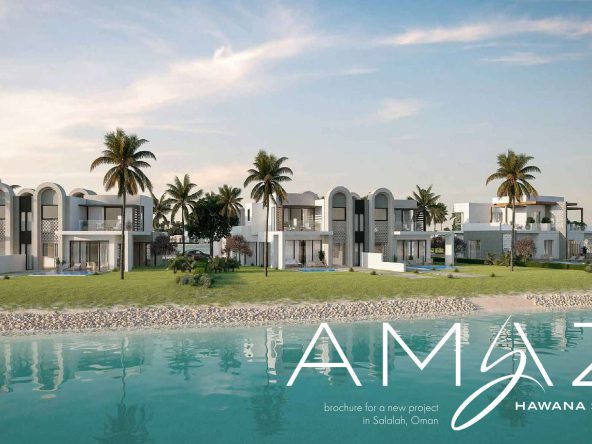
| Amazi, Hawana Salalah | OMR 78,000 ($202,862) | 1-bedroom villa | Q1 2027, first phase | Quoted villa by villa |
| Azura Beach Residences, Al Mouj | OMR 85,000 ($221,000) | 1 to 3 bedrooms | Set in the agreement | Set in the agreement |
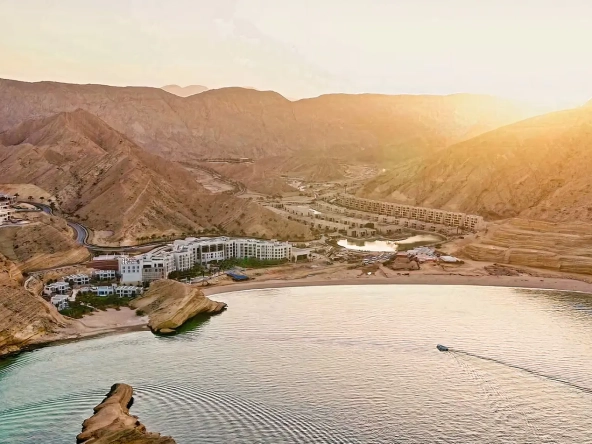
| Muscat Bay, Bandar Jissah | OMR 90,000 ($234,100) | 79 m² 1-bedroom | Completed, move-in ready | OMR 8.72 per m² for apartments |
| ALMAR Residences, Al Mouj | OMR 99,131 ($257,820) | 72 m² 1-bedroom | Q2 2029, indicative | Estimate to be requested |
| Bellevue, Al Mouj | OMR 129,900 ($337,800) | about 87 m² 1-bedroom | Q4 2027 | From OMR 10 per m² |
Two readings of the table matter for a foreign buyer. First, the entry price says little without the size: Hay Al Wafa’s OMR 65,600 buys 158 square metres while Wadi Zaha’s OMR 60,366 buys a 54 square metre studio, so the price per square metre differs by a factor of about 2.7 (roughly OMR 415 against OMR 1,118). Our price per square metre ranking for 29 Oman projects sets out the full comparison. Second, handover targets span from a completed home at Muscat Bay to mid-2029 at Alef Qurum and ALMAR, so the length of time between the first instalment and the title deed varies by years. The handover calendar for ready and off-plan property in Oman lists every date, and the guide to Sultan Haitham City and the Al Mouj guide describe the two districts that account for five of the eleven projects above.
Can You Get a Mortgage When Buying Property in Oman as a Foreigner?
Yes, from some banks and for some projects. Each lender sets its own terms for non-resident borrowers, and the property must sit in an ITC project registered with the bank and approved by the Ministry of Housing and Urban Planning for sale to non-Omanis.
| Term | BankDhofar (page dated 23 August 2026) | Sohar International (product page) |
|---|---|---|
| Borrower | Resident and non-resident expatriates | Resident and non-resident expatriates |
| Maximum loan | OMR 350,000 ($910,280) | OMR 250,000 ($650,200) |
| Loan to value | Up to 70% | Up to 70% for residents; up to 50% for non-residents |
| Term | Up to 20 years | Up to 20 years for residents; up to 10 years for non-residents |
| Rate shown | From 4.15% | 6.00% a year |
| Property | ITC projects registered with the bank and approved for sale to non-Omanis; off-plan through developer arrangements | ITC projects registered with the bank and approved for sale to non-Omanis |
| Income test for non-residents | Assessed under the bank’s own criteria | Salary assigned to the bank of at least OMR 5,000, or stable income outside Oman of at least OMR 25,000 a year; employer letter attested by the Omani embassy or consulate |
According to the BankDhofar announcement, eligible properties include apartments, condominiums, villas and other residential units, and off-plan projects are included through arrangements with developers of integrated residential communities. The Sohar International page lists the documents for a purchase loan: residence card and passport copy, application form, liability certificate, salary certificate, six months of stamped bank statements, a copy of the title deed and the survey sketch, proof of any additional income, a bank-approved valuation report, the purchase agreement, the seller’s identity copy and proof of any down payment to the seller.
What a loan costs per month: an illustration
The figures below use a standard monthly-repayment loan on a purchase of OMR 100,000 and the rates shown by each bank. They illustrate the scale of the payments only; the lender’s offer letter sets the actual figure.
| Case | Loan | Rate and term | Monthly payment | Deposit from the buyer |
|---|---|---|---|---|
| Sohar International, non-resident | OMR 50,000 ($130,040), 50% | 6.00%, 10 years | about OMR 555 | OMR 50,000 plus government costs |
| Sohar International, resident | OMR 70,000 ($182,056), 70% | 6.00%, 20 years | about OMR 502 | OMR 30,000 plus government costs |
| BankDhofar, from-rate | OMR 70,000 ($182,056), 70% | 4.15%, 20 years | about OMR 430 | OMR 30,000 plus government costs |
The comparison shows why loan terms matter more than the headline rate. A non-resident borrowing 50% over ten years pays more per month on a smaller loan than a resident borrowing 70% over twenty. For the wider picture of lenders, eligibility and the documents banks ask for, see our guide on whether foreigners can get a mortgage in Oman. The rial’s fixed peg to the dollar, explained in our article on the Omani rial peg and your property purchase, keeps the rial fixed against the dollar, which matters to dollar-based buyers, while interest-rate and delivery risk remain with the buyer.
Due Diligence Before Buying Property in Oman as a Foreigner
Due diligence in Oman is mostly a matter of checking registrations, because most protections in the 2025 and 2026 laws work through licences and registers. The checklist below draws on the Mondaq legal guide of May 2026, the Ministry’s comments on licensing, the registry law and the lenders’ own requirements. Each row names the document or record to ask for.
| Check | What to ask for | Why it matters |
|---|---|---|
| Designation of the site | The ITC licence reference, or the Ministry designation for a future city, neighbourhood or zone project | Decides whether a non-Omani may hold title |
| Developer licence | The company development licence number | First of the three licensing stages |
| Project licence | The project licence for the specific phase being sold | Second stage; escrow is part of it |
| Advertising permit | The advertising and marketing permit | Third stage; developers must complete it before advertising or selling |
| Escrow account | The bank name and account reference in the agreement | Where off-plan instalments must be paid |
| Registration status | Proof of entry in the Preliminary Real Estate Register, or the title deed for a completed unit | Registration is what gives a right effect against third parties |
| Folio check | The property folio at the Real Estate Registry, including any litigation note | A litigation note signals a pending court claim |
| Broker licence | The broker’s Ministry licence | Brokers and marketers need a Ministry licence under Royal Decree 79/2025 |
| Owners’ association rules and bylaws | Bylaws, the service charge basis and the auditor’s name | Defines ongoing costs and use restrictions |
| Resale and letting limits | Any lock-in period or rental restriction in the project rules | Some projects restrict short-term letting |
| Hazards | Flood and cyclone exposure of the plot and the building design | Coastal and wadi sites face different risks |
Trowers & Hamlins notes that under the new law a buyer can inspect the property folio before exchange and that a litigation annotation signals ongoing court action, which should prompt closer investigation. A claimant must notify the registry and have a note entered on the folio, and a successful claim is treated as registered from the date of the note. Our guides on cyclones and flash floods in Oman and the risks of the Oman real estate market cover the physical and market risks that no register records.
Documents Checklist for a Foreign Buyer
The table below separates the documents that a law, a ministry decision or a lender names from those that follow from the process itself. Treat it as a working list to assemble in advance, because every item on it is requested at a different stage.
| Document | Used for | Named by |
|---|---|---|
| Passport copy, with a valid visa for a loan application | Identity at reservation, registration and any loan | Sohar International |
| Residence card (if resident) | Resident loan terms and identity | Sohar International |
| Reservation receipt for the booking fee | Holding the unit | Booking fees on our listing pages |
| Sale and purchase agreement | Binding terms, price, schedule, handover | Our listing pages; Sohar International for a purchase loan |
| Proof of funds and bank statements | Source-of-funds checks and loan assessment | Sohar International (six months of stamped statements); 2021 Ministry decision |
| Salary or income evidence and employer letter | Loan eligibility | Sohar International |
| Valuation report by a bank-approved agency | Loan amount | Sohar International |
| Specific power of attorney, if buying remotely | Lets an agent act at the registry | Royal Decree 56/2026, as summarised by Trowers & Hamlins |
| Title deed (mulkiya) and English translation | Proof of ownership; residency applications | Royal Decree 56/2026; Golden Residency conditions |
| Certificate from the competent authority | Owner Visa and Property Owner Residency | Royal Oman Police Decision 87/2026 |
Buying remotely with a power of attorney
Remote completion through a power of attorney is possible in some cases, according to the Mondaq legal guide. Under the registry law as summarised by Trowers & Hamlins, a power of attorney must be specific about the transaction it covers, and an agent may register property in their own name only if the document expressly allows it. Oman has been a party to the Hague Apostille Convention since 30 January 2012, following accession on 12 May 2011, according to the Hague Conference status table, which is relevant to documents signed abroad. The registry or a lawyer admitted in Oman confirms the exact formalities for a given power of attorney.
Residency After Buying: Golden Residency and Owner Visa
Two permits are linked to property, and they differ in threshold, authority and duration. Our dedicated guide to Oman residency through property: Golden Residency versus the Owner Visa compares them in detail, and the page on the Oman Golden Visa describes the application route.
Golden Residency in two lines
The Ministry of Commerce, Industry and Investment Promotion states a minimum investment of OMR 200,000 ($520,160) and a renewable ten-year residency, with family members included without limits on age or number, in a news item of 13 September 2025. On the real estate route the investor buys ready-made units inside an ITC, and China Briefing adds that residential, commercial or tourism units qualify, a valid title deed is required, and a company owner needs a certified final balance sheet.
Owner Visa and Property Owner Residency in two lines
Royal Oman Police Decision 87/2026, published in Official Gazette 1653 and effective from 22 June 2026, per Times of Oman, allows buyers of land designated for construction or of units whose registration is incomplete to obtain a sponsor-free visa of six months to a year, renewable, with stays of up to three months per visit, and allows owners of registered units to obtain Property Owner Residency without a sponsor, on a certificate from the competent authority. The decision names no minimum property value, covers spouses and first-degree relatives, and cancels the permits automatically if the property is transferred by any legal act, as the Oman Observer also reported.
What ITC ownership itself provides
Apart from the two permits, the ITC rules in the Times of Oman opinion give a non-Omani owner of a completed unit renewable residency for the owner and first-degree relatives, and give the owner of an undeveloped plot a multi-entry investor visa renewed every two years until construction ends. Neither permit changes where a foreigner may own. A residency plan should therefore be tested against the price of the specific unit: a purchase must clear OMR 200,000 in a single ITC property to be considered for Golden Residency, whereas the Owner Visa carries no value test.
Tax on Ownership, Rent and Sale, Including the 2028 Income Tax
Oman has no recurring tax on owning a residential unit in the VAT and income-tax measures summarised above; the recurring charge is the service fee. The change on the horizon is personal income tax. Royal Decree 56/2025, issued on 22 June 2025 and published in the Official Gazette on 30 June 2025, takes effect on 1 January 2028. EY describes the rate as 5% on net income, meaning income above OMR 42,000 ($109,234) in a tax year. Taxable sources include rent from leasing and the proceeds of real estate disposal, with rental expenses deductible and losses carried forward for five years. The sale of a primary residence and of a secondary residence are both listed exemptions. A tax resident is someone present in Oman for more than 183 days in a tax year and is taxed on income earned in Oman and abroad; a non-resident is taxed only on income earned in Oman, so rent from an Omani unit can reach a non-resident owner. The Chairman of the Oman Tax Authority had to issue the executive regulations within one year of publication.
| Event | Position in 2026 | Position from 1 January 2028 |
|---|---|---|
| Buying a new unit | 5% VAT plus 3% registration fee | No change stated in the income tax law |
| Buying a resale | 3% registration fee; VAT exempt | No change stated |
| Receiving rent | Residential rent is VAT-exempt | Rent is a taxable income source; 5% applies to income above OMR 42,000 a year |
| Selling at a gain | No gain tax appears in the tax sources reviewed | Disposal proceeds are taxable income, with exemptions for a primary and a secondary residence |
As an arithmetic illustration, a resident owner with total annual taxable income of OMR 50,000 would have OMR 8,000 above the threshold, and 5% of that is OMR 400 ($1,040), before any deduction the executive regulations allow. An owner whose only income is OMR 6,000 of annual rent would be well under the OMR 42,000 line. Our guides on property tax in Oman, renting out your Oman property from abroad and whether you can Airbnb a property in Oman go through the rental side. Home-country tax treatment of Omani rent is a separate question for the owner’s own tax adviser.
Selling, Inheritance and Exit for a Foreign Owner
The rules that bind a buyer at purchase also govern the sale. In an ITC, ownership passes only on registration, and the owner must notify the developer when selling. An undeveloped plot cannot be sold before completion. Property-linked permits end on transfer: the Owner Visa and Property Owner Residency are cancelled automatically, together with the accompanying family permits. Under the 2020 apartment usufruct scheme, a four-year bar on sale or letting applies unless an exemption is granted. From 2028, disposal proceeds fall within the income tax law, and the primary and secondary residence exemptions become the relevant test. Our guide to selling property in Oman describes the resale market a foreign owner meets, and the article on inheritance and estate planning for foreign property owners in Oman covers wills and succession. Mondaq’s May 2026 guide notes that in certain ITC structures succession may be governed by the owner’s home-country law and advises planning wills and succession in advance.
Common Mistakes When Buying Property in Oman as a Foreigner
The mistakes below follow directly from the rules set out above. Each can be checked before money changes hands.
- Assuming a Muscat address is enough. Ownership depends on the designation of the specific project, not the district. The 2020 usufruct scheme named areas such as Bausher and Al Amerat, and what it grants there is a fixed-term usufruct right for resident expatriates, not ITC freehold.
- Treating the brochure as the licence. The licence references and the Ministry’s records settle the status, as the Director-General’s advice to confirm developer and project registration shows.
- Paying outside the escrow account. Payments for off-plan units belong in the project’s escrow account named in the agreement.
- Leaving the registration step unfinished. A sale that is not registered creates only a personal obligation between the parties, and the title deed is the only accepted proof of ownership.
- Counting VAT in the wrong place. A new unit carries 5% VAT and a resale does not, so a resale at a similar sticker price costs 5% less in tax.
- Comparing entry prices without areas and service charges. A OMR 5 per square metre charge on 54 square metres and a OMR 300 to 500 flat charge on 158 square metres are different cost bases, as the table above shows.
- Assuming the residency permit follows the purchase. Golden Residency requires OMR 200,000 in a ready-made ITC unit with a valid title deed, and every property-linked permit ends if the property is transferred.
- Relying on a power of attorney that is too general. The registry law requires the power to be specific about the transaction.
- Ignoring the 2028 tax change when modelling rent. Rent and disposal proceeds enter the personal income tax base from 1 January 2028.
Timeline: The Laws That Shape Buying Property in Oman as a Foreigner
| Date | Instrument or event | Relevance |
|---|---|---|
| 2006 | Royal Decree 12/2006 (amended by Royal Decree 76/2010); Ministerial Decision 191/2007 | Foreign ownership system for ITCs |
| 2018 | Royal Decree 29/2018 | Restricts non-Omani ownership in listed areas; ITCs excepted |
| October 2020 | Ministerial Decision 357/2020 | Apartment usufruct for resident expatriates in approved Muscat areas |
| 3 November 2020 | Registration fee cut from 5% to 3% | Core transaction cost |
| 16 April 2021 | VAT takes effect | 5% on first supply of residential property |
| 2022 | Ministerial Decision 109/2022 | Musandam ITC units: usufruct up to 99 years |
| 7 and 14 April 2025 | Royal Decree 38/2025 promulgated and in force | Freehold units for non-Omanis in zone projects (Article 42) |
| 22 and 30 June 2025 | Royal Decree 56/2025 issued and published | Personal income tax from 2028 |
| 13 September 2025 | Ministry news item on Golden Residency | OMR 200,000 threshold; ready-made ITC units |
| 14 September 2025 | Royal Decree 79/2025 published in Gazette 1613 | Developer licensing, escrow; in force March 2026 |
| 28 September 2025 | Jebel Sifah ministerial decree | Sales approvals, escrow, auditor, insurance for one ITC |
| 18 May 2026 | Royal Decree 56/2026 in force | Real Estate Register Law, Preliminary Real Estate Register, electronic title deeds |
| 22 June 2026 | Royal Oman Police Decision 87/2026 effective | Owner Visa and Property Owner Residency |
| 28-29 June 2026 | Ministry of Housing statement | Designated areas for foreign ownership |
| 20 September 2026 | OPAZ Regulation 81/2026 | Zone licensing, off-plan sales, escrow and freehold units for non-Omanis |
| 1 January 2028 | Personal income tax in force | Rent and disposal proceeds taxable above OMR 42,000 |
Two decrees carry the number 56: Royal Decree 56/2025 is the personal income tax law and Royal Decree 56/2026 is the Real Estate Register Law. They are different instruments issued a year apart, and mixing them up is a common source of errors in guides.
How Registration Works Under the 2026 Law, in More Detail
The Real Estate Register Law is the part of Oman’s framework that changed most recently, and it is the one with the most direct effect on a foreign buyer’s paperwork. The decree itself, issued on 13 May 2026 and published in Official Gazette 1648 on 17 May 2026, has four operative articles: it applies the attached law, charges the Minister of Housing and Urban Planning with issuing the executive regulation, repeals Royal Decree 2/1998, and brings the law into force the day after publication, per decree.om. Until the executive regulation is issued, existing regulations continue to apply where they do not conflict with the law.
The law as summarised by Trowers & Hamlins and Pinsent Masons contains several points that touch a purchase. Registered rights are binding evidence against all persons. Non-Omani individuals and legal persons may register property, subject to the laws governing non-Omani ownership, so the registry will not register a foreign title that the ownership laws do not allow. Private entities may be licensed by the Minister to authenticate real estate instruments, subject to the implementing regulation. False information or forged documents attract six months to three years in prison, a fine of OMR 1,000 to OMR 30,000, or both. A buyer therefore gains two practical tools: the ability to check a folio before exchange, and a title deed that is a single authoritative record, in electronic form if the registry issues it that way.
Frequently Asked Questions
Can a foreigner buy property in Oman?
Yes, within designated areas. Buying property in Oman as a foreigner is allowed in licensed Integrated Tourism Complexes, in the future cities and integrated neighbourhoods named by the Ministry of Housing and Urban Planning in June 2026, and in qualifying special economic zone projects under Royal Decree 38/2025. Ownership has not been opened to the whole Sultanate.
Can foreigners buy property in Oman outside tourism complexes?
Only through the other designated routes. These are the named future cities such as Sultan Haitham City, integrated neighbourhoods such as Surooh on a project-by-project basis, freehold units in zone projects, and the usufruct scheme for resident expatriates in approved multi-storey buildings in Muscat. Land on the open mainland remains restricted, and Royal Decree 29/2018 bars non-Omani ownership in a list of governorates and sensitive sites.
How much does buying property in Oman as a foreigner cost in fees and taxes?
The sourced government costs are a 3% registration fee and, on a new unit from a developer, 5% VAT, which is 8% of the price in total. A resale is exempt from VAT, so it carries the 3% fee alone. Legal fees, brokerage, bank charges and service charges are set separately. On a price of OMR 100,000 ($260,080) the government costs are OMR 8,000 for a new unit and OMR 3,000 for a resale.
Who pays the 3% registration fee?
The ministerial reports of the November 2020 cut describe the fee as 3% of the asset value without naming the payer. The sale agreement is the document that allocates it, and a cautious budget for buying property in Oman as a foreigner includes the 3% in the buyer’s column until the contract says otherwise.
Is there an annual property tax in Oman?
The VAT rules and the 2028 income tax law described in this guide contain no recurring tax on owning a residential unit. The recurring charge for owners is the service fee set by the developer or owners’ association, which in the listings above ranges from nothing for five years to about OMR 10 per square metre a year.
Can I buy property in Oman from abroad?
Remote completion through a power of attorney is possible in some cases. Under Royal Decree 56/2026 the power must be specific about the transaction, and an agent may register in their own name only if the document expressly allows it. Anyone buying property in Oman as a foreigner from overseas should also check that the signing and legalisation formalities suit the document, since Oman has applied the Apostille Convention since 30 January 2012.
Does buying property in Oman give me residency?
Not automatically. A purchase of at least OMR 200,000 in a ready-made unit inside an ITC can support a Golden Residency application, and any registered owner may apply for the Royal Oman Police Owner Visa or Property Owner Residency, which has no minimum value and ends on transfer of the property. For buyers weighing residency, buying property in Oman as a foreigner therefore means choosing a unit that meets the specific permit’s conditions.
Can foreigners get a mortgage in Oman?
Yes, from some banks and for ITC projects registered with the lender. BankDhofar advertises up to 70% of value over up to 20 years from 4.15% for resident and non-resident expatriates, and Sohar International lends up to 70% to residents and up to 50% to non-residents, over 20 and 10 years respectively. Buying property in Oman as a foreigner with a loan means choosing a project the bank has registered.
What is the Preliminary Real Estate Register?
It is the register created by Royal Decree 56/2026 in which ownership rights in off-plan units can be recorded provisionally, with the same legal weight as the main register. For anyone buying property in Oman as a foreigner off-plan, confirming the entry is the check that replaces reliance on a private sale agreement alone.
What protects my payments before the unit is finished?
The project escrow account. Royal Decree 79/2025 requires an independent escrow account in the project’s name with a licensed bank, withdrawals limited to approved construction phases, and developer licensing before any sale. For zone projects, Regulation 81/2026 adds a 20% project-cost threshold before marketing and a 5% retention for one year after registration, as reported by the Oman Observer.
Will I pay tax when I sell?
No gain tax appears in the tax sources reviewed for 2026. From 1 January 2028, Royal Decree 56/2025 treats real estate disposal proceeds as taxable income at 5% above OMR 42,000 a year, with exemptions for a primary and a secondary residence. Buying property in Oman as a foreigner today therefore comes with a change of tax regime during the likely holding period.
Can a company buy property in Oman?
Non-Omani companies may own built units and plots in an ITC under Royal Decree 12/2006, according to the Times of Oman opinion. Ownership outside designated areas is restricted, so a company buying property in Oman as a foreigner follows the same designation test as an individual, and corporate use may add legal and tax considerations.
Last checked: 23 October 2026. Sources: Gulf News, Ministry of Housing statement; Times of Oman, ITC legal framework; Oman Observer, ITC licences; Oman Observer, Article 42; Zawya, OPAZ regulations; Oman Observer, OPAZ escrow rules; Oman Observer, Royal Decree 29/2018; decree.om, Royal Decree 79/2025; decree.om, Royal Decree 56/2026; Trowers & Hamlins, register law; Mondaq, legal guide; Oman Observer, registration fee; Deloitte, VAT guide; EY, income tax; BankDhofar; Sohar International; Ministry of Commerce, Industry and Investment Promotion; Times of Oman, Decision 87/2026.