



























The one thing that governs everything else
Oman is the Gulf’s most affordable freehold market with a serious legal framework behind it. You can own outright, in your own name, pay no annual property tax, no capital gains tax on resale and no income tax on rent, and convert a large enough purchase into ten-year residency. Entry starts at $76,700 — well below anything comparable in the UAE.
And then there is the boundary. Foreign freehold in Oman exists only inside Integrated Tourism Complexes. Outside an ITC, a non-Omani generally cannot buy freehold at any price, in any city, however much they want to. That single rule shapes what you can buy, where you can buy it, and — this is the part most pages skip — what you can earn from it.
Because the ITCs are resort developments, they are not where Oman’s highest rental yields sit. The strongest yields in Muscat are in ordinary residential districts like Al Khuwair, Al Ghubra and Al Khoud, and those are closed to you. What remains is a well-built, well-regulated, genuinely attractive resort market with gross yields in roughly the 5–8% band. That is a good market. It is not the market the yield tables describe, and you should know which one you are buying into.
Oman at a glance
| Oman | |
|---|---|
| Foreign ownership | 100% freehold, but only inside Integrated Tourism Complexes |
| Legal basis | Royal Decree 12/2006, widened by Royal Decree 38/2025 |
| Annual property tax | None |
| Capital gains tax | None |
| Income tax on rent | None for individuals |
| Inheritance tax | None |
| Residency | Golden Residency from OMR 200,000 (~$520,160); Owner Visa with no minimum value |
| Citizenship | Not available by investment |
| Purchase costs | ~8% new build (3% + 5% VAT); ~3% resale (VAT-exempt) |
| Currency | Rial pegged to the US dollar; 1 OMR ≈ $2.60 |
| Typical gross yield | 5–8% inside ITCs |
| Our portfolio | 43 projects, $76,700 – $1,950,000 |
The ITC framework, explained properly
An Integrated Tourism Complex is a licensed, master-planned development in which the government permits non-Omanis to hold freehold title. It is the mechanism — the only mainstream one — through which foreign ownership happens in Oman.
The framework dates to Royal Decree 12/2006 and was widened by Royal Decree 38/2025, which expanded the categories of development able to offer foreign freehold. That expansion is genuinely significant and is why several of the newer schemes on this page exist at all. Telal Al Qurm, for example, received its ITC licence in July 2024 and sits far closer to central Muscat than the older resort ITCs.
Two practical consequences follow, and both matter more than the theory.
First, ITC status attaches to the plot, not the brand. A developer’s other projects being ITC-licensed tells you nothing about the one in front of you. Ask for the licence for that specific development, and confirm it before you pay anything.
Second, not every Omani development is open to you. Oman also builds substantial housing aimed at Omani citizens — the Surooh-branded schemes are the clearest example — and those are a different product under different rules. Two projects in our own portfolio sit in this category: Nismat Zain in Sur and Husn Al Zain in Bidbid. We list them because they are real and well-built, and we say plainly that a foreign buyer should confirm eligibility before assuming a purchase is possible. Full detail in buying property in Oman as a foreigner, freehold property in Oman and comparing Oman’s ITCs.
All 43 projects, by city
This is the table that shows what the Omani market actually is: not one market, but a capital, a monsoon coast, a new planned city, and a scatter of regional schemes.
| City / area | Projects | Price range | Character |
|---|---|---|---|
| Salalah | 6 | $128,700 – $1,950,000 | Dhofar coast; the khareef monsoon season |
| Muscat | 6 | $106,900 – $200,100 | The capital; closest to city life |
| Sultan Haitham City | 6 | $82,160 – $499,100 | New planned city west of Muscat |
| Jabal Sifah | 5 | $130,040 – $1,300,000 | Marina, golf and beach resort |
| Muscat Bay | 4 | $234,100 – $479,200 | Dramatic cove setting, 15 min from town |
| Al Mouj | 4 | $221,000 – $842,400 | Oman’s flagship ITC; deepest resale market |
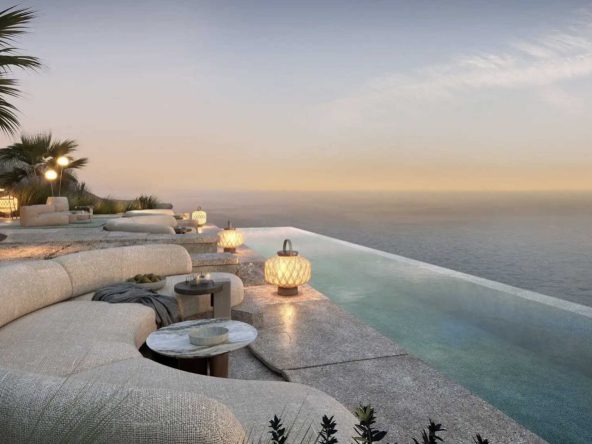
| Yiti | 3 | $182,000 – $416,000 | Sustainable City and AIDA clifftop |
| Muscat Hills | 3 | $163,600 – $194,100 | Golf community inside the capital |
| Shatti Al Qurum | 1 | $447,416 | Branded residences on the city beach |
| Al Seeb | 1 | $165,800 | Large new waterfront masterplan |
| Bidbid | 1 | $123,500 | Interior; Surooh scheme — confirm eligibility |
| Sur | 1 | $104,000 | Coastal east; Surooh scheme — confirm eligibility |
| Sohar | 1 | $95,000 | Northern industrial and port city |
| Duqm | 1 | $76,700 | Special Economic Zone on the Arabian Sea |
Read the concentration: 27 of the 43 projects sit in or immediately around Muscat — the capital itself, Sultan Haitham City, Muscat Bay, Al Mouj, Muscat Hills, Shatti Al Qurum, Al Seeb and Yiti. Oman is, for a foreign buyer, largely a Muscat market with a significant Salalah second act and a handful of regional outliers.
The price ladder
| Project | Where | From (USD) |
|---|---|---|
| Maysan | Duqm | $76,700 |
| Sarooj Oasis Apartments | Sultan Haitham City | $82,160 |
| Uptown Muscat | Knowledge Oasis, Muscat | $106,900 |
| Solaris | Jabal Sifah | $130,040 |
| Mira Ocean Estates | Hawana Salalah | $149,738 |
| Golf Hills | Muscat Hills | $163,600 |
| Yamal | Al Seeb | $165,800 |
| Olive Farms | Jabal Sifah | $195,100 |
| Telal Al Qurm | Muscat | $200,100 |
| Amazi | Hawana Salalah | $202,862 |
| Azura Beach Residences | Al Mouj | $221,000 |
| Lubana Island | Hawana Salalah | $258,800 |
| Luma Residence | Muscat Bay | $300,500 |
| Al Mina | Muscat Bay | $479,200 |
| Raya | Jabal Sifah | $492,100 |
| St. Regis Residences | Al Mouj | $842,400 |
Beyond that sit land plots at Jebel Sifah and Salalah, at $1.3 million and $1.95 million respectively — a different proposition again, for buyers who intend to build.
The useful comparison is outward. Oman’s entry price is roughly 30% below the UAE’s — $76,700 against $110,000 in our Dubai portfolio. That gap is the core of the Oman case, and it is worked through in full in Oman vs Dubai.
Two residency routes, and which one you actually need
| Golden Residency | Owner Visa (ROP 87/2026) | |
|---|---|---|
| Minimum property value | OMR 200,000 (~$520,160) | None |
| Term | 10 years, renewable | 6–12 months, renewable |
| Family included | Yes | Confirm at application |
| Leads to citizenship | No | No |
Applied to the portfolio above, this is concrete: only a handful of projects reach the OMR 200,000 Golden Residency threshold at entry price — St. Regis, Raya, Al Mina and the land plots. Everything else supports the Owner Visa, which has no value floor at all.
That makes Oman unusual. Most Gulf residency programmes have a hard financial gate; Oman’s Owner Visa does not. If your goal is simply the legal right to be in the country as a property owner, Oman asks less of you than anywhere else in the region. If your goal is a ten-year permission, you are looking at larger units. Both routes are compared in Golden Residency vs Owner Visa and the Oman Golden Visa guide; the wider picture is on our Oman investment and immigration page.
Neither route ends in a passport. Oman has no citizenship-by-investment programme, and anyone offering an Omani passport for money is describing something that does not exist.
Costs — and the 5% most buyers miss
| Cost | New build | Resale |
|---|---|---|
| Ministry of Housing transfer fee | 3% | 3% |
| VAT | 5% on first supply | Exempt |
| Agency and registration | Variable | Variable |
| Total acquisition | ~8% | ~3% |
This is the single most valuable line on the page. Buying a resale property in Oman costs roughly 3% in acquisition costs; buying the equivalent new build costs roughly 8%, because VAT applies only to the first supply. On a $300,000 purchase that is a $15,000 difference — more than a year of net rent in most of these schemes — and it is routinely overlooked by buyers focused on the headline price. Detail in property tax in Oman. If you are borrowing, see mortgages for foreigners; for estate planning, inheritance for foreign owners.
Yields, and the ceiling on them
Gross yields inside the ITCs typically run 5–8%. That is respectable, and it is lower than Dubai — for a structural reason rather than a market one, as set out at the top: the highest-yielding Omani districts are closed to foreign ownership, so the comparison is never like-for-like.
Service charges in the ITCs we cover generally fall between OMR 3 and OMR 5.5 per square metre per year, with waterfront and marina-side stock at the upper end. That is materially more predictable than Dubai’s building-by-building variance, and it is one of the quieter advantages of the Omani market. Ask for the figure for the specific building anyway. Our full analysis is in rental yields in Oman and service charges in Oman.
On the demand side, the tenant pool is smaller than Dubai’s and differently composed: expatriate professionals in Muscat, and tourism almost everywhere else. Salalah is the outlier and worth understanding — the khareef monsoon turns Dhofar green from roughly June to September and draws over a million visitors a year, making it the only place in the Gulf where summer is the high season. It also concentrates demand into about a quarter of the year. We compare the two in Muscat vs Salalah.
Off-plan or completed?
A large part of the Omani portfolio is sold before completion, on developer payment plans tied to construction milestones. The trade-offs are not the same as in Dubai, and the difference is worth understanding before you choose.
| Off-plan | Completed | |
|---|---|---|
| Entry price | Lower | Higher |
| Payment | Staged against construction progress | In full on transfer |
| VAT | 5% applies — it is a first supply | Exempt if you buy from a previous owner |
| Income starts | On handover | Immediately |
| Main risk | Delivery timing and finish quality | You inherit the building’s condition |
| Residency | Generally tied to registered title, so it follows completion | Available on transfer |
Two Oman-specific points deserve emphasis, because they cut differently from the Gulf norm.
The VAT position quietly favours completed resale. Every off-plan purchase is a first supply and carries 5% VAT; a resale from a previous owner does not. Combined with the 3% transfer fee, that is the difference between roughly 8% and roughly 3% in acquisition costs. Off-plan usually offers a lower headline price and a payment plan — but check whether the discount actually exceeds the 5% you are adding, because often it does not by as much as it appears.
Residency generally follows registered title, not the contract. If your reason for buying is the Golden Residency or the Owner Visa, an off-plan purchase means waiting until handover and registration before the application can proceed. Buyers on a timeline routinely miss this and are surprised by a delay measured in years rather than months. If residency is time-sensitive, a completed property is the safer instrument.
Oman’s developer market is also smaller than the UAE’s, which cuts both ways: fewer speculative entrants, but also fewer developers with a long delivery record to check. Ask what the developer has actually completed and handed over in Oman specifically — not what the group has built elsewhere in the region.
Where the market is heading
Three things are worth tracking, and they are at very different stages of certainty.
Sultan Haitham City is under construction west of Muscat and is the largest single addition to the capital’s housing stock in a generation. Six of our 43 projects are there, spanning $82,160 to $499,100 — the widest price band of any single location in the portfolio. Detail in our investor guide.
The ITC framework itself is widening. Royal Decree 38/2025 expanded what can qualify, and licences like Telal Al Qurm’s in July 2024 are bringing foreign-eligible stock closer to central Muscat than the resort model allowed. This is the most consequential trend for buyers, because it slowly erodes the constraint this entire page is built around.
Muscat Metro has been studied but not funded. We treat it as unpriced optionality rather than a reason to buy — the honest position, set out in Muscat Metro and property values.
The wider frame is Oman Vision 2040, the diversification strategy driving tourism and real-estate liberalisation. Our market reading is in the Oman market outlook, and the counter-argument — which we would rather you read than not — is in risks of the Oman market.
Oman or the UAE?
| Oman | UAE | |
|---|---|---|
| Entry price | $76,700 | $110,000 |
| Projects we represent | 43 | 69 |
| Where foreigners can own | ITCs only | Designated zones, extensive in Dubai |
| Residency floor | None, on the Owner Visa | AED 750,000 minimum tier |
| Resale liquidity | Thin | Deepest in the Gulf |
| Resale purchase costs | ~3% | ~7–8% |
| Tax on rent, gains, property | None | None |
| Currency | Pegged to USD | Pegged to USD |
| Citizenship | No | No |
Neither is better in the abstract. Oman is cheaper to enter, far cheaper to buy resale, and asks nothing of you financially for basic residency; the UAE gives you more choice and a market you can actually exit quickly. Tax and currency are identical, which is why any comparison that leads with them is telling you nothing.
Living in Oman, and who it actually suits
A large share of Omani buyers are not pure investors. They intend to spend real time in the country, and Oman is a genuinely different proposition from its neighbours in ways that a yield table cannot capture.
| Oman | |
|---|---|
| Pace and density | Low-rise, quiet, unhurried; building heights are controlled |
| Landscape | Mountains meeting the sea, wadis, empty beaches — not engineered coastline |
| Safety | Consistently among the safest countries in the region |
| Cost of living | Noticeably below the UAE |
| Schools and healthcare | Good and improving; less choice than Dubai |
| Air connectivity | Muscat is strong regionally, far thinner globally |
| Driving | Easy, and the country is genuinely worth driving across |
| Summer | Severe in Muscat; green and mild in Salalah during the khareef |
The honest summary is that Oman trades choice for character. You give up the density of international schools, the global flight network and the sheer optionality of Dubai. In exchange you get a country that has deliberately not built itself into a high-rise skyline, where a forty-minute drive from the capital reaches genuinely empty coast, and where the cost of everyday life is materially lower.
That trade suits three groups particularly well. Retirees and semi-retired buyers, for whom cost of living and calm matter more than career infrastructure. Remote workers and second-home owners who want a Gulf base without Gulf intensity, and for whom the Owner Visa’s absence of a value floor is decisive. And buyers already invested in the UAE who want regional diversification without taking on new currency or tax complexity — since both countries are dollar-pegged and neither taxes rental income, an Omani second property adds genuine diversification at almost no structural cost.
It suits one group considerably less well: anyone who needs to be able to sell quickly. Oman’s resale market is thin, and that is the constraint most likely to matter if your circumstances change. If liquidity is your priority rather than value, the honest recommendation is Dubai, and we will make it.
The risks, stated plainly
- The ITC boundary caps your options and your yield. The best-yielding Omani districts are not available to you.
- The resale market is thin. Selling takes longer and depends more on finding the specific buyer who wants that specific scheme.
- Not every project is foreigner-eligible. Surooh-type citizen housing is a different product; confirm before you commit.
- No citizenship, at any value. Residency only, on both routes.
- Salalah’s demand is seasonal, concentrated into the khareef months.
- Off-plan carries delivery risk, and Oman’s developer market is smaller than the UAE’s.
- The dollar peg protects your currency, not your valuation.
Seven checks before you buy in Oman
- Get the ITC licence for that specific plot, not for the developer’s other schemes.
- Confirm the project is open to foreign buyers at all — particularly outside the established resort ITCs.
- Establish whether it is first supply or resale. It decides whether 5% VAT applies.
- Get the service charge in OMR per sqm per year, for that building, in writing.
- Ask how many comparable units resold in that scheme last year, and at what price. This is the number that reveals real liquidity.
- Decide which residency route you need before choosing the unit — the Owner Visa has no floor, the Golden Residency needs OMR 200,000.
- Model eleven months of rent, not twelve — and in Salalah, model the season honestly.
Frequently asked questions
Can foreigners buy property in Oman?
Yes, with one significant condition: freehold purchase by non-Omanis is confined to Integrated Tourism Complexes, licensed under Royal Decree 12/2006 and widened by Royal Decree 38/2025. Outside an ITC, foreign freehold is generally not available.
What is the cheapest property you have in Oman?
Maysan in Duqm, from $76,700, followed by Sarooj Oasis Apartments in Sultan Haitham City at $82,160 and Plumeria in Sohar at $95,000.
Does buying property in Oman give residency?
Yes. The Owner Visa under ROP Decision 87/2026 has no minimum property value, so any purchase can support it. The ten-year Golden Residency requires OMR 200,000, about $520,160. Neither leads to citizenship.
Does Oman charge property tax?
No annual property tax, no capital gains tax on resale and no income tax on rental income for individuals. There is a 3% Ministry of Housing transfer fee, and 5% VAT on first-supply new builds only.
What rental yield can I expect?
Typically 5–8% gross inside the ITCs. Lower than Dubai, largely because foreign buyers are excluded from Oman’s highest-yielding residential districts rather than because the market underperforms.
Is it cheaper to buy new or resale in Oman?
Resale, decisively. Acquisition costs run about 3% on a resale against about 8% on a new build, because VAT applies only to the first supply.
Is Oman cheaper than Dubai?
At entry, yes — $76,700 against $110,000 in our portfolios, roughly a 30% gap. Dubai offers far greater choice and much better liquidity in exchange. See Oman vs Dubai.
Where should I buy in Oman?
For liquidity and finished amenities, Al Mouj. For marina and golf at lower entry prices, Jabal Sifah. For proximity to the city, Muscat and Muscat Hills. For the widest price range, Sultan Haitham City. For seasonal tourism income, Salalah. Our guides to the best areas in Muscat and Muscat as an investment destination go deeper.
Related searches on this site
By place: Al Mouj, Jebel Sifah, Hawana Salalah, Sultan Haitham City, Sohar, Duqm, Yiti, Musandam. By type: villas, apartments, townhouses, beach houses, branded residences. By feature: marina access, private beach, golf course access.
The verdict
Oman is the best-value freehold market in the Gulf for a buyer who understands the ITC constraint and is buying accordingly. Entry at $76,700, resale acquisition costs near 3%, no tax on rent or gains, a dollar-pegged currency, predictable service charges, and a residency route with no financial floor at all — that is a genuinely strong combination, and none of it depends on a growth story that may or may not arrive.
What it is not is the highest-yielding Gulf market, and it is not a liquid one. You are buying a resort-market asset in a country that restricts where you may own, and you should expect a sale to take time. Buy it for the value, the quality of life and the low running costs — not because a yield table promised you something the rules will not let you have.
UInvest Group represents 43 projects across 14 Omani cities and resorts, and 69 in the UAE. We will confirm the ITC status of the specific plot, tell you whether the unit is first supply or resale and what that costs you, give you the building’s actual service charge, and say plainly when the honest answer is a different city — or a different country.
Request a free Oman property consultation
Further reading: Invest Oman is the government’s official investment platform; the Ministry of Heritage and Tourism oversees ITC licensing; the National Centre for Statistics and Information publishes housing and tourism data; the Central Bank of Oman maintains the dollar peg.
